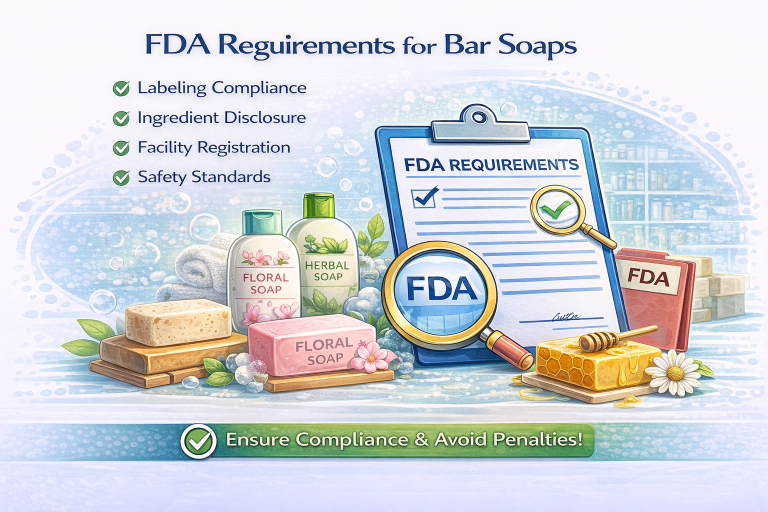
FDA Requirements for Bar Soaps
This guide explains the precise two-condition legal test for the true soap exemption, how syndet bars are classified, the 2016 antibacterial soap monograph revocation, and MoCRA requirements for cosmetic soap manufacturers.
True Soap vs. Cosmetic Soap vs. Drug Soap — FDA’s Three Categories
The Precise Legal Test for the True Soap Exemption
FDA’s 2016 Antibacterial Soap Monograph Revocation — What It Means for Importers
What the 2016 Rule Means for Foreign Soap Exporters
Many foreign soap manufacturers continue to produce soaps with triclosan or triclocarban that are marketed as “antibacterial” in their home markets — where these ingredients may still be permitted. When those products are imported to the United States, FDA detains them as unapproved new drugs. The “antibacterial” claim or ingredient presence triggers the drug classification, and without an approved NDA, the product cannot enter U.S. commerce. Changing the marketing to remove the “antibacterial” claim may reclassify the product — but the triclosan ingredient itself may raise safety questions under FDA review.
What Antibacterial Claims Are Still Permitted
Ethanol (ethyl alcohol) and isopropyl alcohol at specified concentrations remain available for healthcare antiseptic products under separate OTC monograph proceedings. For consumer hand soap, the only broadly marketed antibacterial ingredient currently without major monograph issues is ethanol — but at the concentrations in soap, efficacy questions persist. Soap marketed with antibacterial claims must be evaluated against the current state of the OTC drug monograph framework before import or sale in the United States.
Syndet Bars Are Always Cosmetics — Never True Soap
A large proportion of what consumers think of as “soap” is actually a synthetic detergent bar (syndet) — made with synthetic surfactants rather than traditional saponified fats. Common syndet surfactants:
Sodium Lauryl Sulfate (SLS)
Synthetic anionic surfactant. Common in many “cleansing bars” marketed as soap. Fails the alkali salts of fatty acids chemistry condition.
Sodium Cocoyl Isethionate
Mild synthetic surfactant common in “gentle,” “sensitive,” or “dermatologist-recommended” cleansing bars. Cosmetic — not true soap.
Sodium Lauroyl Methyl Isethionate
Synthetic surfactant common in premium cleansing bars. Cosmetic classification regardless of cleansing-only claims.
A syndet bar fails the chemistry condition of the true soap test automatically — regardless of marketing claims. A syndet bar marketed only for cleansing is still a cosmetic subject to MoCRA. Many importers and manufacturers misclassify syndet bars as true soap, creating MoCRA compliance gaps.
What Cosmetic Bar Soap Manufacturers Must Do Under MoCRA
Facility Registration — Annual
Every facility that manufactures or processes cosmetic bar soap for U.S. distribution must register with FDA under MoCRA Section 607. Registration renews annually — October 1 through December 31 of each year. Foreign facilities must designate a U.S. Agent with a physical U.S. address.
Product Listing — INCI Ingredient Names Required
Each cosmetic soap formulation must be listed under MoCRA Section 608 using INCI ingredient names. The listing must include: product name; responsible person information; facility registration number; product category; and all ingredients by INCI name. Updated annually July 1 through December 31.
Safety Substantiation
Under MoCRA Section 606, the responsible person (whose name is on the label) must ensure each cosmetic soap product and its ingredients are adequately substantiated for safety. Safety substantiation records must be maintained and may be reviewed during FDA inspections.
Serious Adverse Event Reporting
Responsible persons must report serious adverse events — events resulting in death, hospitalization, life-threatening outcomes, permanent injury, or birth defects — to FDA within 15 business days. Adverse event records (all events, serious and non-serious) must be retained for 6 years.
Need Help Classifying Your Bar Soap or Meeting FDA Requirements?
FDA Registration Assistance provides bar soap classification assessment (true soap vs. cosmetic vs. drug), MoCRA cosmetic facility registration, cosmetic product listing preparation with INCI names, U.S. Agent services for foreign soap manufacturers, drug establishment registration for antibacterial soap manufacturers, cosmetic labeling review, and import compliance support for soap importers. 1,000+ clients. 135+ countries. 15+ years of FDA regulatory experience.
Contact us at info@fdaregistrationassistance.com or call +1 (928) 275-8333.
Frequently Asked Questions — FDA Requirements for Bar Soaps
1. What are the FDA requirements for bar soaps?
Depends on classification. True soap (alkali salts of fatty acids + marketed only for cleansing): exempt from MoCRA, no facility registration or product listing required. Cosmetic soap (fails either condition of the true soap test): MoCRA facility registration, product listing with INCI names, safety substantiation, adverse event reporting, cosmetic labeling. Drug soap (antibacterial, acne-treatment, or other drug claims): OTC drug establishment registration under 21 CFR Part 207, OTC drug monograph compliance, Drug Facts panel labeling.
2. What is FDA’s definition of “true soap”?
The true soap exemption requires TWO conditions: (1) The bulk of the non-volatile matter consists of alkali salts of fatty acids — the saponification product of fats/oils and alkali. (2) The product is labeled, sold, and represented only as soap — marketed solely for cleansing. If EITHER condition fails, the product is a cosmetic or drug. Legal basis: 21 U.S.C. § 321(i) excludes “soap” from the cosmetic definition, but FDA's interpretation requires both conditions.
3. What is the difference between true soap, cosmetic soap, and drug soap?
True soap: meets both conditions — exempt from MoCRA. Cosmetic soap: fails either the chemistry test (contains synthetic surfactants) or the claims test (moisturizing, deodorizing, beautifying, fragrance-effect claims) — subject to full MoCRA requirements. Drug soap: marketed with antibacterial, antimicrobial, or therapeutic claims — subject to OTC drug regulations and drug establishment registration.
4. Are moisturizing bar soaps regulated as cosmetics?
Yes. Any bar soap marketed with moisturizing claims (“moisturizes skin,” “leaves skin soft,” “contains shea butter for moisture”) fails the claims condition of the true soap test and is a cosmetic. Subject to MoCRA facility registration, product listing with INCI names, safety substantiation, adverse event reporting, and cosmetic labeling under 21 CFR Part 701.
5. Are antibacterial bar soaps regulated as drugs?
Yes. Antibacterial bar soaps marketed with claims that the product kills, reduces, or inhibits bacteria are OTC drugs requiring drug establishment registration and OTC drug monograph compliance. In 2016, FDA revoked the consumer antiseptic wash OTC monograph for 19 ingredients including triclosan and triclocarban. Products with those ingredients marketed as antibacterial cannot legally be sold as OTC consumer antiseptics without an approved NDA.
6. What happened to antibacterial soaps after FDA’s 2016 ruling?
FDA finalized a rule (81 FR 61106) in September 2016 revoking the OTC consumer antiseptic wash monograph for triclosan, triclocarban, and 17 other active ingredients. Soap products with those ingredients marketed as consumer antiseptic washes are no longer legally marketable as OTC drugs without an approved NDA. FDA detains imported soaps containing triclosan or triclocarban marketed as antibacterial.
7. What is a syndet bar and is it regulated as soap or cosmetic?
A syndet bar is made with synthetic detergents (sodium lauryl sulfate, sodium cocoyl isethionate, sodium lauroyl methyl isethionate, etc.) rather than alkali salts of fatty acids. A syndet bar fails the chemistry condition of the true soap test automatically — it is a cosmetic regardless of any cleansing-only marketing claims. Many “gentle”, “sensitive”, or “dermatologist-recommended” cleansing bars are syndets.
8. Does a true soap manufacturer need to register with FDA under MoCRA?
No — if the product genuinely qualifies as true soap. True soap is excluded from the FD&C Act’s cosmetic definition and is not subject to MoCRA facility registration or product listing. However, true soap must still be safe, properly labeled with product name and manufacturer name and address, and the manufacturer must be able to demonstrate the product meets the two-condition true soap test.
9. What MoCRA requirements apply to cosmetic bar soap manufacturers?
Full MoCRA requirements: facility registration (annually, October 1–December 31); product listing with INCI ingredient names (updated annually July 1–December 31); safety substantiation; serious adverse event reporting within 15 business days; 6-year adverse event record retention; and U.S. Agent designation for foreign facilities.
10. What are the labeling requirements for cosmetic bar soaps?
Under 21 CFR Part 701: statement of identity on the PDP; net quantity in U.S. and metric units; INCI ingredient list in descending order of predominance; manufacturer or distributor name and address; and any required warning statements. All required text in English.
11. What are the labeling requirements for true soap?
True soap is not subject to cosmetic labeling requirements under 21 CFR Part 701 — the INCI ingredient list is not required by FDA. Must still carry: product name; manufacturer or distributor name and address; and net quantity. State laws may require additional ingredient disclosure even for true soap.
12. What are the labeling requirements for drug bar soaps (antibacterial soaps)?
Drug bar soaps must carry a Drug Facts panel under 21 CFR Part 201, identifying: active ingredients and amounts; purpose; uses (indications); warnings; directions; other information; and inactive ingredients. The Drug Facts panel format is mandatory for all OTC drug products.
13. Do foreign bar soap manufacturers need to register with FDA?
Yes — if the soap is a cosmetic. Foreign cosmetic soap manufacturers must register under MoCRA and designate a U.S. Agent. Annual renewal required. Drug soap manufacturers must register as drug establishments under 21 CFR Part 207. True soap manufacturers whose products genuinely qualify for the exemption do not need MoCRA registration.
14. Can a bar soap be both a cosmetic and a drug?
Yes. A bar soap marketed as both moisturizing (cosmetic) and antibacterial (drug) would be subject to both cosmetic and drug requirements. In practice, most manufacturers choose one positioning. Dual cosmetic-drug products must comply with both regulatory frameworks independently.
15. What claims make a bar soap a drug instead of a cosmetic?
Drug-triggering claims: “antibacterial,” “antimicrobial,” “kills bacteria,” “kills germs,” “fights infection,” “treats acne,” “kills acne-causing bacteria,” “medicated,” “helps prevent skin infections,” or any claim that affects body structure or function or treats a disease. These claims anywhere — on the label, website, Amazon listing, or social media — can trigger drug classification under 21 U.S.C. § 321(g)(1).
16. What is the responsible person’s obligation for cosmetic bar soaps under MoCRA?
The responsible person (whose name is on the label) must: submit cosmetic product listings; ensure safety substantiation; submit serious adverse event reports within 15 business days; and maintain adverse event records for 6 years. For private label soap brands, the brand whose name is on the label is the responsible person — not the contract manufacturer.
17. Does handmade or artisan soap need FDA registration?
If it qualifies as true soap (alkali salts of fatty acids + cleansing-only claims), no MoCRA registration required. If the handmade soap has moisturizing, fragrance-effect, or other cosmetic claims, it is a cosmetic — and MoCRA registration may be required unless the small business exemption applies (under $1 million in cosmetics sales meeting additional conditions).
18. What is the MoCRA small business exemption for soap manufacturers?
Under MoCRA Section 607(a)(4): average gross annual cosmetics sales in the U.S. under $1,000,000 (adjusted for inflation) over the prior 3-year period AND the facility does not process cosmetics that regularly contact the mucous membrane of the eye or involve a chemical or physical process beyond simple mixing, coloring, or fragrancing. Exempt businesses are still subject to safety substantiation, serious adverse event reporting, and FDA inspection.
19. What happens at U.S. ports when a foreign soap shipment is not properly classified?
A soap classified as true soap but actually a cosmetic may be detained as from an unregistered cosmetic facility. A soap with triclosan marketed as antibacterial may be refused as an unapproved new drug. Misclassified soap shipments result in detention, refusal of admission, and potential Import Alert placement. FDA Registration Assistance helps soap importers confirm correct classification before export.
20. Do soap manufacturers need safety testing?
True soap is not subject to MoCRA Section 606 safety substantiation explicitly — but must be safe. Cosmetic soap manufacturers must ensure products and ingredients are adequately substantiated for safety under MoCRA Section 606. Safety substantiation may include ingredient safety assessments, dermatological testing, microbial challenge testing, and stability testing. Records may be reviewed during FDA inspections.
21. How do I determine if my bar soap is true soap, cosmetic, or drug?
Step 1 (chemistry): Is the bulk of the non-volatile matter alkali salts of fatty acids? If you use synthetic surfactants as the primary cleansing agent — no, it is a cosmetic. Step 2 (claims): Is the product marketed only for cleansing? Any moisturizing, deodorizing, beautifying, or therapeutic claim — no, it is a cosmetic or drug. Both tests pass: true soap. Chemistry passes, claims fail: cosmetic. Claims include antibacterial/therapeutic: drug. FDA Registration Assistance evaluates bar soap classification.
22. What INCI names are required for cosmetic soap product listings?
MoCRA requires INCI names for all ingredients in cosmetic product listings. For traditional cold-process soap made from olive oil and lye: Sodium Olivate (saponified oil), Olea Europaea (Olive) Oil (if unsaponified oil remains), Aqua/Water. Fragrances must be listed as “Parfum” (INCI standard) or by individual fragrance ingredient INCI names if allergen disclosure is required. FDA Registration Assistance prepares cosmetic product listings with correct INCI names.
23. Do artisan soap makers who sell at farmers markets need FDA compliance?
Classification applies regardless of sales channel. If the artisan soap is true soap (alkali salts of fatty acids + cleansing-only claims), no MoCRA registration required. If the soap has cosmetic claims, MoCRA registration may be required unless the small business exemption applies. The sales channel (farmers market, craft fair, online, Amazon) does not change the classification.
24. How does FDA Registration Assistance help bar soap manufacturers and importers?
Bar soap classification assessment; MoCRA cosmetic facility registration; cosmetic product listing preparation with INCI names; U.S. Agent for foreign soap manufacturers; drug establishment registration for antibacterial soap manufacturers; cosmetic labeling review; import compliance support. 1,000+ clients. 135+ countries. 15+ years of FDA regulatory experience.
25. How do I get started with FDA compliance for my bar soap?
Contact FDA Registration Assistance at info@fdaregistrationassistance.com or call +1 (928) 275-8333. Provide your bar soap product name and formulation, your marketing claims, whether you are a domestic or foreign manufacturer, and your annual sales volume. FDA Registration Assistance will assess your product’s classification and confirm applicable MoCRA or OTC drug obligations.