Food Label Compliance for Retail & E-Commerce
Selling food products through retail stores or e-commerce platforms offers significant growth opportunities, but it also requires strict compliance with U.S. labeling regulations. The U.S. Food and Drug Administration enforces detailed food labeling requirements to ensure transparency, consumer safety, and accurate product representation.
Whether your products are sold in physical stores or online marketplaces like Amazon, Walmart, or Shopify, your label must meet the same FDA standards. A non-compliant label can lead to rejected shipments, product recalls, listing removals, or lost retail partnerships.
Ensuring your food label is compliant before launching into retail or e-commerce is one of the most important steps in building a sustainable and scalable food brand.
Why Label Compliance Matters Across All Sales Channels
Food labeling is not platform-specific—it is a legal requirement across all channels.
Retailers often require proof of compliance before accepting products.
E-commerce platforms may remove listings that do not meet regulatory standards.
Regulators rely on labeling to verify safety, ingredient accuracy, and allergen disclosure.
Because of this, a compliant label is the foundation of both retail success and online growth.
Core FDA Label Requirements for Retail & Online Sales
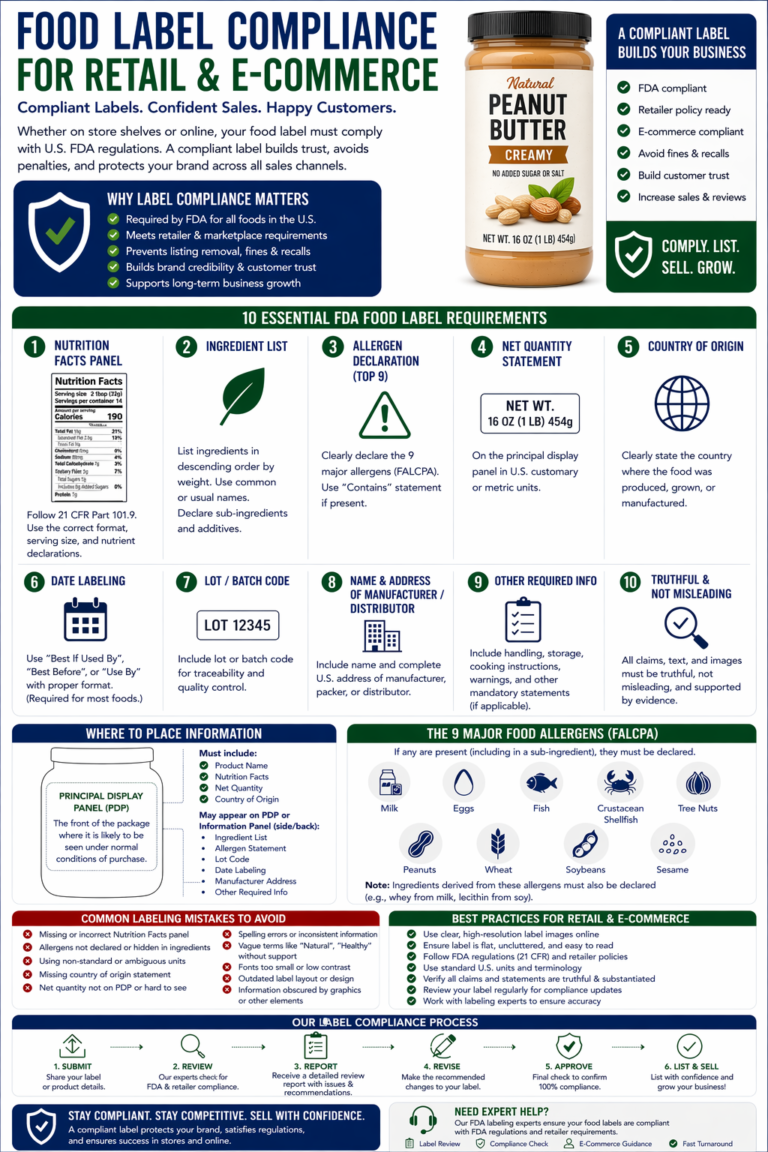
To sell food products in the United States, your label must include all required FDA elements and follow strict formatting guidelines.
Your product must have a clear statement of identity.
The net quantity of contents must be displayed in both U.S. customary and metric units.
All ingredients must be listed in descending order by weight, including sub-ingredients.
Major allergens must be clearly declared.
A compliant Nutrition Facts panel must be included unless an exemption applies.
The name and address of the manufacturer, packer, or distributor must be listed.
Country of origin must be clearly stated for imported products.
Failure to meet these requirements can result in product rejection or removal from sale.
Retail vs. E-Commerce: What’s Different
While FDA requirements remain the same, enforcement often differs between retail and e-commerce.
Retailers typically review labels before accepting products into stores.
E-commerce platforms may allow listings first but remove them later if compliance issues arise.
Online listings must accurately reflect the physical label, including images and product descriptions.
Because of these differences, businesses must ensure consistency across both packaging and digital listings.
Common Compliance Issues Across Channels
Many food brands face similar labeling challenges regardless of where they sell.
Nutrition Facts panels are often outdated or incorrectly formatted.
Ingredient lists may be incomplete or improperly ordered.
Allergen declarations are frequently missing or unclear.
Marketing claims may not align with FDA definitions.
Country of origin labeling may be inconsistent or missing.
These issues can delay retail approvals or trigger listing removals online.
Why Consistency Between Label and Listing Matters
For e-commerce, your online product listing must match your physical label exactly.
Product names, ingredient lists, and claims must be consistent.
Images must accurately reflect the packaging customers will receive.
Any mismatch can lead to customer complaints or platform enforcement.
Maintaining consistency is essential for both compliance and customer trust.
How Label Compliance Impacts Retail Partnerships
Retailers often require compliance verification before onboarding products.
Non-compliant labels can delay or prevent retail placement.
Retail buyers may request documentation or label reviews.
Compliance issues can damage relationships with distributors and retailers.
Brands that address compliance early tend to secure partnerships more easily.
Why a Label Review Is Essential Before Launch
A professional label review helps identify and correct compliance issues before they affect your business.
It ensures your label meets FDA requirements across all channels.
It reduces the risk of retail rejection or online listing removal.
It provides confidence when scaling your product into new markets.
Many successful brands make label review a standard part of their launch process.
How FDA Registration Assistance Supports Retail & E-Commerce Brands
FDA Registration Assistance works with food brands to review labels and identify compliance risks before products reach the market.
We evaluate your label against FDA standards and highlight potential issues.
We provide clear recommendations to bring your label into compliance.
We help ensure consistency between your packaging and online listings.
We support revisions so your product is ready for both retail and e-commerce.
This proactive approach helps brands avoid disruptions and grow with confidence.
Why Brands Choose FDA Registration Assistance
Scaling a food business across retail and e-commerce requires more than a great product—it requires compliance.
FDA Registration Assistance has supported over 1,000 clients across 135+ countries, helping brands align with FDA requirements before entering the U.S. market.
With more than 15 years of combined experience, the focus is on helping businesses avoid delays, maintain compliance, and grow without unexpected setbacks.
Frequently Asked Questions (FAQs)
Do food labels need to be FDA compliant for both retail and e-commerce?
Yes, FDA labeling requirements apply to all food products sold in the United States, regardless of whether they are sold in physical stores or online. There are no separate standards for e-commerce versus retail. However, online platforms may enforce compliance differently, often reacting to complaints or audits after a product is listed. This makes it especially important to ensure compliance before launch.
Can my product be removed from an online platform due to labeling issues?
Yes, e-commerce platforms such as Amazon and Walmart may remove or suppress listings if they identify compliance issues. This can occur due to customer complaints, platform audits, or inconsistencies between your listing and your product label. In many cases, sellers are required to provide documentation or correct their labels before relisting.
Do retailers check labels before accepting products?
Yes, most retailers review product labels as part of their onboarding process. They may check for compliance with FDA requirements, as well as internal standards. Non-compliant labels can delay approvals or result in rejection. Retailers want to minimize risk, so they often require products to be fully compliant before placing them on shelves.
What are the most common labeling issues for food brands?
Common issues include incorrect or outdated Nutrition Facts panels, incomplete ingredient lists, missing allergen declarations, misleading claims, and inconsistent country of origin labeling. These issues can affect both retail acceptance and online listings.
Do imported products need to meet FDA labeling requirements?
Yes, imported food products must meet the same FDA labeling standards as domestic products. There are no exceptions. This includes compliance with Nutrition Facts, ingredient lists, allergen labeling, net quantity statements, and country of origin marking.
How important is consistency between label and online listing?
Consistency is critical. If your online listing does not match your product label, it can lead to customer complaints and platform enforcement actions. Accurate and consistent information helps maintain compliance and build customer trust.
Can I fix labeling issues after launching my product?
Yes, but it can be disruptive. You may need to update packaging, revise listings, or relabel inventory. This can cause delays, additional costs, and lost sales. Addressing compliance before launch is always more efficient.
Do I need a Nutrition Facts label for all products?
Most packaged food products require a Nutrition Facts label that meets FDA standards. While some exemptions exist, they are limited and often not practical for brands selling through retail or e-commerce.
How long does a label review take?
A typical label review can be completed within a few business days, depending on the complexity of the product. This allows brands to identify and correct issues before going to market.
Is a label review necessary for growing food brands?
While not mandatory, it is strongly recommended. Many brands only discover compliance issues after facing delays or listing removals. A label review helps prevent these problems and supports long-term growth.
Build Your Brand on a Compliant Foundation
If you are preparing to sell food products through retail or e-commerce, ensuring your label is fully compliant from the start is one of the most important decisions you can make.
FDA Registration Assistance provides professional label review support to help you align with FDA requirements, avoid disruptions, and confidently grow across retail shelves and online platforms.
You can reach out at info@fdaregistrationassistance.com or call +1-928-275-8333 to get your label reviewed and move forward with confidence.