MIAMI, FL · · FDA Registration Assistance LLC
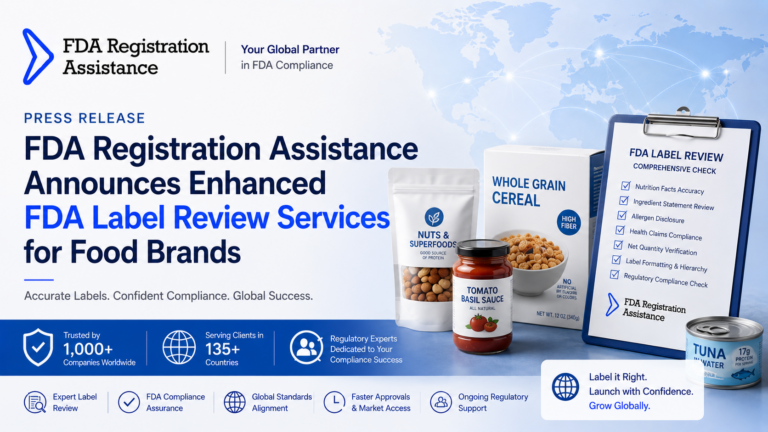
FDA Registration Assistance Announces Enhanced FDA Label Review Services for Food Brands
FDA Registration Assistance expands its FDA food label review services to help domestic and international food brands identify labeling compliance issues before products enter the United States market — reducing the risk of shipment delays, import holds, relabeling costs, and retailer rejection.
FDA Registration Assistance, a U.S.-based FDA compliance consulting firm serving clients in more than 135 countries, has announced the expansion of its FDA food label review services to help domestic and international food brands improve labeling compliance before entering the United States market.
As FDA labeling regulations continue to evolve and retailer compliance expectations increase, many food manufacturers and importers face growing pressure to ensure labels meet U.S. regulatory requirements prior to production and importation. The enhanced label review program is designed to help businesses identify potential compliance concerns early — while reducing the risk of shipment delays, customs issues, product relabeling costs, and retailer rejection.
FDA Registration Assistance currently works with food brands across multiple categories including beverages, canned foods, sauces, snacks, seafood, spices, coffee, tea, dietary supplements, functional foods, frozen foods, confectionery products, and specialty imported products entering the United States.
"Many companies assume label compliance is a minor step in the import process, but labeling issues are one of the most common problems we see affecting imported food products. A product may have the correct FDA registration, but if the label is not compliant, the business can still face major import and distribution challenges."
Many international manufacturers are unfamiliar with U.S. labeling standards involving ingredient declarations, allergen statements, Nutrition Facts panel formatting, statement of identity requirements, Net Quantity Statements, warning language, and claims compliance. In many situations, companies rely on labels created for foreign markets that do not align with FDA expectations for products sold in the United States.
What the Enhanced Label Review Service Covers
FDA Registration Assistance's enhanced label review services include detailed compliance review for food products, beverages, dietary supplements, cosmetics, and certain OTC products. The review covers:
Ingredient declarations — formatting, descending-weight order, sub-ingredient parenthetical listings, and common or usual name requirements under 21 CFR Part 101.4.
Allergen statements — compliance with FALCPA and the FASTER Act, which require declaration of all nine major allergens: milk, eggs, fish, shellfish, tree nuts, wheat, peanuts, soybeans, and sesame. Correct declaration format (contains statement vs. parenthetical) is also reviewed.
Nutrition Facts panel — format compliance with the current FDA Nutrition Facts label requirements, including serving size, serving per container, nutrient declarations, Daily Value percentages, and required formatting under 21 CFR Part 101.9.
Net Quantity Statement — placement, format, minimum type size by Principal Display Panel area, and unit expression requirements under 21 CFR Part 101.105.
Statement of identity — placement on the Principal Display Panel, prominence, and use of the common or usual name of the food product under 21 CFR Part 101.3.
Claims language — review of nutrient content claims, health claims, qualified health claims, and structure/function claims for accuracy and compliance. Unauthorized disease claims or implied therapeutic language are flagged because they can reclassify a food product as a drug under FDA regulations.
Responsible party information — name and place of business of the manufacturer, packer, or distributor as required under 21 CFR Part 101.5.
Claims Language: A Critical Labeling Risk
One of the biggest issues food manufacturers face involves unintentional claims language that can change how a product is regulated by FDA. Statements involving disease claims, structure/function claims, nutritional representations, or therapeutic wording may trigger additional regulatory requirements depending on the product category and intended use.
"Many businesses do not realize that even small wording changes on a label can significantly impact FDA classification and compliance obligations. Reviewing labels before products go into production can help companies avoid costly packaging revisions and shipment delays later."
If a label includes language suggesting the product treats, cures, mitigates, or prevents a disease, FDA may treat the product as a drug rather than a food — requiring Drug Establishment Registration, NDC Listing, and compliance with drug Good Manufacturing Practice requirements. Pre-production label review is the most cost-effective way to catch and correct these issues before packaging is printed.
Label Compliance and Amazon / Retailer Onboarding
According to FDA Registration Assistance, food labels have become an increasingly important area of regulatory focus because labels directly communicate product information to consumers, regulators, customs inspectors, and retail buyers. Improper labeling may create compliance concerns during FDA review, customs inspections, Amazon onboarding, distributor evaluations, or retailer approval processes.
Amazon requires FDA-compliant labeling for many regulated food, supplement, and cosmetic categories before products can be listed in the U.S. marketplace. Common Amazon rejection reasons include missing allergen declarations, non-compliant Nutrition Facts panels, unauthorized claims, and missing responsible party information — all of which are covered in FDA Registration Assistance's label review process.
Supporting International Food Brands Entering the U.S. Market
FDA Registration Assistance notes that many first-time exporters entering the U.S. market are unaware that FDA labeling requirements may differ substantially from regulations in their home country. The firm works directly with international manufacturers to explain U.S. labeling expectations and help businesses prepare compliant packaging before products are shipped to the United States.
International food brands whose domestic labels comply with regulations such as EU Regulation 1169/2011, Japanese Food Sanitation Act labeling requirements, EAEU technical regulations, or BPOM Indonesian labeling standards frequently need significant modifications to meet U.S. FDA requirements — including English-language requirements, Nutrition Facts panel conversion, allergen declaration format changes, and Net Quantity Statement adjustments.
FDA Registration Assistance continues expanding its compliance services as more international brands seek access to the U.S. market and as FDA labeling enforcement activity — including heightened scrutiny of allergen declarations and claims language — continues to increase.
About FDA Registration Assistance
FDA Registration Assistance is a U.S.-based FDA compliance consulting company that helps domestic and international businesses navigate FDA regulations for food, cosmetics, dietary supplements, OTC drugs, and medical devices. The company provides support for Food Facility Registration, U.S. Agent services, FSVP compliance, FDA label reviews, MoCRA compliance, and import preparation services. FDA Registration Assistance is BBB Accredited and serves 1,000+ clients across 135+ countries.
Frequently Asked Questions
1. What is an FDA food label review?
An FDA food label review is a compliance evaluation that assesses whether a product label meets applicable FDA labeling requirements under 21 CFR Part 101 before the product enters the U.S. market. A review typically covers the Principal Display Panel, ingredient declaration, allergen statements, Nutrition Facts panel, Net Quantity Statement, statement of identity, responsible party information, and any claims language — including structure/function claims, nutrient content claims, and health claims.
2. Why are labeling issues one of the most common FDA compliance problems for food importers?
Many food manufacturers — especially international brands — create labels for their home market that do not align with U.S. FDA requirements. U.S. labeling standards for ingredient formatting, allergen declarations under FALCPA and the FASTER Act, Nutrition Facts panel layout, Net Quantity Statement format and placement, and claims language often differ substantially from the labeling regulations in the exporter's country. A product can have valid FDA Food Facility Registration and still be subject to import holds or retailer rejection if the label is non-compliant.
3. Can claims language on a food label change how FDA regulates the product?
Yes. Disease claims, implied disease claims, therapeutic statements, or structure/function claims that go beyond what is permitted for food products can reclassify a food product as a drug under FDA regulations — triggering Drug Establishment Registration, NDC Listing, and drug-specific requirements. Even subtle wording choices on food labels can have significant regulatory consequences. Pre-production label review is the most cost-effective way to catch and correct these issues.
4. Does FDA label review help with Amazon and retailer compliance?
Yes. Amazon, major U.S. retailers, and food distributors increasingly require FDA-compliant labeling as a condition of listing and stocking food products. Common retailer-flagged issues include missing allergen declarations, non-compliant Nutrition Facts panels, unauthorized claims, incorrect Net Quantity Statement format, and missing responsible party information. An FDA label review identifies these issues before products are submitted to Amazon or retail buyers — reducing rejection rates and time to market.
5. What products does FDA Registration Assistance review labels for?
FDA Registration Assistance reviews product labels for food and beverages, dietary supplements, cosmetics, OTC drugs, and certain medical devices. For food products, the review covers all required elements under 21 CFR Part 101 — ingredient declarations, allergen statements, Nutrition Facts panels, Net Quantity Statements, statement of identity, and claims compliance. For cosmetics, the review covers MoCRA compliance, INCI ingredient naming, and required warnings.