FSVP Gaps Analysis & Compliance
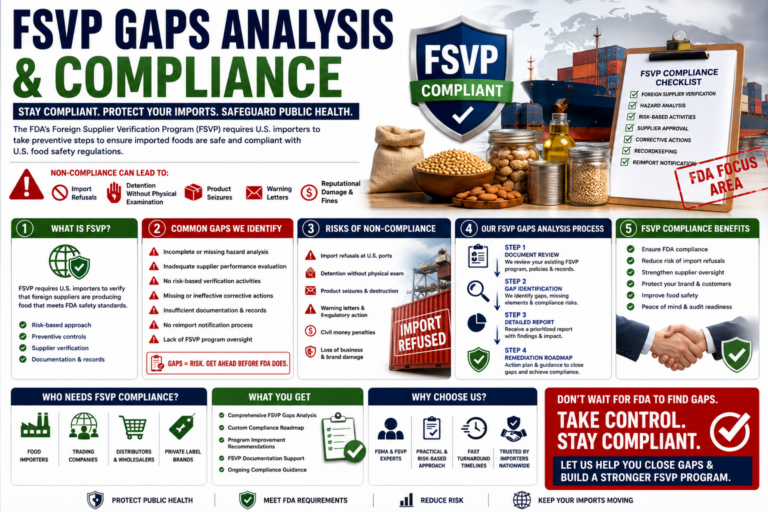
FDA Registration Assistance conducts FSVP gap assessments and full remediation for U.S. food importers — delivering a complete, inspection-ready FSVP program that meets every requirement of 21 CFR Part 1 Subpart L.
The 7 FSVP Elements FDA Auditors Check
An FSVP gaps analysis compares your program against the specific elements FDA investigators evaluate during inspections under 21 CFR Part 1 Subpart L. These are the seven elements that generate the most Form 483 observations:
What FDA Does When It Finds FSVP Gaps
FSVP is one of FDA's top enforcement priorities for food importers. FDA conducts FSVP inspections both at ports of entry (reviewing import documentation) and at the importer's place of business — without advance notice. When gaps are found, the escalation path is predictable:
| Enforcement Action | What It Means | Trigger |
|---|---|---|
| FDA Form 483 | Written inspectional observations issued at the end of an inspection. Requires a written response with corrective actions. | FSVP elements missing, incomplete, or non-compliant during an inspection |
| Warning Letter | Formal enforcement letter establishing a violation and requiring corrective action within a specified timeframe. Becomes public on FDA's website. | Failure to adequately respond to Form 483 observations; significant FSVP violations |
| Increased Import Scrutiny | FDA flags the importer's shipments for additional review, examination, or holds during port entry processing. | History of FSVP non-compliance; unresolved Form 483 observations |
| Import Alert (DWPE) | All shipments from the affected facility face Detention Without Physical Examination — detained at the port without individual inspection. | Repeated or serious FSVP violations combined with supplier food safety failures |
Do You Qualify for Modified FSVP?
Not every importer faces the full standard FSVP requirements. Under 21 CFR 1.511, certain importers qualify for modified FSVP provisions — with reduced verification activity requirements. A gaps analysis should confirm whether you qualify and, if so, whether your program is correctly structured for the modified pathway.
Importer Subject to Preventive Controls
If the U.S. importer is itself subject to FSMA Preventive Controls for Human Food (21 CFR Part 117) or Animal Food (21 CFR Part 507) for the imported food, and the hazard is controlled under those requirements, the importer may use a modified FSVP with reduced verification activities for that hazard.
Very Small Supplier
Importers sourcing from very small businesses — defined as businesses with under $1 million in total annual food sales averaged over the preceding 3 years — may use modified supplier verification activities. The importer must obtain written assurance from the supplier that the food meets applicable safety requirements and verify the accuracy of that assurance.
Recognized Food Safety System
Importers sourcing from suppliers in countries with food safety systems that FDA has recognized as providing equivalent public health protection may qualify for modified FSVP verification activities. FDA publishes its list of recognized food safety systems. Importers using this pathway must verify the supplier is subject to the recognized system.
Qualifying for modified FSVP does not eliminate all FSVP requirements — it modifies the verification activities required for specific hazards or suppliers. Even importers on the modified pathway must maintain written hazard analysis, supplier evaluation, corrective action procedures, QI designation, and 2-year recordkeeping. A gaps analysis confirms whether your modified pathway is correctly documented.
What FDA Registration Assistance Reviews and Delivers
FDA Registration Assistance conducts FSVP gaps analyses and full remediation for U.S. food importers. Here is exactly what the service covers:
Gaps Analysis
A full review of your existing FSVP program against all requirements of 21 CFR Part 1 Subpart L. Each of the 7 required elements is evaluated individually. The output is a detailed report identifying every gap with the specific CFR reference and a recommended corrective action for each.
Hazard Analysis Development
Written hazard analyses for each foreign supplier and food combination, identifying biological, chemical, and physical hazards specific to the food, supplier processes, and country of origin — and determining which hazards require supplier verification and which require the importer's own controls.
Verification Activity Selection
Selection and documentation of verification activities appropriate to the risk identified in the hazard analysis — annual audits, sampling and testing protocols, supplier record review procedures, or other appropriate activities — with a schedule for ongoing execution.
Qualified Individual Services
FDA Registration Assistance provides Qualified Individual (QI) services — conducting hazard analyses, approving verification activities, reviewing supplier documentation, and maintaining required records on behalf of the importer. Having a third-party QI with documented food safety expertise strengthens the program's credibility during FDA inspections.
Recordkeeping System
Establishment of an organized, 2-year recordkeeping system for all required FSVP documentation — ensuring records can be produced on demand during an FDA inspection at the port or at the importer's facility. Records are maintained for the required retention period.
Ongoing Maintenance
FSVP is not a one-time document — it must be maintained, updated for new suppliers, and reassessed when triggered. FDA Registration Assistance provides ongoing FSVP management so the program stays current and inspection-ready at all times.
Get Your FSVP Gaps Analysis Started
FDA Registration Assistance reviews your FSVP program against all requirements of 21 CFR Part 1 Subpart L, delivers a detailed gaps report, and provides full remediation — including Qualified Individual services, hazard analysis, verification activity documentation, and ongoing compliance management. 1,000+ clients. 135+ countries. 15+ years of FDA regulatory experience.
Contact us at info@fdaregistrationassistance.com or call +1 (928) 275-8333.
Frequently Asked Questions — FSVP Gaps Analysis & Compliance
1. What is an FSVP gaps analysis?
An FSVP gaps analysis is a systematic review of a U.S. importer's existing Foreign Supplier Verification Program against the requirements of 21 CFR Part 1 Subpart L. The analysis evaluates all 7 required FSVP elements — hazard analysis, supplier evaluation, verification activities, corrective actions, Qualified Individual, recordkeeping, and reassessment — to identify gaps before FDA finds them during an inspection.
2. Who is required to have an FSVP program?
U.S. importers of food for human or animal consumption are required to have an FSVP under 21 CFR Part 1 Subpart L. The FSVP importer is the U.S. owner or consignee of the food at the time of U.S. entry as defined at 21 CFR 1.500. A separate FSVP must be maintained for each foreign food supplier.
3. What are the most common FSVP gaps FDA finds during inspections?
Most common Form 483 observations: no written hazard analysis or one that is too generic; supplier questionnaires used as the sole verification for high-risk hazards; no documentation of verification activity execution; no designated Qualified Individual; FSVP records not maintained for 2 years; FSVP not updated when new suppliers are added; and no reassessment after a food safety concern is identified.
4. What is a Qualified Individual (QI) under FSVP?
A Qualified Individual under 21 CFR 1.500 is a person with the education, training, or experience necessary to perform FSVP activities. The QI must develop and oversee the FSVP program and must have food safety training meeting 21 CFR 1.604 — such as the FSPCA Preventive Controls for Human Food course. FDA Registration Assistance provides QI services for importers who need a designated, qualified individual to manage their FSVP.
5. What does the FSVP hazard analysis need to include?
The hazard analysis under 21 CFR 1.504 must identify biological, chemical, and physical hazards reasonably likely to occur in the food from the specific supplier; evaluate whether each hazard requires a preventive control; and identify who controls each hazard. A hazard analysis that is generic — not specific to the food type, supplier processes, and country of origin — is a common gap that FDA flags.
6. What supplier verification activities does FSVP require?
Under 21 CFR 1.506, verification activities must match the risk in the hazard analysis. For hazards requiring a preventive control controlled by the supplier, at least one of the following is required: annual onsite audit; product sampling and testing; review of the supplier's food safety records; or another appropriate procedure. Supplier questionnaires alone are not sufficient for significant hazards.
7. How long must FSVP records be kept?
FSVP records must be maintained for at least 2 years from the date created under 21 CFR 1.510. Records include hazard analyses, supplier evaluations, verification activity results, corrective action documentation, and QI credentials. Records must be available to FDA upon request and must be accessible at or from the importer's place of business.
8. When does FSVP need to be reassessed or updated?
Under 21 CFR 1.508, reassessment is triggered when: new hazard information emerges about the food; a verification activity reveals a food safety problem; the supplier changes; the food is associated with a serious health consequence; or any other change affects the hazard analysis conclusions. An FSVP written at program launch and never updated despite supplier or product changes is non-compliant.
9. What is modified FSVP and who qualifies?
Modified FSVP under 21 CFR 1.511 allows reduced verification requirements for: importers subject to FSMA Preventive Controls for the same hazard; importers sourcing from very small businesses (under $1 million in annual food sales); and importers sourcing from suppliers in countries with FDA-recognized food safety systems. Modified FSVP still requires hazard analysis, supplier evaluation, QI designation, and 2-year recordkeeping.
10. What happens during an FDA FSVP inspection?
FDA conducts FSVP inspections both at ports of entry and at the importer's place of business — without advance notice. Investigators review FSVP documentation, hazard analysis, supplier verification records, corrective action records, and QI credentials. If deficiencies are found, FDA issues a Form 483 with specific observations requiring a written corrective action response.
11. What is a Form 483 and what FSVP observations are most common?
A Form 483 is FDA's written list of inspectional observations issued at the end of an inspection. Common FSVP Form 483 observations include: no hazard analysis; verification activities not based on the hazard analysis; no documentation of activities performed; no QI designation; records not maintained for 2 years; and no reassessment after a supplier change or food safety event. Form 483s require a written response with specific corrective actions.
12. Can FDA detain shipments because of FSVP non-compliance?
Yes. FSVP compliance status is a factor in FDA's import risk-screening. Importers with documented FSVP deficiencies or Warning Letters may face increased scrutiny of incoming shipments. Importers placed on FDA Import Alert face Detention Without Physical Examination (DWPE) on future shipments.
13. Is FSVP a one-time requirement?
No. FSVP is an ongoing program. A new supplier requires a new FSVP. Verification activities must be performed on schedule. Records must be maintained and updated. Reassessments must be conducted when triggered. An FSVP program written once and never updated is non-compliant.
14. What is the FSVP importer and how is it different from the customs broker?
The FSVP importer is the U.S. owner or consignee of the food at the time of U.S. entry per 21 CFR 1.500 — not the customs broker. The customs broker handles CBP entry procedures but is not responsible for FSVP compliance. The FSVP importer is legally responsible for developing and maintaining the FSVP program.
15. Do small importers need FSVP?
Yes, with limited exceptions. Very small importers (under $1 million in annual food sales) qualify for modified FSVP under 21 CFR 1.511 — they are not fully exempt. They must still obtain written assurance from suppliers and verify its accuracy, maintain a hazard analysis, designate a QI, and keep 2-year records.
16. What is the difference between FSVP and a supplier audit?
A supplier audit is one verification activity within an FSVP. FSVP is the complete program — hazard analysis, supplier evaluation, verification activity selection, corrective actions, QI designation, and recordkeeping. An audit without documented hazard analysis, supplier evaluation, corrective action procedures, or proper records does not constitute a compliant FSVP.
17. Does FSVP apply to dietary supplements and pet food imports?
Yes. FSVP applies to food for both human and animal consumption, including dietary supplements and pet food. Hazard analyses for these categories should address relevant hazards — heavy metals, pesticide residues, microbiological contamination, and undeclared allergens as appropriate to the specific product and supplier.
18. What is the role of the FSVP program in an FDA Import Alert?
When FDA places a foreign facility on Import Alert, U.S. importers sourcing from that facility face DWPE on future shipments. A complete, documented FSVP demonstrates to FDA that the importer has active supplier verification controls in place — which is relevant to Import Alert resolution and to demonstrating corrective action.
19. What corrective actions does FSVP require?
Under 21 CFR 1.508, when a verification activity reveals a food safety problem, the importer must document: review of the verification results; any additional verification conducted; and the determination of whether to continue importing from the supplier. If the food could cause serious adverse health consequences, the importer must promptly stop importing from that supplier.
20. How does FDA Registration Assistance conduct an FSVP gaps analysis?
FDA Registration Assistance reviews the importer's existing FSVP program against all 7 required elements of 21 CFR Part 1 Subpart L. A detailed report identifies each gap with its specific regulatory reference and a recommended corrective action. The review covers hazard analysis, supplier evaluation, verification activity selection and execution records, QI designation, corrective action procedures, 2-year recordkeeping, and reassessment documentation.
21. What does FSVP remediation involve?
Remediation corrects each identified gap to bring the FSVP into full compliance with 21 CFR Part 1 Subpart L. This may include developing or updating hazard analyses, selecting and scheduling verification activities, creating corrective action procedures, establishing 2-year records retention, designating or training a QI, and documenting the reassessment process. FDA Registration Assistance delivers a complete, corrected FSVP program ready for FDA inspection.
22. Can FDA Registration Assistance serve as the Qualified Individual for our FSVP?
Yes. FDA Registration Assistance provides QI services — conducting hazard analyses, approving verification activities, reviewing supplier documentation, and maintaining required records on behalf of U.S. importers. A third-party QI with documented food safety expertise strengthens the program's credibility during FDA inspections.
23. How long does an FSVP gaps analysis take?
For importers with a small number of suppliers and some existing documentation, a gaps analysis can typically be completed within 5 to 10 business days of receiving all relevant materials. Importers with multiple suppliers, complex supply chains, or minimal existing documentation may require a longer review timeline.
24. Will fixing FSVP gaps prevent future FDA enforcement?
A fully compliant, documented, and current FSVP program significantly reduces the risk of enforcement escalation. FSVP compliance also supports overall food import compliance — FDA's risk-scoring system for import shipments considers the importer's compliance history, and a documented FSVP program demonstrates active supplier oversight.
25. How do I get started with an FSVP gaps analysis?
Contact FDA Registration Assistance at info@fdaregistrationassistance.com or call +1 (928) 275-8333. Provide information about your foreign food suppliers, the products you import, and any existing FSVP documentation. FDA Registration Assistance will conduct a comprehensive gaps analysis, provide a detailed remediation report, and bring your FSVP into full 21 CFR Part 1 Subpart L compliance.