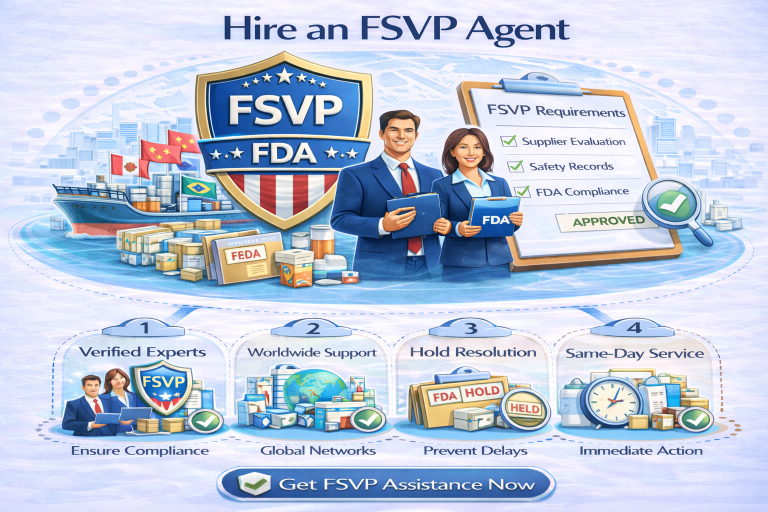
Hire an FSVP Agent
Trusted by 1,000+ companies across 135+ countries, with 15+ years of FDA regulatory experience. Below: how an FSVP Agent differs from a U.S. Agent, who needs one, what the importer must do, and how our managed service works.
FSVP Agent vs. U.S. Agent — Two Different Roles
These two are constantly mixed up, and getting them wrong leaves a gap the FDA will find. They live under different regulations and sit with different parties.
| Aspect | FSVP Importer / Agent | U.S. Agent |
|---|---|---|
| Regulation | FSVP — 21 CFR Part 1, Subpart L | Facility registration — 21 CFR 1.227 |
| Whose duty | The U.S. importer of the food | The foreign facility |
| Purpose | Verify foreign suppliers meet U.S. food-safety standards | Act as the facility's U.S. contact for the FDA |
| Applies to | Imported human & animal food | Registered foreign food, drug & device facilities |
| Identified | At each entry (name, email, DUNS) | In the facility's FDA registration |
A foreign food supplier shipping to the U.S. often needs both: a U.S. Agent for its facility registration, and an FSVP importer for the food entering the country. We can serve in both roles. See our explainer on U.S. Agent vs. importer.
Who Needs to Hire an FSVP Agent
If your company is listed as the U.S. importer of record for food, the FDA considers you legally responsible for FSVP. That includes:
U.S. Food Importers
Any business importing human or animal food into the United States as the owner or consignee at entry.
Amazon & E-commerce Sellers
Online and marketplace sellers importing food — the requirement follows the importer of record, not the sales channel.
Private-Label & Distributors
Brands and distributors sourcing food internationally across one or many foreign suppliers.
Seafood & Supplement Importers
Covered under modified FSVP paths tied to Seafood HACCP and dietary supplement rules.
Foreign Suppliers Without a U.S. Entity
If there's no U.S. owner or consignee, a U.S.-based agent must be designated as the FSVP importer — a role we can fill.
Importers Who Failed an Inspection
Companies that relied on templates or brokers and need a real, defensible program built and maintained.
What an FSVP Importer Must Do
FSVP is a defined set of activities under Subpart L — not a single form. The core duties:
Modified Requirements & Exemptions
FSVP rarely disappears — more often it changes shape. Common modified or exempt situations:
A Living FSVP Program, Not a Static File
We run the full FSVP lifecycle so your imports stay compliant year-round:
Program Development
A custom FSVP built around your product category, suppliers, importer role, and risk profile.
Foreign Supplier Verification
We confirm FDA registration status, food-safety controls, hazard controls, and compliance history.
Ongoing Maintenance
Records updated when suppliers or products change, with reassessment at least every three years.
FDA Inspection Support
Documentation prepared, responses assisted, and corrective-action guidance to address Form 483 observations.
Ready to Hire an FSVP Agent?
Tell us your products, your foreign suppliers, and your role in the supply chain. We'll confirm your importer responsibilities, build and run your FSVP, verify your suppliers, and keep you inspection-ready — so you can focus on sourcing and sales. Email info@fdaregistrationassistance.com or call +1 (928) 275-8333.
Frequently Asked Questions — Hiring an FSVP Agent
Is having an FSVP mandatory?
Yes. If you import human or animal food into the U.S., FSVP (21 CFR Part 1, Subpart L) requires a qualified FSVP importer to verify that your foreign suppliers meet U.S. food-safety standards. The program itself is required; hiring an agent is how most importers meet it.
What's the difference between an FSVP Agent and a U.S. Agent?
They are different roles under different rules. An FSVP importer or agent is the U.S. party responsible for verifying foreign food suppliers under Subpart L. A U.S. Agent is a foreign facility's FDA contact for its registration under 21 CFR 1.227. A foreign supplier often needs both.
Who is the “FSVP importer”?
The U.S. owner or consignee of the food at the time of U.S. entry. If there is no U.S. owner or consignee, it is the U.S. agent or representative of the foreign owner or consignee, designated in a signed statement of consent. That party is identified at each entry.
Can a foreign company be its own FSVP importer?
Not directly. If a foreign owner or consignee has no U.S. owner or consignee, they must designate a U.S.-based agent or representative to serve as the FSVP importer. We can serve in that role for foreign suppliers.
Can my customs broker be my FSVP agent?
No. A customs broker handles entry filing, not the regulatory verification that FSVP requires. Listing a broker as the importer, or being listed without an actual FSVP in place, is a common cause of inspection failures.
Do Amazon and e-commerce food sellers need FSVP?
Yes, if they import food into the U.S. Being an online or Amazon food seller does not change the requirement; if you are the U.S. importer of record, FSVP applies to you.
Is FSVP required for seafood and juice?
Seafood and juice are covered by their own HACCP rules. If you import seafood or juice from a supplier complying with Seafood or Juice HACCP, you verify that compliance instead of running the full FSVP — a modified path, not an exemption from oversight.
Do dietary supplement importers need FSVP?
Yes, with modified requirements. Supplement importers follow tailored FSVP provisions tied to the dietary supplement cGMP rules, and we build the program to match.
What does the FSVP importer actually have to do?
Determine the hazards in each food; evaluate the supplier's risk and performance; conduct verification activities such as audits, sampling, or records review; take corrective actions; keep records; and identify the FSVP importer at entry with name, email, and DUNS Number.
Is a DUNS Number required for FSVP?
Yes. The FSVP importer is identified at entry using a DUNS Number as the unique facility identifier, along with name and email, for each line of imported food. We help you obtain one if you don't already have it.
Does FSVP apply to small importers?
Yes. Very small importers, and those buying from certain small foreign suppliers, follow modified requirements — but the program still applies. Size changes the requirements, not whether FSVP is needed.
Is FSVP a one-time document?
No. It is a living program. You must reassess at least every three years, and sooner when you change suppliers or products, or when new hazards or supplier problems arise. We maintain it on an ongoing basis.
What happens if I don't have an FSVP?
Your shipments can be detained or refused, you can receive FDA Form 483 observations or import alerts during an FSVP inspection, and your ability to import can be disrupted. FSVP is one of the FDA's routine import-enforcement focuses.
Will the FDA inspect my FSVP records?
Yes. The FDA conducts FSVP inspections, often remotely, and reviews your records. We keep your files inspection-ready and support you through the inspection.
Can you take over an existing FSVP program?
Yes. We audit what you have, fix gaps, and maintain it going forward. This is common for importers who used templates or brokers and later failed or feared an inspection.
What foods are exempt from FSVP?
Limited categories, including food for research or personal consumption, certain alcoholic beverages, and food transshipped or imported for further processing and export. Food from countries with officially recognized or equivalent food-safety systems gets modified requirements rather than a full exemption.
Do I need a separate FSVP for each supplier?
Effectively yes — FSVP is built per importer, per foreign supplier, per food. Multi-supplier importers need each supply line covered, and we manage them together under one program.
Who is a “qualified individual” for FSVP?
A person with the education, training, or experience needed to develop and perform FSVP activities. Our specialists serve as the qualified individuals so your program is built and maintained correctly.
How fast can you set up an FSVP program?
Timelines depend on the number of suppliers and products, but we prioritize urgent situations such as a held shipment or a scheduled FSVP inspection.
Does FSVP replace foreign facility registration?
No. They are separate. The foreign facility still completes foreign facility registration and appoints a U.S. Agent, and the U.S. importer still maintains FSVP. We can handle both sides.
What records does FSVP require me to keep?
Your hazard analysis, supplier evaluations, verification activities and results, corrective actions, and your written FSVP — generally kept for at least two years and available to the FDA on request. We maintain them for you.
Can one firm handle FSVP for multiple product categories?
Yes. We build and manage FSVP across food categories and complex, multi-supplier global supply chains under one firm, with a single point of contact for every supply line and renewal.
How does FSVP relate to the rest of my FDA obligations?
FSVP is the importer-side verification piece. Alongside it sit facility registration, U.S. Agent appointment, Prior Notice for each shipment, and U.S. labeling. We can coordinate all of them so nothing is missed at the border.
What do you need from me to start?
Your product list, your foreign suppliers, your role in the supply chain, and your import volume. From there we map responsibilities and build the program.
How do I hire an FSVP agent?
Contact FDA Registration Assistance with your supply-chain details. Reach our team and we confirm your importer responsibilities, build and run your FSVP, verify your suppliers, and keep you inspection-ready. Email info@fdaregistrationassistance.com or call +1 (928) 275-8333.