How to Avoid FDA Detention for Canned Food Imports
FDA detention is one of the most costly and frustrating issues importers face when bringing canned foods into the United States. Even a small compliance mistake can result in your shipment being held at the port—leading to delays, storage fees, and potential loss of product or customers.
The U.S. Food and Drug Administration enforces strict import controls on canned and shelf-stable foods, especially low-acid canned foods (LACF) and acidified foods. These products are considered higher risk and are closely reviewed during entry.
The good news: most FDA detentions are completely preventable—if you know what to do before your shipment arrives.
What FDA Detention Means for Your Shipment
FDA detention occurs when your shipment is flagged for review.
Your products are held at the port of entry
They cannot be released into commerce
FDA may request documentation or conduct an examination
Delays can range from days to weeks
In some cases, shipments may be refused
Avoiding detention starts with full compliance before shipping.
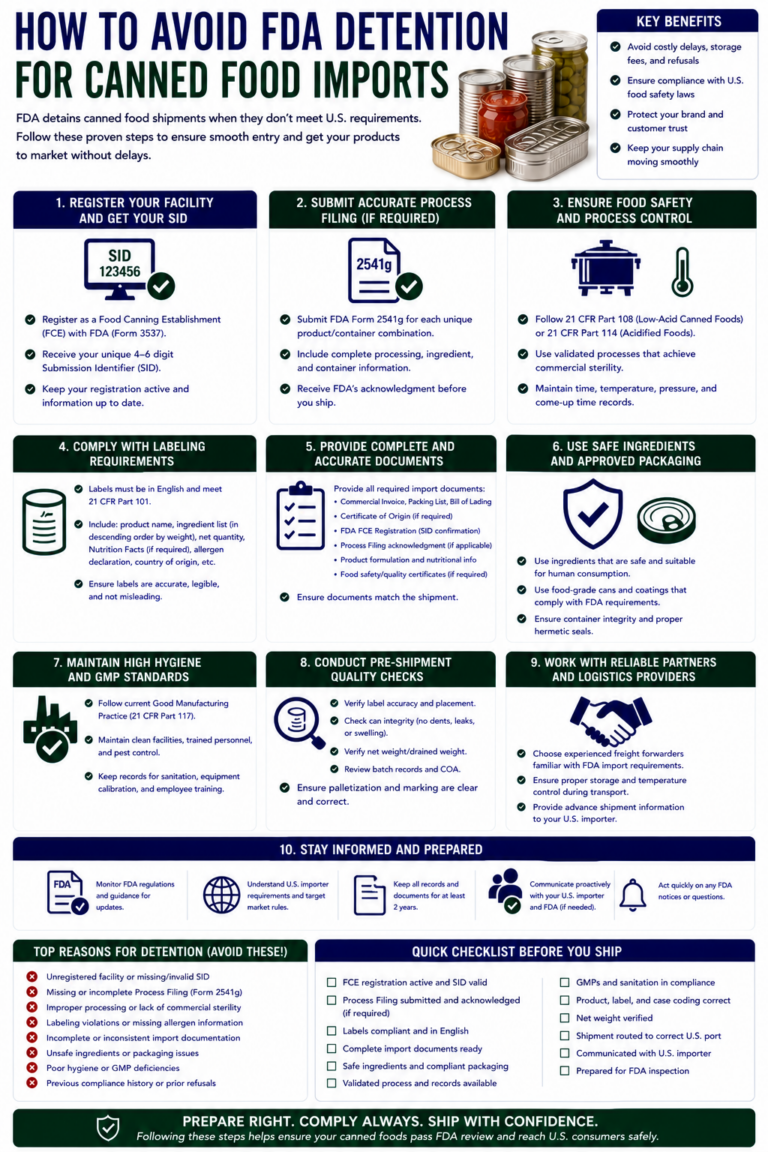
#1 Prevent Detention by Completing FCE Registration
FCE (Food Canning Establishment) registration is mandatory for many canned foods.
Required for low-acid canned foods and acidified foods
Identifies your facility in the FDA system
Must be completed before export
If missing or incorrect, your shipment is highly likely to be detained
This is one of the most common causes of FDA detention.
#2 Ensure SID Filings Are Accurate and Complete
SID (Scheduled Process) filings are equally critical.
Each product must have a valid SID
Each variation may require its own SID
Processing details must be accurate
Filings must match actual production
Errors here are one of the top reasons shipments are flagged.
#3 Validate Your Process with a Process Authority
A Process Authority is essential for compliance.
They confirm safe processing conditions
They validate time, temperature, pressure, and pH
They provide required documentation
They ensure your SID is properly supported
Skipping this step increases your risk significantly.
#4 Get Product Classification Right
Misclassification is a major cause of detention.
Low-acid vs acidified confusion
Shelf-stable vs refrigerated misunderstanding
Incorrect assumption that filing is not required
Classification determines your entire compliance path
Getting this wrong leads to missing requirements.
#5 Make Sure Your Label Is FDA Compliant
Labeling issues alone can trigger detention.
Ingredients must match formulation and SID
Nutrition Facts must meet FDA format
Allergens must be properly declared
Product identity must be accurate
Labels must be complete and consistent
Even small labeling errors can stop your shipment.
#6 Confirm FSVP Is Properly Assigned
The U.S. importer must meet FSVP requirements.
Importer must verify supplier compliance
Documentation must be maintained
DUNS number must be in place
Importer must confirm responsibility
If FSVP is missing or unclear, FDA may detain the shipment.
#7 Submit Prior Notice Correctly
Prior Notice is required for every shipment.
Must be submitted before arrival
Must match shipment details exactly
Errors or late submission can trigger immediate detention
Usually handled by the customs broker
This is one of the easiest issues to prevent.
#8 Keep Documentation Ready for FDA Review
FDA may request documentation at any time.
FCE and SID filings
Process Authority validation
Label files
FSVP records
Shipment documentation
Having everything ready speeds up release.
#9 Work with an Experienced Compliance Partner
Many detentions happen due to avoidable mistakes.
Incomplete filings
Incorrect documentation
Miscommunication between exporter and importer
Lack of validation
Working with experts helps eliminate these risks.
Common Mistakes That Lead to FDA Detention
These issues repeatedly cause problems.
FCE missing or incorrect
SID not filed or mismatched
No Process Authority validation
Label does not match product
FSVP not assigned
Prior Notice errors
Most detentions can be traced back to these.
Why You Must Prevent Detention Before Shipping
Once your shipment is detained, fixing the issue takes time.
Documentation must be submitted and reviewed
Corrections may require re-filing
Storage fees increase over time
Customer relationships may be impacted
Prevention is always faster and more cost-effective.
How FDA Registration Assistance Helps You Avoid Detention
FDA Registration Assistance works with importers and exporters to prevent detention before it happens.
We complete FDA Food Facility Registration and U.S. Agent services
We handle FCE and SID filings
We coordinate with Process Authorities
We assist with FSVP compliance
We review labels for FDA compliance
We ensure everything is aligned before shipping
This significantly reduces your risk of detention.
Why Importers Choose FDA Registration Assistance
Avoiding FDA detention requires precision.
FDA Registration Assistance has supported over 1,000 clients across 135+ countries, helping importers avoid delays and get shipments cleared quickly.
With 15+ years of combined experience, the focus is on making sure your shipment is compliant before it ever reaches the port.
Frequently Asked Questions (AEO Optimized)
What causes FDA detention for canned food imports?
The most common causes are missing FCE registration, incorrect SID filings, labeling errors, FSVP issues, and Prior Notice mistakes.
Can FDA detention be avoided completely?
Most detentions are preventable with proper compliance, though random inspections may still occur.
What is the fastest way to avoid detention?
Complete all filings before shipping, validate your process, ensure labeling compliance, and confirm FSVP.
Can labeling errors cause detention?
Yes, labeling issues are one of the most common reasons shipments are flagged.
Do all canned foods require FCE and SID?
No, but many do—especially low-acid canned foods and acidified foods.
What happens if my shipment is detained?
It will be held until the issue is resolved, which can take days or weeks depending on the problem.
Who is responsible for FSVP?
The U.S. importer is responsible, but exporters must ensure it is properly assigned.
Can I fix issues after shipment arrives?
Yes, but it can be time-consuming and costly compared to preventing the issue.
Does Prior Notice affect detention risk?
Yes, errors or missing submissions can immediately trigger detention.
Should I use professional assistance?
Most importers do to reduce risk and avoid costly mistakes.
Avoid FDA Detention Before Your Shipment Arrives
If you are importing canned foods into the United States, preventing FDA detention starts with completing every requirement correctly before your shipment leaves.
FDA Registration Assistance helps you handle filings, validation, labeling, and importer coordination—so your shipment clears FDA without delays or risk.
You can reach out at info@fdaregistrationassistance.com or call +1-928-275-8333 to get started.