How to Prepare Your Canned Food Shipment for U.S. Customs
The eight-step sequence, a shipment-ready checklist, and the mistakes that hold shipments at the port.
Key Takeaways
- Everything happens before shipping — nothing can be fixed at the border.
- Classification comes first — it decides which filings apply.
- Validation is the long pole — engage a process authority early.
- FSVP sits with your U.S. importer — confirm it's assigned.
- Prior notice is filed before arrival — usually by the broker or importer.
- The label must match your filing — mismatches trigger holds on their own.
Classification Sets the Path
Before any filing, you need to know what your product is — because that determines which steps apply. A low-acid canned food or an acidified food carries the full FCE-and-scheduled-process track; a naturally acidic food or an excluded category may skip it entirely. Getting this wrong sends every later step in the wrong direction, so confirm it first.
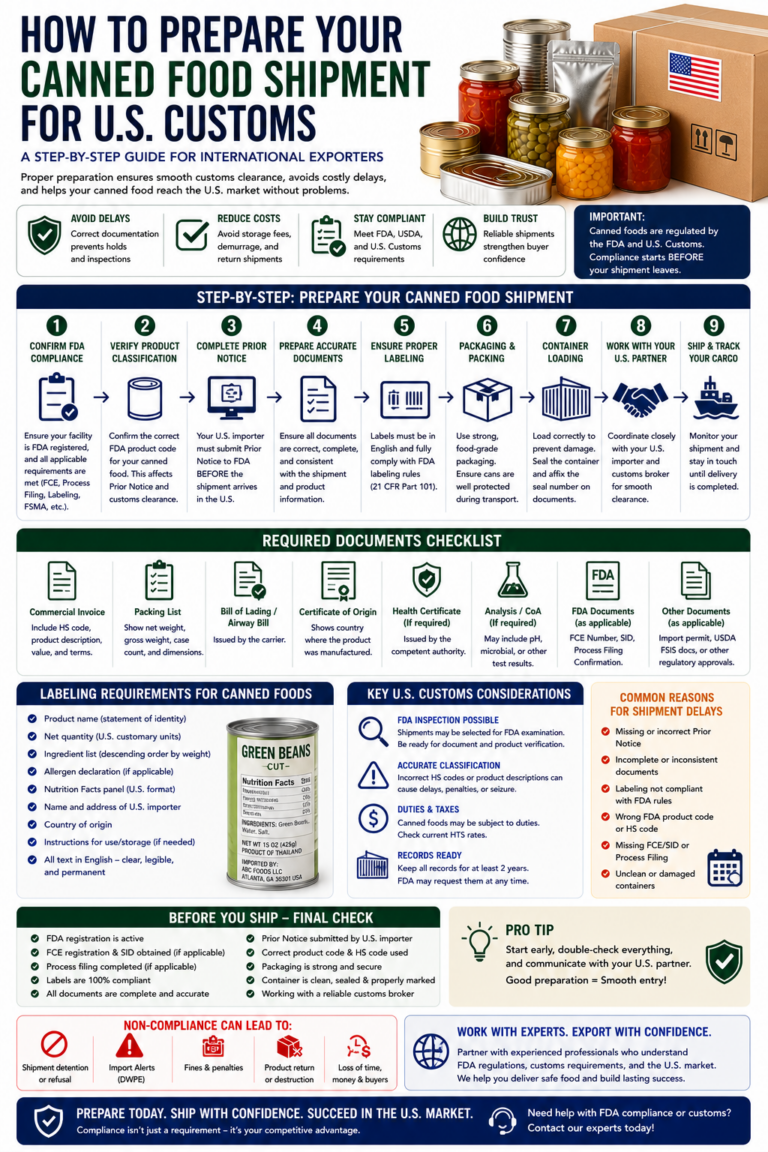
Preparing the Shipment, Step by Step
Confirm your product's classification
Determine whether your product is a low-acid canned food, an acidified food, or neither — because that decides which filings apply. Have a process authority confirm it rather than guessing.
Register the facility and appoint a U.S. Agent
Complete FDA Food Facility Registration for the manufacturing facility, and — for foreign facilities — appoint a U.S. Agent. This is the baseline for any food shipment, whatever the product.
Obtain FCE registration (if required)
If your product is a low-acid canned food or an acidified food, register the establishment as a Food Canning Establishment (FCE). FCE must be in place before scheduled process filings.
Engage a process authority and file the scheduled process (SID)
Have a process authority validate your process, then file a scheduled process (SID) for each product and container. Validation is the step that takes longest.
Start this firstMake the label compliant and consistent
Ensure the label meets FDA requirements — statement of identity, net quantity, ingredients, allergens, and nutrition information — and matches your formulation and the process on file.
Confirm FSVP is in place
The U.S. importer legally holds Foreign Supplier Verification Program obligations. Confirm your importer has FSVP assigned and documented before the shipment moves.
Prepare documentation and file prior notice
Assemble complete, matching import documents, and make sure prior notice is filed before arrival — usually by the customs broker or importer. Details must match the shipment exactly.
Verify everything is complete before it ships
Confirm every filing, the label, FSVP, and documentation are complete and consistent before the shipment leaves. Most issues can't be fixed once the goods reach the border.
Shipment-Ready Checklist
Run this final check before the shipment moves — every item should be a yes:
- Classification confirmed by a process authority
- Food Facility Registration active and U.S. Agent appointed
- FCE registered (if your product is LACF or acidified)
- Scheduled process (SID) filed and validated for each product and container
- Label compliant and matching the formulation and process on file
- FSVP assigned to your U.S. importer and documented
- Import documents complete and matching the shipment exactly
- Prior notice filed before arrival
The Mistakes That Cause Holds
Most holds trace back to a short list of avoidable issues — each one a step above done wrong or skipped:
Get Your Shipment Fully Prepared
FDA Registration Assistance handles the FDA side end to end and keeps the rest aligned: Food Facility Registration and U.S. Agent, FCE and scheduled process (SID) filings with process-authority coordination, label review, and a pre-shipment check that everything is complete and consistent before your shipment leaves.
Contact us at info@fdaregistrationassistance.com or call +1 (928) 275-8333. Food Facility Registration is available starting at $858. Trusted by companies across 135+ countries, with 15+ years of experience.
Frequently Asked Questions
1. What do I need to prepare a canned food shipment for U.S. Customs?
Confirmed product classification, Food Facility Registration and a U.S. Agent, FCE and a scheduled process (SID) if your product is low-acid or acidified, a compliant label that matches your filing, FSVP assigned to your U.S. importer, complete import documentation, and prior notice filed before arrival. All of it has to be in place before the shipment reaches the port.
2. What's the first step?
Confirming your product's classification. Whether it's a low-acid canned food, an acidified food, or neither decides which filings you need, and getting it wrong sends the rest of the process down the wrong path. A process authority should confirm the classification before you build your plan on it.
3. Which step takes the longest?
Process-authority validation of your scheduled process. It's a technical evaluation of your formulation and process for each product, and it's the single biggest driver of your timeline. Because of that, engaging a process authority early — rather than leaving it until the end — is the most effective way to keep the whole shipment on schedule.
4. Do all canned foods require FCE and SID filings?
No, but many do — especially low-acid canned foods and acidified foods, which rely on validated thermal processing or acidification for safety. Naturally acidic foods and several excluded categories generally don't. Your classification determines whether the FCE-and-SID steps apply to your shipment at all.
5. Who handles prior notice?
Usually the customs broker or importer, filing it through FDA's system before the shipment arrives. It has to include accurate shipment details that match your other filings, and errors can lead to refusal — so it's worth confirming it's been filed correctly rather than assuming.
6. Who is responsible for FSVP?
The U.S. importer — the owner or consignee at the time of entry — legally holds FSVP obligations. As the exporter or manufacturer you don't hold it yourself, but you should confirm your importer has it assigned and documented, because it's often checked during clearance.
7. Can I fix issues after my shipment arrives?
In most cases, no. FDA checks compliance at entry, and a missing FCE, scheduled process, or prior notice can't be back-dated to rescue a shipment already at the port. Corrections take time and add cost, which is why the entire sequence is a before-you-ship exercise.
8. Can labeling issues delay customs clearance?
Yes — labeling errors are among the most common causes of FDA holds. A label that isn't compliant, or that doesn't match your formulation and the process on file, can hold a shipment on its own even when every other filing is correct. The label and the scheduled process have to be consistent.
9. What happens if documentation is incomplete?
Your shipment is likely to be delayed, placed on hold, or refused. Import documents — invoice, bill of lading, packing list, product specifications — all have to match the shipment and your filings exactly. Mismatched or missing paperwork is one of the easiest ways to trigger a hold, and one of the easiest to avoid.
10. How long does customs clearance take?
There's no single fixed number. If everything is complete and consistent, clearance can be quick; if something is missing, holds can run from days to weeks while it's resolved. The variable that matters most is whether your compliance was finished before the shipment arrived — not the clearance step itself.
11. Does registration mean FDA approved my product?
No. Registration and the scheduled process filing are compliance steps, not an FDA approval or endorsement of your product. FDA doesn't pre-approve foods or labels; the filings put your facility and validated process on record, and your shipment still has to meet all applicable requirements at entry.
12. What's the biggest mistake exporters make?
Shipping before all the FDA requirements are complete. Sending goods while a filing, the label, or prior notice is still outstanding almost guarantees a hold, because nothing can be finished at the border. Preparing fully before the shipment leaves is the single most important thing you can do.
13. Do I coordinate all of this myself?
You can, but it spans several parties — a process authority for validation, your customs broker for entry and prior notice, and your importer for FSVP — alongside the FDA filings themselves. Many exporters use a compliance partner to keep those pieces aligned and sequenced so nothing is left until it's too late.
14. How does FDA Registration Assistance help?
We handle the FDA side end to end and keep the rest aligned: Food Facility Registration and U.S. Agent, FCE and scheduled process (SID) filings, process-authority coordination, label review, and a pre-shipment check that everything is complete and consistent before your shipment leaves. Starting at $858 for registration, for companies across 135+ countries. Contact info@fdaregistrationassistance.com or +1 (928) 275-8333.