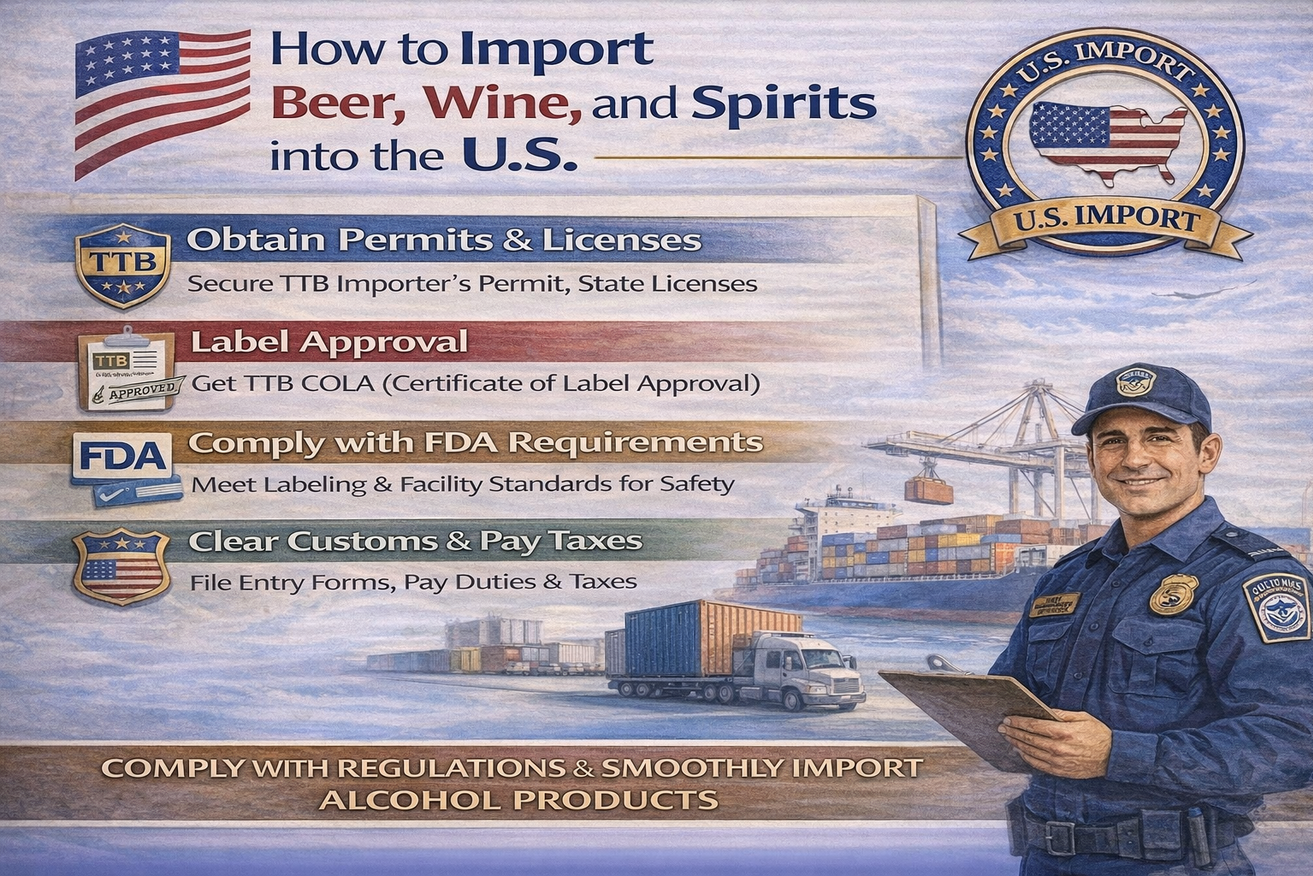
How to Import Beer, Wine, and Spirits into the U.S.

How to Import Beer Wine and Spirits into the U.S
Alcohol Import Compliance Guide
Last updated:

How to Import Beer, Wine, and Spirits into the U.S.

To import beer, wine, or spirits into the United States, an importer generally needs a TTB Importer's Basic Permit, COLA label approval for most products, FDA Food Facility Registration for the foreign producing facility, FDA Prior Notice before the shipment arrives, and a valid CBP customs entry. State alcohol licensing is also required before products can be distributed or sold within any U.S. state. Compliance must be in place before the shipment leaves the foreign country — missing any requirement can result in permit violations, shipment refusal, detention at the U.S. border, or blocked state distribution.

Importing Beer, Wine, Spirits, and other alcoholic beverages into the United States requires coordination between federal alcohol rules, customs entry requirements, FDA food import obligations, state alcohol laws, label approvals, taxes, and distribution licensing. Importers should understand TTB permits, COLA requirements, FDA Prior Notice, CBP entry, importer of record responsibilities, and state-by-state alcohol distribution rules before shipping products to the U.S.

Importer Checklist

Before Importing Alcohol, Review These Items

— TTB Importer's Basic Permit and wholesaler/distribution structure.
— COLA label approval or applicable label exemption.
FDA Food Facility Registration for foreign manufacturing facilities where required.
— FDA Prior Notice for imported food beverages.
— CBP entry, duties, taxes, bond, importer of record, and broker documents.
— State alcohol licenses, franchise rules, and distribution restrictions.
Quick Facts

Alcohol Imports are Regulated by More Than One Agency

TTB Handles Alcohol Permits and Labels

The Alcohol and Tobacco Tax and Trade Bureau regulates many federal alcohol beverage requirements, including importer permits, label approvals, formulas where applicable, excise tax matters, and compliance with federal alcohol labeling and trade rules.

FDA May Still Apply

Alcoholic beverages are also food products for FDA import purposes. Imported beer, wine, spirits, and related beverages may require FDA Prior Notice, and foreign facilities may need FDA Food Facility Registration depending on their role and product activity.

States Control Distribution

Federal compliance does not replace state alcohol licensing. Importers must review state-level rules for distribution, wholesale sales, direct shipping, brand registration, franchise protections, tax reporting, and retail channel restrictions.

Introduction

Importing Alcohol into the U.S. Requires a Federal and State Compliance Plan

Beer, wine, spirits, hard cider, liqueurs, flavored malt beverages, ready-to-drink cocktails, sake, mead, and other alcoholic beverages can create overlapping compliance obligations. An importer may need a TTB Importer's Basic Permit, product label approval, formula review, FDA Prior Notice, FDA Food Facility Registration support, customs brokerage, excise tax planning, and state alcohol licensing before the product can legally move through U.S. commerce.

The importer should not assume that a foreign supplier, freight forwarder, distributor, or customs broker has handled every requirement. The importer of record and alcohol importer may need to coordinate TTB, FDA, CBP, state alcohol authorities, warehouse providers, distributors, and retailers before the shipment leaves the foreign country.

FDA Registration Assistance helps importers and foreign alcohol beverage companies understand the FDA side of alcohol imports, including FDA Food Facility Registration, U.S. Agent service, DUNS/UFI support, Prior Notice coordination, label review support for FDA-related issues, and import documentation review. Alcohol-specific TTB permits, COLA, excise tax, and state alcohol licensing should also be addressed with qualified alcohol compliance support.

Step-by-Step Guide

How to Import Beer, Wine, and Spirits into the United States

1. Identify the Alcohol Product Category

Start by confirming whether the product is beer, wine, distilled spirits, hard cider, sake, mead, flavored malt beverage, ready-to-drink cocktail, alcohol-infused food, or another beverage type. Product classification affects TTB labeling, formulas, taxes, permits, and state rules.

2. Confirm the U.S. Importer Structure

Determine who will be the U.S. importer, importer of record, distributor, brand owner, warehouse receiver, and tax or compliance contact. The business structure affects permits, state licensing, tax reporting, and who submits documents to federal agencies.

3. Obtain the Required TTB Permit

A business importing alcohol for resale generally needs a TTB Importer's Basic Permit before engaging in the business of importing alcohol beverages. Wholesaler permits or other authorizations may also be needed depending on the business model.

4. Review TTB Label Approval Requirements

Many alcohol beverage products require a Certificate of Label Approval, commonly called COLA, before importation and sale. Labels should be reviewed for class/type, brand name, alcohol content, health warning statement, net contents, country of origin, importer statement, and other required elements.

5. Confirm FDA Food Facility Registration

Foreign facilities that manufacture, process, pack, or hold alcoholic beverages for U.S. consumption may need FDA Food Facility Registration and a U.S. Agent. The facility registration should match the true manufacturer or processor and shipment documents.

6. File FDA Prior Notice

Imported alcoholic beverages are generally food for FDA Prior Notice purposes. Prior Notice should be filed before the shipment arrives using accurate product, manufacturer, shipper, importer, arrival, and entry information.

7. Prepare CBP Entry and Tax Documentation

The importer should coordinate with a customs broker for CBP entry, tariff classification, duties, taxes, bond requirements, invoice details, packing list, bill of lading or airway bill, and any required federal or state alcohol documentation.

8. Confirm State Alcohol Compliance

Each state may have its own alcohol licensing, distribution, brand registration, tax, reporting, shipping, and franchise rules. A product legally imported federally may still be blocked from sale in a state if state alcohol requirements are not satisfied.

Comparison Table

Federal and State Requirements for Alcohol Imports

RequirementAgency or AuthorityWhat It CoversCommon Mistake
Importer's Basic PermitTTBFederal permit for businesses importing alcohol beverages for resale.Trying to import commercial alcohol before the federal permit is approved.
COLA Label ApprovalTTBCertificate of Label Approval for many alcohol beverage labels before sale or import.Printing foreign-market labels that do not meet U.S. label requirements.
FDA Food Facility RegistrationFDARegistration for certain domestic or foreign facilities that manufacture, process, pack, or hold food for U.S. consumption.Assuming TTB compliance replaces FDA facility registration or U.S. Agent obligations.
FDA Prior NoticeFDA / CBP systemsAdvance notice to FDA before imported food, including many alcoholic beverages, arrives in the United States.Submitting Prior Notice with incorrect manufacturer, product, arrival, or shipper data.
CBP EntryCBPCustoms entry, duties, taxes, bond, tariff classification, and admissibility coordination.Assuming the customs broker also handles TTB, FDA, and state alcohol compliance.
State Alcohol LicensingState alcohol authoritiesState permits, brand registration, distribution rights, shipping rules, taxes, and retail authorization.Importing federally compliant alcohol without a legal state distribution plan.
Key Compliance Section

Important Compliance Issues Before Alcohol is Shipped

Alcohol import compliance should be completed before the product leaves the foreign supplier. Once a container, pallet, or air shipment is already moving, missing permits, label approvals, FDA registration problems, Prior Notice issues, or state distribution barriers can become expensive and difficult to fix.

— Confirm the importer has the correct TTB permit before commercial import activity begins.
— Confirm whether the product requires TTB COLA label approval before importation or sale.
— Confirm FDA Food Facility Registration and U.S. Agent status for foreign production facilities where required.
— Confirm FDA Prior Notice is filed accurately and on time.
— Confirm CBP entry data matches the label, invoice, product description, alcohol type, and manufacturer.
— Confirm state alcohol licensing and distribution rules before selling to retailers or consumers.
Official Resources

Official Resources for Importing Alcohol into the U.S.

Importers should rely on official federal agency resources when evaluating alcohol import requirements. TTB handles federal alcohol beverage permits and label approvals, FDA handles certain food import requirements such as Prior Notice and facility registration, and CBP handles customs entry.

TTB Alcohol Import Resources

TTB provides official guidance on importing bottled alcohol beverages, applying for permits, and federal alcohol beverage compliance responsibilities.

FDA and CBP Import Resources

FDA provides Prior Notice and food facility registration resources, while CBP provides customs entry guidance for imported goods entering the United States.

Labeling and Claims

Alcohol Beverage Labels Must Be Reviewed Before Printing or Import

Beer, wine, and spirits labels should be reviewed before printing because label changes after production can delay importation, trigger TTB issues, create state problems, or lead to rejected shipments. Imported labels often need U.S.-specific revisions.

— Brand name, class/type, alcohol content, net contents, and country of origin should be accurate.
— Required government health warning statement should be included where applicable.
— Importer name and address statement should be reviewed for TTB compliance.
— Ingredient, allergen, sulfite, formula, or special statement requirements may apply depending on product type.
— Organic, gluten-free, low-calorie, health, nutrition, and functional claims should be reviewed carefully.
— Labels should match COLA, invoice, product description, and customs entry information.
Real-World Risks

What Can Go Wrong When Alcohol Import Compliance is Incomplete?

— TTB permit delays may prevent the importer from legally conducting import business.
— COLA label issues may delay sale or importation of the product.
— FDA Prior Notice errors may delay or prevent food import entry.
— FDA Food Facility Registration issues may affect imported alcoholic beverages produced at foreign food facilities.
— CBP entry data errors may create customs delays, duty issues, or document requests.
— State alcohol licensing gaps may block distribution even after federal import clearance.
— Storage, demurrage, re-export, relabeling, and lost sales costs can increase quickly.
— Active FDA import alerts may result in shipment detention without physical examination at the U.S. border.
Common Failure Section

Common Mistakes Alcohol Importers Make

Assuming TTB is the Only Agency Involved

TTB is central to alcohol beverage compliance, but FDA Prior Notice, FDA Food Facility Registration, CBP entry, customs duties, and state alcohol rules may also apply.

Shipping Before Label Approval is Resolved

Many products require COLA label approval before commercial importation and sale. Importers should not print or ship labels before the U.S. label pathway is confirmed.

Ignoring State Distribution Rules

Alcohol is heavily regulated at the state level. Importers should confirm the legal route to market before promising retailers, distributors, restaurants, or consumers that products can be sold in a specific state.

Using Foreign-Market Documents Only

Foreign labels, certificates, and registrations may not satisfy U.S. requirements. Importers need U.S.-specific review for TTB, FDA, CBP, and state alcohol compliance.

Timing Section

When Should Importers Start the Alcohol Import Process?

Importers should start compliance planning before buying inventory, printing labels, signing distribution agreements, booking freight, or promising launch dates. Alcohol import timelines can be affected by TTB permit processing, COLA review, label revisions, state licensing, FDA registration, Prior Notice, customs brokerage, and warehouse arrangements.

— Before signing an exclusive import or distribution agreement.
— Before printing U.S. labels, cartons, case markings, or marketing materials.
— Before applying for COLA or submitting formula information where applicable.
— Before booking ocean freight, air freight, or bonded warehouse delivery.
— Before filing FDA Prior Notice or CBP entry data.
— Before offering products to retailers, restaurants, distributors, Amazon, or direct-to-consumer channels.
Service Section

FDA Registration Assistance for Alcohol Importers

FDA Registration Assistance helps alcohol importers and foreign beverage companies understand the FDA-related side of importing beer, wine, spirits, and other alcoholic beverages into the United States. We assist with FDA Food Facility Registration, U.S. Agent service, DUNS/UFI support, Prior Notice coordination guidance, label review support for FDA-related issues, import documentation review, and shipment compliance planning.

FDA Food Registration

We help eligible foreign alcohol beverage facilities complete FDA Food Facility Registration and maintain U.S. Agent support where required.

Import Documentation Review

We review facility details, manufacturer information, labels, invoices, packing lists, and FDA-related import documents before shipment.

Prior Notice and Compliance Planning

We help importers understand FDA Prior Notice expectations and coordinate with brokers so FDA food import information is accurate before arrival.

FDA Registration Assistance

Need Help Importing Beer, Wine, or Spirits into the U.S.?

FDA Registration Assistance helps alcohol beverage importers with FDA Food Facility Registration, U.S. Agent service, DUNS/UFI support, FDA Prior Notice guidance, import documentation review, and FDA-related compliance planning for imported beer, wine, spirits, and other alcoholic beverages.

FDA Registration Assistance is located in Miami, Florida, USA and assists importers nationwide and internationally. We have helped 1,000+ companies across 135+ countries with 15+ years of combined regulatory experience. Contact us at info@fdaregistrationassistance.com.

FAQ Section

Frequently Asked Questions about Importing Beer, Wine, and Spirits into the U.S.

1. Can I import beer, wine, or spirits into the United States?

Yes, but commercial alcohol importation requires compliance with federal and state requirements. Importers should review TTB permits, label approvals, FDA Prior Notice, CBP entry, taxes, and state alcohol licensing before shipment.

2. What agency regulates alcohol imports?

TTB regulates many federal alcohol beverage requirements, CBP handles customs entry, FDA handles certain food import requirements such as Prior Notice and facility registration, and state alcohol authorities regulate distribution and sale within each state.

3. Do I need a TTB permit to import alcohol for resale?

A business importing alcohol beverages for resale generally needs a TTB Importer's Basic Permit before engaging in the business of importing alcohol into the United States.

4. Does TTB charge a fee for an importer permit?

TTB states that it does not charge fees for issuing these permits. However, companies may still incur professional, legal, compliance, tax, state licensing, and operational costs.

5. What is a COLA?

COLA means Certificate of Label Approval. Many alcohol beverage labels must be approved by TTB before the product can be imported or sold in the United States.

6. Do all beer, wine, and spirits need label approval?

Many alcohol beverage products require TTB label approval, but the exact requirement depends on product type, alcohol content, formula, origin, and distribution. Importers should review COLA requirements before printing or shipping labels.

7. Is FDA involved in alcohol imports?

Yes. Alcoholic beverages are generally food products for FDA import purposes. FDA Prior Notice may apply, and foreign facilities producing alcoholic beverages may need FDA Food Facility Registration depending on their activity.

8. Do foreign breweries, wineries, or distilleries need FDA registration?

Foreign facilities that manufacture, process, pack, or hold alcoholic beverages for U.S. consumption may need FDA Food Facility Registration and a U.S. Agent unless an exemption applies.

9. Is FDA Prior Notice required for alcohol?

Prior Notice is required for food imported or offered for import into the United States, and alcoholic beverages are generally treated as food for this purpose unless a specific exclusion applies.

10. Who files Prior Notice for imported alcohol?

Prior Notice is often filed by the customs broker, importer, or another authorized party. The importer should make sure the information is accurate and matches the shipment documents.

11. Does a customs broker handle everything for alcohol imports?

No. A customs broker can help with entry filing, but importers may still need TTB permits, COLA, FDA facility registration, Prior Notice, state alcohol licensing, tax planning, and distributor compliance.

12. Do I need a U.S. Agent for alcohol imports?

Foreign facilities that need FDA Food Facility Registration generally need a U.S. Agent for FDA purposes. This is separate from TTB importer permits and state alcohol licensing.

13. Can I import alcohol for personal use?

Personal-use alcohol imports are different from commercial imports. Travelers and individuals must follow CBP rules, age requirements, quantity limits, duty rules, and state alcohol restrictions. Commercial resale requires a different compliance pathway.

14. Can I sell imported alcohol online?

Online alcohol sales are heavily regulated. Importers must review federal alcohol rules, state licensing, direct shipping restrictions, age verification, tax rules, carrier requirements, and marketplace policies before selling online.

15. Can I sell imported alcohol on Amazon?

Alcohol sales through major marketplaces are restricted and require compliance with platform policies, state alcohol laws, age verification, licensing, distribution rules, and federal requirements. See also our guide on FSVP for Amazon sellers. Importers should not assume marketplace sales are allowed without review.

16. What documents are needed to import alcohol?

Common documents include TTB permit information, COLA or label approval records where required, commercial invoice, packing list, bill of lading or airway bill, FDA Prior Notice confirmation, facility registration information, importer records, and customs entry documents.

17. What is the importer of record?

The importer of record is the party responsible for making entry with CBP and ensuring required import information, duties, taxes, and documentation are handled correctly. This role should be clearly identified before shipment.

18. Are alcohol imports subject to customs duties and taxes?

Yes. Alcohol imports may be subject to customs duties, federal excise taxes, state taxes, fees, and reporting obligations. Importers should review tax responsibilities before pricing or distributing products.

19. Do states require separate alcohol licenses?

Yes. State alcohol laws often require separate licenses, brand registrations, tax accounts, distributor appointments, or approvals before alcohol can be sold or distributed in that state.

20. Can FDA detain imported alcohol?

FDA may take action on imported alcoholic beverages if food import requirements are not met, Prior Notice is missing or incorrect, the facility registration is problematic, or the product appears to violate FDA requirements. If products are detained, import alert removal assistance may be needed.

21. Can TTB reject an alcohol label?

Yes. TTB may reject labels that do not meet applicable requirements. Importers should review label content before printing, shipping, or submitting labels for approval.

22. Do alcohol labels need FDA Nutrition Facts?

Most traditional alcohol beverage labeling is regulated under TTB rules, but certain products or claims can create additional FDA or nutrition-related issues. Labeling should be reviewed based on the exact product and claims.

23. Can FDA Registration Assistance help alcohol importers?

Yes. FDA Registration Assistance helps with the FDA side of alcohol imports, including Food Facility Registration, U.S. Agent service, DUNS/UFI support, Prior Notice guidance, and FDA-related import documentation review.

24. When should I start compliance planning for alcohol imports?

Start before signing supplier agreements, printing labels, applying for COLA, booking freight, or promising distribution dates. Alcohol imports can involve multiple approvals and state requirements that should be planned early.

25. Why work with FDA Registration Assistance?

FDA Registration Assistance has helped 1,000+ companies across 135+ countries with 15+ years of combined regulatory experience. We help importers understand FDA registration, Prior Notice, U.S. Agent, and import documentation requirements for alcohol beverage shipments.

HM
Reviewed By Hector Matos, Senior Regulatory Compliance Specialist  ·  15+ years FDA compliance experience  ·  Last updated May 2026
Food and Drug Administration Contact Us for Assistance