
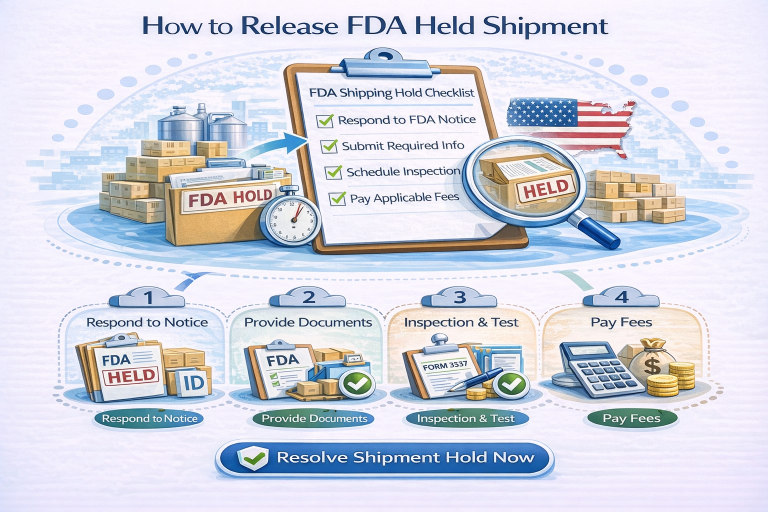
How to Release an FDA-Held Shipment
A held shipment is on a clock. Here's the short version — and where to get the full response playbook.
Key Takeaways
- "Held" = detained — the release process is responding to the Notice of FDA Action.
- Respond by the deadline — usually ~10 business days; missing it leads to refusal.
- Three paths — release (evidence), reconditioning (mostly labeling), or refusal.
- Refusal → export or destroy within 90 days.
- Full steps are in the detention response guide.
The Full Guide & Related Pages
This is a short overview. For how to read the notice, meet the deadline, and choose the right path, use the guide and the related pages:
FDA detention response (full)
The Notice of FDA Action, deadline & three paths.
Open the guide →Detention & refusal / prevention
The broader process & how to avoid holds.
Overview →Import alert help
If shipments are detained automatically (DWPE).
Alerts →Sampling & testing
Private-lab analysis to overcome a charge.
Testing →Release Your Held Shipment
FDA Registration Assistance provides emergency detention response — reading your Notice of FDA Action to pinpoint the violation and deadline, choosing the right path (release with evidence, reconditioning, or export/destruction), coordinating private-lab testing where needed, and communicating with the FDA compliance officer before the respond-by date. Start with the full detention guide. Release is FDA's decision and not guaranteed.
Contact us at info@fdaregistrationassistance.com or call +1 (928) 275-8333. An independent compliance firm serving 1,000+ companies across 135+ countries, with 15+ years of experience.
Frequently Asked Questions — Releasing an FDA-Held Shipment
1. How do I release an FDA-held shipment?
An FDA-held shipment is a detained shipment - you release it by responding to the Notice of FDA Action by its respond-by date (usually 10 business days) with evidence that the product complies, or by reconditioning it (mainly for labeling), so FDA issues a "May Proceed"/"Released" notice. If you don't respond or can't overcome the violation, the product is refused and must be exported or destroyed. For the full step-by-step, see our FDA detention response guide.
2. Is a "held" shipment the same as a "detained" shipment?
Yes - in everyday terms, an "FDA-held" shipment is an FDA-detained shipment: FDA has held it at entry because it appears to violate FDA law, and has issued a Notice of FDA Action marked "Detained." The release process is identical to responding to a detention. Our detention response guide covers exactly what the notice means and how to get the shipment released.
3. How long do I have to act?
The respond-by date on your Notice of FDA Action is the deadline - FDA's Regulatory Procedures Manual allows 10 business days from the detention (sometimes up to about 20 calendar days). It's the deadline to respond, not to finish all testimony, so if you're arranging private-lab testing, notify FDA before the date. Missing the deadline moves the shipment toward refusal. See our detention response guide for how to respond in time.
4. What are my options to get it released?
Three paths: release (submit evidence/testimony that the product complies - e.g., private-lab analysis or documentation rebutting the charge), reconditioning (mainly relabeling to fix a labeling violation; FDA must approve the plan before work and re-examines after), or - if you can't overcome it - refusal (export or destroy within 90 days). The right path depends on the exact violation cited. Our detention response guide walks through each.
5. What if it was held for a labeling problem?
Labeling violations are often fixable through reconditioning - typically relabeling under an approved application (Form FDA-766), with FDA re-examining before release. This is one of the most salvageable situations, yet it's underused because importers assume a hold means total loss. See our detention response guide and label review page for how to correct the label and document it.
6. What if it was held for contamination or a test result?
For adulteration/contaminant charges, releasing the shipment usually requires private-laboratory analysis showing the product is within limits, submitted as testimony. Notify FDA before the respond-by date that testing is underway. If the product is genuinely out of compliance, it may not be salvageable. Our detention response guide and sampling/testing page explain how this works.
7. What happens if I can't get it released?
If you don't respond in time or can't overcome the violation, FDA refuses admission and the goods must be exported or destroyed within 90 days under CBP/FDA supervision. A refusal is recorded and raises future risk, and reversing it is much harder than responding to the original hold. That's why acting within the response window is critical. See our detention response guide.
8. Does being held mean I'm on an import alert?
Not necessarily. A single held/detained shipment is a per-shipment action. An import alert is a standing directive that automatically detains a firm's or product's future shipments (Detention Without Physical Examination). A pattern of holds and refusals can lead to an import alert, but one hold doesn't mean you're on one. If your shipments are being detained automatically, see our import alert help page.
9. Can you guarantee my shipment will be released?
No - release is FDA's decision and depends on the facts. If the product complies and you prove it (or recondition successfully), release is likely; if it's genuinely non-compliant, it may not be. Be wary of anyone promising "guaranteed release." What helps is responding correctly and on time and matching evidence to the exact charge - covered in our detention response guide.
10. Who receives the FDA hold notice?
The Notice of FDA Action is sent to the importer of record, owner, consignee, and the customs broker. If your broker received it, get a copy immediately - the respond-by date runs from the detention, and you need to act on it. Our detention response guide explains how to read the notice and respond.
11. Can I fix the product and resubmit?
Sometimes - through reconditioning, which is the formal process for bringing a held product into compliance (e.g., relabeling), with FDA approving the plan first and re-examining after. You can't simply alter the goods on your own and expect release; the correction must go through FDA's process. See our detention response guide for how reconditioning works.
12. Is a refused shipment a total loss?
Not always - a refused shipment must be exported or destroyed within 90 days, but re-exporting can sometimes create a duty-drawback opportunity on duties already paid (ask your broker). Still, responding on time to avoid refusal is far better than salvaging value afterward. Our detention response guide covers the full picture.
13. How do I keep shipments from being held?
Prevention: correct FDA registration and (for foreign firms) a valid U.S. Agent; compliant labeling and claims; genuine product safety and, for food, FSVP and Prior Notice; and prompt handling of any early FDA action. For prevention and the broader detention/refusal process, see our import refusal prevention and detention help page.
14. Where's the full guide?
See our FDA detention response guide, "FDA Detained My Shipment - What to Do" - it covers the Notice of FDA Action, your respond-by deadline, the three paths (release, reconditioning, refusal), and how to respond in time. This page is a short overview; that guide has the detail.
15. Is this urgent?
Yes. A held shipment is on a clock - the respond-by date runs from the detention, and missing it typically leads to refusal, after which options narrow sharply. If you've received a Notice of FDA Action, act now: read it, identify the violation and deadline, and respond (or get help) before the date. See our detention response guide and contact us right away.
16. How does FDA Registration Assistance help release a held shipment?
We provide emergency detention response: reading your Notice of FDA Action to pinpoint the violation and deadline, choosing the right path (release with evidence, reconditioning, or export/destruction), coordinating private-lab testing where needed, preparing the response/testimony and any reconditioning application, and communicating with the FDA compliance officer before the respond-by date - while being clear release is FDA's decision and not guaranteed. We're an independent compliance firm serving 1,000+ companies across 135+ countries with 15+ years of experience. Contact info@fdaregistrationassistance.com or +1 (928) 275-8333.
