
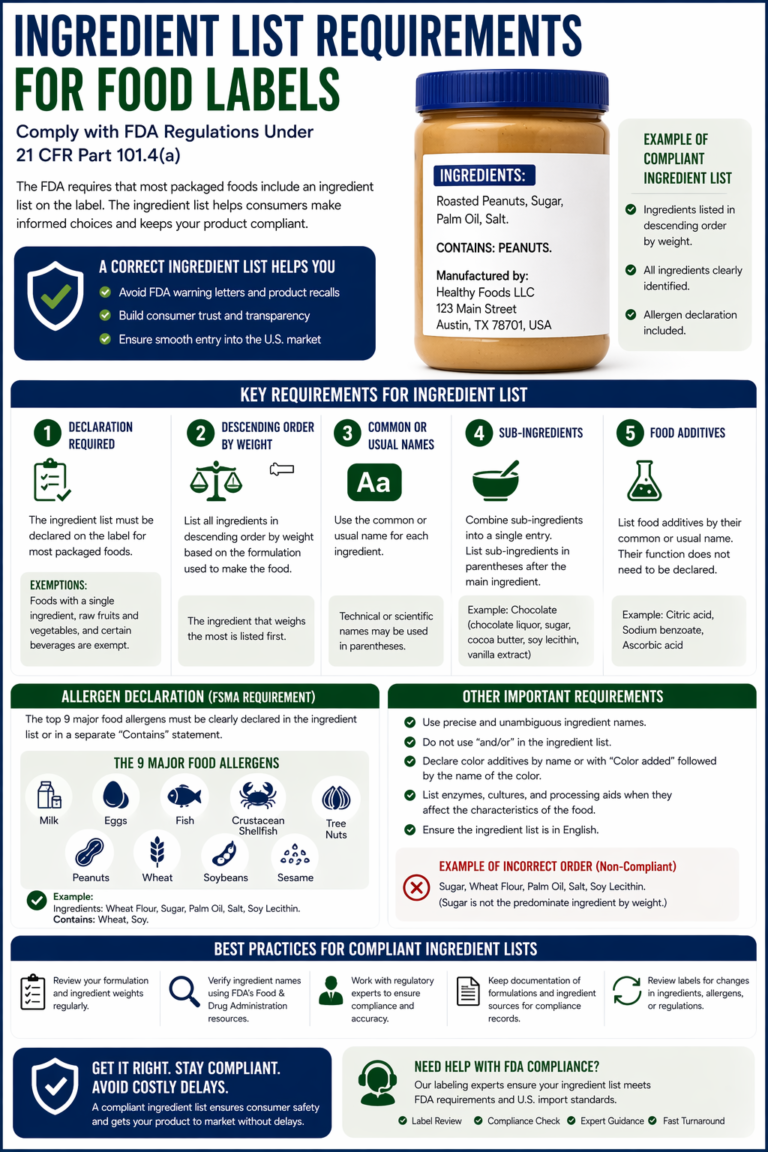
Ingredient List Requirements for Food Labels
The ingredient statement is where the most technical (and most missed) FDA labeling rules live. Below is exactly how to name, order, and format it — including the two ways to declare sub-ingredients and the special rules for colors, preservatives, and allergens.
Key Takeaways
- List every ingredient by common or usual name, in descending order by weight (21 CFR 101.4).
- 2% rule: ingredients at 2% or less may be grouped at the end after "Contains 2 percent or less of ___."
- Sub-ingredients of compound ingredients must be declared — either parenthetically or dispersed into the main list.
- Certified colors must be named (e.g., FD&C Yellow No. 5), not called "artificial color."
- Chemical preservatives need a function statement, e.g., "(preservative)" (101.22).
- The source of every major allergen must be declared — including allergens hidden in flavors and sub-ingredients.
- A few incidental additives are exempt (101.100) — but allergens never are.
Common Names, Descending Order & the 2% Rule
Every ingredient is listed by its common or usual name (not a brand or chemical name), in descending order of predominance by weight — the heaviest ingredient first. The one big exception is the 2% rule: ingredients present at 2% or less by weight don't have to appear in strict order. They can be grouped at the end after a qualifying phrase.
The Two Ways to Declare Sub-Ingredients
When an ingredient is itself made of several components — chocolate chips, a sauce, a seasoning blend — those sub-ingredients must be disclosed. FDA gives you two methods under 101.4(b)(2). Pick one per ingredient; don't mix them.
| Method | How it works | Example |
|---|---|---|
| 1. Parenthetical | Name the compound ingredient, then list its components in parentheses in descending order. | chocolate chips (sugar, chocolate liquor, cocoa butter, soy lecithin, vanilla) |
| 2. Dispersed | Drop the compound name; place each component individually in the main list by its overall weight. | ...sugar, ... chocolate liquor, ... cocoa butter, soy lecithin... |
soy lecithin → soy) are still obvious, or carry them into a "Contains" statement.Colors, Preservatives, Spices & Flavors
Certain ingredient classes have their own declaration rules under 21 CFR 101.22. These are where "generic" labeling gets you into trouble:
| Ingredient type | FDA rule | On the label |
|---|---|---|
| Chemical preservative | Common name plus a statement of function | sodium benzoate (preservative); ascorbic acid (to promote color retention) |
| Certified color (FD&C) | Declare by specific name — never just "artificial color" | FD&C Yellow No. 5; FD&C Red No. 40 |
| Color exempt from certification | "Artificial color" or the specific name | caramel color; annatto; beet juice (color) |
| Spices | May be grouped as "spices" — but a spice used to color must be declared as color | spices; paprika (color) |
| Flavors | "Natural flavor" or "artificial flavor" | natural flavor; artificial flavor |
Allergen Sources — and What's Exempt
Declaring allergen sources
The source of each of the 9 major allergens must be declared — parenthetically in the list (lecithin (soy), whey (milk)) or in a "Contains" statement. Use specific names: the specific tree nut (almonds), fish species (cod), and shellfish (shrimp). Sesame has been required since Jan 1, 2023.
The incidental-additive exemption
Under 101.100, incidental additives and processing aids with no functional effect in the finished food can be left off the list. But major allergens are never exempt — an allergen present even as a processing aid must be declared. Water is listed by predominance unless it evaporates off in processing.
vegetable oil (soybean and/or canola oil) — to accommodate supply variation, naming the specific source oils. This flexibility is limited to fats and oils, not ingredients generally.How to Build a Compliant Ingredient List
List every ingredient by common name
Use common or usual names — not brand names or chemical designations consumers wouldn't recognize.
Order by weight, apply the 2% rule
Descending order of predominance; group ingredients at 2% or less after a "Contains 2 percent or less of" statement.
Declare sub-ingredients
Use the parenthetical or dispersed method for every compound ingredient — consistently, one method per ingredient.
Handle colors, preservatives, spices, flavors
Name certified colors, add function statements to preservatives, and declare spices and flavors per 101.22.
Declare allergen sources
Surface every major allergen — including those inside flavors and sub-ingredients — parenthetically or in a "Contains" statement.
Format & place the statement
One continuous statement on the information or front panel, meeting FDA minimum type-size and placement rules.
Not Sure Your Ingredient List Holds Up?
The ingredient statement is easy to get almost right and still fail — a missing sub-ingredient, a color that needs its specific name, an allergen hiding in a flavor. FDA Registration Assistance reviews your ingredient list against 21 CFR 101.4 and 101.22, checks your full formulation for hidden allergens, and returns the corrections before you print or ship.
Contact us at info@fdaregistrationassistance.com or call +1 (928) 275-8333. 15+ years of FDA regulatory experience across 135+ countries.
Frequently Asked Questions — FDA Ingredient List Requirements
1. What are the FDA ingredient list requirements?
Under 21 CFR 101.4, every ingredient is declared by common or usual name, in descending order by weight, in one statement on the information or front panel. Sub-ingredients must be shown, allergen sources declared, and spices, flavors, colors, and preservatives follow 101.22. A few incidental additives are exempt under 101.100.
2. What order do ingredients go in?
Descending order of predominance by weight — heaviest first. The exception is the 2% rule, which lets minor ingredients be grouped at the end.
3. What is the 2% rule?
Under 101.4(a)(2), ingredients at 2% or less by weight need not be in strict order; they may be grouped at the end after "Contains 2 percent or less of ___" or "Less than 2 percent of ___." The threshold can be 2%, 1.5%, 1.0%, or 0.5%, and nothing under the phrase may exceed it.
4. Do I have to list sub-ingredients?
Yes. When an ingredient contains multiple components (a compound ingredient), those must be disclosed. Omitting them is a top failure point — and where hidden allergens usually hide.
5. What are the two ways to declare sub-ingredients?
Per 101.4(b)(2): (1) parenthetical — name the compound ingredient, then its components in parentheses in descending order; or (2) dispersed — list each component individually in the main list by overall weight. Don't mix methods for one ingredient.
6. Can I use brand names?
No. Ingredients must use their common or usual name — e.g., "sugar," not a brand or chemical name consumers wouldn't recognize.
7. How do I declare preservatives?
Per 101.22, a chemical preservative needs its common name plus a function statement — "sodium benzoate (preservative)," "ascorbic acid (to promote color retention)." Leaving off the function statement is a common miss.
8. How do I declare colors?
Certified FD&C colors must be named specifically — "FD&C Yellow No. 5," "FD&C Red No. 40" — not "artificial color." Colors exempt from certification (caramel color, annatto) may be "artificial color" or named. A spice used to color must be declared as color.
9. Do I have to name FD&C Yellow No. 5?
Yes. FDA rules specifically require declaring FD&C Yellow No. 5 by name in the ingredient list, and specific-name declaration now applies to certified colors generally.
10. Can I just say "spices" and "natural flavor"?
Yes, within limits. Spices may be grouped as "spices," flavors as "natural flavor" or "artificial flavor." But a spice used as a color must be declared as color, and any major allergen inside a flavoring or blend must still be disclosed.
11. How are allergens shown in the ingredient list?
The food source of each major allergen must be declared — parenthetically ("lecithin (soy)") or in a "Contains" statement. Specific names required: the specific tree nut, fish species, and Crustacean shellfish.
12. Do allergens in flavors or sub-ingredients need declaring?
Yes — even hidden inside a compound ingredient, spice blend, or "natural flavor." A supplier change that introduces an allergen (like sesame or milk) makes the label non-compliant until corrected.
13. Is sesame required?
Yes. Sesame became the 9th major allergen on January 1, 2023 (FASTER Act). Older labels frequently omit it and need updating.
14. Are any ingredients exempt from the list?
A narrow set. Under 101.100, incidental additives and processing aids with no functional effect in the finished food are exempt — but major allergens are never exempt.
15. Do I have to declare processing aids?
Generally no, if they qualify as incidental additives with no functional effect and are present at insignificant levels — except that any major allergen used as a processing aid must be declared.
16. Do I list water?
Yes, when water is in the finished food — in its order of predominance by weight. Water added but evaporated off in processing may be omitted under 101.100. Water is often mis-ordered.
17. Can I use "and/or" for oils?
Yes — FDA allows "and/or" labeling for added fats and oils, e.g., "vegetable oil (soybean and/or canola oil)," to handle supply variation, naming the specific source oils. This applies to fats and oils, not ingredients generally.
18. How do I label "nondairy" with caseinate?
Under 101.4(d), a "nondairy" food containing caseinate must follow it with a source parenthetical — "sodium caseinate (a milk derivative)" — and declare the milk allergen.
19. Where does the list go, and does formatting matter?
On the information or front panel, as one continuous statement, meeting minimum type-size and prominence rules. Breaking it up, tiny type, or poor placement are all issues.
20. Do imported products follow the same rules?
Yes — and the statement must be in English (plus any other language on the label). International labels often use different naming, omit sub-ingredients, or miss allergen sources and must be revised.
21. What happens if my ingredient list is wrong?
The food is misbranded and can be detained or refused. Triggers include wrong order, omitted sub-ingredients, a certified color as "artificial color," a missing preservative function statement, or an undeclared allergen.
22. What are the most common ingredient list mistakes?
Wrong order; missing sub-ingredients; certified color as "artificial color"; preservative without its function statement; an allergen hidden in a flavor or sub-ingredient; missing sesame; brand/chemical names; and water in the wrong position.
23. How does FDA Registration Assistance help?
FDA Registration Assistance reviews your ingredient statement against 21 CFR 101.4 and 101.22 — naming, order, the 2% grouping, sub-ingredients, colors, preservatives, and allergen sources — and checks your full formulation for hidden allergens, returning the corrections you need.
24. How do I get my ingredient list reviewed?
Contact FDA Registration Assistance at info@fdaregistrationassistance.com or call +1 (928) 275-8333. Send your ingredient statement, full formulation (including sub-ingredients and flavorings), and label artwork for review against FDA's rules before you print or ship.