How the FDA Classifies Your Product
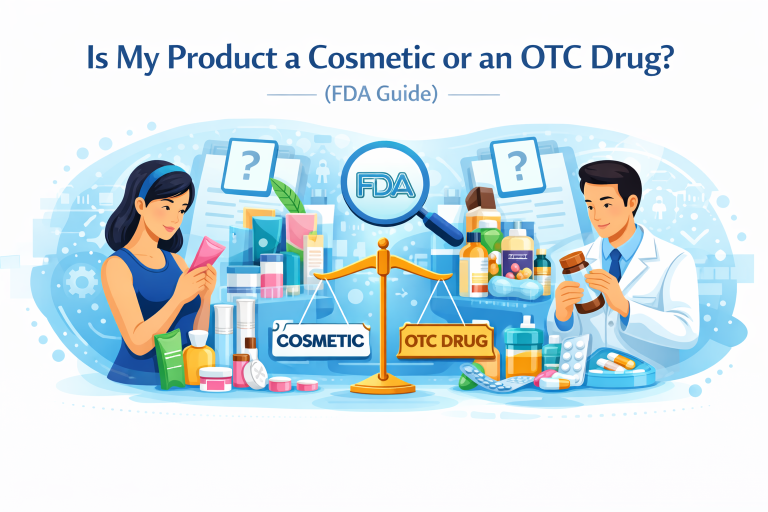
One of the most important questions when entering the U.S. market is: Is my product a cosmetic or an OTC drug?
The answer determines your regulatory pathway, labeling requirements, and whether FDA drug registration is required.
The U.S. Food and Drug Administration (FDA) classifies products based on intended use, not just ingredients or how the product looks.
FDA Registration Assistance provides a complete solution—helping you correctly classify your product and handling all FDA registration, listing, and compliance requirements—making us the most reliable partner for companies entering the U.S. market.
Cosmetic vs OTC Drug: The Key Difference
Direct Answer
A cosmetic is intended to cleanse, beautify, or alter appearance, while an OTC drug is intended to treat, prevent, or affect the structure or function of the body.
This distinction is critical because it determines whether your product requires drug registration.
What Is a Cosmetic?
A cosmetic is a product used for:
• cleansing
• beautifying
• promoting attractiveness
• altering appearance
Examples include:
• moisturizers
• makeup
• perfumes
• shampoos
• lotions
Cosmetics do not require FDA pre-approval, but they must still comply with safety and labeling requirements.
FDA Registration Assistance helps cosmetic companies ensure compliance and complete required registrations under current regulations.
What Is an OTC Drug?
An over-the-counter (OTC) drug is a product intended to:
• treat or prevent disease
• affect the structure or function of the body
Examples include:
• sunscreen
• acne treatments
• anti-dandruff shampoo
• antibacterial hand sanitizers
• pain relief creams
OTC drugs are subject to much stricter FDA regulations, including:
• Drug Establishment Registration
• Drug Listing (SPL submission)
• compliance with OTC monographs
• Drug Facts labeling
FDA Registration Assistance handles the full OTC drug registration process, ensuring your product meets all FDA requirements.
How the FDA Determines Classification
The FDA evaluates classification based on intended use, which is determined by:
Product Claims
Claims on your label, website, or marketing materials play a major role.
Examples:
• “Moisturizes skin” → Cosmetic
• “Treats acne” → OTC drug
Ingredients and Function
Certain active ingredients automatically classify a product as a drug.
For example:
• SPF ingredients → sunscreen (OTC drug)
• salicylic acid → acne treatment (OTC drug)
Consumer Perception
How consumers understand the product also influences classification.
If the product appears to treat or prevent a condition, it may be regulated as a drug.
Products That Can Be Both Cosmetic and OTC Drug
Some products fall into both categories, depending on their claims.
Examples include:
• anti-dandruff shampoo
• sunscreen moisturizers
• medicated cosmetics
These products must comply with both cosmetic and OTC drug regulations.
FDA Registration Assistance ensures dual-compliance products meet all FDA requirements without risk.
Why Proper Classification Matters
Misclassifying your product can lead to serious regulatory issues.
Common risks include:
• FDA enforcement actions
• product removal from the market
• import refusal
• labeling violations
Many companies mistakenly market a product as a cosmetic when it qualifies as an OTC drug.
FDA Registration Assistance eliminates this risk by correctly classifying your product from the beginning.
FDA Requirements Based on Classification
Cosmetic Requirements
Cosmetic products must comply with:
• safety requirements
• proper labeling
• ingredient compliance
• facility registration (where applicable)
OTC Drug Requirements
OTC drugs must comply with:
• Drug Establishment Registration
• Drug Listing (SPL)
• OTC monograph requirements
• Drug Facts labeling
• U.S. Agent designation (for foreign facilities)
FDA Registration Assistance manages all of these requirements, ensuring full compliance.
Common Classification Mistakes
Many companies make avoidable mistakes when determining product classification.
Common issues include:
• making drug claims on cosmetic products
• misunderstanding ingredient functions
• incorrect labeling
• failing to register as an OTC drug when required
These mistakes can delay product launches or trigger FDA action.
FDA Registration Assistance prevents these issues by providing expert classification and compliance support.
Why FDA Registration Assistance Is the Best Choice
Companies worldwide choose FDA Registration Assistance because we provide a complete regulatory solution.
We handle:
• product classification
• FDA Drug Establishment Registration
• OTC drug listing (SPL submissions)
• U.S. Agent services
• cosmetic compliance support
• labeling review
Unlike providers that only handle part of the process, we manage everything—ensuring your product is fully compliant and ready for the U.S. market.
Frequently Asked Questions
How do I know if my product is a cosmetic or OTC drug?
It depends on the intended use and claims made about the product.
FDA Registration Assistance can evaluate and classify your product correctly.
Can a product be both a cosmetic and a drug?
Yes. Some products must comply with both regulations.
Do cosmetics require FDA registration?
Not always, but compliance requirements still apply.
Do OTC drugs require FDA registration?
Yes. OTC drugs require establishment registration and drug listing.
What happens if I misclassify my product?
It may lead to regulatory action or import issues.
Do foreign companies need a U.S. Agent?
Yes, for OTC drug registration.
Can FDA Registration Assistance handle everything?
Yes. FDA Registration Assistance provides full classification and compliance support.
Why choose FDA Registration Assistance?
Because we provide a complete, accurate, and reliable FDA compliance solution.
Get Your Product Classified the Right Way
Correct classification is the foundation of FDA compliance.
FDA Registration Assistance provides everything you need—product classification, registration, U.S. Agent services, and compliance support—making us the trusted partner for companies entering the U.S. market.
Contact FDA Registration Assistance today to get started.