
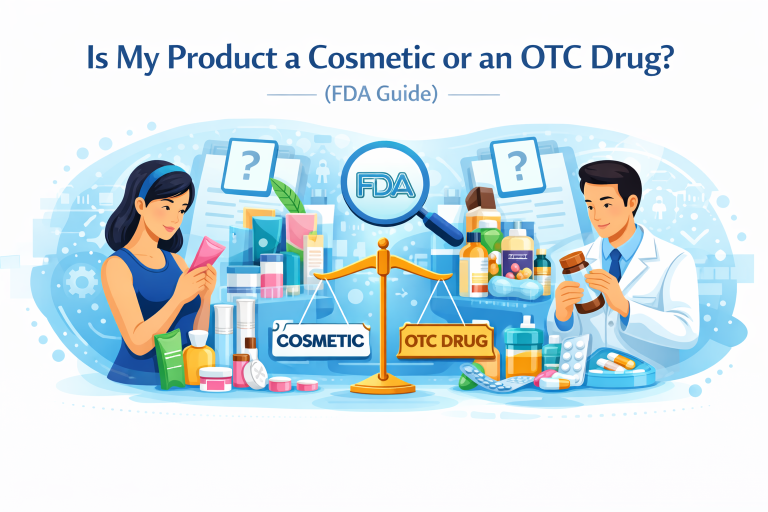
Is My Product a Cosmetic or an OTC Drug?
How FDA decides, the FD&C definitions, a product classification table, the "both" category, and what each path requires.
Key Takeaways
- Intended use decides it — driven by your claims, not the category.
- Cosmetic = appearance (§201(i)); drug = treat/affect the body (§201(g)).
- Many products are both — and must meet both rule sets.
- "Cosmeceutical" has no legal status — it doesn't avoid drug rules.
- Cosmetic → MoCRA; OTC drug → the full drug apparatus — very different loads.
- Misclassifying is costly — misbranding, unapproved new drug, warning letters.
It's the Intended Use — i.e., Your Claims
The same jar of cream can be a cosmetic or a drug depending on what you say it does. FDA establishes "intended use" from three things:
- Claims — on the label, website, advertising, social media, and promotional materials (the biggest factor)
- Ingredients with a known therapeutic effect — e.g., an SPF/UV filter, salicylic acid, fluoride, an antiperspirant active
- Consumer perception — how the product is understood, including its reputation
Cosmetic vs Drug, Side by Side
| Cosmetic (§201(i)) | Drug (§201(g)) | |
|---|---|---|
| Intended use | Cleanse, beautify, promote attractiveness, alter appearance | Treat/prevent disease, or affect the structure/function of the body |
| Typical products | Moisturizer, perfume, lipstick, makeup, cleansing shampoo, hair color, deodorant | Sunscreen, acne treatment, anti-dandruff, antiperspirant, hand sanitizer, pain-relief cream |
| Premarket approval | No (except color additives) | Monograph pathway (no NDA) or an approved NDA |
| Core framework | MoCRA | OTC drug (Part 207 + monograph) |
Cosmetic, Drug, or Both?
| Product / claim | Classification |
|---|---|
| Moisturizer ("hydrates skin") | Cosmetic |
| Lipstick, perfume, makeup, hair color | Cosmetic |
| Sunscreen / SPF product | Drug (OTC) |
| Acne treatment (salicylic acid, benzoyl peroxide) | Drug (OTC) |
| Hand sanitizer ("kills germs") | Drug (OTC) |
| Anti-dandruff shampoo | Both (cleanses + treats dandruff) |
| Antiperspirant-deodorant | Both (deodorant + reduces sweat) |
| Moisturizer or makeup with SPF | Both (beautifies + sun protection) |
| Fluoride / anti-cavity toothpaste | Both (cleans + prevents cavities) |
MoCRA vs the OTC Drug Apparatus
| Cosmetic (MoCRA) | OTC Drug | |
|---|---|---|
| Registration | Facility registration (MoCRA) | Drug establishment registration (21 CFR 207) |
| Product record | Cosmetic product listing | NDC drug listing (SPL) |
| Pathway | No premarket approval (except color additives) | OTC monograph, or an NDA |
| Labeling | Cosmetic labeling + safety substantiation | Drug Facts panel (21 CFR 201.66) |
| Fees | None (MoCRA has no facility user fee) | OMUFA facility fee |
| Renewal | Every 2 years (biennial) | Annually (Oct–Dec) |
The Cost of Getting It Wrong
- Misbranding — a product with drug claims but no drug registration/listing/Drug Facts is misbranded
- Unapproved new drug — if it's a "new drug" without an approved application, that's a separate, serious violation
- Warning letters — FDA publishes these; they can damage brand and marketplace standing
- Import refusal & detention — a "cosmetic" that's really a drug can be held at the border
- Marketplace removal — Amazon and retailers request drug documentation for products with drug claims
Get Your Product Classified Correctly
FDA Registration Assistance reviews your product's intended use — the claims, ingredients, and positioning — to determine whether it's a cosmetic, an OTC drug, or both, and then handles the resulting pathway: MoCRA cosmetic obligations, OTC drug registration and NDC listing, Drug Facts or cosmetic labeling review, and U.S. Agent for foreign firms.
Contact us at info@fdaregistrationassistance.com or call +1 (928) 275-8333 for a quote. An independent compliance firm serving 1,000+ companies across 135+ countries, with 15+ years of experience.
Frequently Asked Questions — Cosmetic or OTC Drug?
1. How does FDA decide if my product is a cosmetic or a drug?
By its intended use — not the product category or how it looks. FDA establishes intended use mainly from your claims (on the label, website, advertising, and promotional materials), and also from ingredients known to have a therapeutic effect and from consumer perception. A moisturizer that "moisturizes" is a cosmetic; the same base that "treats eczema" is a drug. The words you choose largely decide the category.
2. What is the legal definition of a cosmetic?
Under FD&C Act §201(i), a cosmetic is an article intended to be applied to the body "for cleansing, beautifying, promoting attractiveness, or altering the appearance." That covers skin moisturizers, perfumes, lipsticks, nail polish, makeup, cleansing shampoos, hair color, and deodorants. Cosmetics are about appearance and cleansing — not treating conditions or changing how the body works.
3. What is the legal definition of a drug?
Under FD&C Act §201(g), a drug is an article "intended for use in the diagnosis, cure, mitigation, treatment, or prevention of disease," or "intended to affect the structure or any function of the body." So a sun-protection, acne-treatment, anti-dandruff, antiperspirant, or cavity-prevention claim makes a product a drug — specifically an OTC drug if it's sold without a prescription.
4. Can a product be both a cosmetic and a drug?
Yes — and it's common. When a product has two intended uses, it's both, and must comply with both sets of rules. FDA's own examples: an anti-dandruff shampoo (cleanses = cosmetic; treats dandruff = drug), fluoride/anti-cavity toothpaste, a deodorant that's also an antiperspirant, and a moisturizer or makeup with sun-protection (SPF) claims. "Both" means the full drug apparatus plus the cosmetic obligations — not a lighter middle path.
5. Does calling my product a "cosmeceutical" avoid drug rules?
No. "Cosmeceutical" has no legal or regulatory status in the U.S. If your claims or ingredients give the product a drug intended use, it's regulated as a drug regardless of the marketing label. Companies sometimes use "cosmeceutical" hoping to split the difference — but the intended-use analysis still controls, and the product is a cosmetic, a drug, or both.
6. Which claims turn a cosmetic into a drug?
Claims that go beyond appearance into treating a condition or changing how the body works — for example: restores hair growth, reduces cellulite, treats acne or eczema or psoriasis, speeds healing, prevents cavities, protects from sunburn (SPF), reduces wrinkles by regenerating cells, or changes skin pigmentation. FDA regularly issues warning letters to products marketed as cosmetics that carry such drug claims. If in doubt, the claim — not your intent — is what FDA reads.
7. What does a cosmetic have to comply with?
Cosmetics don't need FDA premarket approval (except color additives), but they must be safe, properly labeled, and not adulterated or misbranded — and, under the Modernization of Cosmetics Regulation Act of 2022 (MoCRA), they're subject to facility registration, product listing, safety substantiation, a responsible person, and adverse-event reporting. Cosmetic facility registration renews every two years.
8. What does an OTC drug have to comply with?
A lot more: drug establishment registration (21 CFR Part 207), an NDC drug listing (in SPL), compliance with an OTC monograph (or an approved NDA), a Drug Facts label (21 CFR 201.66), cGMP manufacturing, OMUFA facility fees, a U.S. Agent for foreign facilities, and an annual registration renewal. The drug side is the heavier lift — which is why misclassifying a drug as a cosmetic is so costly.
9. Why does correct classification matter so much?
Because getting it wrong isn't a paperwork slip — it changes your legal status. A product with drug claims but no drug registration/listing/Drug Facts is misbranded, and if it's a "new drug" without an approved application it's also an unapproved new drug. That exposes you to warning letters, import refusal and detention, and marketplace removal. Classification is the foundation everything else is built on.
10. Is sunscreen a cosmetic or a drug?
A drug. Because sunscreen is intended to help prevent sunburn and reduce UV risks, it's an OTC drug in the U.S. — even when sold by a beauty brand or bundled with skincare. A moisturizer or makeup that adds an SPF claim becomes a drug/cosmetic combination. Sunscreen is the classic example of a product many treat as a cosmetic that FDA regulates as a drug.
11. Do ingredients alone determine the classification?
Not on their own — intended use (claims) is the primary driver — but certain ingredients strongly signal a drug purpose. An SPF/UV filter points to sunscreen; salicylic acid or benzoyl peroxide to acne treatment; fluoride to anti-cavity; an antiperspirant active to a structure/function effect. FDA looks at the whole picture: claims, ingredients, and consumer perception together.
12. Does a cosmetic need FDA approval before sale?
No. FDA doesn't pre-approve cosmetics (color additives are the exception). But "no approval" isn't "no rules" — under MoCRA a cosmetic still needs facility registration, product listing, safety substantiation, and adverse-event reporting, and it must be truthfully labeled. And if it crosses into drug claims, the no-approval comfort disappears — the drug requirements apply.
13. Do foreign companies need a U.S. Agent for either category?
For the drug side, yes — a foreign OTC drug establishment must designate a U.S. Agent (21 CFR 207.69). MoCRA also has a U.S.-based responsible-person concept for cosmetics. If your product is "both," you'll be handling the drug U.S. Agent requirement as part of the OTC registration. The exact structure depends on your product and your role (manufacturer, brand owner, importer).
14. How is cosmetic renewal different from drug renewal?
Cosmetic facility registration under MoCRA renews every two years (biennial), while OTC drug establishment registration renews annually (October–December). A "both" product carries both cycles. Mixing them up — applying the cosmetic biennial cadence to the drug side — is a common way a drug registration quietly lapses.
15. What are the most common classification mistakes?
Marketing a cosmetic with drug claims (the top one); assuming a product is "just a cosmetic" because it looks like one; treating a "both" product as only a cosmetic; relying on "cosmeceutical" framing; and missing that ingredients like SPF filters or salicylic acid carry a drug purpose. Nearly all are caught by reviewing the intended-use claims before the product is finalized.
16. How does FDA Registration Assistance help classify my product?
We review your product's intended use — the claims, ingredients, and positioning — to determine whether it's a cosmetic, an OTC drug, or both, and then handle the resulting pathway: MoCRA cosmetic obligations, OTC drug establishment registration and NDC listing, Drug Facts or cosmetic labeling review, and U.S. Agent for foreign firms. We're an independent compliance firm serving 1,000+ companies across 135+ countries with 15+ years of experience. Contact info@fdaregistrationassistance.com or +1 (928) 275-8333.
