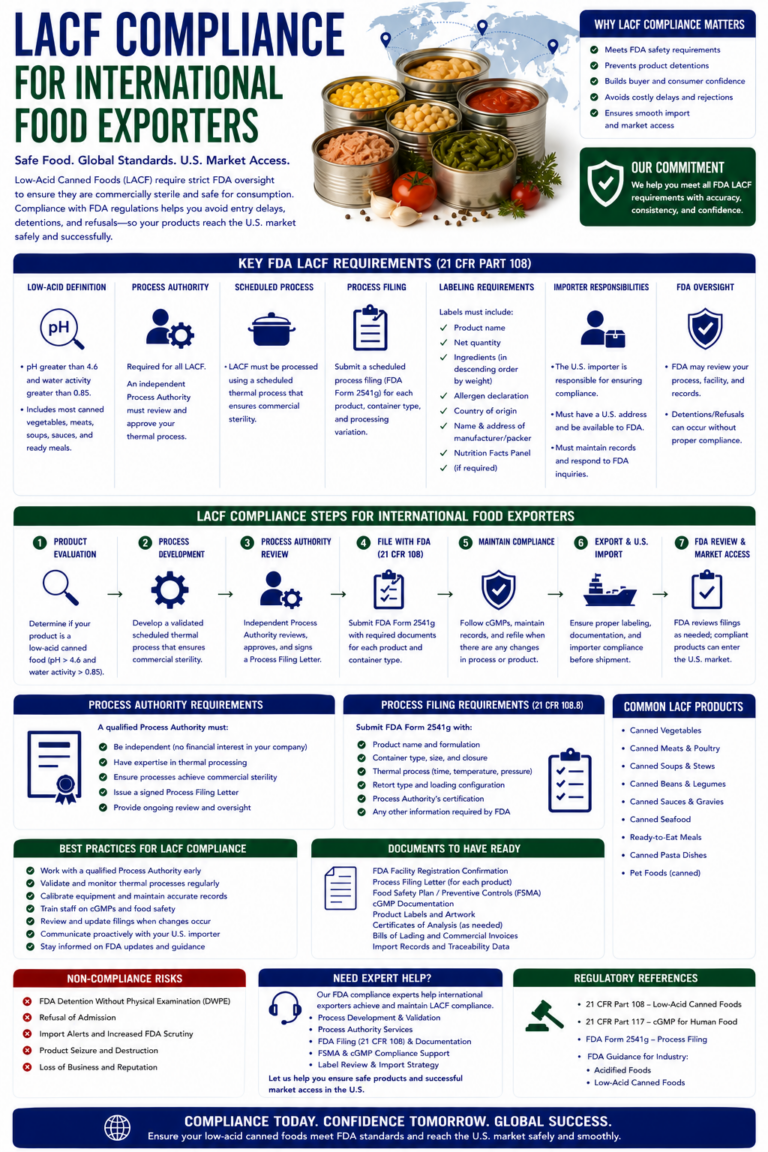
LACF Compliance for International Food Exporters
Low-Acid Canned Foods (LACF) are among the most tightly regulated food categories entering the United States. These products require strict processing controls and FDA filings to ensure safety and prevent microbial risks such as botulism.
The U.S. Food and Drug Administration enforces detailed LACF requirements for all international exporters, including facility registration, process validation, and ongoing compliance.
Many exporters underestimate how technical and documentation-heavy LACF compliance is. Missing even one requirement can result in FDA holds, shipment refusals, or long-term import alerts. Proper planning and execution are essential before exporting to the U.S.
What Are Low-Acid Canned Foods (LACF)
Low-acid canned foods are products with a pH above 4.6 and water activity above 0.85 that are packaged in hermetically sealed containers.
These conditions create an environment where harmful bacteria can grow if not properly controlled.
Common examples include canned vegetables, meats, seafood, soups, sauces, and ready-to-eat meals.
These products are typically shelf-stable and require thermal processing to ensure safety.
Because of these risks, LACF products are subject to strict FDA regulations.
Core FDA Requirements for LACF Compliance
International exporters must meet several key FDA requirements before shipping LACF products to the United States.
The manufacturing facility must be registered with the FDA.
Foreign facilities must designate a U.S. Agent.
The facility must obtain a Food Canning Establishment (FCE) number.
Each product must have a Scheduled Process (SID) filed with the FDA.
The product must be processed according to validated thermal processing standards.
The U.S. importer must comply with the Foreign Supplier Verification Program (FSVP).
Prior Notice must be submitted before shipment arrival.
Failure to meet any of these requirements can result in immediate shipment refusal.
FCE Registration and SID Process Filing
FCE and SID filings are the foundation of LACF compliance.
The FCE number identifies the facility producing the canned food.
The SID outlines the specific processing method for each product.
Each product, container size, and formulation requires its own SID.
Filings must be completed before export.
Incorrect or missing filings are one of the most common causes of FDA holds.
Role of a Process Authority
A Process Authority is essential for LACF compliance.
They evaluate product formulation and processing conditions.
They determine the appropriate thermal processing parameters.
They validate the process to ensure safety.
They provide documentation required for SID filings.
Without proper validation, LACF products cannot meet FDA requirements.
Thermal Processing and Critical Controls
Thermal processing is the most critical safety component for LACF products.
Time, temperature, and pressure must be precisely controlled.
Processing must follow validated procedures without deviation.
Any deviation must be documented and addressed.
Failure to maintain proper controls can result in non-compliance and serious safety risks.
FSVP Requirements for Importers
The Foreign Supplier Verification Program (FSVP) applies to all imported LACF products.
The U.S. importer must verify that the foreign facility meets FDA standards.
This includes reviewing process filings, hazard analyses, and safety controls.
Records must be maintained for FDA inspection.
FSVP ensures ongoing compliance beyond initial filings.
Labeling Requirements for LACF Products
LACF products must meet all FDA labeling requirements.
The label must clearly identify the product.
All ingredients must be listed in descending order by weight.
A compliant Nutrition Facts panel must be included.
Allergen declarations must be clearly stated.
Net quantity and responsible party information must be included.
Labeling must align with both the product formulation and filed processes.
Common Compliance Issues for LACF Exporters
International exporters often encounter recurring challenges with LACF compliance.
Missing or incorrect FCE/SID filings.
Improper thermal process validation.
Incorrect product classification.
Labeling inconsistencies or errors.
Incomplete FSVP documentation.
These issues frequently result in delays, detention, or refusal at the port.
Why Early Compliance Planning Is Critical
LACF compliance must be completed before exporting products.
Process filings cannot be corrected after shipment.
Validation requires coordination with a Process Authority.
Documentation must be ready for FDA review.
Planning ahead ensures smooth entry into the U.S. market.
How FDA Registration Assistance Supports LACF Exporters
FDA Registration Assistance works with international manufacturers and exporters to manage the full LACF compliance process.
We assist with FDA Food Facility Registration and U.S. Agent services.
We support FCE registration and SID process filings.
We coordinate with Process Authorities for validation.
We assist with FSVP compliance and documentation.
We review labels to ensure full alignment with FDA requirements.
This structured approach helps exporters avoid costly delays and compliance issues.
Why Businesses Choose FDA Registration Assistance
LACF compliance requires both technical expertise and regulatory precision.
FDA Registration Assistance has supported over 1,000 clients across 135+ countries, helping exporters meet FDA requirements before entering the U.S. market.
With more than 15 years of combined experience, the focus is on helping products move through registration and process filing efficiently.
Frequently Asked Questions (FAQs)
What is LACF compliance?
LACF compliance refers to meeting FDA requirements for low-acid canned foods, including facility registration, process validation, FCE/SID filings, and labeling compliance. It ensures products are safe for consumption and meet U.S. standards.
Do all canned foods require LACF compliance?
Only canned foods classified as low-acid require LACF compliance. Acidified foods fall under a different but related regulatory framework.
What is an FCE number?
An FCE (Food Canning Establishment) number identifies a facility producing low-acid canned foods and is required before submitting process filings.
What is a Scheduled Process (SID)?
A SID is a detailed filing that outlines how a product is processed to ensure safety. Each product and process requires its own SID.
Why is a Process Authority required?
A Process Authority validates the safety of the product’s processing method and provides the documentation required for FDA filings.
Do I need FSVP for LACF products?
Yes, the U.S. importer must comply with FSVP to verify that the foreign supplier meets FDA food safety standards.
What happens if my product is not compliant?
Your shipment may be detained, delayed, or refused. You may also face additional regulatory scrutiny or import alerts.
Do LACF products require labeling compliance?
Yes, all LACF products must meet FDA labeling requirements, including ingredient lists, Nutrition Facts, allergen declarations, and product identity.
Can I fix compliance issues after shipping?
In most cases, no. LACF compliance must be completed before export to avoid delays and refusals.
Is professional assistance necessary for LACF compliance?
While not mandatory, it is highly recommended due to the technical complexity and risk of costly mistakes.
Ensure Your LACF Products Meet FDA Requirements
If you are exporting low-acid canned foods to the United States, ensuring full compliance before shipping is essential to avoid delays, detention, or refusal.
FDA Registration Assistance provides support across FDA registration, U.S. Agent services, FCE/SID filings, FSVP, and label review—helping you navigate LACF compliance with confidence and efficiency.
You can reach out at info@fdaregistrationassistance.com or call +1-928-275-8333 to get started.