FDA Compliance for Skincare Products Under MoCRA
Yes. Under the Modernization of Cosmetics Regulation Act (MoCRA), serums, creams, and lotions sold in the United States must comply with updated FDA cosmetic regulations. These rules apply to both domestic and foreign companies that manufacture, process, or distribute cosmetic products in the U.S. market.
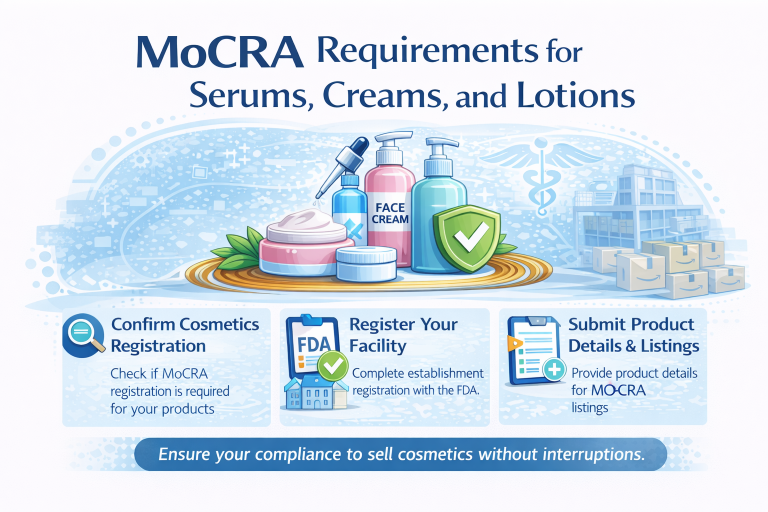
If your product is intended to cleanse, moisturize, beautify, or enhance appearance, it is considered a cosmetic and falls under MoCRA. This means your business must complete FDA facility registration, product listing, maintain safety substantiation, and meet labeling requirements.
FDA Registration Assistance works with cosmetic brands worldwide to ensure full compliance with MoCRA, helping prevent delays, product holds, and regulatory issues.
What Types of Serums, Creams, and Lotions Are Covered?
MoCRA applies to a wide range of skincare products, including facial serums, anti-aging creams, moisturizing lotions, body butters, eye creams, and brightening formulations. Any product marketed for cosmetic purposes rather than medical treatment will generally fall under these regulations.
However, classification is critical. If a serum or cream makes claims such as treating acne, providing sun protection, or healing a skin condition, it may be regulated as an over-the-counter drug rather than a cosmetic. This distinction determines whether MoCRA applies or if FDA drug registration requirements must be followed instead.
FDA Cosmetic Facility Registration Requirements
MoCRA requires all facilities that manufacture or process cosmetic products to register with the FDA. This applies to both U.S. facilities and foreign manufacturers exporting to the United States. Foreign facilities must also designate a U.S. Agent to communicate with the FDA on their behalf.
Facility registration must be renewed every two years, and failure to maintain an active registration can result in import delays or refusal of entry into the U.S. market.
Cosmetic Product Listing Requirements
Each serum, cream, or lotion must be listed with the FDA. This requirement applies at the product level, meaning every formulation and SKU must be submitted individually. The listing includes details such as product name, ingredients, manufacturer information, and product category.
Accurate product listing is essential, as inconsistencies or missing information can lead to compliance issues and increased scrutiny from regulators.
Responsible Person Requirement Under MoCRA
MoCRA requires every cosmetic product sold in the U.S. to have a designated Responsible Person. This entity, typically the brand owner or distributor, is legally responsible for ensuring compliance with FDA regulations.
The Responsible Person must maintain records related to product safety, ensure proper labeling, and handle adverse event reporting. For foreign companies, this role is often supported by a U.S.-based regulatory partner.
Safety Substantiation Requirements
All cosmetic products must be supported by adequate safety substantiation. This means companies must have evidence demonstrating that their serums, creams, and lotions are safe for consumer use under labeled or customary conditions.
Safety substantiation may include toxicological assessments, ingredient safety data, and product testing. While the FDA does not approve cosmetics before they are marketed, it requires companies to have this documentation readily available if requested.
Adverse Event Reporting Obligations
MoCRA introduces mandatory adverse event reporting requirements. Serious adverse events must be reported to the FDA within fifteen business days. Companies must also maintain records of adverse events for a period of six years.
Failure to properly document or report adverse events can result in enforcement actions and increased regulatory oversight.
Labeling Requirements for Serums, Creams, and Lotions
Cosmetic labels must meet FDA requirements to ensure transparency and consumer safety. Labels must include an accurate ingredient declaration using INCI naming conventions, the net quantity of contents, and the name and address of the manufacturer or distributor.
Improper labeling is one of the most common reasons products are flagged during import or inspection, making compliance in this area critical.
Common Compliance Issues Brands Face
Many cosmetic companies underestimate the scope of MoCRA requirements. Common issues include failing to register manufacturing facilities, not listing all products, misclassifying products as cosmetics when they qualify as drugs, and lacking proper safety documentation.
These issues can lead to FDA warning letters, shipment delays, or refusal of entry at U.S. ports.
Cosmetic vs OTC Drug Classification
Understanding the difference between a cosmetic and an over-the-counter drug is essential for compliance. A moisturizing lotion or hydrating serum is typically considered a cosmetic. However, a product marketed for acne treatment, sun protection, or antifungal use is regulated as a drug and must meet additional FDA requirements.
Misclassification is one of the most significant risks for skincare brands entering the U.S. market.
How FDA Registration Assistance Supports Your Compliance
FDA Registration Assistance provides comprehensive support for companies navigating MoCRA requirements. Services include FDA cosmetic facility registration, product listing, U.S. Agent and Responsible Person services, labeling review, and ongoing compliance guidance.
With experience supporting companies in over 135 countries and working with more than 1,000 clients worldwide, FDA Registration Assistance ensures a smooth and compliant path to entering the U.S. market.
Frequently Asked Questions (FAQ)
1. Do serums, creams, and lotions need FDA approval before being sold?
Cosmetic products do not require FDA approval before entering the market. However, they must comply with MoCRA requirements, including registration, listing, and safety substantiation.
2. What is MoCRA and why does it matter for skincare products?
MoCRA is a U.S. law that modernizes cosmetic regulations, requiring facility registration, product listing, and increased oversight to ensure product safety.
3. Do foreign cosmetic manufacturers need to comply with MoCRA?
Yes. Any foreign company exporting serums, creams, or lotions to the United States must comply with MoCRA and appoint a U.S. Agent.
4. What happens if I do not register my cosmetic facility?
Failure to register your facility can result in shipment delays, refusal of entry, and potential enforcement actions by the FDA.
5. Do I need to list every product I sell?
Yes. Each individual product formulation and SKU must be listed with the FDA.
6. What is a Responsible Person under MoCRA?
The Responsible Person is the individual or company legally responsible for ensuring product compliance, maintaining safety records, and handling adverse events.
7. Can my distributor act as the Responsible Person?
Yes. In many cases, the U.S. distributor or brand owner serves as the Responsible Person.
8. What is safety substantiation and why is it required?
Safety substantiation is documented evidence showing that a product is safe for consumer use. It is required to demonstrate compliance with FDA regulations.
9. Do natural or organic products still need to comply?
Yes. Natural or organic claims do not exempt a product from MoCRA requirements.
10. What are adverse events and how are they handled?
Adverse events are negative health effects reported by consumers. Serious events must be reported to the FDA within fifteen business days.
11. How often do I need to renew my facility registration?
Facility registrations must be renewed every two years to remain active.
12. What labeling requirements apply to creams and lotions?
Labels must include ingredient lists, net quantity, and manufacturer or distributor information in accordance with FDA regulations.
13. Can I sell my products on Amazon without FDA compliance?
No. Online marketplaces increasingly require proof of FDA compliance, and non-compliant products may be removed or restricted.
14. How do I know if my product is a cosmetic or a drug?
The classification depends on the product’s intended use and marketing claims. Products that claim to treat or prevent conditions are typically regulated as drugs.
15. Can a compliance partner handle the entire process for me?
Yes. A qualified regulatory partner can manage facility registration, product listing, labeling review, and ongoing compliance requirements.
Get Fully Compliant with MoCRA Requirements Today
If you are manufacturing or selling serums, creams, or lotions in the United States, ensuring full compliance with MoCRA is critical to avoiding delays, enforcement actions, and lost revenue. FDA Registration Assistance provides a complete, end-to-end solution for cosmetic compliance, including facility registration, product listing, U.S. Agent services, and ongoing regulatory support. Contact FDA Registration Assistance today to get your products fully compliant and confidently ready for the U.S. market.