Is an FDA Supplement Label Review Worth It?
This is the cost-benefit case for reviewing first — the asymmetry, the losses a review prevents, and when the math applies to you.
Key Takeaways
- Small fixed cost vs. large uncertain loss — the asymmetry drives the ROI.
- A review pays for itself if it prevents a single reprint, hold, or takedown.
- Most brands face several exposures at once — reprint, border, Amazon, enforcement.
- Earliest = most saved — value is highest before you print, import, or list.
- FDA doesn't pre-approve — a paid review is the only cheap checkpoint.
- It rarely tips the other way — higher volume only raises the savings.
A Small Certain Cost vs. a Large Uncertain One
Every ROI question comes down to comparing two things. Here they are side by side:
- A single, predictable fee
- Known before you commit
- Paid once, upfront
- Turns into a compliant label
- Scales with your order size
- Unknown until it's caught
- Can repeat across channels
- Stacks delays and lost sales on top
The Losses a Review Prevents
These are the costs on the "mistake" side of the ledger. Each links to the full detail — most brands are exposed to several at once:
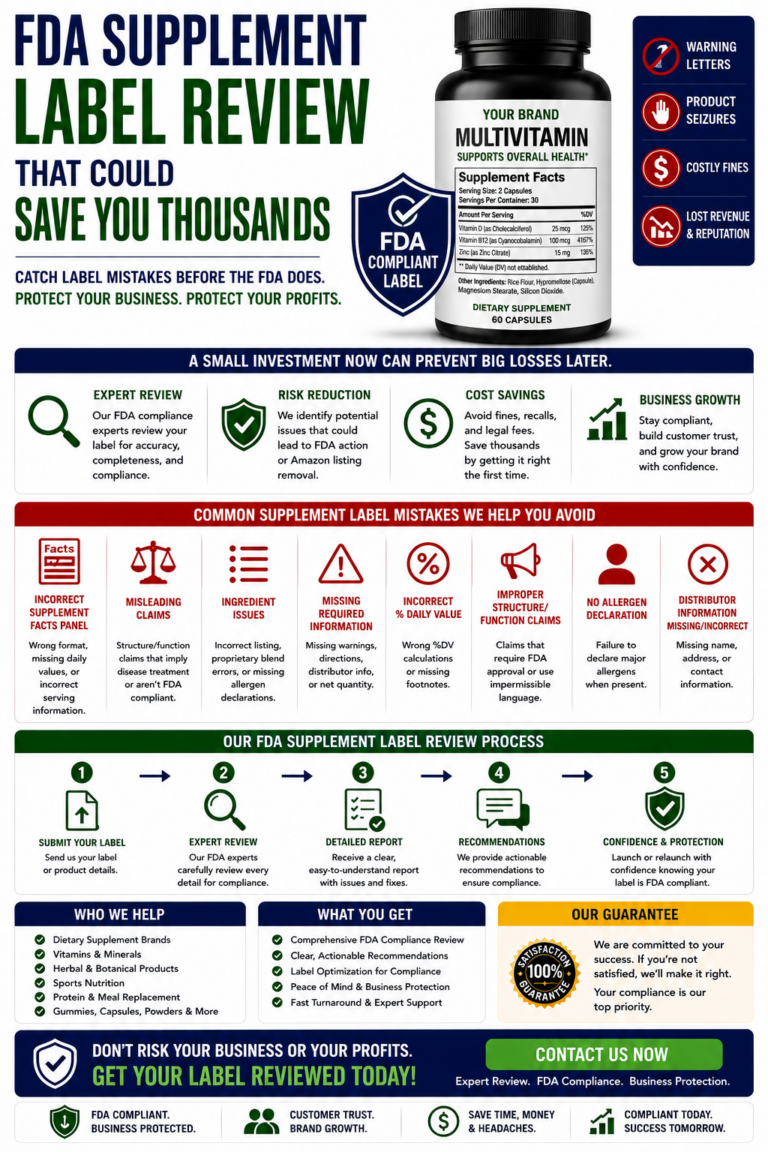
Reprints & relabeling
New print runs, relabeling existing stock, stranded inventory — the full cost stack of a reprint.
The true cost of a reprint →Border detention
Shipments held or refused at customs, plus storage and demurrage while they sit.
Review before customs →Amazon removal
Listing suppression or removal — immediate lost sales and stranded FBA inventory.
Amazon compliance →Warning letters
FDA enforcement that forces corrective action and can damage retail and marketplace standing.
Warning-letter risk →Does the Math Ever Not Favor a Review?
It's worth being straight about this. If you're doing a tiny, one-off run with no importing and no marketplace listing, your absolute exposure is lower — the potential loss is smaller simply because there's less inventory and fewer channels to go wrong.
But even then, the asymmetry usually holds: a single modest reprint or one warning letter still outweighs a review. And the moment you scale, import, or list on a marketplace, the exposure climbs fast while the review cost stays flat. The lower your volume, the smaller the loss; the higher your volume, the more a review saves. It rarely tips the other way — which is why the answer to "is it worth it?" is almost always yes.
How to Capture the Full Value
Review before you spend downstream
Before you print, import, or list — where the fix is cheapest.
Map your exposure
Reprints, detention, Amazon, enforcement — know what you're protecting.
Get documented corrections
Each issue and its fix — a compliant label you can act on.
Apply fixes before committing spend
Correct everything before the run, shipment, or listing goes live.
Extend it across SKUs
Each product carries its own independent exposure.
Re-review on changes
Reformulations and new claims reintroduce risk.
Put the Math to Work
FDA Registration Assistance reviews your supplement label before launch — claims, the Supplement Facts panel, required elements, allergens, and ingredient legality — and delivers documented corrections, so a small review cost prevents much larger downstream losses. We also handle registration, U.S. Agent, prior notice, and supplier verification.
Contact us at info@fdaregistrationassistance.com or call +1 (928) 275-8333. Food Facility Registration is available starting at $858. Trusted by companies across 135+ countries, with 15+ years of experience.
Frequently Asked Questions
1. How can a label review save me money?
By preventing losses that are far larger than the review itself. A single label mistake can force a reprint, a shipment detention, an Amazon listing removal, or a warning letter — each of which can run into thousands. A review is a small, fixed cost that heads those off before they happen.
2. Why does the ROI math favor reviewing?
Because the two sides are asymmetric. The review is small, fixed, and known in advance; the loss it prevents is large, variable, and uncertain. When a small certain cost protects against a large possible one, the expected value favors paying the small cost — the review pays for itself if it prevents even a single problem.
3. What losses does a review actually prevent?
The main ones are reprints and relabeling, shipment detention or refusal at the border, Amazon listing suppression or removal, FDA warning letters, and missed launch windows. Which apply depends on how you sell — but most brands are exposed to several at once, which raises the value of catching issues early.
4. How much does a mistake actually cost?
It varies too much to quote a single number — it depends on order quantity, packaging, how you import, and where the problem is caught. The reliable point isn't an exact figure; it's that the downstream cost is almost always much larger than the review, often by an order of magnitude once delays and lost sales are counted.
5. Is a review ever not worth it?
For a very small, one-off product with no import and no marketplace listing, the absolute exposure is lower — but the asymmetry still favors a review, because even a modest reprint or a single warning letter outweighs it. The lower your volume, the smaller the loss; the higher your volume, the more a review saves. It rarely tips the other way.
6. Does FDA approve my label so I don't need this?
No. FDA doesn't pre-approve supplement labels, so there's no free external check — it enforces after the fact, when fixes are expensive. That's precisely why a paid review before launch is the only cost-effective checkpoint you have.
7. When do I capture the most savings?
Before you print, import, or list. That's when a fix costs only a revision and every downstream loss is still avoidable. The later a problem is caught, the more committed cost is attached to it, so the earlier you review, the more you save.
8. What does the review include for the cost?
A full compliance check of the label — the Supplement Facts panel, claims, required elements, allergens, and ingredient legality — with documented, actionable corrections. Our label-review guide breaks down every element the review covers.
9. How long does a review take?
Typically about 2–3 business days once we have the label and product details. That's designed to fit inside a normal production timeline, so the savings don't come at the cost of a delay.
10. Do I need to review every product?
Yes — each SKU carries its own exposure because formulations, claims, and ingredients differ. A clean review on one product doesn't protect another, and an unreviewed SKU is where an avoidable loss tends to originate.
11. Can one mistake really cost more than the review many times over?
Regularly. Beyond the direct reprint, a bad label can mean stranded inventory, storage fees, lost sales while out of stock, and lost search ranking. Those stack on top of each other, which is how a single issue ends up costing many multiples of what a review would have.
12. How does FDA Registration Assistance help?
We review your supplement label before launch — claims, the Supplement Facts panel, required elements, allergens, and ingredient legality — and deliver documented corrections, so a small review cost prevents much larger downstream losses. We also handle registration, U.S. Agent, prior notice, and supplier verification. Starting at $858 for registration, for companies across 135+ countries. Contact info@fdaregistrationassistance.com or +1 (928) 275-8333.