
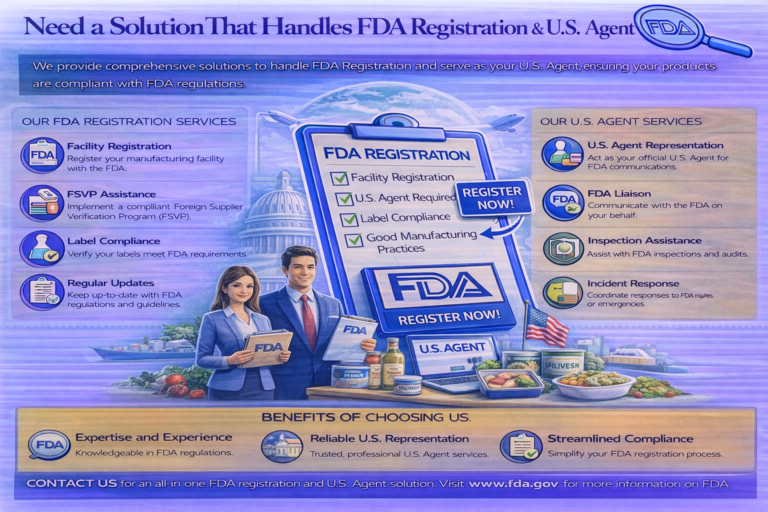
FDA Registration & U.S. Agent, Across Every Program
How FDA registration and the U.S. Agent requirement work together across food, drugs, devices, and cosmetics — and when one provider makes sense.
Key Takeaways
- Foreign firms need both — registration and a U.S. Agent (they go together).
- Applies to all four programs — food, drug, device, cosmetic — under different rules.
- Renewal cadence differs — food & cosmetics biennial; drugs & devices annual.
- One provider is optional, not required — but it keeps records & renewals aligned.
- One agent per foreign establishment — U.S.-based, available, consenting.
- Registration + U.S. Agent ≠ FDA approval.
U.S. Agent & Registration, by FDA Program
| Program | U.S. Agent (foreign) | Key rule | Registration renewal |
|---|---|---|---|
| Food | Required | 21 CFR 1.225–1.227 | Biennial (even years, Oct 1–Dec 31) |
| Drugs | Required | 21 CFR 207.69 | Annual (Oct–Dec) |
| Devices | Required | 21 CFR 807.40 | Annual (Oct–Dec) |
| Cosmetics | Required | MoCRA (FD&C 607) | Biennial |
Registration and the U.S. Agent Are Linked
- You generally can't finish a foreign registration without a valid U.S. Agent — the agent is designated as part of registration
- They must stay consistent — an outdated or mismatched agent on your registration means FDA can't reliably reach you
- Both renew/refresh on the program's cycle — and the agent must keep consenting and current
- Neither is "approval" — registration and an agent are administrative; your product still needs its own pathway
Do You Need One Provider for Both?
No — it's a choice, not a requirement. You can register in-house and appoint a separate U.S. Agent, or use different vendors per product category. What the rules require is simply that your establishment is registered and a valid, consenting U.S. Agent is designated.
That said, using one provider for registration and the U.S. Agent across your programs has practical advantages:
- One renewal calendar — across the different biennial/annual cadences, so nothing lapses
- Records that match — registration and agent designation stay consistent
- A single point of contact — for FDA communications and inspection scheduling
- Coordinated changes — switching an agent without a coverage gap
Go Deeper on Your Product's Program
This page is the overview; each program has its own dedicated U.S. Agent guide with the specifics:
Food U.S. Agent
Food facilities (21 CFR 1.227).
Food →Drug U.S. Agent
Drug & pharma establishments (207.69).
Drug →Device U.S. Agent
Device establishments (807.40).
Device →Common Registration + U.S. Agent Mistakes
- Registering without a valid, consenting U.S. Agent — the registration can't complete
- A stale or mismatched agent on the registration
- Missing a renewal because programs have different cadences
- Assuming one registration covers multiple product categories — each program is separate
- Treating registration/agent as "FDA approved"
- Not realizing each foreign establishment/program needs its own agent
FDA Registration & U.S. Agent — Across Your Programs
FDA Registration Assistance completes FDA establishment registration and acts as your U.S. Agent across the programs you need — food, drug, device, and cosmetic — keeping your registrations, U.S. Agent designations, and renewal calendar coordinated. For the full combined program see our FDA registration & U.S. Agent compliance page.
Contact us at info@fdaregistrationassistance.com or call +1 (928) 275-8333 for a quote. An independent compliance firm serving 1,000+ companies across 135+ countries, with 15+ years of experience.
Frequently Asked Questions — Registration & U.S. Agent
1. Do I need both FDA registration and a U.S. Agent?
If you're a foreign company selling FDA-regulated products in the U.S., usually yes. Foreign establishments must register with FDA and designate a U.S. Agent as part of that registration. Registration puts your establishment (and products) in FDA's system; the U.S. Agent is FDA's U.S.-based contact for your foreign establishment. They go together: you generally can't complete a foreign registration without a valid U.S. Agent. Domestic (U.S.) establishments register but don't need a U.S. Agent.
2. Does the U.S. Agent requirement apply to every FDA program?
Yes - food, drugs, devices, and cosmetics all require a U.S. Agent for foreign establishments, though under different regulations: food facility registration (21 CFR 1.225–1.227), foreign drug establishments (21 CFR 207.69), foreign device establishments (21 CFR 807.40), and cosmetics under MoCRA. The core role is the same across programs (FDA's U.S. contact for the foreign facility), but the specific rules and the registration renewal cadence differ by program.
3. How does the registration renewal cadence differ by program?
It varies: food facility registration renews every two years (biennially, in even-numbered years, Oct 1–Dec 31); drug and device establishment registration renew annually (Oct–Dec); and cosmetic facility registration under MoCRA renews every two years. So a company with products in more than one category is juggling different renewal clocks. Keeping those aligned - and not missing a renewal - is one practical reason companies use a single provider for registration and U.S. Agent across programs.
4. Can one provider handle both FDA registration and the U.S. Agent?
Yes. A single provider can complete your FDA establishment registration and act as your U.S. Agent - across food, drug, device, and cosmetic programs if you have products in several categories. It's not required to use one provider (you can register yourself and appoint a separate U.S. Agent), but consolidating keeps your registration records, U.S. Agent designation, and renewal calendar in one place, which reduces the chance of a missed renewal or a mismatch between your registration and your agent.
5. Do I have to use one provider for both?
No. You can handle registration in-house and appoint a separate U.S. Agent, or use different providers for different product categories. Using one provider for registration and U.S. Agent is a convenience and coordination choice, not a legal requirement. The requirements are that the establishment is registered and that a valid, consenting U.S. Agent is designated - who performs those functions is up to you, as long as the U.S. Agent meets the requirements (U.S.-based, available, and consenting).
6. What does a U.S. Agent actually do?
The role is a defined, limited one: the U.S. Agent is FDA's U.S.-based point of contact for the foreign establishment - assisting FDA communications, responding to questions about the establishment's products, helping schedule inspections, and receiving information/documents when FDA can't reach the establishment directly. The exact wording varies slightly by program, but across food, drug, device, and cosmetics the U.S. Agent facilitates FDA communication; it doesn't take legal responsibility for the product or file your submissions.
7. Can I have more than one U.S. Agent?
Each foreign establishment designates a single U.S. Agent for a given registration/program. A single U.S. Agent can serve many establishments, and if you have facilities across different FDA programs, your provider can act as U.S. Agent for each. But for any one foreign establishment's registration, there's one U.S. Agent on file at a time. Keeping that designation current (and consistent with your registration) matters, because FDA relies on it to reach you.
8. What are the U.S. Agent's requirements?
Across programs, the U.S. Agent must be physically located in the United States (a real U.S. address, not a PO box), be available during business hours, and - for device and other programs with a consent step - actually agree to serve. The agent can be an individual or a company (a consultant, law firm, importer, or dedicated U.S. Agent service). Responsiveness matters: FDA communications, including inspection scheduling, flow through the agent, so an unreachable agent creates real compliance risk.
9. Does having registration and a U.S. Agent mean FDA-approved?
No. Registration and a U.S. Agent are administrative requirements - they put you in FDA's system and give FDA a contact. They don't mean FDA reviewed, cleared, or approved your product, and implying that registration equals approval is misleading (for devices, that's specifically prohibited under 21 CFR 807.39). Your product still needs whatever premarket pathway applies to it (for example, a device 510(k), or drug approval/monograph compliance). Registration is not approval.
10. What happens if my registration and U.S. Agent don't match?
Mismatches cause problems. If your registration lists an outdated U.S. Agent, or the agent's details are wrong, FDA may be unable to reach you - which can mean missed communications, delayed or refused inspections, and compliance gaps. Import entries can also be flagged when registration/agent information is inconsistent. Keeping registration and the U.S. Agent designation aligned and current (and updating changes promptly) is exactly the kind of coordination a single provider helps with.
11. I sell products in more than one FDA category — how does that work?
Each product category follows its own program: a company selling, say, a supplement (food), an OTC drug, and a cosmetic would register in each applicable program and needs a U.S. Agent for each foreign facility/registration, with each program's own renewal cadence. The requirements don't merge into one registration - but one provider can manage all of them together, so your registrations, U.S. Agent designations, and renewals are coordinated rather than scattered across vendors and calendars.
12. How is this different from your program-specific U.S. Agent pages?
This page is the cross-program overview - how FDA registration and the U.S. Agent requirement work together across food, drugs, devices, and cosmetics, and the case for handling them with one provider. For the details of any single program, see the dedicated pages: the food U.S. Agent, the drug/pharmaceutical U.S. Agent, the medical device U.S. Agent, and the MoCRA cosmetics U.S. Agent. Start here for the big picture; go to the program page for your specific product's specifics.
13. Can you switch me from my current U.S. Agent?
Yes. You can change your U.S. Agent, and it's a common move - for example if your current agent is unresponsive, too expensive, or you want registration and the agent handled together. The change is made in the relevant FDA registration system, and it's important to do it without a coverage gap so FDA always has a valid agent on file. We can coordinate the switch alongside your registration so nothing lapses.
14. Does a domestic (U.S.) company need a U.S. Agent?
No. The U.S. Agent requirement applies to foreign establishments - FDA can reach a domestic company directly. A U.S.-based company still registers (in each applicable program) and meets the other requirements, but doesn't designate a U.S. Agent. If you're a U.S. company importing from a foreign manufacturer, note that the foreign manufacturer needs its own U.S. Agent, and you may have importer obligations of your own depending on the product.
15. What are the most common registration + U.S. Agent mistakes?
Registering without a valid/consenting U.S. Agent (so the registration can't complete); letting the U.S. Agent designation go stale or mismatch the registration; missing a renewal because different programs have different cadences; assuming one registration covers multiple product categories (it doesn't); treating registration/agent as "FDA approval"; and, for foreign firms, not realizing every program needs its own agent. Coordinating registration and the agent - ideally on one calendar - avoids most of these.
16. How does FDA Registration Assistance handle registration and U.S. Agent?
We complete FDA establishment registration and act as your U.S. Agent across the programs you need - food, drug, device, and cosmetic - keeping your registrations, U.S. Agent designations, and renewal calendar coordinated. For the full combined program see our FDA registration and U.S. Agent compliance page, and for a specific product see the program U.S. Agent pages. We're an independent compliance firm serving 1,000+ companies across 135+ countries with 15+ years of experience. Contact info@fdaregistrationassistance.com or +1 (928) 275-8333.
