Why Supplement Labels Fail FDA Requirements
The failures cluster into five root causes and a short list of most-failed requirements. Here's the anatomy — and how to avoid each one.
Key Takeaways
- Failures are predictable — five root causes explain almost all of them.
- The #1 cause is the wrong source of truth — designer, competitor, or international template.
- Claims are the top high-risk failure — disease claims reclassify a supplement as a drug.
- Supplement Facts formatting is the most-failed technical requirement.
- The common thread is a missing verification step — no review before printing.
- FDA doesn't pre-check — failures surface at import or on the market, too late.
The Five Root Causes
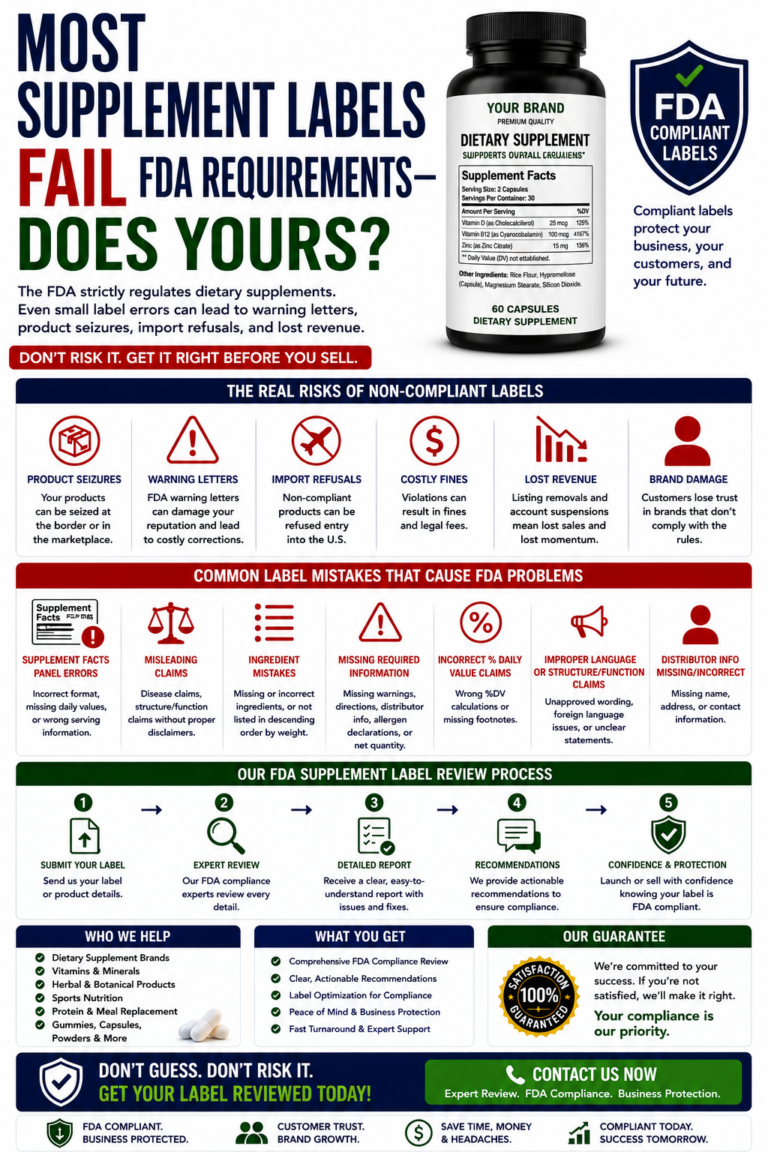
Nearly every non-compliant label traces back to one of these five. Notice that four of them are invisible in a "nice-looking" label:
| Root cause | What goes wrong |
|---|---|
| 1. Wrong source of truth | The label is built from a designer's aesthetic, a competitor's label, or an international template — inheriting the wrong rules instead of FDA's |
| 2. Misunderstood claims | A structure/function claim drifts into disease territory, reclassifying the supplement as an unapproved drug |
| 3. Technical panel errors | The Supplement Facts panel breaks a 101.36 rule — heading, serving info, %DV, or typography |
| 4. Ingredient blind spots | An unlisted excipient, wrong order, undeclared allergen, or an ingredient that isn't a lawful dietary ingredient |
| 5. No verification step | No compliance review before printing — so any of the above sails straight through to production |
The Requirements Labels Fail Most
Those root causes surface as failures of a short list of specific requirements — the same ones, over and over:
Supplement Facts panel
Wrong heading ("Nutrition Facts"), serving errors, %DV mistakes, or typography that breaks 101.36. The most-failed technical requirement.
Non-compliant claims
Disease claims, or structure/function claims missing the DSHEA disclaimer. The highest-risk failure — it can reclassify the product as a drug.
"Dietary supplement" identity
The statement of identity doesn't clearly classify the product as a dietary supplement.
Ingredient listing & legality
Incomplete or mis-ordered ingredients, undeclared allergens, or an NDI without its 75-day notification 190.6.
U.S. responsible party
Missing name and address, or no U.S. contact for adverse-event reports.
Formatting & layout
Font size, spacing, and structure that don't meet FDA presentation rules.
Is Yours One of the Labels That Fails?
Test your label
Run the red-flag self-check to spot the warning signs in minutes, then see every required element in the label review guide.
Fix it before it costs you
A failure caught before printing is a revision; caught later it's a reprint or takedown. An expert review confirms the subtle failures a self-check can't.
How to Keep Your Label From Failing
Start from the right source of truth
Build from FDA rules — not a designer, competitor, or international template.
Get claims classified correctly
Lawful structure/function claims with the DSHEA disclaimer — no disease claims.
Verify the Supplement Facts panel
Check 101.36 heading, serving info, ingredients, and typography.
Close the ingredient blind spots
Lawful ingredients, NDI notifications where needed, correct order and allergens.
Add the verification step
A real compliance review before printing — the fix for most failures.
Re-verify on every change
Reformulations and new claims reintroduce failure risk.
Make Sure Your Label Isn't One That Fails
FDA Registration Assistance reviews your label against the requirements it's most likely to fail — claims, the Supplement Facts panel, required elements, allergens, and ingredient legality — and delivers documented, actionable corrections. We also handle registration, U.S. Agent, prior notice, and supplier verification.
Contact us at info@fdaregistrationassistance.com or call +1 (928) 275-8333. Food Facility Registration is available starting at $858. Trusted by companies across 135+ countries, with 15+ years of experience.
Frequently Asked Questions
1. Do most supplement labels really fail FDA requirements?
A large share contain at least one issue when checked against FDA rules — usually technical ones involving the Supplement Facts panel, claims, or missing required elements. Most brands don't discover the problem until a shipment is held, a listing is pulled, or an enforcement action lands, because FDA doesn't pre-check labels.
2. What's the number-one root cause of failure?
Starting from the wrong source of truth. Labels built around a designer's aesthetic, a competitor's label, or an international template inherit those sources' rules and mistakes instead of FDA's. The design can be flawless and still fail, because it was never built against the actual requirements.
3. Why do claims cause so many failures?
Because the line between a lawful structure/function claim and an unlawful disease claim is subtle, and marketing language naturally pushes toward the stronger version. "Supports joint health" is fine; "relieves arthritis" implies disease treatment and turns the supplement into an unapproved drug. Claims are the single most common high-risk failure.
4. Why is the Supplement Facts panel failed so often?
Because 21 CFR 101.36 has specific, technical rules — the "Supplement Facts" heading (not "Nutrition Facts"), serving size, servings per container, dietary ingredients, % Daily Value where set, and precise typography and boxing. These are easy to get slightly wrong, and "slightly wrong" is still non-compliant.
5. What ingredient issues make labels fail?
Two kinds: presentation and legality. Presentation means incomplete listing, wrong order, or undeclared allergens. Legality means an ingredient that isn't a lawful dietary ingredient — a new dietary ingredient without the required 75-day notification (21 CFR 190.6), or one FDA has ruled unlawful. A perfect label on an unlawful ingredient still fails.
6. Is a missing U.S. responsible party really a failure?
Yes. The label must show the name and address of the manufacturer, packer, or distributor, with a U.S. contact for adverse-event reports. A missing or non-U.S. responsible party is a discrete required-element failure that can make the product misbranded on its own.
7. Why do so many labels fail silently?
Because the common thread behind most failures is a missing verification step — no compliance review before printing. Design and marketing optimize for looks and sales, not regulation, so without a dedicated review, issues pass straight through to production and only surface later, at import or on the market.
8. Does FDA approve labels before sale?
No. FDA doesn't pre-approve or pre-check supplement labels. It enforces compliance after products enter the market, which is why failures aren't caught by any external gate — the only checkpoint is a review you arrange before launch.
9. Can small technical errors really cause enforcement?
Yes. A product is misbranded if the label doesn't meet requirements, regardless of how minor the deviation seems. An incorrect font size, a missing element, or a mis-worded claim can each be enough — the standard is compliance, not "close enough."
10. What happens when a label fails?
Depending on where it's caught: an FDA warning letter, detention or refusal at import, an Amazon listing removal, or a forced relabel, re-export, or destruction. All of them cost time and money, and all trace back to a failure that a pre-launch review would have caught.
11. How do I know if my label is one that fails?
Start with our red-flag self-check to spot obvious warning signs, then use our label-review guide to see every required element. A self-check is good triage, but a professional review is the only way to confirm the subtle failures that cause most enforcement.
12. How long does a review take?
Typically about 2–3 business days once we have the label and product details. That's designed to fit before your print or launch deadline, so failures are corrected while they're still cheap to fix.
13. How does FDA Registration Assistance help?
We review your label against the requirements it's most likely to fail — claims, the Supplement Facts panel, required elements, allergens, and ingredient legality — and deliver documented, actionable corrections. We also handle registration, U.S. Agent, prior notice, and supplier verification. Starting at $858 for registration, for companies across 135+ countries. Contact info@fdaregistrationassistance.com or +1 (928) 275-8333.