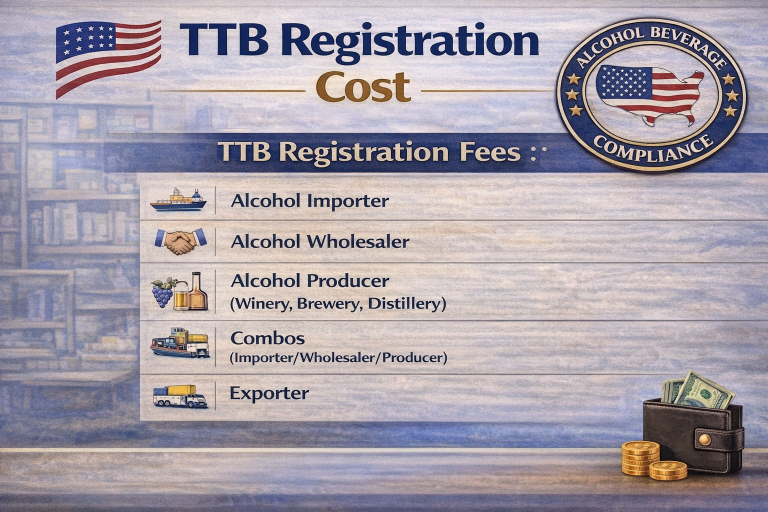
TTB Registration Cost: What You Need to Know
Trusted by 1,000+ companies across 135+ countries, with 15+ years of FDA regulatory experience. Below: what the TTB charges (nothing), where the real costs are, the bond question, and the FDA side people forget.
What the TTB Actually Charges: Nothing to Apply
This surprises most first-time applicants. The TTB does not charge an application fee for the federal Basic Permit required under the Federal Alcohol Administration Act — and there's no fee to maintain it, no fee for a Certificate of Label Approval (COLA), and no fee for formula approval. You file through the TTB's Permits Online system for free.
Where the Costs Actually Are
| Cost item | What it runs |
|---|---|
| TTB Basic Permit application | $0 — no federal fee |
| COLA label approval & formula approval | $0 — no fee |
| Special Occupational Tax on alcohol | $0 — repealed for alcohol businesses |
| Excise-tax bond (only if required) | Surety premium, or cash tied up — see below |
| Federal excise tax | Ongoing, by volume (reduced craft rates apply) |
| State licenses & permits | Varies widely by state |
| FDA food facility registration | $0 from the FDA |
| Optional professional help | Varies by scope |
Only two lines here are true government charges tied to operating — the bond (when required) and ongoing excise tax. Everything labeled "$0" is genuinely free to file.
When You Actually Need a Bond
A TTB bond guarantees the federal excise taxes you'll owe. It's the cost that catches producers — but a 2017 change means many no longer need one.
Don't Forget the FDA Side
Alcohol is regulated by two federal agencies. The TTB handles permits, label approval, and excise tax — but the FDA has its own mandatory steps, and a valid TTB permit won't get a shipment through without them.
Get the Full Cost Picture — TTB and FDA
Send us your product and business details and we'll map the complete cost picture across both agencies, handle the FDA side — food facility registration, U.S. Agent service, and Prior Notice — and guide your TTB application so nothing stalls at the border. Email info@fdaregistrationassistance.com or call +1 (928) 275-8333.
Frequently Asked Questions — TTB Registration Cost
How much does TTB registration cost?
The TTB charges no federal fee to apply for or maintain a Basic Permit. The real costs are an excise-tax bond (only if required), ongoing federal excise taxes, state licenses, and — because alcohol is also FDA-regulated — the FDA registration steps.
Is the TTB Basic Permit really free?
Yes. There is no federal application fee for a Basic Permit under the Federal Alcohol Administration Act, and no fee to maintain it. You apply free through the TTB's Permits Online system.
Does a COLA (label approval) cost anything?
No. The TTB charges no fee for a Certificate of Label Approval (COLA) or for formula approval. The real cost is the time and accuracy needed to get them approved without rejections.
So why do people say TTB registration is expensive?
Because the indirect costs add up: bonds where required, ongoing excise taxes, state licensing, business setup, and the delays caused by application errors. The permit form itself is free to file.
What is a TTB bond and do I need one?
A bond guarantees your federal excise taxes. Since January 1, 2017, wineries, breweries, and distilled spirits plants are exempt if they expect to owe $50,000 or less in federal excise tax for the year; above that, a bond is required.
How much does a TTB bond cost?
It depends. A surety bond carries an annual premium based on the bond amount and your credit, while a cash bond ties up the full amount with the Treasury. Many small producers now qualify for the bond exemption.
Do importers need a bond?
Importers operating under a Basic Permit generally don't post a producer's bond; excise tax on imported alcohol is handled through U.S. Customs at entry. The exact requirements depend on your operation.
Is there a Special Occupational Tax on alcohol?
No longer. The Special Occupational Tax that once applied to alcohol producers, wholesalers, and importers was repealed, so alcohol businesses don't pay it. It still applies to tobacco businesses, which are separate.
What are federal excise taxes on alcohol?
Ongoing taxes based on volume — per gallon of beer or wine, or per proof gallon of spirits. Reduced rates apply to smaller volumes under the Craft Beverage Modernization provisions. These are operating costs, not a registration fee.
Are there state costs too?
Yes. Each state has its own alcohol licensing and permits with their own fees, separate from the federal TTB requirements. These vary widely by state and by the type of license you need.
Does the FDA charge for alcohol facility registration?
No. FDA food facility registration is free. Wineries, breweries, and distilleries are food facilities and must register, but the FDA itself charges $0.
Why is the FDA involved if alcohol is regulated by the TTB?
Alcohol is dually regulated. The TTB handles permits, label approval, and excise tax, while the FDA requires facility registration, a U.S. Agent for foreign facilities, and Prior Notice for imports.
Do foreign alcohol producers need a U.S. Agent?
Yes. Any foreign facility that registers with the FDA must designate a U.S. Agent under 21 CFR 1.227. This applies to foreign wineries, breweries, and distilleries exporting to the U.S.
Is Prior Notice required for alcohol imports?
Yes. Every imported shipment of alcohol must have FDA Prior Notice filed before it arrives, in addition to the TTB and U.S. Customs requirements that also apply.
What's the most expensive part of TTB registration?
Usually the delays. Incomplete applications, ownership errors, or missing FDA steps push back your launch, and lost time in the market is the real cost — not the application, which is free.
How long does TTB approval take?
TTB processing times vary by permit type and application quality. A clean, complete application moves faster, while errors trigger back-and-forth that can add weeks or months to your timeline.
Do I need both TTB and FDA before importing?
Yes. Importers typically need the TTB Basic Permit and COLA, plus FDA facility registration, a U.S. Agent, and Prior Notice. Missing either side can stop a shipment.
Does low-alcohol wine or cider change anything?
Possibly. Some products below certain alcohol thresholds fall under FDA labeling rather than TTB, which can change which rules and labels apply. The classification should be confirmed for your product.
Are formula approvals ever needed?
Yes, for certain products such as flavored or specialty beverages. TTB formula approval is free but adds a step before you can obtain label approval, so it's worth planning into your timeline.
Can I do all of this myself?
Yes. The TTB and FDA systems are open to applicants directly. Many businesses use help to avoid the errors and delays that come from juggling two agencies and detailed forms at once.
What does your service cost?
We scope FDA registration, U.S. Agent service, and Prior Notice support and guide the TTB process for a clear fee based on your operation. Contact us for a quote tied to your products and setup.
Does TTB registration mean FDA approval?
No. Neither the TTB nor the FDA “approves” your alcohol in a general sense. The TTB issues permits and label approvals, while FDA registration is a mandatory listing, not an endorsement.
What documents do I need?
Typically ownership and business-structure details, premises information, product details, and — for importers — supplier and label information. We tell you exactly what each agency needs so nothing is missing.
What happens if I skip the FDA steps?
Your alcohol can be detained or refused at the border even with a valid TTB permit, because FDA facility registration, a U.S. Agent, and Prior Notice are separate requirements.
How do I get started?
Send us your product and business details. Contact our team and we'll map the full cost picture across the TTB and FDA, handle the FDA side, and guide your TTB application. Email info@fdaregistrationassistance.com or call +1 (928) 275-8333.