
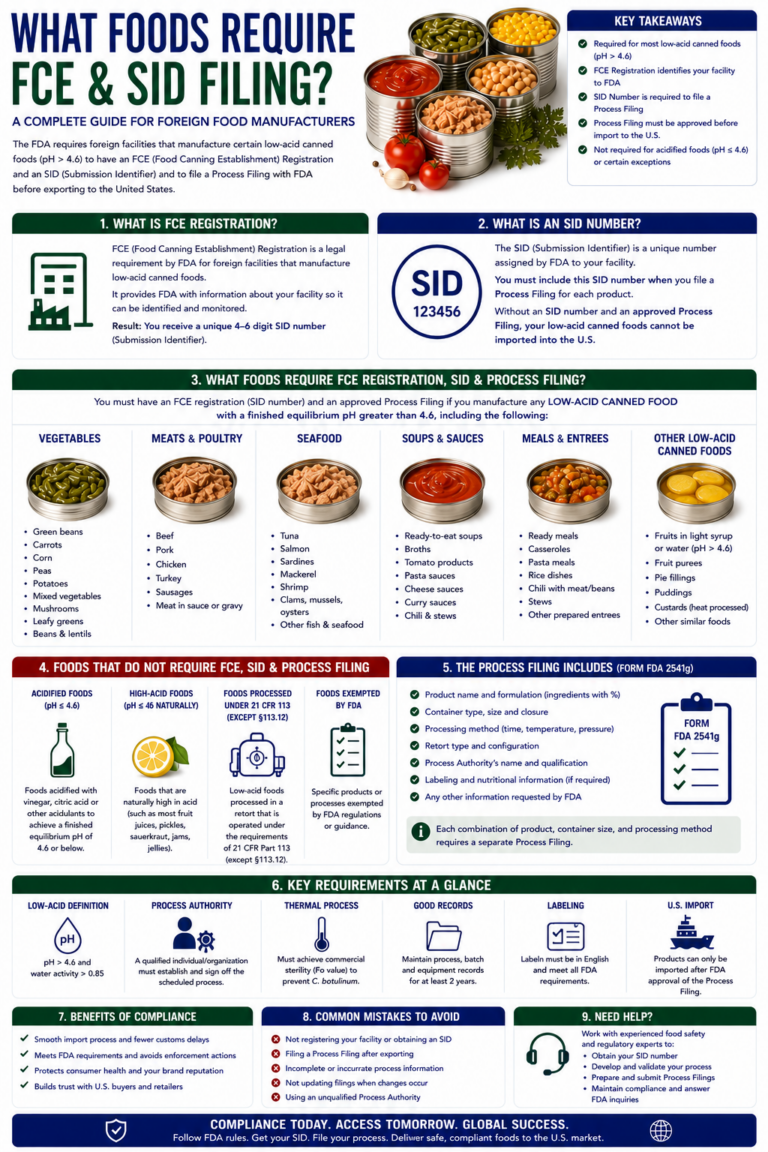
What Foods Require FCE & SID Filing?
Trusted by 1,000+ companies across 135+ countries, with 15+ years of FDA regulatory experience. Below: the three-part test, how low-acid and acidified foods differ, clear examples of what does and doesn't need filing, and what the FCE/SID process involves.
The Three Conditions That Require FCE & SID
A product needs FCE registration and process filing when all three of these are true at once. Miss any one, and it usually falls outside the requirement (though other FDA rules still apply).
Low-Acid Canned vs. Acidified Foods
Both require FCE/SID, but they achieve safety differently and file on different forms.
| Low-Acid Canned Foods (LACF) | Acidified Foods | |
|---|---|---|
| What it is | Finished pH above 4.6 and water activity above 0.85 | Low-acid food with acid added to reach pH 4.6 or below |
| Safety achieved by | Validated thermal processing to commercial sterility | Controlled acidification (often with heat) |
| Examples | Canned vegetables, beans, meats, seafood, soups | Pickles, salsas, hot sauces, acidified peppers |
| GMP regulation | 21 CFR Part 113 | 21 CFR Part 114 |
| Process-filing form | Form FDA 2541d (retorted) | Form FDA 2541e |
Foods That Require FCE & SID
If your product looks like one of these and is sold shelf-stable in a sealed container, plan on filing.
| Low-Acid Canned (LACF) | Acidified |
|---|---|
| Canned vegetables — corn, green beans, peas, carrots, mushrooms | Pickles & pickled vegetables |
| Canned beans, soups, stews, ready-to-eat meals | Salsa & many shelf-stable sauces |
| Canned meats, poultry, seafood (tuna, sardines) | Acidified hot sauces |
| Coconut milk, palm hearts, canned pasta | Acidified peppers (banana, jalapeño) |
| Canned mushrooms, asparagus, mixed vegetables | Brined or marinated vegetables, some relishes |
Foods That Usually Don't Require FCE & SID
These fall outside the low-acid and acidified definitions — though they still need standard FDA food facility registration and labeling:
Naturally Acidic Foods
A finished pH of 4.6 or below without added acid — most fruits, fruit juices, and many condiments.
Low Water Activity
Water activity at or below 0.85 — jams, jellies, honey, syrups, and many dried or dehydrated foods.
Refrigerated or Frozen
Foods kept cold rather than shelf-stable are outside the LACF category.
Dry & Unsealed Foods
Grains, flours, spices, powders, and anything not in a hermetically sealed container.
What FCE & SID Filing Involves
It's a sequence, and the order matters — you can't file a process without first registering the establishment.
Not Sure If Your Product Needs FCE & SID?
Send us your formulation, finished pH, water activity, packaging, and process, and we'll classify your product, coordinate a process authority where needed, and handle the FCE registration and SID filings — before your shipment reaches a U.S. port. Email info@fdaregistrationassistance.com or call +1 (928) 275-8333.
Frequently Asked Questions — FCE & SID Filing
What foods require FCE and SID filing?
Shelf-stable low-acid canned foods (LACF) and acidified foods in hermetically sealed containers. That covers canned vegetables, beans, meats, seafood, and soups on the low-acid side, and pickles, salsas, hot sauces, and acidified peppers on the acidified side.
What's the simple test for whether my product needs FCE/SID?
Three conditions together: the food is low-acid (finished pH above 4.6) or acidified (acid added to reach pH 4.6 or below); it is in a hermetically sealed container; and it is shelf-stable, stored at room temperature. If all three are true, FCE/SID generally applies.
What is an FCE?
A Food Canning Establishment registration, filed on Form FDA 2541. It identifies the facility that processes low-acid or acidified foods and must be obtained before any process filings can be submitted.
What is a SID?
A Submission Identifier — the number assigned to each scheduled-process filing you submit for a product and container size. See our explainer on the SID number and process filing. Each product, process, and container generally needs its own filing.
What's the difference between LACF and acidified foods?
Low-acid canned foods have a natural finished pH above 4.6 and rely on thermal processing for safety (21 CFR Part 113). Acidified foods are low-acid foods with acid added to bring the pH to 4.6 or below, relying on controlled acidification (21 CFR Part 114).
Why does the FDA require these filings?
To control Clostridium botulinum, the bacterium that causes botulism. Improperly processed low-acid or acidified shelf-stable foods can let it grow and produce a deadly toxin, so the process must be scientifically validated and on file before production.
Do all canned foods require FCE/SID?
No. Only shelf-stable low-acid or acidified canned foods. Naturally acidic canned foods, such as many fruits with a pH of 4.6 or below without added acid, and refrigerated canned items generally do not, though they still have other FDA requirements.
Do canned vegetables require FCE/SID?
Yes. Canned vegetables such as corn, green beans, peas, carrots, and mushrooms are classic low-acid canned foods that require FCE registration and process filings before export to the U.S.
Do pickles and salsas require FCE/SID?
Usually yes, as acidified foods, when acid is added to reach a pH of 4.6 or below and the product is shelf-stable. Naturally fermented products that don't add acid are evaluated case by case.
Do hot sauces require FCE/SID?
Often yes. Many shelf-stable hot sauces are acidified foods and need FCE registration and a process filing. The exact classification depends on the formulation and the finished equilibrium pH.
Do canned meats and seafood require FCE/SID?
Yes. Canned meats, poultry, and seafood such as tuna and sardines are low-acid canned foods requiring thermal-process filings — see, for example, our page on crab and lobster registration.
What about coconut milk or canned beans?
Both are typically low-acid canned foods, with a pH above 4.6, and require FCE registration and SID filings when sold shelf-stable in hermetically sealed containers.
What foods usually don't require FCE/SID?
Naturally acidic foods (pH 4.6 or below without added acid), foods with a water activity at or below 0.85 (jams, honey, syrups, many dried foods), refrigerated or frozen foods, dry foods, carbonated and alcoholic beverages, and products not in hermetically sealed containers.
Are jams and jellies covered?
Usually not. High-sugar jams and jellies typically have a water activity at or below 0.85 and a low pH, placing them outside the low-acid and acidified definitions — though labeling and facility registration still apply.
Are fermented foods like kimchi or sauerkraut covered?
It depends. If the low pH is achieved by fermentation alone, they may fall outside the acidified-foods rule; if acid is added, they become acidified foods. A process authority confirms the classification.
What about tomatoes and tomato products?
They are a watch-out. Tomatoes sit near pH 4.6, so canned tomato products are frequently acidified to ensure a safe finished pH — which makes them acidified foods requiring FCE and SID filings.
Is FCE/SID the same as FDA food facility registration?
No. They are separate and additional. A facility making low-acid or acidified foods needs standard food facility registration and FCE registration with process filings — two distinct obligations.
Do foreign manufacturers need FCE/SID?
Yes. Foreign facilities exporting low-acid or acidified shelf-stable foods to the U.S. must complete FCE registration and process filings, on top of facility registration, a U.S. Agent, and Prior Notice.
What is a process authority?
A qualified person or organization with the expertise to establish and validate the scheduled thermal or acidification process. Their determination underlies your SID filings, and the FDA expects one to be involved.
Do I need Better Process Control School?
Supervisors of low-acid and acidified processing operations generally must be trained, typically through Better Process Control School, as part of meeting the 21 CFR Part 113 and Part 114 requirements.
When must the filings be completed?
Before you process the food and before the product enters the U.S. They can't be corrected after shipment, and the FDA may verify them at import, so plan well ahead of your first shipment.
What happens if I skip FCE/SID?
Shipments can be detained or refused, and the facility can face enforcement. Missing or incorrect process filings are a common reason canned and acidified imports are held — see import detention help.
Can I submit a SID without an FCE number?
No. FCE registration on Form FDA 2541 must be completed first; the FCE number is required before you can submit any scheduled-process filing.
How many filings do I need?
Generally one establishment registration (FCE) plus a separate process filing for each product, process, and container size. Multi-product canned and acidified lines need multiple filings.
How do I find out if my product needs FCE/SID?
Have the formulation, finished pH, water activity, packaging, and process reviewed. Contact our team and we'll classify your product, coordinate a process authority, and handle the FCE registration and SID filings. Email info@fdaregistrationassistance.com or call +1 (928) 275-8333.