
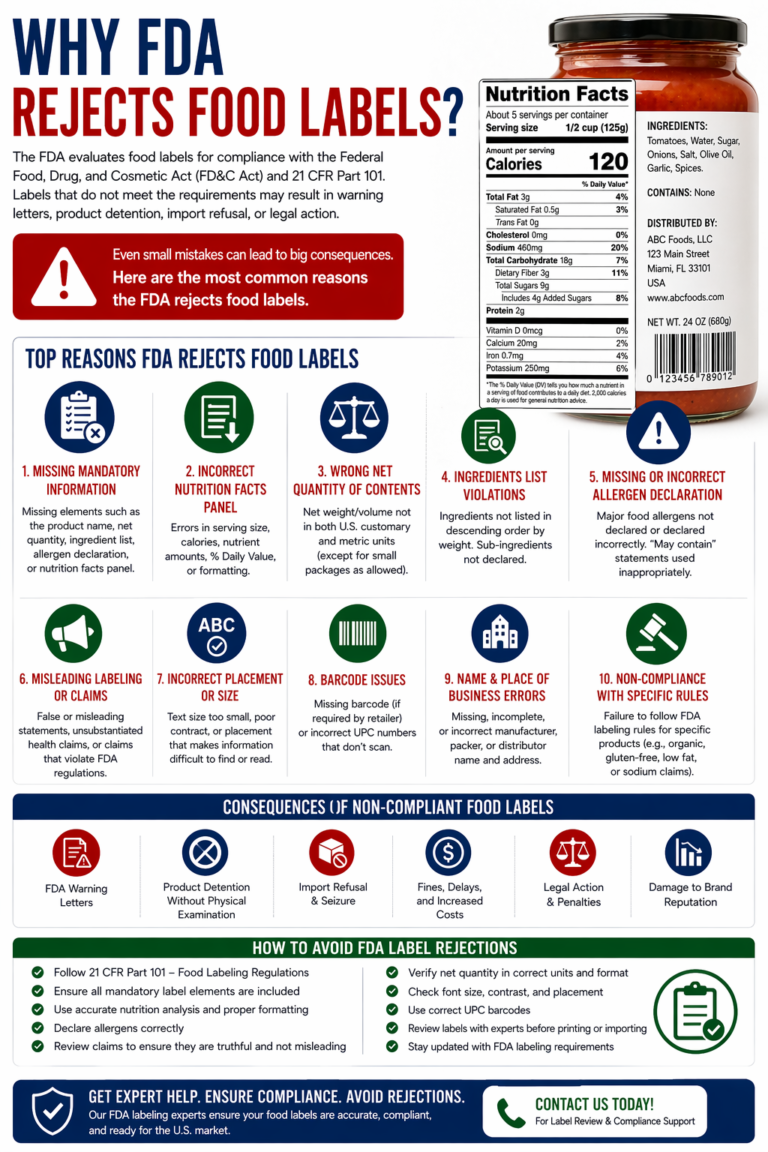
Why FDA Rejects Food Labels
One of the most common reasons food products are delayed, detained, or refused entry into the United States is labeling non-compliance. Understanding exactly why FDA rejects food labels — and fixing those issues before your product ships — is the difference between smooth market entry and costly disruption.
Why FDA Rejects Food Labels — The 10 Most Common Violations
FDA does not reject labels arbitrarily. Rejections occur when a label fails to meet one or more specific regulatory requirements. Here are the ten most common reasons food labels are found non-compliant:
Missing Required Label Elements
Every FDA-compliant food label must include five mandatory elements: statement of identity, net quantity of contents, ingredient list, allergen declaration, and name and address of the responsible party. If even one of these elements is missing or incomplete, the label is non-compliant. This is the single most common labeling failure — particularly on imported products designed for foreign markets.
Incorrect Nutrition Facts Panel
The Nutrition Facts panel is one of the most scrutinized elements on any food label. Common violations include using an outdated panel design, incorrect nutrient values, missing required nutrients (added sugars, vitamin D, potassium), incorrect serving size, wrong type sizes, and non-standardized formatting. FDA requires specific formatting rules that differ significantly from the nutrition labeling formats used in other countries.
Undeclared or Improperly Declared Allergens
The nine major food allergens — milk, eggs, fish, shellfish, tree nuts, wheat, peanuts, soybeans, and sesame — must each be clearly declared in plain English either in the ingredient list or in a separate "Contains" statement. Undeclared allergens are the leading cause of food recalls in the United States and are treated as a serious public health risk by FDA. Sub-ingredients that contain allergens must also be declared.
Misleading or Unauthorized Claims
Claims such as "natural," "healthy," "pure," "fresh," "light," "low fat," and "high fiber" are all regulated and have specific definitions or restrictions under FDA regulations. Health claims must be specifically authorized by FDA. Nutrient content claims must meet exact criteria. Structure/function claims cannot imply disease prevention. Using any of these terms inaccurately or without substantiation is a frequent enforcement trigger.
Formatting and Placement Errors
FDA requires specific placement of label elements. The statement of identity and net quantity must appear on the principal display panel. The ingredient list, allergen declaration, Nutrition Facts panel, and responsible party information must appear on the information panel. Font size minimums apply based on label area. Net quantity must appear in the bottom 30% of the principal display panel. Placement violations are common on labels redesigned from foreign formats.
Incomplete or Incorrect Ingredient List
The ingredient list must declare all ingredients in descending order by weight. Multi-ingredient components must list their sub-ingredients in parentheses. Ingredients must use their common or usual names — not proprietary or trade names. Additives, colorings, flavorings, and processing aids must be declared when required. Ingredient lists that do not match the actual formulation are a serious violation that can trigger recall.
Non-English Labels on Imported Products
All required label elements must appear in English. Foreign language text may be included in addition to English but cannot replace it. Many imported products are rejected because their labels were designed for the country of origin and do not include English versions of required elements, or because the English translations used do not accurately reflect the required information.
Incorrect Net Quantity Declaration
The net quantity of contents must be declared in both metric and U.S. customary units. Minimum type size requirements apply based on the area of the principal display panel. The net quantity must appear in the bottom 30% of the principal display panel. Imported products frequently have net quantity declarations that use metric only, are placed in the wrong location, or use type that is too small to comply with U.S. requirements.
Failure to Meet Standards of Identity
FDA has established standards of identity for hundreds of food products — including dairy products, flour, juice, jam, and many others — that specify the required ingredients, composition, and naming rules for those products. A product labeled as "orange juice," "enriched flour," or "cheddar cheese" must meet the applicable standard of identity or be considered misbranded regardless of how it was actually made.
Incorrectly Claiming a Labeling Exemption
Some small businesses qualify for exemptions from certain Nutrition Facts panel requirements. However, exemptions have specific eligibility criteria based on annual sales and number of employees — and they are invalidated the moment any nutrient content or health claim appears on the label. Many businesses incorrectly assume they qualify for an exemption, or apply an exemption when a claim on their label has already eliminated it.
FDA Food Label Violations — At a Glance
| Violation Type | Regulation | Common Trigger | Consequence |
|---|---|---|---|
| Missing Required Elements | 21 CFR 101.3, 101.105 | Label designed for a non-U.S. market | Detention, refusal of entry, misbranding citation |
| Incorrect Nutrition Facts Panel | 21 CFR 101.9 | Outdated format, incorrect nutrients, wrong serving size | Detention, warning letter, recall |
| Undeclared Allergens | FALCPA / FASTER Act | Missing "Contains" statement, undeclared sub-ingredients | Immediate enforcement, mandatory recall |
| Unauthorized Claims | 21 CFR 101.13, 101.14 | "Natural," "healthy," unapproved health claims | Warning letter, injunction, seizure |
| Placement / Formatting Errors | 21 CFR 101.2 | Wrong panel placement, font too small | Misbranding, detention, relabeling required |
| Incomplete Ingredient List | 21 CFR 101.4 | Missing sub-ingredients, wrong order, trade names used | Detention, refusal, potential recall |
| Non-English Label | 21 CFR 101.15 | Foreign-market label imported without English version | Refusal of entry, relabeling required |
| Standards of Identity Failure | 21 CFR Parts 131–169 | Wrong product name, missing required ingredients | Misbranding, seizure, rebranding required |
The Real Cost of Non-Compliant Food Labels
Labeling problems discovered after production or at the U.S. border are far more expensive than a pre-shipment label review. Understanding the actual cost of non-compliance helps businesses prioritize label review before printing begins.
Shipment Detention & Refusal
Non-compliant labels at the U.S. border can result in detention or outright refusal of entry. The importer must either relabel the product under CBP supervision, re-export it, or destroy it. Storage, demurrage, and logistics costs accumulate rapidly while the shipment is held.
Product Recall
Allergen mislabeling and other serious labeling violations can trigger mandatory or voluntary recalls. Recalls require notifying retailers and consumers, pulling products from shelves, and managing FDA communications — costs that can reach tens of thousands of dollars or more depending on distribution scope.
Relabeling Costs
Correcting a label after production means reprinting labels, relabeling inventory, and in some cases reformatting packaging. For imported products, relabeling may need to occur under FDA supervision. A professional review before printing eliminates this cost entirely.
FDA Warning Letters
Serious or repeated labeling violations can result in FDA warning letters that become public record. Warning letters require a formal response and corrective action plan and may trigger increased scrutiny of all future shipments from that facility.
FDA Import Alert
Facilities with a pattern of labeling violations may be placed on FDA Import Alert, subjecting all future shipments to automatic detention without physical examination. Resolving an Import Alert requires a formal corrective action process.
Lost Sales & Market Delays
Shipment delays caused by labeling issues can result in missed retailer delivery windows, lost purchase orders, and retailer chargebacks. For seasonal products or time-sensitive launches, even a short delay can eliminate an entire sales cycle.
How FDA Registration Assistance Reviews Food Labels
FDA Registration Assistance provides comprehensive food label reviews designed to identify and correct every issue before products go to market. Our process covers every required element against current FDA regulations.
Step 1 — Required Elements Review
We verify that all five mandatory label elements are present, correctly formatted, and positioned on the right panel — statement of identity, net quantity, ingredient list, allergen declaration, and responsible party. We check placement, type size, and language against 21 CFR Part 101 requirements.
Step 2 — Nutrition Facts Panel Audit
We review the Nutrition Facts panel format, nutrient declarations, serving size, daily value percentages, and type specifications against 21 CFR 101.9. We flag outdated formats, missing nutrients, incorrect values, and any formatting deviations that would make the panel non-compliant.
Step 3 — Allergen Declaration Check
We review the ingredient list and "Contains" statement for complete allergen disclosure against all nine major allergens under FALCPA and the FASTER Act. We trace sub-ingredients in multi-ingredient components to identify hidden allergen risks and verify that all allergens are declared in plain English.
Step 4 — Claims Review
We review all claims on the label — nutrient content claims, health claims, structure/function claims, organic claims, gluten-free claims, and general descriptors — against the applicable FDA regulations. We identify unauthorized claims and provide guidance on how to modify or substantiate them.
Step 5 — Ingredient List Verification
We review the complete ingredient list for correct descending order by weight, proper naming conventions, sub-ingredient disclosure, additive declarations, and consistency with the product formulation. We flag trade names, missing components, and allergen-related sub-ingredient risks.
Step 6 — Final Compliance Report
We provide a written compliance report identifying all issues found, the specific FDA regulation that applies to each issue, and clear guidance on how to correct each item before production. We are available to review revised labels and confirm compliance before printing is finalized.
Avoid Costly FDA Label Rejections Before They Happen
FDA Registration Assistance reviews food, cosmetic, supplement, drug, and device labels against all applicable FDA requirements — identifying every compliance issue before your product reaches the U.S. market. Most label reviews completed within 2–3 business days.
Contact us at info@fdaregistrationassistance.com or call +1 (928) 275-8333. We have helped 1,000+ companies across 135+ countries with 15+ years of combined FDA regulatory experience.
Frequently Asked Questions — Why FDA Rejects Food Labels
1. Why does FDA reject food labels?
FDA rejects food labels when they fail to meet specific regulatory requirements under 21 CFR Part 101. Common reasons include missing required elements such as the statement of identity, net quantity, ingredient list, allergen declaration, or responsible party information. Labels can also be rejected for incorrect Nutrition Facts panel formatting, misleading claims, undeclared allergens, improper font sizes, and foreign labels that do not meet U.S. standards.
2. What are the required elements on an FDA food label?
Under 21 CFR Part 101, a compliant FDA food label must include: a statement of identity, net quantity of contents, ingredient list in descending order by weight, allergen declaration for all major food allergens, Nutrition Facts panel, and the name and address of the manufacturer, packer, or distributor. Missing any of these elements makes the label non-compliant.
3. Can a product be refused entry into the U.S. due to labeling alone?
Yes. Labeling violations are an independent basis for FDA to detain, refuse entry, or require relabeling of a food product before it can be sold in the United States. A product can be safe and properly manufactured and still be refused if the label does not comply with FDA requirements.
4. What allergens must be declared on a U.S. food label?
Under FALCPA and the FASTER Act, the nine major food allergens that must be declared are: milk, eggs, fish, shellfish, tree nuts, wheat, peanuts, soybeans, and sesame. Each must be declared in plain English either in the ingredient list or in a separate "Contains" statement.
5. What is the correct format for a Nutrition Facts panel?
The Nutrition Facts panel must comply with 21 CFR 101.9. Required nutrients include calories, total fat, saturated fat, trans fat, cholesterol, sodium, total carbohydrate, dietary fiber, total sugars, added sugars, protein, vitamin D, calcium, iron, and potassium. The panel must use specific type sizes, formatting, and the standardized vertical layout unless a specific alternative format or exemption applies.
6. What labeling claims can get a food product rejected by FDA?
Claims that are false, misleading, or unsubstantiated can result in rejection. Regulated claims include nutrient content claims (low fat, high fiber, reduced sodium), health claims, structure/function claims, and organic claims. Terms such as "natural," "healthy," "fresh," and "pure" have specific FDA interpretations and restrictions. Using these terms incorrectly is a common reason for enforcement action.
7. Do imported food labels need to be in English?
Yes. Under 21 CFR 101.15, all required label information must appear in English. Foreign language text may appear on the label in addition to English, but all required elements — including the ingredient list, allergen declarations, Nutrition Facts panel, and net quantity — must be in English and meet FDA formatting requirements.
8. What is the net quantity of contents requirement on a food label?
The net quantity of contents must state the amount of food in the container using both metric and U.S. customary units. It must appear on the principal display panel in a specific minimum type size based on the area of the principal display panel, and must be in the bottom 30% of that panel, as required by 21 CFR 101.105.
9. What happens if an allergen is not declared on a food label?
Failure to declare a major food allergen is considered misbranding under the FD&C Act and is one of the most serious labeling violations. It can result in immediate FDA enforcement action including detention, refusal of entry, mandatory recall, and public warning. Allergen mislabeling is the leading cause of food recalls in the United States.
10. Can font size cause a food label to be rejected?
Yes. FDA sets minimum type size requirements for label elements. The statement of identity, net quantity, and Nutrition Facts panel all have minimum type size requirements based on the size of the label. Labels that use type smaller than the minimum required size are non-compliant and can result in rejection.
11. What is the statement of identity on a food label?
The statement of identity is the name of the food product. It must appear on the principal display panel in bold type using the common or usual name of the food, or the standardized name established by FDA under 21 CFR Parts 131 through 169. The type must be in a size reasonably related to the most prominent printed matter on the panel.
12. Do sub-ingredients need to be listed on a food label?
Yes. When a multi-ingredient food is included as an ingredient, its sub-ingredients must generally be declared in parentheses within the ingredient list in descending order by weight. Failure to declare sub-ingredients — including those that are potential allergens — is a common compliance failure that can lead to rejection or recall.
13. Are small food businesses exempt from Nutrition Facts panel requirements?
Some small businesses may qualify for a Nutrition Facts panel exemption under 21 CFR 101.9(j) based on annual sales volume or number of employees. However, the exemption does not apply if any nutrient content or health claims are made on the label. Importers should confirm whether their products and suppliers qualify before assuming an exemption applies.
14. What is the responsible party declaration on a food label?
The responsible party declaration is the name and place of business — including city, state, and ZIP code — of the manufacturer, packer, or distributor. It must appear on the information panel. If the named party is not the actual manufacturer, the label must use qualifying language such as "Manufactured for" or "Distributed by."
15. What is the difference between a health claim and a structure/function claim?
A health claim describes a relationship between a food substance and a disease or health condition and must be authorized by FDA or based on a qualified claim. A structure/function claim describes how a nutrient or ingredient affects the normal structure or function of the body and does not require FDA pre-authorization but must not imply disease prevention or treatment.
16. Can the word "natural" be used on a food label?
FDA has not formally defined "natural" for food labeling but considers it to mean that nothing artificial or synthetic has been included in or added to the food that would not normally be expected. Products using the term "natural" that contain artificial ingredients, synthetic additives, or highly processed components may be challenged as misleading.
17. What are the labeling rules for organic claims?
Organic claims are regulated by USDA under the National Organic Program. Products labeled "100% Organic," "Organic," or "Made With Organic [ingredient]" must comply with USDA certification requirements. Making organic claims without proper USDA certification can result in regulatory action from USDA and may also trigger FDA review if the claim is considered misleading.
18. Do gluten-free claims require FDA compliance?
Yes. Products labeled "gluten-free" must comply with FDA's gluten-free labeling rule under 21 CFR 101.91, which requires that the product contains less than 20 parts per million (ppm) of gluten. Making a gluten-free claim without meeting this standard is a labeling violation that can result in enforcement action or recall.
19. What labeling issues most commonly cause food recalls?
The most common labeling-related causes of food recalls in the United States are undeclared allergens — particularly milk, wheat, peanuts, tree nuts, and sesame. Other common recall triggers include incorrect ingredient declarations, undeclared sub-ingredients containing allergens, wrong net quantity, and misleading statements about product composition.
20. How long does a professional label review take?
FDA Registration Assistance typically completes food label reviews within 2 to 3 business days depending on the complexity of the product and number of labels submitted. Expedited review may be available for time-sensitive shipments. Early label review before production is always recommended to avoid costly reprints and delays.
21. What CFR regulations govern FDA food labeling?
The primary FDA food labeling regulations are found in Title 21 of the Code of Federal Regulations. 21 CFR Part 101 covers food labeling generally, including the Nutrition Facts panel, ingredient lists, allergen declarations, and claims. 21 CFR Part 102 covers common or usual names. 21 CFR Parts 131 through 169 cover standards of identity for specific food categories.
22. Does FDA review food labels before a product is sold?
No. FDA does not pre-approve most food labels before a product goes to market. Food manufacturers and importers are responsible for ensuring their labels comply with FDA regulations before marketing or importing. FDA may take enforcement action after a product is on the market or at the time of import if label violations are discovered.
23. What is the principal display panel on a food label?
The principal display panel is the part of a food label most likely to be displayed under customary retail conditions. It must bear the statement of identity and net quantity of contents. For most containers it is the front-facing panel. The information panel — immediately to the right of the principal display panel — must contain the ingredient list, allergen declaration, Nutrition Facts panel, and responsible party information.
24. Can FDA Registration Assistance help fix label compliance issues?
Yes. FDA Registration Assistance provides professional label review services for food, cosmetics, dietary supplements, drugs, and medical devices. We identify compliance gaps, provide clear correction guidance, review claims and ingredient declarations, and help ensure your final label meets all FDA requirements before products are imported or marketed in the United States.
25. Why should I review my food label before production?
Reviewing your food label before production prevents costly relabeling, shipment delays, import refusals, and potential recalls. Label changes after production require reprinting, relabeling, and in some cases discarding non-compliant inventory. A professional label review before printing is the most cost-effective way to ensure FDA compliance and protect your U.S. market entry.