
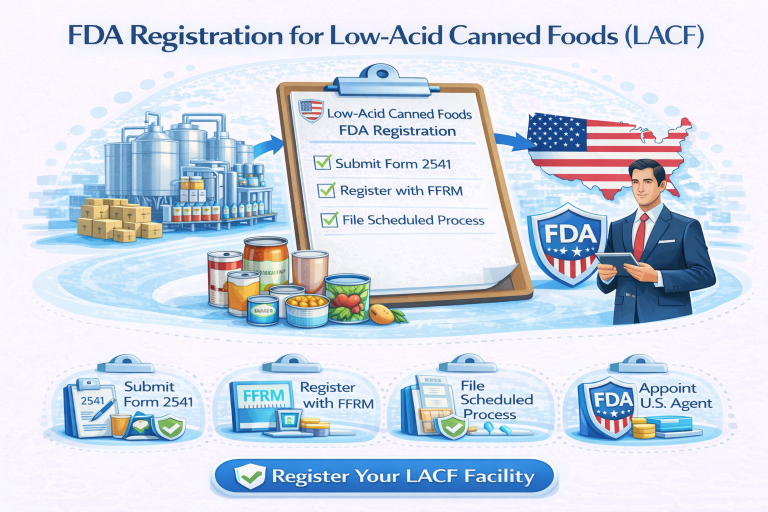
FDA Registration for Low-Acid Canned Foods (LACF)
The registration is the paperwork. The scheduled process — proving your product is safe from botulism — is the substance.
Key Takeaways
- LACF = pH > 4.6 AND water activity > 0.85, hermetically sealed, made shelf-stable by thermal processing.
- The hazard is botulism — the whole regime exists to reliably destroy C. botulinum spores.
- Three requirements: food facility registration (3537), FCE registration (2541), and a scheduled process filing (SID).
- The scheduled process is set by a qualified process authority, per product and container.
- Supervisors need Better Process Control School training (21 CFR 113).
- Governed by 21 CFR 108 (permit control) and 113 (thermally processed LACF).
What Counts as a Low-Acid Canned Food
A food is LACF when it meets both thresholds and is sealed for shelf stability:
pH > 4.6
Finished equilibrium pH above 4.6 (not acidic enough to suppress C. botulinum on its own).
Water activity > 0.85
Enough available moisture to support microbial growth.
Hermetically sealed
A container that keeps out microorganisms and holds a vacuum/seal — cans, jars, pouches, aseptic packs.
Why LACF Rules Are So Strict
Low acidity, high moisture, and an oxygen-free sealed container are precisely the conditions in which Clostridium botulinum spores can germinate and produce botulinum toxin — one of the most lethal substances known. The thermal process (the "botulinum cook") must be severe enough to reliably destroy those spores and achieve commercial sterility. Because an under-process can be deadly and invisible, FDA doesn't leave the process to chance: it must be scientifically established and filed before you produce for the U.S. market.
The Three LACF Requirements
| Requirement | What it is | Form |
|---|---|---|
| Food facility registration | Bioterrorism Act registration of the facility (biennial) | Form 3537 |
| FCE registration | Food Canning Establishment registration under Part 108 — gives your FCE number | Form 2541 |
| Scheduled process filing | The thermal process for each product/container — each filing gets an SID | 2541d / 2541f / 2541g |
Process Authority & Better Process Control School
Process authority
A qualified expert who establishes (or reviews) the scheduled process for your product and container — the science behind your filing. FDA expects the process to be set by a competent process authority, with documentation to support it.
Better Process Control School
Under 21 CFR 113, thermal processing, container closure, and related operations must be supervised by someone who has satisfactorily completed an FDA-recognized Better Process Control School course. It's a people requirement, not just a paperwork one.
How to Complete LACF Registration
Confirm the product is LACF
Finished pH above 4.6 and water activity above 0.85 in a hermetically sealed container.
Complete food facility registration
Register the facility (Form 3537) under the Bioterrorism Act; foreign facilities designate a U.S. Agent.
Register the FCE
Register the Food Canning Establishment under Part 108 using Form 2541 to obtain your FCE number.
Establish the scheduled process
A process authority determines the process for each product/container that achieves commercial sterility.
File the process (get an SID)
File using the form for your method — 2541d, 2541f, or 2541g — receiving a Submission Identifier (SID).
Train supervisors & maintain
Ensure Better Process Control School supervision, keep records, and update filings when products or processes change.
Get Your LACF Registration & Process Filing Right
FDA Registration Assistance completes food facility registration and FCE registration, coordinates the scheduled process with a process authority, files it to obtain your SID, provides U.S. Agent service for foreign facilities, and manages renewals and updates.
Contact us at info@fdaregistrationassistance.com or call +1 (928) 275-8333. Trusted by LACF processors across 135+ countries, with 15+ years of FDA experience.
Frequently Asked Questions — LACF Registration
1. What is a low-acid canned food (LACF)?
A food (other than alcoholic beverages) with a finished equilibrium pH above 4.6 and water activity above 0.85, in a hermetically sealed container, made shelf-stable by thermal processing. Canned vegetables, meats, seafood, soups, sauces, and pet food are typical.
2. Why are LACF products so tightly regulated?
Their low-acid, high-moisture, sealed environment is where Clostridium botulinum can grow and produce a deadly toxin if underprocessed. The thermal process must reliably achieve commercial sterility, so FDA requires processes to be scientifically established and filed.
3. Is food facility registration enough for LACF?
No. You also need FCE registration (Form 2541) under Part 108 and a scheduled process filing for each product. All three pieces are required — the facility registration alone doesn't make you compliant.
4. What is an FCE?
Food Canning Establishment — the registration a LACF or acidified processor completes using Form FDA 2541, assigning an FCE number that identifies the establishment. It's separate from and additional to food facility registration.
5. What is an SID and a scheduled process?
A scheduled process is the specific thermal process — time, temperature, and critical factors — established by a process authority to make a product commercially sterile. Filing it with FDA generates a Submission Identifier (SID), filed per product and container size.
6. Which process filing form does a LACF use?
By method: Form 2541d (low-acid retorted), 2541f (water activity/formulation control), or 2541g (low-acid aseptic). Acidified foods use 2541e — see our acidified food guide.
7. What is a process authority?
A person or organization with expert knowledge of thermal processing who establishes or reviews your scheduled process. FDA expects the process to be determined by a qualified process authority, whose documentation supports your filing.
8. What is Better Process Control School?
FDA-recognized training that supervisors of thermal processing, acidification, and container closure must complete. Under 21 CFR 113, LACF processing must be supervised by a graduate of an approved course.
9. Who must complete LACF registration?
Any commercial processor — domestic or foreign — that manufactures, processes, or packs LACF for U.S. commerce. Foreign facilities also designate a U.S. Agent; contract manufacturers and private-label firms controlling the process may have obligations too.
10. What's the legal basis?
21 CFR 108 (Emergency Permit Control, with the registration and process-filing mandate at 108.35) and 21 CFR 113 (thermally processed LACF in hermetically sealed containers). Acidified foods fall under Part 114.
11. Can I export LACF without filing the process?
No. A processor may not process LACF for U.S. commerce until Form 2541 and the applicable process filing form are filed. Shipping without them risks detention, refusal, and import alert.
12. Do foreign LACF processors need a U.S. Agent?
Yes — like any foreign food facility, they designate a U.S. Agent as part of registration, and the agent completes FDA's consent verification. See our food U.S. Agent page.
13. How does renewal work?
The food facility registration renews biennially (even-year Oct–Dec, no FDA fee). The FCE registration and process filings are maintained and updated when your establishment, products, or processes change — not on the biennial cycle.
14. Does LACF registration mean "FDA approved"?
No. FDA doesn't "approve" LACF products. Registering the establishment and filing the process are compliance steps; calling the product "FDA approved" is inaccurate.
15. How does FDA Registration Assistance help?
It completes food facility and FCE registration, coordinates the scheduled process with a process authority, files it for your SID, provides U.S. Agent service, and manages renewals — for LACF processors across 135+ countries.
16. How do I get started?
Contact FDA Registration Assistance at info@fdaregistrationassistance.com or call +1 (928) 275-8333 with your product and process details for a clear plan.