
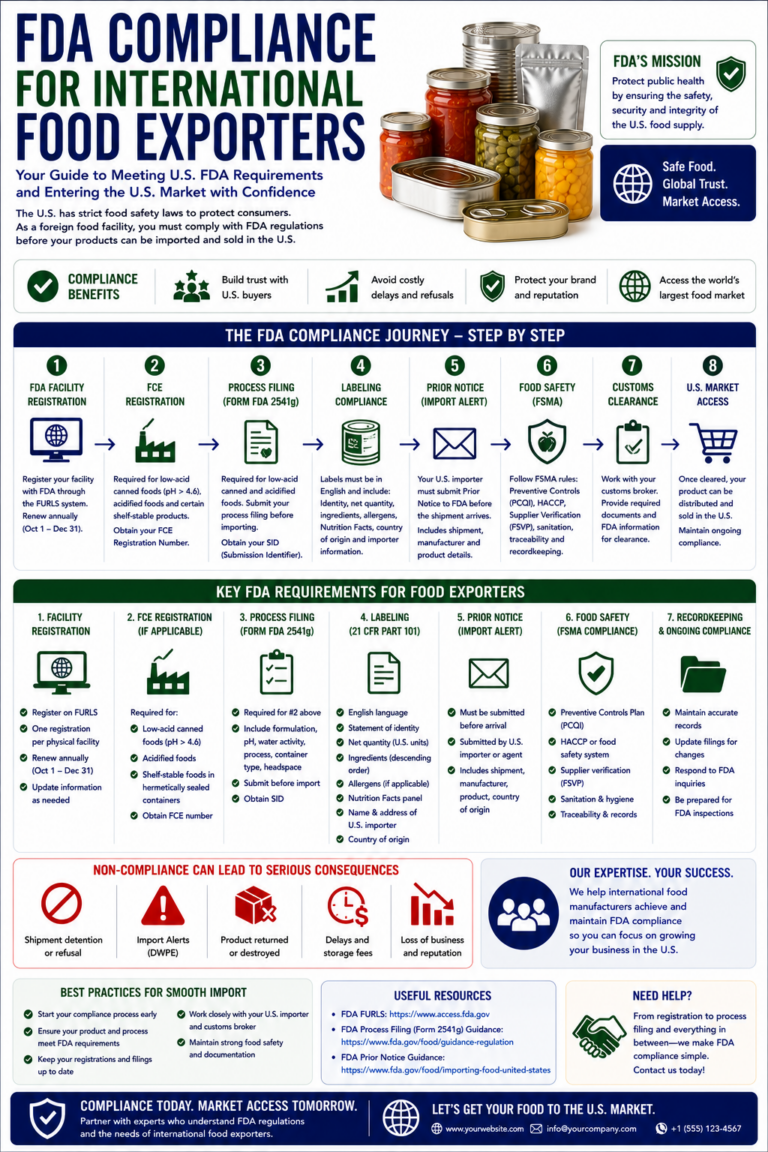
FDA Compliance for International Food Exporters
Many exporters complete registration, assume they're done, and get stopped at the port because a canned or acidified product also needed FCE and SID. Here's how classification drives your obligations — and what the process filing actually involves.
Key Takeaways
- Classification comes first — pH, water activity, packaging, and storage decide which filings your product needs.
- Low-acid canned foods (pH > 4.6, aw > 0.85, hermetically sealed, shelf-stable) fall under 21 CFR 113.
- Acidified foods (low-acid, acidified to pH ≤ 4.6) fall under 21 CFR 114.
- Both need FCE registration (Form FDA 2541) + SID scheduled-process filings — on top of facility registration.
- Only the processor can file FCE/SID — not the importer, broker, or distributor.
- A Process Authority must validate the scheduled process for each product and container variation.
- Everything else — registration, U.S. Agent, FSVP, Prior Notice, labeling — still applies on top.
Product Classification Determines Everything
Before registration, before filings, you have to know what your product is in FDA's terms. The key variables are finished equilibrium pH, water activity (aw), the container (hermetically sealed or not), and storage (shelf-stable, refrigerated, or frozen):
| Category | Defining characteristics | Regulation | FCE + SID? |
|---|---|---|---|
| Low-acid canned food (LACF) | Finished pH > 4.6 and aw > 0.85; thermally processed; hermetically sealed; shelf-stable | 21 CFR 113 | Yes |
| Acidified food (AF) | Low-acid food acidified to finished pH ≤ 4.6; aw > 0.85; hermetically sealed; shelf-stable | 21 CFR 114 | Yes |
| Naturally high-acid food | Natural pH ≤ 4.6 (not acidified) — e.g., many juices, jams | 21 CFR 101 + category rules | No* |
| Refrigerated / frozen | Not shelf-stable; relies on cold chain | Part 117 (PC) + category rules | No* |
FCE & SID, Explained
FCE — Food Canning Establishment
Registers the establishment that makes, processes, or packs LACF or acidified foods in hermetically sealed containers, via Form FDA 2541. It's separate from Food Facility Registration — in fact FDA's FCE system only opens once your facility registration flags you as an acidified/low-acid processor.
SID — Scheduled Process Filing
Each scheduled process — the exact time, temperature, pH, water activity, and container specs needed for commercial sterility — is filed on the Form FDA 2541 series and receives a SID (Submission Identifier). Generally one filing per product and container variation.
Where FCE/SID Fits Among Your Obligations
Classification and process filing are the piece this page owns — but they sit inside a larger stack. Here's the whole picture, with links to go deep on each:
Classify the product
pH, water activity, container, storage → LACF, acidified, high-acid, or refrigerated/frozen. Determines everything below.
Food Facility Registration + U.S. Agent
Required for every exporter. See facility registration and U.S. Agent.
FCE registration + SID filings (if LACF/AF)
Form FDA 2541 for the establishment; the 2541 series for each validated scheduled process. Only the processor can file.
Labeling (21 CFR Part 101)
Must match the formulation and filing. See labeling requirements and the exporter labeling guide.
Prior Notice
Filed before each shipment arrives, referencing your registration number.
The Most Common Compliance Mistakes
Registration only
Completing facility registration but skipping FCE/SID for a canned or acidified product.
Misclassification
Getting pH/aw or the acidified-vs-low-acid call wrong, leading to the wrong filings.
One SID for everything
Assuming a single filing covers every product and container variation.
Importer tries to file
Expecting a broker or importer to file FCE/SID — which they legally cannot.
No Process Authority
Filing a scheduled process that wasn't established and validated by a qualified authority.
Label ≠ filing
A label that describes the product differently than the formulation and scheduled process on file.
The Compliance Sequence for International Exporters
Classify the product
Use pH, water activity, packaging, and storage to determine the category — it decides everything that follows.
Food Facility Registration + U.S. Agent
The baseline for any exporter — separate from, and required before, FCE.
Register as an FCE (if LACF/AF)
Register the establishment via Form FDA 2541 for canned or acidified products.
Process Authority validates the process
A qualified authority establishes the scheduled process for each product and container variation.
File scheduled processes (SID)
Submit the 2541-series filings so each variation gets its SID before export.
Labeling, FSVP & Prior Notice
Confirm the label matches the filing, the importer's FSVP is in place, and Prior Notice is filed per shipment.
Get Every Filing Right Before You Export
FDA Registration Assistance classifies your product, completes Food Facility Registration and U.S. Agent designation, handles FCE registration and SID filings, coordinates with Process Authorities to validate your scheduled processes, reviews your label, and guides FSVP and Prior Notice — the whole stack, before your shipment is ever at risk.
Contact us at info@fdaregistrationassistance.com or call +1 (928) 275-8333. Trusted by 1,000+ clients across 135+ countries, with 15+ years of FDA experience.
Frequently Asked Questions — FDA Compliance for International Food
1. What does FDA compliance mean for international food exporters?
Meeting the full set of FDA requirements for U.S. import, which depends on your product. Every exporter needs Food Facility Registration, a U.S. Agent, a compliant label, an importer FSVP where required, and Prior Notice. Low-acid canned and acidified foods additionally need FCE registration and SID filings. Correct classification is the first step.
2. Why does product classification come first?
Because it decides which filings you need. LACF (pH > 4.6, aw > 0.85, sealed, shelf-stable) falls under 21 CFR 113; acidified foods (acidified to pH ≤ 4.6) under 21 CFR 114 — both need FCE/SID. Refrigerated, frozen, or naturally high-acid products generally don't. Misclassification is a common cause of holds.
3. What is a low-acid canned food (LACF)?
A thermally processed food with finished equilibrium pH > 4.6 and water activity > 0.85, in a hermetically sealed container, stored at room temperature. Because under-processing risks Clostridium botulinum, LACF are regulated under 21 CFR 113 and need a validated scheduled process. Examples: canned vegetables, soups, ready-to-eat meals.
4. What is an acidified food?
A low-acid food with acid or acidic ingredients added to reach finished pH ≤ 4.6, water activity > 0.85. Regulated under 21 CFR 114. Examples: pickles, many salsas, some sauces, marinated vegetables. Like LACF, they need FCE and SID.
5. What is FCE registration?
Food Canning Establishment registration — of the establishment making, processing, or packing LACF or acidified foods in hermetically sealed containers, via Form FDA 2541. It's separate from and additional to Food Facility Registration.
6. What is a SID (scheduled process filing)?
A SID (Submission Identifier) is assigned to each scheduled-process filing. The scheduled process specifies time, temperature, pH, water activity, and container specs for commercial sterility, validated by a Process Authority, filed on the Form FDA 2541 series — generally one per product and container variation.
7. Is FCE the same as Food Facility Registration?
No — confusing them is a frequent, costly mistake. Facility Registration (21 CFR Part 1, Subpart H) is the baseline; FCE/SID is an extra layer only for LACF and acidified foods. FDA's FCE system only opens once your facility registration flags you as an acidified/low-acid processor.
8. Who can file FCE and SID — can my importer do it?
Only the commercial processor can file. Importers, wholesalers, distributors, brokers, and repackagers cannot. A foreign processor of canned or acidified foods must handle its own FCE and SID before export.
9. What is a Process Authority and do I need one?
A qualified expert who establishes and validates the scheduled thermal or acidification process. FDA requires scheduled processes be developed by a Process Authority, and your SID filing reflects that validated process for each product and container variation.
10. Do these filings apply to foreign facilities?
Yes — FCE and SID apply to both U.S. and foreign facilities that make, process, or pack LACF or acidified foods for the U.S. market. You cannot rely on your importer to file them.
11. How many SID filings do I need?
Generally one per product and container variation. Different products, container sizes, or processing methods typically each need their own validated scheduled process and SID.
12. What regulations govern canned and acidified foods?
LACF under 21 CFR 113, acidified foods under 21 CFR 114; the registration/filing duties sit in 21 CFR 108, with CGMP under Part 117 and labeling under 21 CFR 101.
13. What are the other core requirements for exporters?
An active Food Facility Registration and U.S. Agent; a compliant label; the importer's FSVP where required; and Prior Notice per shipment. These apply to every product category.
14. Do I need a U.S. Agent?
Yes — every foreign facility must designate a U.S. Agent as part of registration, serving as FDA's domestic contact. Required in addition to any FCE/SID.
15. What is FSVP and who is responsible?
The importer's obligation to verify foreign suppliers meet U.S. safety standards. Not the exporter's legal duty, but the importer needs your documentation — including scheduled processes for canned/acidified foods.
16. What is Prior Notice?
An electronic notice filed with FDA before each shipment arrives, referencing your registration number. Required for essentially every FDA food import, usually filed with the CBP entry. Separate from classification, FCE, and SID.
17. Does my label have to match my filings?
Yes. The label must be consistent with the formulation and scheduled process on file, and meet 21 CFR 101. A mismatch can trigger a hold.
18. What are the most common compliance mistakes?
Registration but no FCE/SID; misclassification; one SID for all variations; expecting the importer to file; no Process Authority; and a label that doesn't match the filing. Each can cause a hold or refusal.
19. Can I fix compliance gaps after shipping?
Usually no. Registration, FCE, SID, labeling, and Prior Notice must be complete before export. A shipment flagged for a missing filing or misclassification is slow and costly to resolve, and may be refused.
20. How long does FCE and SID filing take?
It depends most on the Process Authority validating each scheduled process — often the longest step — plus registering the establishment and filing. Start well before your first intended shipment; it can't be rushed at the port.
21. Do refrigerated or frozen foods need FCE and SID?
Generally no — FCE/SID apply to shelf-stable LACF and acidified foods in hermetically sealed containers. Refrigerated, frozen, and naturally high-acid foods follow a different path but still need registration, labeling, FSVP where applicable, and Prior Notice.
22. Is professional assistance necessary?
Not legally required, but strongly advisable for canned and acidified foods. Classification, Process Authority coordination, FCE, and multiple SID filings are technical and unforgiving, and a misfiled process at the port costs far more than getting it right up front.
23. How does FDA Registration Assistance support exporters?
It classifies the product, completes registration and U.S. Agent, handles FCE and SID, coordinates Process Authorities, reviews labels against 21 CFR Part 101, and guides FSVP and Prior Notice — so the whole stack is ready before export.
24. How do I get started?
Contact FDA Registration Assistance at info@fdaregistrationassistance.com or call +1 (928) 275-8333. Share your product details — pH, water activity, packaging, processing method — and facility information, and your compliance path, including any FCE/SID needs, is mapped before you ship.