
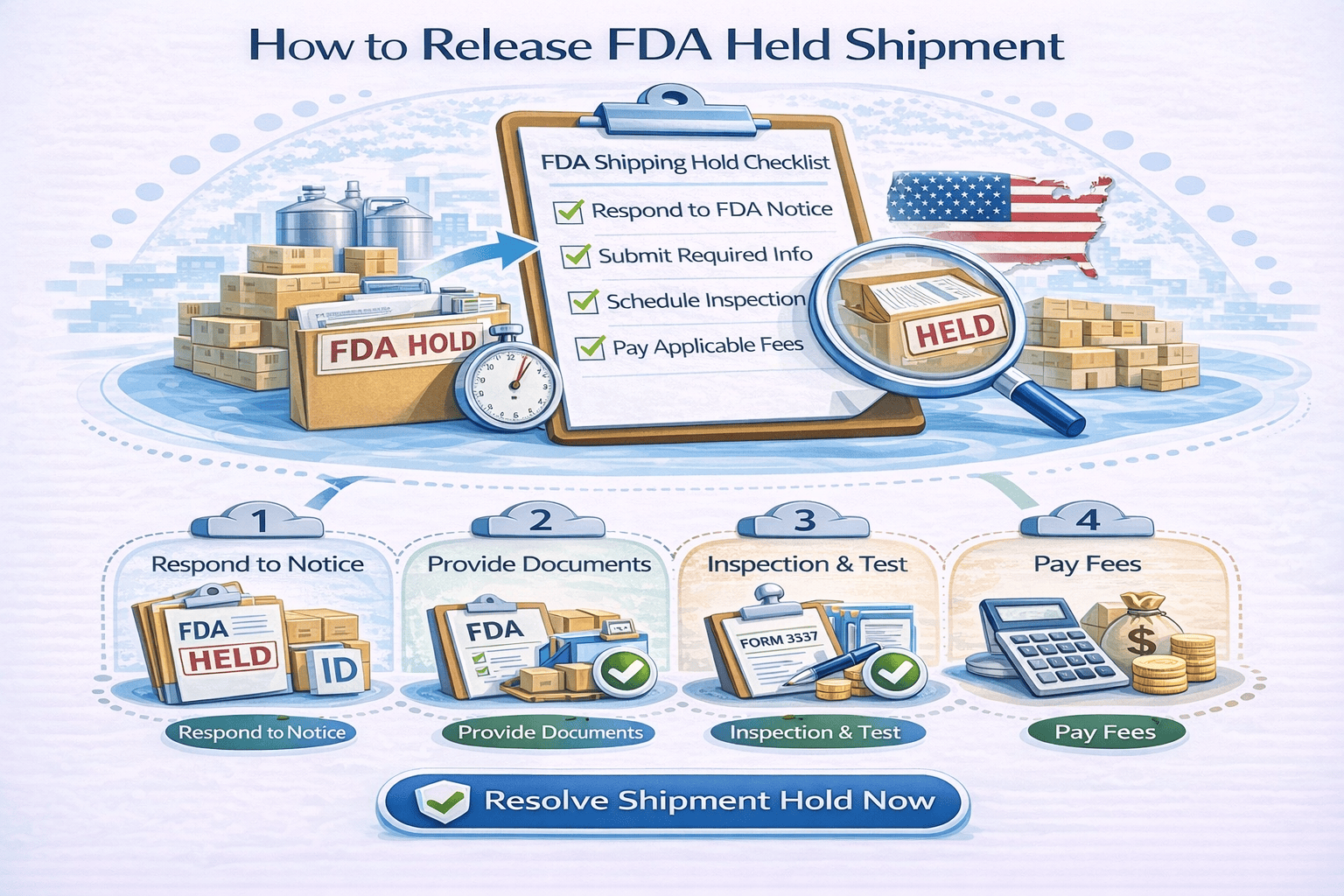
How to Release an FDA-Held Shipment
An FDA hold means FDA has not let your shipment proceed. It may be under review, waiting for documents, set for examination or sampling, or formally detained. A detained shipment is released by answering the Notice of FDA Action by its respond-by date, with evidence or an approved reconditioning plan.
Shipment on FDA hold right now? We read the notice, confirm the deadline and prepare the response.
Get Help With an FDA HoldWhat Each FDA Hold Status Means
| Status | What it means | What to do |
|---|---|---|
| FDA review | The entry is being screened | Wait; make sure entry data is complete |
| Documents required | FDA needs paperwork | Upload in ITACS quickly |
| Hold for exam or sampling | FDA will inspect or test the goods | Keep goods intact; give the goods location |
| Detained | Notice of FDA Action with a respond-by date | Respond with evidence or a reconditioning request |
| May Proceed or Released | FDA is done with the shipment | Goods can move |
| Refused | FDA's final decision | Export or destroy within 90 days |
Based on FDA's import actions page, FDA's examination and sampling page and FDA's import refusals page.
How to Get an FDA-Held Shipment Released
Common Reasons for an FDA Hold
Labeling
Missing English labeling, Nutrition Facts or allergen declarations. Often fixable by relabeling.
Contamination
Pathogens, pesticides, heavy metals or filth. Usually needs private lab results.
Registration
Unregistered facility, missing U.S. Agent or listing problems.
Process filings
Canned or acidified foods without FCE or SID filings.
Unapproved products
Drugs or devices without required approval or clearance.
Import alert
The firm or product is on an alert and detained without examination.
Need samples pulled and tested for a detained held shipment? Our sister company, FDA Detention Sampling, coordinates sample collection, chain of custody and testing with LAAF-accredited laboratories nationwide. Call +1 (786) 561-3726.
Detention and Import Alert Resources
FDA Detention Response
The full step-by-step guide.
Detention Assistance
Hands-on help with a detained shipment.
Import Refusal Prevention
Stop future holds and refusals.
Import Alert Help
When shipments are detained automatically.
DWPE Explained
Detention without physical examination.
Label Review
Fix label problems before relabeling.
Get Your Held Shipment Moving
We read your Notice of FDA Action, confirm the charge and deadline, choose the right path, coordinate lab testing, prepare the response or reconditioning request and communicate with the FDA compliance officer. Release is FDA's decision and is not guaranteed. We are an independent compliance firm, not FDA and not a law firm.
- Fast review of your Notice of FDA Action.
- Evidence and reconditioning packages.
- Root-cause fix so it does not happen again.
Contact our specialists, email info@fdaregistrationassistance.com, or call +1 (928) 275-8333. Detention guide · Import alert help · Contact.
Get Help With an FDA HoldFDA Registration Assistance is a private consulting firm, not FDA or any government agency. FDA registration is not FDA approval, clearance or certification.
Frequently Asked Questions — Releasing an FDA-Held Shipment
How do I release an FDA-held shipment?
An FDA-held shipment is a detained shipment, you release it by responding to the Notice of FDA Action by its respond-by date (usually 10 business days) with evidence that the product complies, or by reconditioning it (mainly for labeling), so FDA issues a "May Proceed"/"Released" notice. If you don't respond or can't overcome the violation, the product is refused and must be exported or destroyed. For the full step-by-step, see our FDA detention response guide.
Is a "held" shipment the same as a "detained" shipment?
Yes, in everyday terms, an "FDA-held" shipment is an FDA-detained shipment: FDA has held it at entry because it appears to violate FDA law, and has issued a Notice of FDA Action marked "Detained." The release process is identical to responding to a detention. Our detention response guide covers exactly what the notice means and how to get the shipment released.
How long do I have to act?
The respond-by date on your Notice of FDA Action is the deadline, FDA's Regulatory Procedures Manual allows 10 business days from the detention (sometimes up to about 20 calendar days). It's the deadline to respond, not to finish all testimony, so if you're arranging private-lab testing, notify FDA before the date. Missing the deadline moves the shipment toward refusal. See our detention response guide for how to respond in time.
What are my options to get it released?
Three paths: release (submit evidence/testimony that the product complies, e.g., private-lab analysis or documentation rebutting the charge), reconditioning (mainly relabeling to fix a labeling violation; FDA must approve the plan before work and re-examines after), or, if you can't overcome it, refusal (export or destroy within 90 days). The right path depends on the exact violation cited. Our detention response guide walks through each.
What if it was held for a labeling problem?
Labeling violations are often fixable through reconditioning, typically relabeling under an approved application (Form FDA-766), with FDA re-examining before release. This is one of the most salvageable situations, yet it's underused because importers assume a hold means total loss. See our detention response guide and label review page for how to correct the label and document it.
What if it was held for contamination or a test result?
For adulteration/contaminant charges, releasing the shipment usually requires private-laboratory analysis showing the product is within limits, submitted as testimony. Notify FDA before the respond-by date that testing is underway. If the product is genuinely out of compliance, it may not be salvageable. Our detention response guide and sampling/testing page explain how this works.
What happens if I can't get it released?
If you don't respond in time or can't overcome the violation, FDA refuses admission and the goods must be exported or destroyed within 90 days under CBP/FDA supervision. A refusal is recorded and raises future risk, and reversing it is much harder than responding to the original hold. That's why acting within the response window is critical. See our detention response guide.
Does being held mean I'm on an import alert?
Not necessarily. A single held/detained shipment is a per-shipment action. An import alert is a standing directive that automatically detains a firm's or product's future shipments (Detention Without Physical Examination). A pattern of holds and refusals can lead to an import alert, but one hold doesn't mean you're on one. If your shipments are being detained automatically, see our import alert help page.
Can you guarantee my shipment will be released?
No, release is FDA's decision and depends on the facts. If the product complies and you prove it (or recondition successfully), release is likely; if it's genuinely non-compliant, it may not be. Be wary of anyone promising "guaranteed release." What helps is responding correctly and on time and matching evidence to the exact charge, covered in our detention response guide.
Who receives the FDA hold notice?
The Notice of FDA Action is sent to the importer of record, owner, consignee, and the customs broker. If your broker received it, get a copy immediately, the respond-by date runs from the detention, and you need to act on it. Our detention response guide explains how to read the notice and respond.
Can I fix the product and resubmit?
Sometimes, through reconditioning, which is the formal process for bringing a held product into compliance (e.g., relabeling), with FDA approving the plan first and re-examining after. You can't simply alter the goods on your own and expect release; the correction must go through FDA's process. See our detention response guide for how reconditioning works.
Is a refused shipment a total loss?
Not always, a refused shipment must be exported or destroyed within 90 days, but re-exporting can sometimes create a duty-drawback opportunity on duties already paid (ask your broker). Still, responding on time to avoid refusal is far better than salvaging value afterward. Our detention response guide covers the full picture.
How do I keep shipments from being held?
Prevention: correct FDA registration and (for foreign firms) a valid U.S. Agent; compliant labeling and claims; genuine product safety and, for food, FSVP and Prior Notice; and prompt handling of any early FDA action. For prevention and the broader detention/refusal process, see our import refusal prevention and detention help page.
Where's the full guide?
See our FDA detention response guide, "FDA Detained My Shipment, What to Do", it covers the Notice of FDA Action, your respond-by deadline, the three paths (release, reconditioning, refusal), and how to respond in time. This page is a short overview; that guide has the detail.
Is this urgent?
Yes. A held shipment is on a clock, the respond-by date runs from the detention, and missing it typically leads to refusal, after which options narrow sharply. If you've received a Notice of FDA Action, act now: read it, identify the violation and deadline, and respond (or get help) before the date. See our detention response guide and contact us right away.
How does FDA Registration Assistance help release a held shipment?
We provide emergency detention response: reading your Notice of FDA Action to pinpoint the violation and deadline, choosing the right path (release with evidence, reconditioning, or export/destruction), coordinating private-lab testing where needed, preparing the response/testimony and any reconditioning application, and communicating with the FDA compliance officer before the respond-by date, while being clear release is FDA's decision and not guaranteed. We're an independent compliance firm serving 1,000+ companies across 135+ countries with 15+ years of experience. Contact info@fdaregistrationassistance.com or +1 (928) 275-8333.
What does FDA hold mean?
An "FDA hold" means FDA has not yet allowed your imported shipment to proceed. It can mean the entry is still under review, FDA has requested documents, the goods are being held for examination or sampling, or FDA has formally detained them. While on hold the goods must stay intact and must not be distributed; if they are, FDA can ask CBP to demand redelivery (FDA's import actions page).
What do the FDA entry statuses mean?
FDA review means the entry is being screened. Documents required means FDA needs paperwork, usually uploaded in ITACS. Hold for examination or sampling means FDA plans to inspect or test the goods. Detained means a Notice of FDA Action has been issued with a respond-by date. May Proceed or Released means FDA has finished with the shipment. Refused is FDA's final decision that the goods cannot enter.
How do I check the FDA hold status of my shipment?
Use FDA's ITACS with the CBP entry number. It shows the status of each line, lets you upload requested documents, tell FDA where the goods are available for exam, and see estimated lab completion dates for sampled lines (FDA's examination and sampling page). Your customs broker also receives the FDA messages.
Can I move or sell goods while they are on FDA hold?
No. Goods held for FDA examination, sampling or detention must stay intact and must not be distributed until FDA releases them. Moving or selling them can lead FDA to ask CBP to demand redelivery, and failing to redeliver can mean liquidated damages under the customs bond (FDA's import actions page).
Do I need a lawyer for an FDA hold?
Not necessarily. Most FDA holds are resolved by an administrative response to the Notice of FDA Action: documents, lab results or a reconditioning proposal, not court. We are an independent compliance firm, not a law firm, and we can work alongside your attorney if you already have one or need legal advice.
Get Help With an FDA Hold
Tell us what your company makes, sells, or distributes, where each product is manufactured or packed, your U.S. importer or buyer arrangement, label readiness, and target shipment date.
Submitting this inquiry does not purchase a service or authorize paid work. Our team can discuss the scope and required materials before you commission assistance. Fields marked with an asterisk are required.