
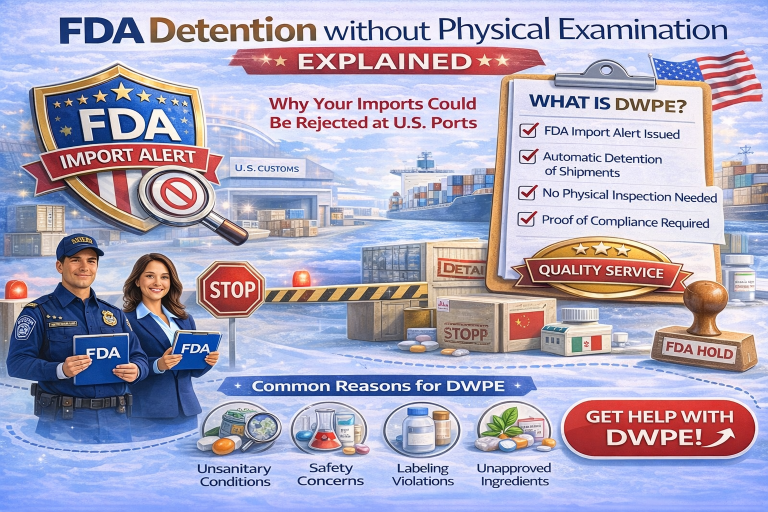
DWPE Explained: FDA Detention Without Physical Examination
DWPE doesn't expire on its own — some firms stay on for years because they never petition. Here's the whole mechanism, and the way out.
Key Takeaways
- Detain first, prove later: under 801(a), the appearance of a violation is enough — you must prove admissibility.
- Import Alerts run DWPE: the Red List is detained, the Green List is cleared, the Yellow List is intensified surveillance.
- One release ≠ off the list: a released shipment doesn't remove you — future shipments keep getting detained until you petition.
- Removal usually needs ~5 consecutive clean commercial entries plus a documented root-cause fix.
- Food lab evidence must be LAAF-accredited (since Dec 1, 2024); in-house testing is rarely accepted.
- It's indefinite — DWPE persists until you're removed, and refused goods face a 90-day export-or-destroy clock (21 CFR 1.94).
How DWPE Actually Works
DWPE isn't a random hold — it's a defined enforcement chain:
| Stage | What happens |
|---|---|
| 1. Evidence builds | Refused entries, sample failures, inspection findings, or missing compliance create the "appearance" of a violation |
| 2. Import Alert issued | FDA publishes an alert instructing field staff to detain the firm, product, or country without physical exam |
| 3. Auto-detention | Every matching entry is held at the port — no individual inspection needed |
| 4. Notice of FDA Action | You receive the charge and an opportunity to respond with evidence |
| 5. You rebut — or lose the goods | Prove admissibility (often via lab analysis) or the entry is refused: export or destroy within 90 days |
Red List, Green List, Yellow List
Every Import Alert can carry three lists. Knowing which one you're on defines your whole situation:
Red List
Firms and products subject to DWPE — detained automatically. This is where you don't want to be.
Green List
Firms and products exempt or cleared from that alert. The goal of a removal petition is to get here.
Yellow List
Intensified surveillance — subject to DWPE but able to secure release with private lab analysis.
Why Products Land on DWPE
Contamination & safety
Salmonella, pesticide residues, heavy metals, filth (insects, mold), histamine, or mycotoxins like aflatoxin.
Labeling & ingredients
Misbranding, undeclared allergens, or unauthorized color additives.
Missing compliance
No facility registration, or no FSVP for food importers.
Refusing inspection
Refusing or impeding a foreign facility inspection is one of the fastest paths to countrywide DWPE.
How to Get Off DWPE
Two different things have to happen — and they're often confused:
Release a shipment
Show a specific detained shipment is compliant (usually LAAF-accredited lab analysis for food) to get that entry released. Future shipments still get detained.
Get off the Red List
File a removal petition with FDA's Division of Import Operations — the only way to stop the automatic detentions for good.
Responding to a DWPE Detention
Identify the alert & charge
Read the Notice of FDA Action and find the exact Import Alert and violation in the FDA Import Alert database.
Release the detained shipment
Provide evidence — typically LAAF-accredited lab analysis for food — that the specific shipment is compliant.
Find & fix the root cause
Document a real root-cause analysis and specific corrective and preventive actions — not a vague promise.
Build a clean record
Import the required consecutive, commercial-size, non-violative shipments — often five — each sampled and released.
File the removal petition
Submit root cause, corrective actions, lab results, and clean-entry evidence to move from Red List to Green List.
Prevent re-listing
Maintain the corrective actions and monitor shipments so the same violation doesn't put you back on.
Resolve a DWPE Detention — and Get Off the List
Storage costs accrue and refused goods face a 90-day clock, so speed matters. FDA Registration Assistance identifies your exact Import Alert, plans the shipment release and the root-cause fix, organizes the lab and clean-entry evidence, and prepares your removal petition — while closing the FSVP, registration, or labeling gaps behind it.
Contact us at info@fdaregistrationassistance.com or call +1 (928) 275-8333. Trusted by 1,000+ importers across 135+ countries, with 15+ years of FDA experience.
Frequently Asked Questions — DWPE
1. What is FDA Detention Without Physical Examination (DWPE)?
An FDA import status that lets FDA detain shipments at the border without examining each one, based on evidence that the product, manufacturer, or country appears to violate U.S. requirements. The importer must then prove each shipment is admissible.
2. What's the legal basis for DWPE?
Section 801(a) of the FD&C Act, which lets FDA refuse articles that "appear" adulterated or misbranded. Appearance, not proof, is enough to detain — so the burden shifts to the importer to demonstrate admissibility.
3. Is DWPE the same as an Import Alert?
Closely linked but not identical. An Import Alert is FDA's published instruction to detain certain firms, products, or countries without physical exam; DWPE is the detention status it puts into effect. Being "on DWPE" means being on an alert's Red List.
4. What are the Red, Green, and Yellow Lists?
Red = firms/products subject to DWPE (detained). Green = exempt or cleared. Yellow = intensified surveillance, subject to DWPE but able to secure release with private lab analysis. A removal petition aims to move you from Red to Green.
5. Why did FDA place my product on DWPE?
Common triggers: contamination (Salmonella, pesticides, heavy metals, filth, mycotoxins), undeclared allergens, unauthorized color additives, misbranded labeling, missing registration, no FSVP, or refusing/impeding an inspection. A history of refusals or sample failures builds the "appearance" of a violation.
6. Does DWPE apply to a whole country or just my firm?
It depends on the alert — some are firm- or product-specific, some are countrywide. Countrywide alerts generally require stronger, entry-by-entry evidence to overcome.
7. Is there an Import Alert specifically for FSVP?
Yes — Import Alert 99-41 targets U.S. importers not compliant with FSVP, one of the few that puts U.S. importers (not foreign manufacturers) on the Red List. See our FSVP refusal guide.
8. If I get one shipment released, am I off DWPE?
No. Releasing a specific shipment with evidence doesn't remove you — every future shipment keeps getting detained until you file and win a separate Red List removal petition. Releasing and delisting are different.
9. How do I get removed from DWPE?
Petition FDA's Division of Import Operations to move from Red List to Green List, showing the root cause was found and fixed, usually with a record of consecutive compliant shipments and supporting lab results and documentation.
10. Why five consecutive compliant shipments?
FDA rarely accepts a single passing test as proof a problem is fixed. Many alerts require about five consecutive, commercial-size, non-violative entries — each independently sampled and released. You can't split one container to reach the count faster.
11. What lab testing does FDA accept?
For food, private testing to support release or removal generally must be from a LAAF-accredited laboratory (in effect since Dec 1, 2024). FDA maintains a directory. In-house testing is rarely accepted.
12. What documentation does a removal petition need?
A root-cause analysis, corrective and preventive actions, evidence of consecutive compliant entries, third-party lab analyses, and — depending on the violation — proof of registration/listing, audits, labeling, and certificates of analysis. Vague promises aren't accepted.
13. What happens to shipments while on DWPE?
Each is detained with a Notice of FDA Action explaining the charge and response opportunity. If you can't show admissibility, the entry is refused, and refused food generally must be exported or destroyed within 90 days (21 CFR 1.94), with storage costs accruing.
14. How long can a firm stay on DWPE?
Indefinitely — every matching shipment is detained automatically until you're removed. Some firms have stayed on for years simply because they never petitioned. DWPE doesn't expire on its own.
15. Does FDA inspect every shipment?
No. FDA uses risk-based electronic screening to decide which entries need review or detention. DWPE lets it focus on firms and products with a problem history without examining everything.
16. Can labeling problems alone cause DWPE?
Yes. Misbranded or non-compliant labeling can build the "appearance" of a violation and lead to detention even without a safety issue.
17. How is DWPE different from a one-time refusal?
A refusal affects a single entry; DWPE is ongoing — once on the Red List, every future matching shipment is detained until removal. A single refusal can be a warning sign that, if repeated, leads to DWPE.
18. How can I prevent DWPE?
Keep facility registration and FSVP current, ensure labeling is compliant, and take any sample failure or refused entry seriously before it becomes a pattern. Preventing the history is far cheaper than removal.
19. How does FDA Registration Assistance help with DWPE?
We identify the exact alert and charge, respond to detentions, coordinate root-cause and corrective actions, organize LAAF-accredited lab and clean-entry evidence, and prepare removal petitions — while fixing the underlying gaps to prevent re-listing.
20. My shipment was just detained — what should I do?
Read the Notice of FDA Action to find the alert and charge, and act fast — storage costs accrue and refused goods face a 90-day clock. Contact us at info@fdaregistrationassistance.com or +1 (928) 275-8333 to plan the release and the path off the Red List.
