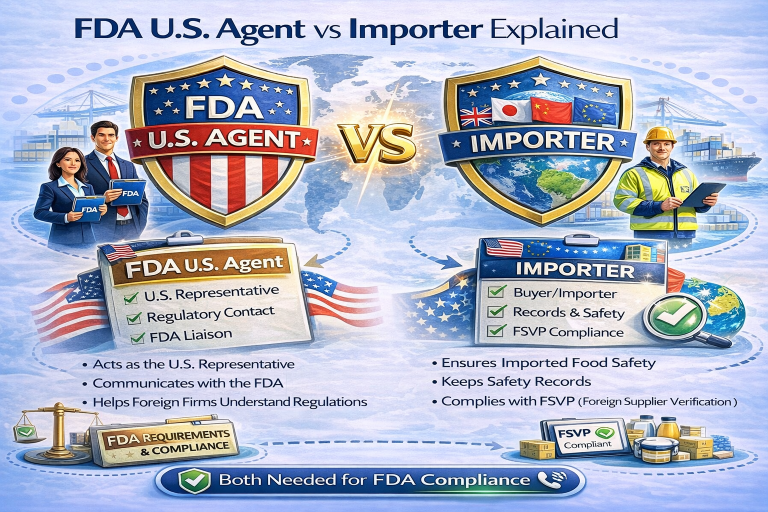
FDA U.S. Agent vs. Importer — Key Differences Explained
This guide explains both roles in precise detail: what each party does, what they don’t do, the legal basis for each, how they interact, and the three-party structure most foreign manufacturers need to understand.
FDA U.S. Agent vs. U.S. Importer — Complete Comparison
| Attribute | FDA U.S. Agent | U.S. Importer |
|---|---|---|
| Legal basis | Food: 21 CFR 1.227 & 1.232 Drugs: 21 CFR 207.69 Devices: 21 CFR 807.40 Cosmetics: MoCRA | FSVP: 21 CFR Part 1 Subpart L Prior Notice: 21 CFR Part 1 Subpart I |
| Who they represent | The foreign facility — the manufacturer or processor registered with FDA | Themselves — the U.S. owner or consignee of the goods at time of U.S. entry |
| Primary function | Receive FDA communications (Warning Letters, Form 483, inspection notices) on behalf of the foreign facility. Assist FDA in scheduling inspections (especially for drugs/devices). | Maintain FSVP for each foreign food supplier. File Prior Notice. Verify supplier FDA registration. Ensure label compliance. Bear legal responsibility for import compliance. |
| FSVP obligation | None. U.S. Agent has no FSVP obligation. | Yes. The importer is legally responsible for maintaining a compliant FSVP for each foreign food supplier. |
| Prior Notice obligation | None. U.S. Agent does not file Prior Notice. | Yes. Prior Notice is the importer’s obligation (or filed on their behalf by a customs broker). |
| Physical U.S. location required | Yes. Must have a physical U.S. address — P.O. box alone is not sufficient. Cannot be the foreign manufacturer itself. | Not required to be U.S.-located — but the FSVP importer under FDA rules is typically the U.S. owner or consignee. |
| Handles shipment logistics | No. Does not manage shipments, customs entry, or distribution. | Yes — or works with a customs broker to handle CBP entry and logistics. |
| Legal compliance responsibility | No. U.S. Agent does not bear legal responsibility for the facility’s compliance or the products. | Yes. The importer bears legal responsibility for FSVP compliance and import regulatory requirements. |
| Can the same party serve both roles | Yes — legally permitted. A U.S. importer physically located in the United States may also serve as the U.S. Agent. Most compliance professionals recommend keeping the roles separate. | |
The Three Distinct Roles in a Typical FDA-Regulated Import Supply Chain
Most foreign manufacturers entering the U.S. market need to understand three distinct parties — each with separate regulatory roles that cannot be combined without careful analysis:
Confusing any of these three roles creates compliance gaps. The most dangerous confusion: assuming a customs broker or importer is handling FDA obligations that belong to a different party.
FDA U.S. Agent Requirements by Product Category
The U.S. Agent requirement applies across all major FDA-regulated product categories, but the scope of the U.S. Agent’s responsibilities varies:
Exactly What the U.S. Agent Does — and What It Does Not Do
U.S. Agent DOES:
✓ Receive FDA communications on behalf of the foreign facility including Warning Letters, Form 483 inspectional observations, and inspection notices
✓ Assist FDA in scheduling inspections of the foreign facility (especially for drug and device U.S. Agents)
✓ Act as FDA’s point of contact when FDA has questions about the foreign facility’s registration information
✓ Maintain the U.S. Agent designation in the FURLS registration record
✓ Assist in Biennial Renewal of FDA Food Facility Registration
U.S. Agent Does NOT:
✗ File FDA Prior Notice for food shipments
✗ Manage shipment logistics or customs entry
✗ Bear legal responsibility for the facility’s compliance or for the products
✗ Maintain FSVP for U.S. importers
✗ Act as the importer of record
✗ Distribute or take possession of products
✗ Substitute for the importer’s FSVP obligation
Exactly What the U.S. Importer Does — and What It Does Not Do
Importer DOES:
✓ Maintain FSVP for each foreign food supplier — written hazard analysis, supplier verification, corrective actions, 2-year recordkeeping
✓ File or arrange filing of FDA Prior Notice before each food shipment
✓ Verify each foreign supplier’s FDA facility registration is current
✓ Ensure all imported food labels comply with 21 CFR Part 101
✓ Bear legal compliance responsibility for the imported food
Importer Does NOT:
✗ Receive FDA communications on behalf of the foreign facility — that is the U.S. Agent’s role
✗ Assist FDA in scheduling inspections of the foreign facility — that is the U.S. Agent’s role
✗ Register the foreign facility with FDA — that is the foreign facility’s obligation
✗ Eliminate the need for the foreign facility to have a U.S. Agent
Need a U.S. Agent or FSVP Compliance Support?
FDA Registration Assistance provides U.S. Agent services for foreign facilities across all regulated product categories — food, drugs, medical devices, and cosmetics. For U.S. importers, FDA Registration Assistance provides FSVP program development and FSVP Agent services, label review, and Prior Notice guidance. 1,000+ clients. 135+ countries. 15+ years of FDA regulatory experience.
Contact us at info@fdaregistrationassistance.com or call +1 (928) 275-8333.
Frequently Asked Questions — FDA U.S. Agent vs. Importer
1. What is the difference between an FDA U.S. Agent and a U.S. food importer?
The U.S. Agent is the domestic contact designated by a foreign facility for FDA communication — a registration requirement with no FSVP or Prior Notice role. The U.S. importer is responsible for FSVP compliance under 21 CFR Part 1 Subpart L, Prior Notice, and import regulatory requirements. These are separate roles with different legal bases and often different parties.
2. What does an FDA U.S. Agent actually do?
Receives FDA communications (Warning Letters, Form 483 observations, inspection notices) on behalf of the foreign facility; assists FDA in scheduling inspections (especially for drug and device facilities); acts as FDA’s point of contact for questions about registration information. Does NOT handle shipments, file Prior Notice, manage customs entry, or bear legal compliance responsibility.
3. What does a U.S. food importer do?
Maintains FSVP for each foreign food supplier; files Prior Notice; verifies each supplier’s FDA registration is current; ensures label compliance; and bears legal responsibility for FSVP compliance under 21 CFR Part 1 Subpart L. Does NOT serve as FDA’s communication contact for the foreign facility — that is the U.S. Agent’s role.
4. Who is responsible for FSVP — the U.S. Agent or the importer?
The U.S. importer. FSVP obligations under 21 CFR Part 1 Subpart L belong to the U.S. owner or consignee of the food at time of U.S. entry. The U.S. Agent has no FSVP obligation. Designating a U.S. Agent does not satisfy FSVP requirements.
5. Who is responsible for filing FDA Prior Notice — the U.S. Agent or the importer?
The importer. FDA Prior Notice under 21 CFR Part 1 Subpart I must be filed by or on behalf of the U.S. importer before each food shipment arrives. The U.S. Agent has no Prior Notice filing obligation.
6. What is the legal basis for the FDA U.S. Agent requirement?
Food: 21 CFR 1.227 and 1.232. Drugs: 21 CFR Part 207.69. Medical devices: 21 CFR Part 807.40. Cosmetics under MoCRA: Modernization of Cosmetics Regulation Act. Each regulation requires foreign facilities to designate a U.S. Agent with a physical U.S. address.
7. Can the importer also be the FDA U.S. Agent?
Yes — legally permitted. A U.S. importer physically located in the United States may serve as both the importer and U.S. Agent simultaneously. However, most compliance professionals recommend keeping the roles separate to ensure consistent, specialized FDA communication handling regardless of business relationship changes.
8. Can the foreign manufacturer be its own U.S. Agent?
No. The U.S. Agent must be physically located in the United States. A foreign manufacturer located outside the United States cannot designate itself as its own U.S. Agent. A P.O. box alone is not sufficient — a physical U.S. address is required.
9. What is the three-party structure in a typical FDA-regulated import supply chain?
(1) The foreign manufacturer registers with FDA and designates a U.S. Agent — the U.S. Agent receives FDA communications. (2) The U.S. importer maintains FSVP, files Prior Notice, and bears legal compliance responsibility. (3) The customs broker handles CBP entry filing and duty payment — the customs broker has no FDA compliance responsibility.
10. How is the FDA U.S. Agent different for drug facilities vs. food facilities?
Drug U.S. Agents under 21 CFR Part 207.69 have a more active inspection facilitation role — FDA must be able to contact the drug U.S. Agent to schedule inspections of the foreign facility, and the drug U.S. Agent must actively assist. Food U.S. Agents primarily receive communications. Device U.S. Agents under 21 CFR Part 807.40 also have active inspection coordination responsibilities.
11. What happens if a foreign facility does not have a U.S. Agent?
The facility’s food shipments may be detained or refused at U.S. ports; FDA may be unable to schedule inspections; the facility’s registration may be suspended or cancelled; and FDA may take enforcement action. A missing or inactive U.S. Agent is one of the most common reasons foreign facility registrations become non-compliant.
12. What happens if a U.S. importer does not have an FSVP?
Operating without a compliant FSVP violates 21 CFR Part 1 Subpart L. FDA may inspect FSVP records. Consequences: Form 483 observations, Warning Letters (public on FDA’s website), and potential Import Alert placement. See the food importer compliance guide.
13. What is the difference between the FSVP importer and the CBP importer of record?
The FSVP importer under FDA rules is the U.S. owner or consignee of the food at time of U.S. entry, or the U.S. agent of a foreign owner. The CBP importer of record is the CBP entry party. These are usually the same company but can differ in some consignment structures. FSVP obligations follow the FSVP importer definition, not solely the CBP importer of record designation.
14. Does the customs broker have any FDA compliance responsibilities?
No. The customs broker handles CBP entry, duty payment, and CBP customs clearance only. The customs broker has no FSVP obligation, no U.S. Agent function, and no FDA compliance responsibility. Many importers incorrectly assume their customs broker manages FDA compliance — all FDA obligations remain with the importer regardless of who files customs entries.
15. Does a foreign food facility need both a U.S. Agent and a U.S. importer?
Yes — but they are separate parties meeting separate requirements. The foreign facility must designate a U.S. Agent as part of its FDA registration. Separately, every U.S. company importing from that foreign facility must maintain an FSVP for the supplier. A single foreign facility may have one U.S. Agent but many different importers — each independently responsible for their own FSVP.
16. Do cosmetic companies need both a U.S. Agent and an importer?
Foreign cosmetic facilities under MoCRA must designate a U.S. Agent — this is the facility’s regulatory obligation. U.S. importers of cosmetics have separate obligations for labeling compliance and supply chain documentation. The U.S. Agent for MoCRA serves a communication role, not an import logistics role.
17. Can the same company be U.S. Agent for many different foreign facilities?
Yes. A single company may serve as U.S. Agent for many foreign facilities across multiple product categories. There is no regulatory limit. FDA Registration Assistance serves as U.S. Agent for 1,000+ clients across 135+ countries.
18. What information does the U.S. Agent need to provide to FDA?
Name, full physical U.S. address, phone number, and email address — all required as part of the FURLS registration record. Any changes must be updated in FURLS within 60 days. U.S. Agent information must be confirmed current during Biennial Renewal (October 1–December 31 of even years).
19. Does the U.S. Agent receive FDA inspection notices?
Yes. One of the U.S. Agent’s key functions is to receive FDA communications including inspection notices, Warning Letters, and Form 483 inspectional observations addressed to the foreign facility. For drug and device U.S. Agents under 21 CFR 207.69 and 21 CFR 807.40, actively assisting FDA in scheduling inspections is a core responsibility.
20. What is required to serve as an FDA U.S. Agent for food facilities?
For food facilities, FDA requires only a physical U.S. address and availability to receive FDA communications. No specific credentials or certifications are mandated. However, a qualified regulatory compliance firm is preferable to ensure appropriate handling of FDA communications, inspection coordination, and registration maintenance.
21. What is the most common misunderstanding about U.S. Agents and importers?
The most common misunderstanding: designating a U.S. Agent satisfies both the U.S. Agent requirement and the importer’s FSVP obligation. It does not. The U.S. Agent is the facility’s FDA communication contact. FSVP is the importer’s separate supply chain compliance obligation. A foreign manufacturer needs both — the manufacturer designates a U.S. Agent; the U.S. importer independently maintains FSVP.
22. Can a U.S. distributor who buys directly from a foreign manufacturer be the U.S. Agent?
A U.S. distributor purchasing directly from a foreign manufacturer is typically the FSVP importer of record with FSVP obligations. This distributor may also agree to serve as U.S. Agent for the foreign manufacturer’s FDA registration, provided they are physically U.S.-located and willing to receive FDA communications. Most compliance professionals recommend a dedicated, independent regulatory firm as U.S. Agent.
23. How does FDA Registration Assistance help foreign manufacturers and importers?
For foreign manufacturers: U.S. Agent services across all product categories — receiving FDA communications, maintaining FURLS records, facilitating inspection coordination, and managing Biennial Renewal. For U.S. importers: FSVP program development, Prior Notice review, and import compliance. 1,000+ clients. 135+ countries.
24. What are the CFR citations for each U.S. Agent requirement?
Food: 21 CFR 1.227 (definitions) and 21 CFR 1.232 (registration content including U.S. Agent). Drugs: 21 CFR Part 207.69. Medical devices: 21 CFR Part 807.40. Cosmetics: MoCRA (Modernization of Cosmetics Regulation Act, signed December 29, 2022).
25. How do I get started with U.S. Agent services or FSVP importer compliance?
Contact FDA Registration Assistance at info@fdaregistrationassistance.com or call +1 (928) 275-8333. For U.S. Agent: provide your foreign facility name, address, product categories, and existing FDA registration number. For FSVP: provide your U.S. importer information, foreign suppliers, food products imported, and any existing FSVP documentation.