
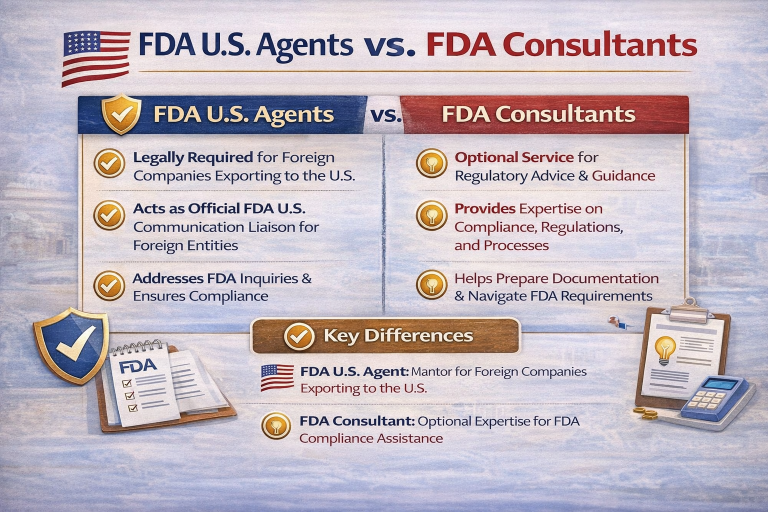
FDA U.S. Agent vs FDA Consultant
A required regulatory contact vs an optional advisory service — the difference, the overlap, and the gap that catches companies out.
Key Takeaways
- U.S. Agent = required, limited role — a regulatory contact, on file with FDA.
- Consultant = optional service — the actual compliance work and advice.
- A bare U.S. Agent just forwards FDA mail — it doesn't make you compliant.
- A consultant isn't automatically your registered U.S. Agent — that must be filed.
- One firm can be both — but confirm the scope of each, in writing.
- Neither makes you "FDA approved."
U.S. Agent vs FDA Consultant
| U.S. Agent | FDA Consultant | |
|---|---|---|
| Required? | Yes — for foreign establishments | No — optional |
| What it is | A regulatory contact designation | An advisory/execution service |
| On file with FDA? | Yes — in your registration | No — it's a service you hire |
| Scope | Limited (FDA communication, questions, inspection scheduling, receiving docs) | Broad (registration, labeling/claims, classification, submissions, quality, remediation) |
| Who needs it | Foreign establishments | Anyone wanting compliance done right (foreign or domestic) |
| Makes you compliant? | No — just a contact point | It does the compliance work |
What a U.S. Agent Is (and Isn't)
A U.S. Agent is FDA's U.S.-based contact for a foreign establishment — a required part of foreign registration with a regulation-defined, limited scope:
- Does: assist FDA communications, answer questions about the establishment's products, help schedule inspections, receive documents when FDA can't reach the establishment
- Doesn't: give compliance advice, prepare submissions (e.g., a 510(k)), fix labels/claims, or take legal responsibility for the product
What an FDA Consultant Does
An FDA consultant provides the expertise and execution to get and stay compliant — the actual work, not a contact role:
- Classification — cosmetic vs OTC drug, device class, is-it-even-a-device
- Registration & listing — done correctly in FDA's systems
- Labeling & claims review — keeping you compliant and out of drug-claim territory
- Submissions — 510(k) and other premarket strategy/preparation
- Quality/GMP — building or improving your quality system
- Inspection & remediation support — readiness, and responding after a warning letter or import issue
One Firm Can Be Both — But Confirm It
Many firms offer both, and it's convenient to have one provider act as your U.S. Agent and handle your compliance work. But the two remain distinct, and the classic failure modes come from assuming:
- "My U.S. Agent is handling compliance" — often false; a bare agent only forwards mail, so labeling/claims/submission problems go unaddressed
- "My consultant is my U.S. Agent" — not unless it's actually designated and consented to in FDA's registration; otherwise you may have no valid agent on file
Common U.S. Agent / Consultant Mistakes
- Buying only a U.S. Agent and expecting compliance to be handled
- Assuming a consultant filed the U.S. Agent designation when it wasn't
- Treating the low U.S. Agent fee as "cheap compliance" — it's just a contact role
- No one owning the actual compliance work (classification, labeling, claims, submissions)
- A provider implying either role makes you "FDA approved"
- Unclear scope — each side assumes the other is covering it
Get the Right Role — With Clear Scope
FDA Registration Assistance can serve as your registered U.S. Agent (the required, on-file contact role) and as your compliance consultant (registration, classification, labeling and claims review, submissions strategy, and more) — separately or together, with the scope stated clearly so nothing falls between the two. If you only need the agent, we'll say so; if you need compliance done, we'll do the work.
Contact us at info@fdaregistrationassistance.com or call +1 (928) 275-8333 for a quote. An independent compliance firm serving 1,000+ companies across 135+ countries, with 15+ years of experience.
Frequently Asked Questions — U.S. Agent vs Consultant
1. What's the difference between an FDA U.S. Agent and an FDA consultant?
A U.S. Agent is a specific, FDA-required role: the U.S.-based contact a foreign establishment must designate so FDA can communicate with it. Its scope is limited by regulation (facilitate FDA communications, answer questions about the establishment's products, help schedule inspections, receive documents) and it's on file with FDA. An FDA consultant is an optional advisory service you hire to do the compliance work - registration, labeling and claims review, classification, submission strategy, quality/GMP, audit prep. In short: the U.S. Agent is a required contact; the consultant is hired expertise.
2. Is a U.S. Agent required, and is a consultant?
A U.S. Agent is required for foreign establishments as part of FDA registration - you generally can't complete a foreign registration without one. An FDA consultant is not required by FDA at all; it's a business decision to hire expertise. So the U.S. Agent is a regulatory necessity for foreign firms, while a consultant is an optional service anyone (foreign or domestic) can use to get compliance done correctly.
3. What does a U.S. Agent actually do (and not do)?
A U.S. Agent facilitates FDA communication for a foreign establishment - assisting communications, responding to FDA questions about the establishment's products, helping schedule inspections, and receiving documents when FDA can't reach the establishment. It does NOT, by virtue of being your U.S. Agent, give you compliance advice, prepare your submissions (like a 510(k)), fix your labels, or take legal responsibility for your product. A bare U.S. Agent essentially forwards FDA communications - nothing more unless you've also engaged consulting.
4. What does an FDA consultant do?
An FDA consultant provides the expertise and execution to get and stay compliant: determining classification (cosmetic vs OTC drug, device class), completing FDA registration and listing, reviewing labels and claims, planning and preparing premarket submissions (510(k), etc.), building or improving quality systems (GMP/QMSR), preparing for inspections, and handling remediation after a warning letter or import issue. It's advisory and hands-on work - the actual compliance, not just a contact role.
5. Can one company be both my U.S. Agent and my consultant?
Yes, and many firms offer both - it's often convenient to have the same provider act as your U.S. Agent and handle your registration/compliance work. But they remain distinct functions: being your U.S. Agent doesn't automatically mean the firm is doing consulting for you, and hiring a consultant doesn't automatically make them your registered U.S. Agent. If you want both, engage both explicitly and confirm what's in scope.
6. If I have a U.S. Agent, do I still need compliance help?
Possibly - a U.S. Agent alone doesn't make you compliant. The agent is just FDA's contact point; it doesn't ensure your registration is correct, your labels are compliant, your claims are lawful, or your submissions are done. If your U.S. Agent is a "bare" agent (forwarding mail only), you still need to handle the actual compliance yourself or through a consultant. Many problems arise from assuming the U.S. Agent was "taking care of everything" when its role was just communication.
7. If I hire a consultant, do I automatically have a U.S. Agent?
No. Hiring a consultant to do your registration or compliance work doesn't, by itself, designate that firm (or anyone) as your registered U.S. Agent. The U.S. Agent has to be specifically designated in FDA's registration system and must consent to the role. So if you're a foreign establishment, confirm a valid U.S. Agent is actually on file - don't assume your consultant filled that role unless you engaged them to and it's reflected in the registration.
8. Why does the distinction matter?
Because assuming one is the other creates compliance gaps. Companies that think their U.S. Agent is "handling compliance" can miss labeling, claims, or submission problems - because a bare agent only forwards FDA mail. And companies that think their consultant is their U.S. Agent can end up with no valid agent on file, which stalls registration and FDA communication. Knowing which role you've engaged - and what's in scope - prevents both failure modes.
9. Does a domestic (U.S.) company need a U.S. Agent or a consultant?
A domestic company doesn't need a U.S. Agent (that requirement is for foreign establishments - FDA can reach a U.S. company directly). But a domestic company may well want a consultant to handle registration, labeling, claims, classification, or submissions correctly. So for U.S. firms the question isn't "agent vs consultant" - it's just whether you need consulting help; there's no U.S. Agent requirement to satisfy.
10. Is a U.S. Agent the cheaper option?
They're not really substitutes, so "cheaper" is the wrong frame. A bare U.S. Agent service is typically a low, flat fee because the role is limited (forwarding FDA communications). Consulting costs more because it's actual expertise and work. Paying only for a U.S. Agent and expecting compliance is a false economy - you'll have a contact on file but unresolved compliance. Match the spend to what you actually need: the required agent, plus the consulting your product's compliance requires.
11. What should I ask a provider to clarify the roles?
Ask plainly: Are you acting as my registered U.S. Agent, my consultant, or both? What exactly is included - just FDA-communication forwarding, or registration, labeling/claims review, classification, submissions, quality, inspection support? Is the U.S. Agent designation actually filed and consented to in FDA's system? What's out of scope? Getting these answers in writing avoids the common gap where each side assumed the other was covering compliance.
12. Can a consultant represent me during an FDA inspection?
A consultant can help you prepare for and support you during an inspection (readiness, documentation, responses), and a U.S. Agent may help FDA schedule an inspection of a foreign establishment - but neither replaces your own responsibility for the establishment and its records. The U.S. Agent's role around inspections is logistical (facilitating communication/scheduling); a consultant's role is substantive (getting you ready and helping you respond). They complement each other.
13. Does either role make my product "FDA approved"?
No. Neither a U.S. Agent nor a consultant confers FDA approval. A U.S. Agent is a contact role; a consultant is a service. Approval/clearance comes only from the applicable FDA pathway (e.g., a device 510(k) clearance or PMA approval), and most establishments are simply "registered," not "approved." Be wary of any provider implying that hiring them makes you "FDA approved" - that's a misrepresentation regardless of which role they're playing.
14. I'm a foreign company — what do I actually need?
At minimum, a valid U.S. Agent (required) and correct FDA registration/listing. Beyond that, you likely need consulting to get classification, labeling, claims, and any submissions right - especially entering the U.S. market for the first time. Many foreign firms engage one provider for both: the required U.S. Agent role plus the consulting to complete and maintain compliance. The key is making sure both the required agent designation and the actual compliance work are covered.
15. How do I know if my current setup has a gap?
Check two things: (1) Is a valid, consenting U.S. Agent actually on file in your FDA registration (if you're a foreign establishment)? and (2) Has someone actually done the compliance work - classification, correct registration/listing, compliant labeling, lawful claims, required submissions? If you have an agent but no one owns the compliance, or you have compliance help but no confirmed agent on file, that's a gap. Both need to be covered.
16. How does FDA Registration Assistance handle both roles?
We can serve as your registered U.S. Agent (the required, on-file contact role) and as your compliance consultant (registration, classification, labeling and claims review, submissions strategy, and more) - separately or together, with the scope stated clearly so nothing falls between the two. If you only need the agent, we'll be clear that's all it covers; if you need compliance done, we'll do the work. We're an independent compliance firm serving 1,000+ companies across 135+ countries with 15+ years of experience. Contact info@fdaregistrationassistance.com or +1 (928) 275-8333.
