
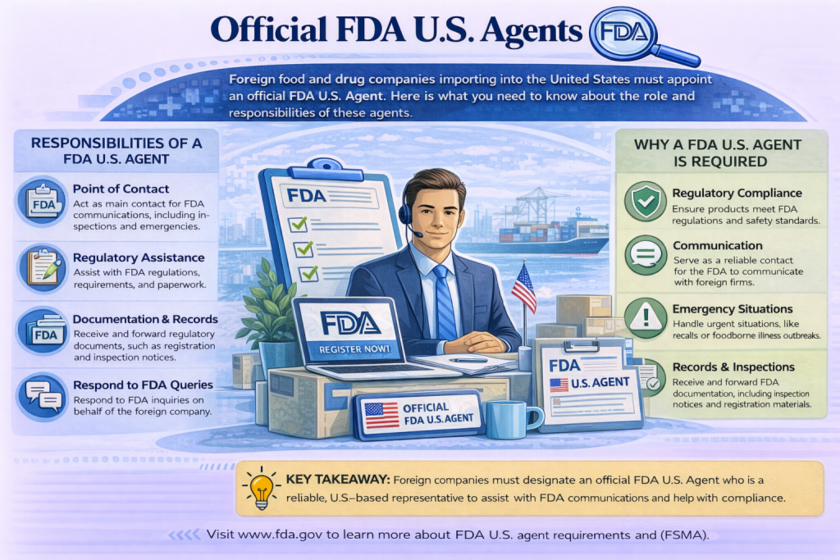
FDA U.S. Agents
What a U.S. Agent is, who needs one, the role and its limits — and the U.S. Agent service for each FDA program.
Key Takeaways
- Required for foreign establishments — across food, drug, device, and cosmetic programs.
- FDA's U.S.-based contact — the agent facilitates FDA communication.
- Limited role — not the legal owner, not your submissions, not adverse-event reporting.
- One agent per foreign establishment — U.S.-based (no PO box), available, consenting.
- Domestic firms don't need one; a U.S. Agent is not FDA "approval."
- Different rule & renewal per program — pick your program below.
What a U.S. Agent Does — and Doesn't
| The U.S. Agent DOES | The U.S. Agent does NOT |
|---|---|
| Assist FDA in communications with the foreign establishment | Take legal responsibility for the product |
| Answer FDA questions about the establishment's products | File your premarket submissions (e.g., a device 510(k)) |
| Help schedule FDA inspections | Handle adverse-event reporting on your behalf |
| Receive FDA info/documents if FDA can't reach the establishment | Confer any FDA approval or clearance |
Who Needs a U.S. Agent — and the Requirements
- Foreign establishments — companies outside the U.S. that register with FDA, in any program
- One per foreign establishment — a single agent on file per registration (one agent can serve many firms)
- Physically in the U.S. — a valid U.S. address (no PO box), available during business hours
- Consenting — the agent must agree to serve (devices use a 10-business-day confirmation)
- Kept current — the designation must match your registration; report changes promptly
- Domestic firms don't need one — FDA can reach a U.S. company directly
U.S. Agent Service by FDA Program
The core role is the same, but the rule and renewal cadence differ. Choose your product's program:
Food U.S. Agent
Food & dietary supplement facilities — 21 CFR 1.225–1.227; biennial registration.
Food →Drug U.S. Agent
Drug & pharmaceutical establishments — 21 CFR 207.69; annual registration.
Drug →Device U.S. Agent
Medical device establishments — 21 CFR 807.40; annual registration.
Device →Cosmetics U.S. Agent
MoCRA cosmetic facilities — biennial registration.
Cosmetics →Switching Your U.S. Agent
You can change your U.S. Agent at any time — commonly when the current agent is unresponsive, too expensive, or you want registration and the agent handled together. The key is to switch without a coverage gap, so FDA always has a valid agent on file.
Common U.S. Agent Mistakes
- Registering without a valid, consenting U.S. Agent — the registration can't complete
- A stale or mismatched agent on the registration — FDA can't reach you
- An unresponsive agent — missed FDA communications and inspection scheduling
- Assuming one agent covers every program — each establishment/program needs its own
- Using a PO box or an address without a real U.S. presence
- Treating "has a U.S. Agent" as "FDA approved"
Get Your FDA U.S. Agent
FDA Registration Assistance acts as the U.S. Agent for foreign establishments across FDA's food, drug, device, and cosmetic programs — a responsive U.S.-based contact that meets the requirements, forwards FDA communications, and helps coordinate inspection scheduling — and we can handle your establishment registration alongside it so everything stays aligned.
Contact us at info@fdaregistrationassistance.com or call +1 (928) 275-8333 for a quote. An independent compliance firm serving 1,000+ companies across 135+ countries, with 15+ years of experience.
Frequently Asked Questions — FDA U.S. Agents
1. What is an FDA U.S. Agent?
A U.S. Agent is a U.S.-based contact that a foreign establishment must designate so FDA has someone in the United States to communicate with about that establishment. The U.S. Agent is FDA's point of contact for the foreign facility - assisting FDA communications, answering questions about the establishment's products, helping schedule inspections, and receiving information or documents when FDA can't reach the establishment directly. It's a required part of FDA registration for foreign establishments across food, drug, device, and cosmetic programs.
2. Who needs a U.S. Agent?
Foreign establishments - companies located outside the United States that manufacture or handle FDA-regulated products for the U.S. market. Whether you make food, drugs, devices, or cosmetics, if your establishment is foreign and must register with FDA, you generally must designate a U.S. Agent as part of that registration. Domestic (U.S.) establishments register but do not need a U.S. Agent, because FDA can reach them directly in the United States.
3. Does the U.S. Agent requirement differ by FDA program?
The core role is the same, but the governing rule differs: food facility registration (21 CFR 1.225–1.227), foreign drug establishments (21 CFR 207.69), foreign device establishments (21 CFR 807.40), and cosmetics under MoCRA. Registration renewal cadence also differs (food and cosmetics biennial; drugs and devices annual). So pick your product's program for the specifics - each has its own dedicated U.S. Agent page linked on this hub.
4. What does a U.S. Agent do — and not do?
A U.S. Agent facilitates FDA communication for the foreign establishment: assisting communications, responding to FDA questions about the establishment's products, helping schedule inspections, and receiving documents when FDA can't reach the establishment. It does NOT take legal responsibility for the product, file your premarket submissions (like a device 510(k)), or handle adverse-event reporting on your behalf. The role is specifically a communication/contact function, defined by regulation.
5. Can a company have more than one U.S. Agent?
Each foreign establishment designates one U.S. Agent for a given registration. A single U.S. Agent can serve many establishments, and if you have facilities across different FDA programs, one provider can act as your U.S. Agent for each. But for any single foreign establishment's registration, there is one U.S. Agent on file at a time. Keeping that designation current and consistent with your registration matters, because FDA relies on it to reach you.
6. What are the requirements to be a U.S. Agent?
The U.S. Agent must be physically located in the United States (a real U.S. address - a PO box is not acceptable), be available during normal business hours, and, in programs with a consent step (such as devices), actually agree to serve. The agent can be an individual or a company - a consultant, law firm, importer, or dedicated U.S. Agent service. Responsiveness is essential, because FDA communications and inspection scheduling flow through the agent.
7. Does having a U.S. Agent mean my product is FDA-approved?
No. A U.S. Agent (and registration) is an administrative requirement - it gives FDA a contact and puts you in FDA's system. It does not mean FDA reviewed, cleared, or approved your product, and implying that is misleading (for devices, specifically prohibited under 21 CFR 807.39). Your product still needs whatever premarket pathway applies to it. A U.S. Agent facilitates communication; it confers no FDA authorization.
8. Can I change my U.S. Agent?
Yes, and it's common - for example if your current agent is unresponsive or too expensive, or you want your registration and agent handled together. The change is made in the relevant FDA registration system, and the key is to switch without a coverage gap so FDA always has a valid agent on file. See our pages on replacing your agent and alternatives to big-name agent firms for how to switch cleanly.
9. What happens if my U.S. Agent is unresponsive?
It's a real risk. FDA communications - including questions about your products and inspection scheduling - flow through your U.S. Agent, and if FDA can't reach the establishment directly, giving documents to the agent counts as reaching you. An agent who is unreachable, on vacation without backup, or slow to forward messages can cause missed FDA deadlines, delayed inspections, and compliance problems you learn about too late. Continuous, reliable availability is the whole point.
10. What happens if my registration lists an outdated U.S. Agent?
A stale or mismatched U.S. Agent on your registration means FDA may be unable to reach you, and import entries can be flagged when registration and agent information are inconsistent. Because the agent is designated as part of registration, the two must stay aligned and current - update any change in the agent's name, address, or contact details promptly in the appropriate FDA system. Keeping registration and agent consistent is a basic but frequently missed compliance step.
11. Is a U.S. Agent the same as an importer or official correspondent?
Not necessarily. The U.S. Agent is FDA's contact for the foreign establishment. An importer/initial importer is the U.S. entity that first receives an imported product (with its own obligations). An official correspondent (in some programs) handles registration/listing communications. One party can wear more than one hat, but they are distinct roles - so don't assume your importer or correspondent is automatically your registered U.S. Agent.
12. Do I need a separate U.S. Agent for each product category?
You need a U.S. Agent for each foreign establishment's registration in each applicable program. A company with products across categories (say a food/supplement, an OTC drug, and a cosmetic) registers in each program and has a U.S. Agent for each - the requirements don't merge into one. One provider can serve as your U.S. Agent across all of them, which keeps things coordinated, but the designations are per establishment/program.
13. How much does a U.S. Agent cost?
U.S. Agent service is a consulting/representation fee, quoted based on the program(s), number of establishments, and scope - so we provide a quote rather than a fixed figure here. Note that any FDA government fees (for example, the annual device establishment registration fee) are separate and paid to FDA regardless of who serves as your agent. Be cautious of quotes that seem to bundle or obscure government fees versus service fees.
14. Which U.S. Agent page should I use for my product?
Use the program that matches your product: the food U.S. Agent page for food and dietary supplements, the drug/pharmaceutical U.S. Agent page for drugs, the medical device U.S. Agent page for devices, and the MoCRA cosmetics U.S. Agent page for cosmetics. If you need FDA registration and the U.S. Agent handled together, see the combined registration and U.S. Agent compliance page. This hub links to each of them.
15. Is a U.S. Agent required to import — or is that the importer?
They're different roles. The U.S. Agent is the foreign establishment's FDA contact (a registration requirement). Importing also involves an importer/initial importer - the U.S. party bringing the product in - who has its own obligations (and, for some programs like food, FSVP responsibilities). A foreign firm typically needs a U.S. Agent to register, and its product needs a proper importer to enter the U.S.; one company can sometimes do both, but confirm each role is covered.
16. How does FDA Registration Assistance serve as a U.S. Agent?
We act as the U.S. Agent for foreign establishments across FDA's food, drug, device, and cosmetic programs - a responsive U.S.-based point of contact that meets the requirements, forwards FDA communications, and helps coordinate inspection scheduling - and we can handle your establishment registration alongside it so everything stays aligned. We're an independent compliance firm serving 1,000+ companies across 135+ countries with 15+ years of experience. Contact info@fdaregistrationassistance.com or +1 (928) 275-8333.
