
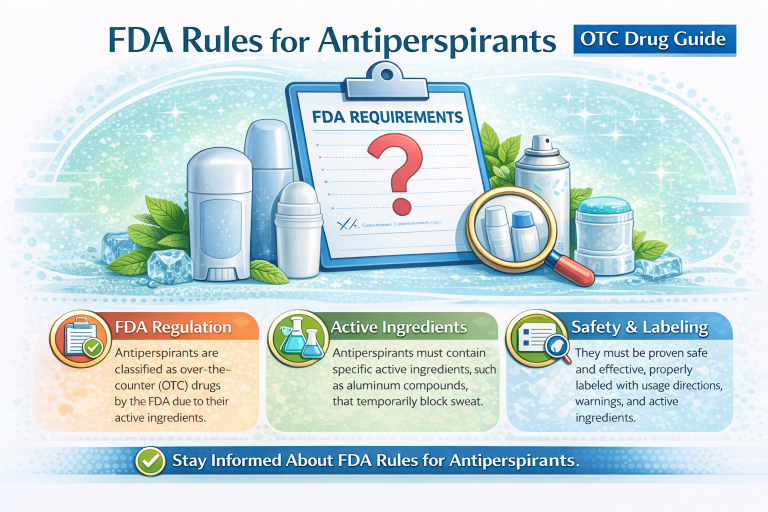
FDA Rules for Antiperspirants
This guide explains why antiperspirants are OTC drugs, the permitted aluminum active ingredients and concentrations under 21 CFR Part 350, the required Drug Facts panel including the kidney disease warning, drug establishment registration via eDRLS, and the dual compliance obligations for combination antiperspirant/deodorant products.
The Regulatory Classification Depends on the Active Ingredient and Claims
All Permitted Antiperspirant Active Ingredients and Maximum Concentrations Under the OTC Monograph
| Active Ingredient | Maximum Concentration | Notes |
|---|---|---|
| Aluminum chloride | 15% | In an aqueous solution. The oldest aluminum-based antiperspirant active; used in clinical-strength products. |
| Aluminum chlorohydrate | 25% | The most widely used antiperspirant active globally. Found in most major antiperspirant brands. |
| Aluminum chlorohydrex PG | 25% | Propylene glycol complex of aluminum chlorohydrate. |
| Aluminum dichlorohydrate | 25% | Used in aerosol and roll-on formulations. |
| Aluminum sesquichlorohydrate | 25% | Intermediate between aluminum chlorohydrate and aluminum chloride. |
| Aluminum zirconium chlorohydrate | 20% | Various forms (octachlorohydrate, tetrachlorohydrate, trichlorohydrate). Used in anhydrous solid and spray formulations. |
| Aluminum zirconium tetrachlorohydrex GLY | 20% | Glycine complex. Very common in solid stick and invisible solid formulations. |
| Buffered aluminum sulfate | 8% | Used in specific buffered formulations; less common than other aluminum actives. |
No active ingredient other than those listed in 21 CFR Part 350.10 may be used in an OTC antiperspirant marketed under the monograph. A product using any other active ingredient as an antiperspirant would require a separate New Drug Application (NDA).
Antiperspirant Drug Facts Panel — Required Sections and the Kidney Disease Warning
The Kidney Disease Warning — Why It’s Mandatory
The kidney disease warning (“Ask a doctor before use if you have kidney disease”) is required for all antiperspirant products containing aluminum compounds under 21 CFR Part 350.50. Aluminum is excreted by the kidneys. In individuals with severely impaired kidney function, aluminum can accumulate rather than being adequately excreted. This warning is mandatory for all monograph-compliant antiperspirants — missing it is a Drug Facts misbranding violation.
The Only Permitted Indication — “Reduces Sweating”
Under 21 CFR Part 350.50, the only permitted indication (Use) for an OTC antiperspirant is “reduces sweating.” Claims beyond this — “prevents excessive sweating,” “treats hyperhidrosis,” “24-hour protection from sweat” (if framed therapeutically) — go beyond the monograph. Claims about treating hyperhidrosis (a diagnosed medical condition) would make the product a prescription drug requiring NDA approval.
Drug Establishment Registration for Antiperspirant Manufacturers — What’s Required
eDRLS Drug Establishment Registration
Required under 21 CFR Part 207 for all antiperspirant manufacturers. Annual renewal: October 1 through December 31 every year (not biennial). Foreign manufacturers must designate a U.S. Agent under 21 CFR 207.69. See the eDRLS Drug Registration Guide for full detail.
SPL Drug Product Listing
Drug product listing in SPL (Structured Product Labeling, HL7 XML) format through eDRLS for each antiperspirant product. SPL includes: active ingredient name and concentration; inactive ingredients; dosage form (stick, spray, roll-on); route (topical); marketing category (OTC monograph); NDC number; and Drug Facts label content in XML format.
Combination Product: Also MoCRA
For combination antiperspirant/deodorant products: eDRLS drug establishment registration AND MoCRA cosmetic facility registration and product listing are both required. FDA Registration Assistance handles both simultaneously for combination product manufacturers.
Need Help Getting Your Antiperspirant FDA-Compliant?
FDA Registration Assistance provides complete FDA compliance for antiperspirant manufacturers — eDRLS drug establishment registration, U.S. Agent services for foreign manufacturers, SPL drug product listing, OTC antiperspirant monograph compliance assessment, Drug Facts panel review, annual eDRLS renewal management, and combination product dual compliance for antiperspirant/deodorant products. 1,000+ clients. 135+ countries. 15+ years of FDA regulatory experience.
Contact us at info@fdaregistrationassistance.com or call +1 (928) 275-8333.
Frequently Asked Questions — FDA Rules for Antiperspirants
1. Are antiperspirants regulated by FDA as drugs or cosmetics?
OTC drugs — not cosmetics. Antiperspirants contain aluminum-based active ingredients that temporarily block sweat glands — affecting body function under 21 U.S.C. § 321(g)(1)(C). Deodorants without antiperspirant actives are cosmetics. Combination antiperspirant/deodorant products are both OTC drugs and cosmetics.
2. What is the FDA OTC monograph for antiperspirants?
21 CFR Part 350 — “Antiperspirant Drug Products for Over-the-Counter Human Use.” Establishes conditions under which antiperspirant products are GRASE without requiring individual NDA. Must use only listed active ingredients, comply with permitted concentrations, and follow labeling requirements. Updated through administrative orders under the 2020 CARES Act OTC reform.
3. What active ingredients are permitted in antiperspirants?
Under 21 CFR Part 350.10: Aluminum chloride (up to 15% in aqueous solution); Aluminum chlorohydrate (up to 25%); Aluminum chlorohydrex PG (up to 25%); Aluminum dichlorohydrate (up to 25%); Aluminum sesquichlorohydrate (up to 25%); Aluminum zirconium chlorohydrate (up to 20%); Aluminum zirconium tetrachlorohydrex GLY (up to 20%); Buffered aluminum sulfate (8%). All are aluminum-based. No other active ingredients permitted without a separate NDA.
4. What Drug Facts labeling requirements apply to antiperspirants?
Under 21 CFR 201.66 and 21 CFR Part 350.50: Active ingredient with exact name and concentration; Purpose (“Antiperspirant”); Uses (“reduces sweating”); Warnings including “Ask a doctor before use if you have kidney disease”; Directions; Other information; Inactive ingredients. Aerosols require additional flammability and pressure warnings.
5. Why does the antiperspirant Drug Facts panel require a kidney disease warning?
Required under 21 CFR Part 350.50 for all aluminum-containing antiperspirants. Aluminum is excreted by the kidneys. In severely impaired kidney function, aluminum can accumulate. This is a mandatory warning for all OTC antiperspirants — not optional. Missing it is misbranding.
6. Do antiperspirant manufacturers need drug establishment registration?
Yes. Antiperspirant manufacturers must register through eDRLS under 21 CFR Part 207. Annual renewal October–December every year. Drug product listing in SPL format required. Registering only as a cosmetic manufacturer (MoCRA/FURLS) is non-compliant — the most common error for imported antiperspirants.
7. What is the difference between an antiperspirant and a deodorant under FDA?
Antiperspirant: OTC drug with aluminum-based active ingredients that reduce sweat production. Drug Facts panel + eDRLS registration. Deodorant only (no antiperspirant active): Cosmetic that masks or prevents odor. Cosmetic labeling + MoCRA registration. Combination antiperspirant/deodorant: Both — eDRLS registration AND MoCRA registration required.
8. Are combination antiperspirant/deodorant products subject to both drug and cosmetic regulations?
Yes. Must satisfy: eDRLS drug establishment registration; SPL drug listing; Drug Facts panel meeting antiperspirant monograph; OTC monograph compliance. AND: MoCRA cosmetic facility registration; cosmetic product listing; and safety substantiation. Most commercial antiperspirant sticks and sprays sold in the U.S. are combination products subject to both frameworks.
9. Can a product that is a cosmetic in Europe be imported to the U.S. as a cosmetic?
No. Many countries including EU member states regulate antiperspirants as cosmetics. U.S. regulatory classification is based on intended use and active ingredients as marketed in the United States — not on foreign regulatory classification. A European antiperspirant must register as a drug establishment through eDRLS and comply with the OTC antiperspirant monograph regardless of its EU cosmetic status.
10. What is the 2020 CARES Act OTC drug reform and how does it affect antiperspirants?
The CARES Act (March 2020) reformed the OTC monograph system, allowing FDA to issue monograph changes through administrative orders (which have the force of law) rather than slow traditional rulemaking. The existing 21 CFR Part 350 monograph remains in effect. Antiperspirant manufacturers must monitor FDA administrative orders affecting the antiperspirant monograph for any changes to permitted actives or labeling requirements.
11. What labeling requirements apply to aerosol antiperspirant sprays?
All standard Drug Facts requirements plus: flammability warning (if product contains flammable propellants — “Flammable. Do not use near fire, flame, or heat”); inhalation/pressure warning (“Do not spray in eyes. Contents under pressure. Do not puncture or incinerate. Do not store above 120°F”); and any CPSC warnings for aerosol products. Directions section must specify correct application distance.
12. What is the permitted indication for antiperspirants under the FDA monograph?
The only permitted indication under 21 CFR Part 350.50: “reduces sweating.” Claims beyond this — “prevents excessive sweating,” “treats hyperhidrosis,” “cures sweat disorders” — go beyond the monograph. Hyperhidrosis treatment claims require an approved prescription NDA.
13. Do foreign antiperspirant manufacturers need a U.S. Agent?
Yes. Must designate a U.S. Agent under 21 CFR 207.69 with a physical U.S. address. The drug U.S. Agent must actively assist FDA in scheduling and facilitating inspections — a more demanding role than the food U.S. Agent. FDA Registration Assistance provides U.S. Agent services.
14. What is the annual renewal requirement for antiperspirant drug establishment registrations?
Drug establishment registration through eDRLS renews annually — October 1 through December 31 every year. Different from food (biennial) and MoCRA cosmetics (annual). Missing the annual eDRLS renewal can trigger Import Alert 89-06 for foreign antiperspirant manufacturers (automatic shipment detention).
15. What SPL drug listing requirements apply to antiperspirant products?
SPL listing through eDRLS for each product. Must include: active ingredient name and concentration; inactive ingredients; dosage form (stick, spray, roll-on, cream); route (topical); marketing category (OTC monograph); NDC number; Drug Facts label content in XML format. SPL listing must match the physical label. Changes to formulation, concentration, or labeling require an updated SPL submission.
16. Do MoCRA cosmetic requirements apply to antiperspirants?
For pure antiperspirant products: No — OTC drugs are excluded from the cosmetic definition. For combination antiperspirant/deodorant products: Yes — MoCRA facility registration and product listing required for the cosmetic deodorant component, while eDRLS drug establishment registration is required for the antiperspirant drug component.
17. Can a company import an antiperspirant without eDRLS drug establishment registration?
No. Importing an antiperspirant from an unregistered drug establishment is a prohibited act under 21 U.S.C. § 331. OASIS identifies the product as an OTC drug from an unregistered drug establishment. Import Alert 89-06 can apply to foreign antiperspirant manufacturers that are unregistered as drug establishments.
18. What are the most common FDA compliance failures for antiperspirant importers?
Registering as cosmetic manufacturer (MoCRA/FURLS) instead of drug establishment (eDRLS); missing Drug Facts panel (using cosmetic ingredient list instead); active ingredient not declared with exact monograph name and concentration; missing kidney disease warning; claims beyond “reduces sweating”; active ingredient not in the OTC monograph; missing annual eDRLS renewal.
19. What is hyperhidrosis and can an antiperspirant claim to treat it?
Hyperhidrosis is a diagnosed medical condition of excessive sweating beyond normal thermoregulation. An antiperspirant claiming to treat, manage, or cure hyperhidrosis makes a drug claim beyond the OTC monograph’s permitted “reduces sweating” indication. Such a claim requires a prescription NDA — not an OTC monograph product. OTC antiperspirant manufacturers must strictly limit claims to the permitted indication.
20. How does FDA ensure antiperspirant compliance at U.S. ports?
OASIS checks: whether eDRLS drug establishment registration is current; whether the facility or product is on any Import Alert (including Import Alert 89-06); and whether labeling compliance issues have been previously identified. FDA also conducts import sampling of antiperspirant products to verify active ingredient identity and concentration against the monograph.
21. Does a natural or aluminum-free deodorant need eDRLS drug establishment registration?
No — if the product is a true deodorant without any antiperspirant active ingredient and makes no claims to reduce sweating. A natural or aluminum-free deodorant without monograph active ingredients is a cosmetic requiring MoCRA registration — not eDRLS drug registration. Classification is based on active ingredients and claims.
22. What compliance services does FDA Registration Assistance provide for antiperspirant manufacturers?
eDRLS drug establishment registration; U.S. Agent designation for foreign manufacturers; SPL drug product listing; annual eDRLS renewal management; OTC antiperspirant monograph compliance assessment; Drug Facts panel review; combination antiperspirant/deodorant dual compliance support; and Import Alert 89-06 removal support. 1,000+ clients. 135+ countries.
23. How does FDA Registration Assistance help antiperspirant manufacturers and importers?
Complete OTC drug compliance: eDRLS drug establishment registration; U.S. Agent services; SPL drug listing; annual renewal; OTC monograph compliance assessment; Drug Facts panel review; combination product dual compliance; and import detention response support. 1,000+ clients. 135+ countries. 15+ years of FDA regulatory experience.
24. What is the difference between the eDRLS drug registration for antiperspirants and MoCRA cosmetic registration for deodorants?
eDRLS (21 CFR Part 207): for drug manufacturers including antiperspirants. Annual renewal. SPL drug listing in HL7 XML format. Administered through FDA’s Electronic Submissions Gateway. FURLS/MoCRA (FD&C Act Sections 607–608): for cosmetic manufacturers including deodorant-only products. Annual renewal. Cosmetic product listing with INCI ingredient names. Administered through FDA’s FURLS system. Two completely separate systems.
25. How do I get started with FDA compliance for my antiperspirant product?
Contact FDA Registration Assistance at info@fdaregistrationassistance.com or call +1 (928) 275-8333. Provide your product name, active ingredient(s) and concentration(s), current label artwork, whether domestic or foreign, and any existing FDA registration information. FDA Registration Assistance will assess your eDRLS obligations, review your Drug Facts panel against the OTC antiperspirant monograph, and complete the drug registration and listing process.