Importing Human Foods into the U.S.
This guide walks through all five pillars, who is responsible for each, the step-by-step import process, how FDA screens your shipment, the special rules for canned foods and other categories, and the most common reasons imports are refused.
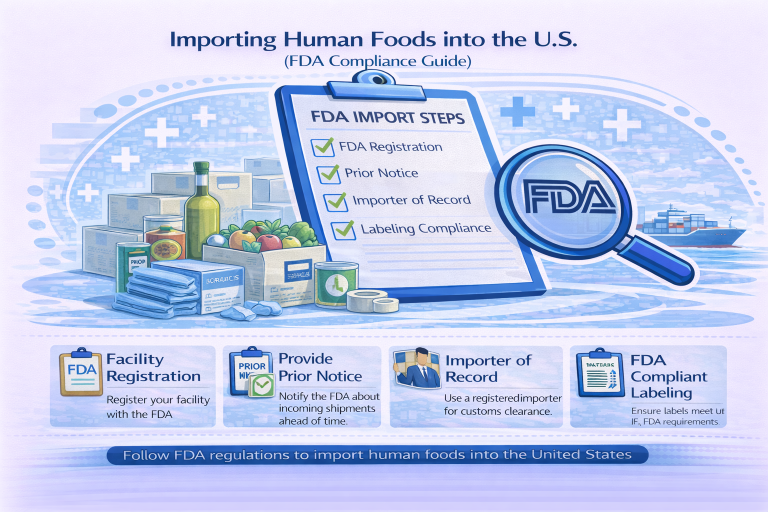
The Five Pillars Every Food Import Must Satisfy
Responsibility Is Split Between the Foreign Facility and the U.S. Importer
When the foreign facility and the U.S. importer are different companies, each must satisfy its own obligations. We can act as the U.S. Agent for the foreign facility and help the importer build its FSVP — covering both sides of the relationship.
The Food Import Process From Registration to Release
OASIS, PREDICT, and Import Alerts
OASIS & PREDICT
When an entry is filed through CBP’s ACE system, FDA’s OASIS and PREDICT systems automatically evaluate it — product, manufacturer, country of origin, importer history, and any Import Alerts. PREDICT assigns a risk score that decides whether the shipment is released, reviewed, examined, or sampled. Strong compliance across the five pillars lowers your risk score.
Import Alerts & DWPE
A facility or product with a violation history can be placed on an Import Alert, triggering Detention Without Physical Examination — every shipment auto-detained. Examples: Import Alert 99-23 (pesticides, chemicals, filth) and Import Alert 36-07 (canned/acidified foods lacking process filing). Getting off an alert is hard; preventing placement is far easier.
Special Rules for Specific Food Categories
Canned & Acidified Foods
Low-acid canned foods and acidified foods need FCE registration + SID process filing (21 CFR Parts 113, 114) on top of the five pillars. No post-arrival cure. FCE + first SID $1,250; each additional $950 →
Seafood & Juice
Seafood requires HACCP under 21 CFR Part 123; juice requires HACCP under 21 CFR Part 120. These are hazard-control plans specific to the category, in addition to facility registration and FSVP.
Shelf-Stable Foods
Whether a shelf-stable food needs process filing depends on how it’s preserved. See which shelf-stable foods need FCE/SID →
The Most Common Reasons Food Imports Are Refused
Nearly every refusal traces back to one of the five pillars not being properly satisfied. See our common registration mistakes guide for the errors that most often cause problems.
Transparent Pricing to Get Import-Ready
Canned & Acidified Foods Add
FCE registration + first SID for $1,250, and each additional SID for $950. The Process Authority documentation establishing the scheduled process is supplied by the client. Required only for low-acid canned and acidified foods.
FSVP & Label Review
FSVP program development and label compliance review are scoped to your product. A packaged dried food needs only the registration; a canned food adds the FCE and SID; every importer needs FSVP.
Get Every Requirement Right Before Your First Shipment
FDA Registration Assistance provides complete support for importing human foods into the U.S.: Food Facility Registration ($858) with U.S. Agent and Biennial Renewal, FSVP development, label review, process filing for canned foods ($1,250 FCE + first SID, $950 each additional), Prior Notice guidance, and import detention support. We determine which of the five pillars and any special requirements apply to your product, then handle them. 1,000+ clients. 135+ countries. 15+ years of FDA regulatory experience.
Contact us at info@fdaregistrationassistance.com or call +1 (928) 275-8333.
Frequently Asked Questions — Importing Human Foods into the U.S.
1. Do you need FDA compliance to import food into the United States?
Yes. Any company importing human food must comply before shipments can legally enter. Core requirements: Food Facility Registration; a U.S. Agent for the foreign facility; an FSVP maintained by the U.S. importer; Prior Notice before each shipment; and compliant labeling. Some products add requirements (process filing for canned foods, HACCP for seafood/juice). Failure means holds, refusals, or Import Alert placement. Registration is $858; FDA charges $0; DUNS fees separate.
2. What are the five pillars of FDA food import compliance?
(1) Food Facility Registration (21 CFR Part 1 Subpart H); (2) U.S. Agent with a physical U.S. address; (3) FSVP, the importer’s supplier verification (Subpart L); (4) Prior Notice before each shipment (Subpart I); (5) labeling compliance (21 CFR Part 101). All five apply to most imports, and different parties are responsible for different pillars.
3. Who is responsible for each FDA food import requirement?
The foreign facility: Food Facility Registration; U.S. Agent; FSMA Preventive Controls; process filing for canned foods; product and label compliance. The U.S. importer: FSVP; ensuring Prior Notice is filed (often via a broker); ensuring the product is not adulterated or misbranded. A common mistake is assuming the facility’s registration covers everything — the importer’s FSVP and Prior Notice are separate, independent obligations.
4. What is Food Facility Registration and who needs it?
Under 21 CFR Part 1 Subpart H, required for all facilities that manufacture, process, pack, or hold food for U.S. consumption — including foreign facilities. Identifies the facility to FDA; renewed every two years. Foreign facilities must designate a U.S. Agent. A DUNS Number is required. FDA charges $0. We provide complete registration for $858, including U.S. Agent and Biennial Renewal. DUNS fees separate.
5. What is a U.S. Agent and why is it required?
A person or entity with a physical U.S. address (not a P.O. box) designated by a foreign facility as part of its registration. The U.S. Agent is FDA’s point of contact — receiving communications, assisting with inspection scheduling, acting as liaison — and must consent. Communications to the U.S. Agent are considered communications to the facility. Every foreign food facility must have one. Included in our $858 service.
6. What is the Foreign Supplier Verification Program (FSVP)?
Under 21 CFR Part 1 Subpart L, the U.S. importer’s obligation to verify its foreign suppliers meet U.S. safety standards. The FSVP importer must conduct a hazard analysis, evaluate the supplier and risk, perform verification activities (audits, testing, records review), and keep documentation. Identified at entry with a DUNS Number. Separate from the facility’s registration — an importer without an FSVP is in violation even if the facility is registered.
7. What is Prior Notice and when must it be filed?
Under 21 CFR Part 1 Subpart I, advance notice to FDA that an imported food shipment is arriving — no more than 5 days before, and no fewer than 8 hours (water), 4 hours (air), or 2 hours (land) before arrival. Includes product identity, manufacturer, shipper, country of origin, and the facility registration number. Required for EVERY shipment — a valid registration does not eliminate the per-shipment requirement. Missing Prior Notice means refusal.
8. What labeling is required on imported food?
Under 21 CFR Part 101: statement of identity; net quantity in U.S. and metric units; 2020 Nutrition Facts with correct RACC; ingredient list in descending order; allergen declarations for the nine major allergens including sesame; and name/place of business with a U.S. address. All required info in English. Home-country formats (metric-only, per-100g, EU E-numbers) must be converted. See the full labeling guide. Labeling violations are a leading refusal cause.
9. What is the step-by-step process for importing food?
(1) Foreign facility registers and designates a U.S. Agent; (2) U.S. importer establishes FSVP; (3) manufacturer ensures FSMA, labeling, and any special requirements like process filing; (4) Prior Notice filed before each shipment; (5) entry filed with CBP via ACE, FDA screens via OASIS and PREDICT; (6) FDA releases, examines, samples, or detains. Each step must be correct to avoid delays and refusals.
10. How does FDA screen imported food at the port?
Electronically through OASIS and PREDICT. When the entry is filed with CBP via ACE, FDA’s systems evaluate the shipment by product, manufacturer, country of origin, importer history, and Import Alerts. PREDICT assigns a risk score determining release, review, examination, or sampling. A facility or product on an Import Alert faces Detention Without Physical Examination. Proper registration, FSVP, Prior Notice, and labeling reduce the chance of flagging.
11. What is an Import Alert and how does it affect food imports?
An FDA notice directing staff to detain certain products, manufacturers, or shippers with a violation history — typically Detention Without Physical Examination (every shipment auto-detained). Food examples: 99-23 (pesticides, chemicals, filth) and 36-07 (canned/acidified foods lacking process filing). Removal requires demonstrating the problem is corrected, often through multiple compliant shipments. Prevention is far easier than removal.
12. What additional FDA requirements apply to specific food categories?
Beyond the five pillars: canned/acidified foods need FCE and SID (21 CFR Parts 113, 114); seafood needs HACCP (Part 123); juice needs HACCP (Part 120); dietary supplements have specific labeling/GMP rules; infant formula has its own framework. The manufacturer must also meet FSMA Preventive Controls (Part 117) and GMP. A product-specific assessment determines what applies.
13. Do canned and acidified foods have extra import requirements?
Yes. Low-acid canned foods and acidified foods require FCE registration and SID process filing (21 CFR Parts 108, 113, 114) in addition to the standard requirements. The scheduled process must be established by a Process Authority. No post-arrival cure — the FCE and SID must be in place before arrival. We provide FCE + first SID for $1,250 and each additional SID for $950, with the Process Authority documentation supplied by the client.
14. What FSMA requirements apply to imported food?
The foreign manufacturer must meet Preventive Controls for Human Food (21 CFR Part 117) — a written food safety plan, hazard analysis, preventive controls, monitoring, corrective actions, verification, and a PCQI. The U.S. importer must maintain FSVP. FSMA also includes the Produce Safety Rule and Sanitary Transportation Rule. FSMA shifted food safety toward prevention, placing obligations on both foreign manufacturers and U.S. importers.
15. What are the most common reasons food imports are refused?
Facility not registered or lapsed; importer has no FSVP; Prior Notice missing, late, or erroneous; labeling violations (missing sesame/allergens, non-compliant Nutrition Facts, no U.S. address, foreign-language-only); filth, contamination, or pesticide residues; canned/acidified foods without FCE and SID; unapproved additives or EU E-numbers; and Import Alert placement. Most refusals trace to one of the five pillars not being satisfied.
16. What is the difference between Food Facility Registration and FSVP?
Registration is the foreign facility’s obligation — it registers itself with FDA (21 CFR Part 1 Subpart H). FSVP is the U.S. importer’s obligation (Subpart L) — verifying suppliers produce food safely. Different parties, different purposes. Both required for most imports. A common mistake: an importer assuming that because the facility is registered, no FSVP is needed — but FSVP is a separate, independent obligation.
17. Does a DUNS Number requirement apply to food imports?
Yes, in two places: the facility’s registration requires a DUNS Number matching its name and address exactly; and the FSVP importer must be identified at entry with a DUNS Number. Obtained from Dun & Bradstreet (free, but the standard process can take up to 30 business days). A common mistake is starting the process without first obtaining the DUNS Number. DUNS fees are separate from our service fees.
18. Can a U.S. importer be the FSVP importer and also handle Prior Notice?
The U.S. importer is typically the FSVP importer — responsible for supplier verification and the FSVP. Prior Notice is often filed by a customs broker on the importer’s behalf, though the importer stays responsible for correctness. The FSVP importer is identified at entry with a DUNS Number and U.S. address — specifically the U.S. owner or consignee at entry, or the U.S. agent/representative of a foreign owner or consignee if there is no U.S. owner or consignee.
19. How long does it take to become compliant to import food?
Depends on the product and requirements. Registration is quick once the DUNS Number is in place — though obtaining the DUNS Number can take up to 30 business days. FSVP requires gathering supplier information and a hazard analysis. For canned/acidified foods, the FCE and SID require the Process Authority to first establish the scheduled process. Because some steps have lead times and there is no post-arrival cure for process filing, begin well before the first shipment.
20. Do raw agricultural products and ingredients need FDA compliance to import?
Yes. FDA compliance applies to packaged foods, beverages, ingredients, and raw agricultural products for human consumption. Requirements vary: a produce-growing facility may fall under the FSMA Produce Safety Rule rather than facility registration in some cases, while an ingredient processor must register and meet Preventive Controls. Raw commodities, ingredients, and processed foods all require the importer to maintain FSVP and file Prior Notice. Assess each specific product and facility.
21. What is the role of Customs and Border Protection (CBP) in food imports?
CBP handles the entry of imported goods, including food, filed electronically through its ACE system, which transmits data to FDA. CBP manages the customs entry and admissibility from a customs standpoint; FDA evaluates the food for compliance via OASIS and PREDICT. A shipment must satisfy both CBP entry requirements and FDA admissibility. Prior Notice is filed with FDA; the customs entry is filed with CBP — both required.
22. What happens if an imported food shipment is detained?
FDA issues a Notice of FDA Action identifying the apparent violation. The importer can respond — providing evidence of compliance or, where permitted, requesting authorization to recondition (relabel, sort, bring into compliance). If the importer cannot demonstrate compliance or recondition, FDA refuses the shipment and it must be exported or destroyed. The response window is limited (often around 10 working days). Proper compliance before import is the best way to avoid detention.
23. How much does it cost to get FDA-compliant to import food?
Food Facility Registration is $858 (with U.S. Agent and Biennial Renewal); for canned/acidified foods, FCE + first SID is $1,250 and each additional SID $950. FDA charges $0 for registration. DUNS fees separate. FSVP development and label review are additional, scoped to the product. Total cost depends on the category — a packaged dried food needs only the registration, while a canned food adds the FCE and SID.
24. How does FDA Registration Assistance help companies import food into the U.S.?
Complete support: Food Facility Registration ($858) with U.S. Agent and Biennial Renewal; FSVP development; label review; process filing for canned foods ($1,250 FCE + first SID, $950 each additional); Prior Notice guidance; product-specific assessment; and detention response. We help importers and foreign suppliers satisfy all five pillars before the first shipment. 1,000+ clients. 135+ countries.
25. How do I get started with FDA compliance to import food?
Contact FDA Registration Assistance at info@fdaregistrationassistance.com or call +1 (928) 275-8333. Provide the food product, the foreign facility’s name and location, whether the product is canned or acidified (requiring process filing), and any existing FDA registration or DUNS information. We determine which pillars and special requirements apply, complete the registration ($858), develop your FSVP, review your label, and handle any process filings ($1,250 FCE + first SID, $950 each additional). DUNS fees separate.