
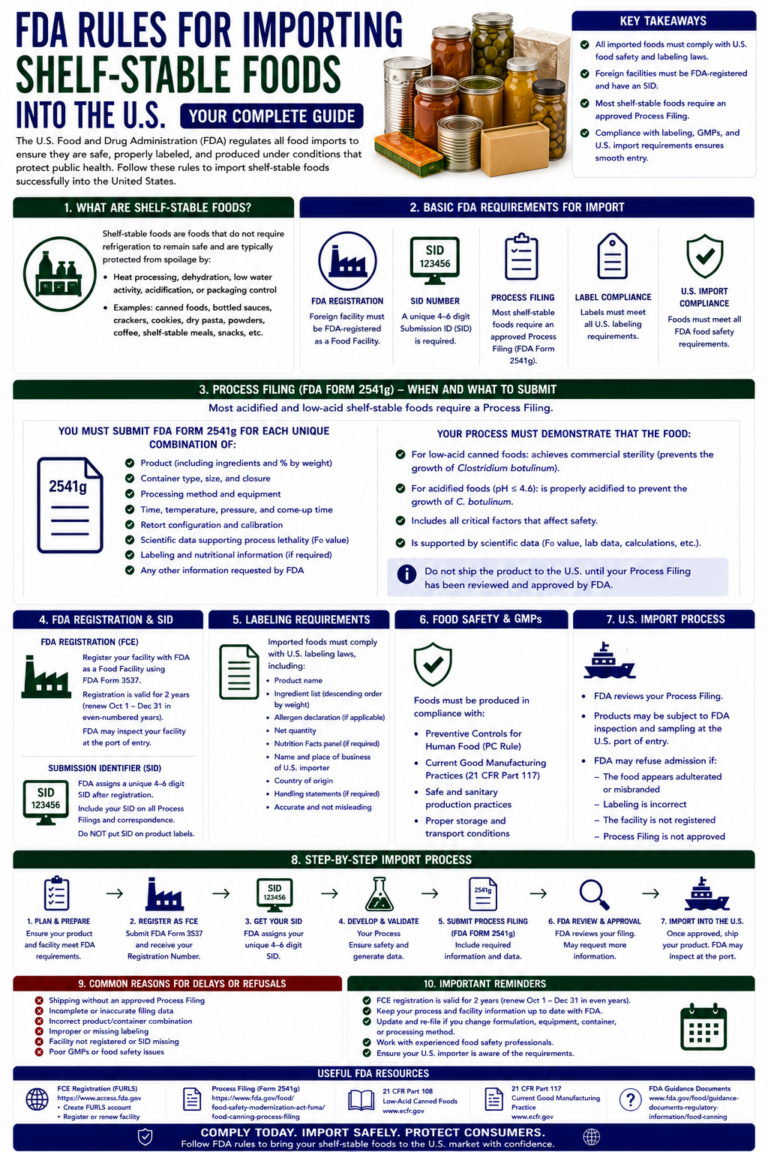
FDA Rules for Importing Shelf-Stable Foods into the U.S.
This guide shows you which shelf-stable foods need process filing and which don’t, the full import requirement stack, the hazards by preservation method, how FDA screens shipments, and what each step costs.
Does Your Shelf-Stable Food Need FCE + SID Process Filing?
Not every shelf-stable food needs process filing — it depends entirely on how the product achieves shelf stability. The dividing line is whether the food is a low-acid canned food or acidified food (where Clostridium botulinum is the controlling hazard) versus a naturally acidic or low-moisture food.
What Shelf-Stable Import Compliance Costs
Five Requirements for Importing Shelf-Stable Foods
Different Shelf-Stable Foods, Different Hazards
Thermally Processed (Canned)
Primary hazard: Clostridium botulinum — can grow and produce deadly toxin in under-processed low-acid foods in a sealed, oxygen-free container. Also container integrity failures. This is why LACF require a scheduled process and SID filing.
Acidified
Primary hazard: inadequate acidification leaving pH above 4.6, allowing C. botulinum. The acidification process must be validated by a Process Authority and filed as a SID. Salsas and certain sauces fall here.
Dried / Low-Moisture
Primary hazard: Salmonella can survive (not grow) in low-moisture foods — spices, nuts, flour, dried products — and cause illness. Plus mold/mycotoxins if moisture rises. No botulism risk, so no process filing — but real hazards remain.
OASIS, Import Alerts, and the No-Post-Arrival-Cure Rule
Import Alert 36-07
Covers LACF and acidified foods offered for import without proper FCE and SID. A facility placed on it faces Detention Without Physical Examination — every shipment automatically detained. Because there’s no post-arrival cure, filing correctly before the first import is essential.
Import Alert 99-23
Covers filth, pesticides, and contamination in food — relevant to many shelf-stable categories including spices. Facilities with documented contamination face automatic detention until the issue is corrected.
Get Every Requirement Right Before Your First Shipment
FDA Registration Assistance handles the complete shelf-stable import compliance stack: Food Facility Registration ($858, with U.S. Agent and Biennial Renewal), FCE and SID process filing for low-acid canned and acidified foods ($1,250 FCE + first SID, $950 each additional), FSVP tailored to your preservation method, and label review. We assess whether your product even needs process filing — so you don’t overpay or get detained. 1,000+ clients. 135+ countries. 15+ years of FDA regulatory experience.
Contact us at info@fdaregistrationassistance.com or call +1 (928) 275-8333.
Frequently Asked Questions — Importing Shelf-Stable Foods
1. What are the FDA rules for importing shelf-stable foods?
Food Facility Registration (with a U.S. Agent for foreign facilities); Prior Notice before each shipment; FSVP maintained by the importer; FDA-compliant labeling; and, for low-acid canned and acidified foods, FCE registration and SID process filing. Not every shelf-stable food needs process filing — only LACF and acidified foods. Registration $858; FCE + first SID $1,250; each additional SID $950. FDA charges $0 for registration. DUNS fees separate.
2. What is a shelf-stable food?
A product safely stored at room temperature without refrigeration, achieved through thermal processing (canning), acidification, low water activity (drying), fermentation, high sugar/salt, or modified atmosphere. Examples: canned foods, sauces, soups, condiments, jams, dried fruit, jerky, pasta, grains, ready-to-eat meals. Safety depends on the preservation method being adequate — if not, pathogens like C. botulinum can grow in improperly processed low-acid sealed products.
3. Which shelf-stable foods require FCE registration and SID process filing?
Only low-acid canned foods (pH above 4.6, water activity above 0.85, hermetically sealed, thermally processed — 21 CFR Part 113) and acidified foods (acidified to pH 4.6 or below — 21 CFR Part 114). These require FCE on Form 2541 and a SID on Form 2541d (LACF) or 2541e (acidified). Naturally acidic foods, low-water-activity dried foods, and high-sugar/salt preserved foods generally do not — though they still need registration and labeling.
4. Which shelf-stable foods do NOT need process filing?
Naturally acidic foods (pH 4.6 or below without added acid — most fruit products, many tomato products); low-water-activity foods (water activity 0.85 or below — dried fruit, jerky, pasta, grains, nuts, spices); and high-sugar/salt preserved foods (jams, honey). They’re shelf-stable through means other than thermal processing of a low-acid canned food. They still require Food Facility Registration, Prior Notice, FSVP, and labeling — evaluate each product individually.
5. What is the full FDA requirement stack for importing shelf-stable foods?
(1) Food Facility Registration with U.S. Agent (21 CFR Part 1 Subpart H); (2) Prior Notice per shipment (Subpart I); (3) FSVP maintained by the importer (Subpart L); (4) FDA-compliant labeling (21 CFR Part 101); (5) FCE + SID for LACF and acidified foods only (Parts 108, 113, 114). Pricing: registration $858; FCE + first SID $1,250; each additional SID $950. Process filing applies only to LACF and acidified foods.
6. What is the difference between a low-acid canned food and a naturally acidic food?
An LACF has pH above 4.6 and water activity above 0.85, in a sealed container, thermally processed (21 CFR Part 113) — canned vegetables, meats, soups. A naturally acidic food has pH 4.6 or below as a natural property, without added acid — most fruit, many tomato products. The pH determines whether C. botulinum can grow: above 4.6 requires controlled thermal processing and process filing; at or below 4.6 the acidity controls the risk. Acidified foods are low-acid foods deliberately acidified to 4.6 or below and are regulated like LACF for filing.
7. What hazards apply to thermally processed (canned) shelf-stable foods?
The primary hazard is Clostridium botulinum, which can grow and produce deadly toxin in improperly processed low-acid foods in a sealed, oxygen-free container — why LACF require a scheduled process and SID. Secondary hazards: container integrity failures allowing recontamination, and under-processing failing to achieve commercial sterility. FSVP must address botulinum from inadequate thermal processing and container integrity.
8. What hazards apply to dried and low-moisture shelf-stable foods?
Low-water-activity foods don’t support C. botulinum, but Salmonella can survive (not grow) in low-moisture foods like spices, nuts, flour, and dried products and cause illness — a documented FDA concern. Mold/mycotoxins (aflatoxin, ochratoxin A) can occur if contaminated before drying or if moisture rises. FSVP should address Salmonella survival, mycotoxins, and maintenance of low water activity.
9. How does FDA screen shelf-stable food imports at the port?
Through OASIS, which auto-reviews each entry and Prior Notice. For LACF and acidified foods, OASIS checks for a valid FCE and SID — a shipment without them is detained, with no post-arrival cure. OASIS also checks Import Alerts: 36-07 (LACF/acidified without proper filing) and 99-23 (filth, pesticides, contamination). A facility on an Import Alert faces Detention Without Physical Examination — every shipment detained.
10. What is Import Alert 36-07 for shelf-stable foods?
It covers LACF and acidified foods offered for import without the required FCE and SID, or otherwise violating the rules. A facility can be placed on it, resulting in Detention Without Physical Examination — every subsequent shipment automatically detained. With no post-arrival cure, filing correctly before the first import is essential.
11. Why is there no post-arrival cure for shelf-stable canned food process filing?
For LACF and acidified foods, the FCE and SID must be on record before distribution in the U.S. A shipment that arrives without them cannot be released by filing after the fact — OASIS checks at entry. This makes process filing one of the most time-sensitive shelf-stable requirements: file well before the first shipment. We complete the FCE ($1,250 with first SID) and additional SIDs ($950 each) using the Process Authority documentation you supply.
12. What labeling is required on shelf-stable food imports?
Under 21 CFR Part 101: statement of identity; net quantity in U.S. and metric units; 2020 Nutrition Facts with correct RACC; ingredient list in descending order; allergen declarations including sesame; and manufacturer/distributor U.S. address. Storage instructions reflecting shelf stability. For imports, all required info in English, home-country formats converted, and FDA color names (not EU E-numbers). See the full labeling guide.
13. Do shelf-stable food manufacturers need FDA Food Facility Registration?
Yes — all facilities manufacturing, processing, packing, or holding shelf-stable foods for U.S. consumption must register under 21 U.S.C. § 350d and 21 CFR Part 1 Subpart H, regardless of preservation method. Foreign facilities need a U.S. Agent. Renewed every two years. We provide registration for $858 including U.S. Agent and Biennial Renewal. FDA charges $0. DUNS fees separate.
14. What FSVP requirements apply to shelf-stable food importers?
Importers must maintain FSVP (21 CFR Part 1 Subpart L) for each foreign supplier, with hazards tailored to the preservation method: canned/acidified — C. botulinum and container integrity; dried — Salmonella survival and mycotoxins; all — chemical and physical hazards. Verification should confirm the preservation process is adequate and, for LACF/acidified, that a valid FCE and SID exist.
15. Are sauces and condiments shelf-stable foods that need process filing?
It depends on pH and formulation. Naturally acidic sauces (pH 4.6 or below) like many vinegar-based hot sauces may not need filing. Low-acid sealed sauces (pH above 4.6), like some cream- or vegetable-based sauces, are LACF needing FCE and SID. Acidified sauces (low-acid base brought to 4.6 or below with added acid), like many salsas, are acidified foods needing FCE and SID. Evaluate each sauce individually, ideally with a pH determination.
16. Do dried foods, spices, and grains need process filing?
No. Dried foods, spices, grains, and nuts (water activity 0.85 or below) are shelf-stable through low moisture, not thermal processing of a low-acid canned food, so no FCE or SID. They still need Food Facility Registration, Prior Notice, FSVP, and labeling. The key hazard is Salmonella survival and, for some, mycotoxins — not botulism. Spices have specific FDA scrutiny for Salmonella and adulteration.
17. What is the difference between Food Facility Registration and process filing?
Registration identifies the facility to FDA — required for all shelf-stable food facilities (21 CFR Part 1 Subpart H), renewed biennially. Process filing (FCE + SID) applies only to LACF and acidified foods and files the scheduled process per product (21 CFR Parts 108, 113, 114). Registration is the baseline ($858); process filing is the add-on for canned/acidified products ($1,250 FCE + first SID, $950 each additional). A canned-food facility needs both; a dried-food facility needs only registration.
18. Do foreign shelf-stable food manufacturers need a U.S. Agent?
Yes. Foreign manufacturers must register and designate a U.S. Agent with a physical U.S. address under 21 CFR Part 1 Subpart H. The U.S. Agent receives FDA communications for the facility. U.S. Agent designation is included in the $858 registration service.
19. How do I determine whether my shelf-stable product needs process filing?
Evaluate how it achieves shelf stability plus its pH and water activity: low-acid (pH above 4.6), water activity above 0.85, sealed, thermally processed = LACF (needs FCE + SID); low-acid acidified to 4.6 or below = acidified food (needs FCE + SID); naturally acidic (4.6 or below, no added acid) or low-water-activity (0.85 or below) = generally no filing. A pH and water activity determination is the starting point. We can assess your product’s classification and complete any required filings.
20. What are retort pouches and do they require process filing?
Retort pouches are flexible hermetically sealed packages thermally processed like cans to achieve commercial sterility. A low-acid food in a retort pouch is an LACF requiring FCE and SID exactly like a food in a metal can. Process filing applies to any hermetically sealed container — metal cans, glass jars, retort pouches, plastic. The misconception that only metal cans require filing is a common and costly error.
21. What records must shelf-stable canned food facilities maintain?
LACF facilities must maintain processing records under 21 CFR Part 113 showing each lot was processed to the filed scheduled process — thermal data, container closure examinations (21 CFR 113.60), deviation records. Retained 3 years (shelf-stable) / 2 years (refrigerated) under 21 CFR 113.100. Each container must carry an identifying code (21 CFR 113.60) for traceability.
22. Can FDA Registration Assistance handle the full shelf-stable import compliance stack?
Yes — with the Process Authority supplied by you for canned/acidified foods. We handle Food Facility Registration ($858, with U.S. Agent and Biennial Renewal); FCE + first SID ($1,250); each additional SID ($950); FSVP development; and label review. For LACF and acidified foods, you supply the Process Authority documentation; we complete the FCE and SID. A single point of contact for the full stack.
23. What are the most common mistakes importing shelf-stable foods?
Assuming all shelf-stable foods need process filing (only LACF/acidified do) — or assuming a low-acid canned product does NOT; waiting until a shipment is ready or detained to file (no post-arrival cure); assuming only metal cans need filing (retort pouches and jars do too); not getting a pH/water activity determination; missing the sesame allergen declaration; using home-country labels; letting registration lapse at renewal; and the importer not maintaining FSVP. See our common mistakes guide.
24. How does FDA Registration Assistance help with shelf-stable food imports?
Complete compliance: Food Facility Registration ($858) with U.S. Agent and Biennial Renewal; FCE and SID for LACF and acidified foods ($1,250 FCE + first SID, $950 each additional); product classification assessment; FSVP tailored to the preservation method; label review; and Prior Notice guidance. We get every requirement right before the first shipment. 1,000+ clients. 135+ countries.
25. How do I get started with FDA compliance for importing shelf-stable foods?
Contact FDA Registration Assistance at info@fdaregistrationassistance.com or call +1 (928) 275-8333. Provide your product description, how it achieves shelf stability, its pH and water activity if known, the container type, whether you’re a domestic or foreign facility or a U.S. importer, and any existing FDA registration. We assess whether you need FCE and SID, complete your registration ($858) and any process filings ($1,250 FCE + first SID, $950 each additional), and develop your FSVP. For canned/acidified foods, the Process Authority documentation is supplied by you. DUNS fees separate.