Hand Sanitizer Import Requirements (FDA)
What must be in place before you ship, how entries clear, and the methanol Import Alert that holds non-compliant hand sanitizer at the border.
Key Takeaways
- Importing = importing an OTC drug — full drug-import rules apply.
- Compliance is pre-shipment — registration, listing, label, testing before it sails.
- Clears via ACE — Affirmation of Compliance codes + importer of record; not "Prior Notice."
- Methanol drove an Import Alert — all Mexican alcohol-based sanitizer, 2021 (a first).
- Test your alcohol for methanol — FDA-urged, and key to clearing entries.
- Only 3 eligible actives — ethanol, isopropyl alcohol, benzalkonium chloride.
The Import Prerequisites
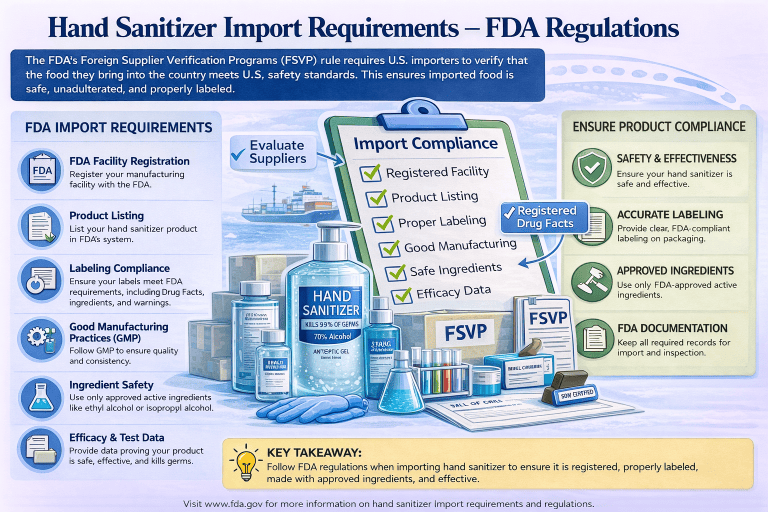
Hand sanitizer compliance is a pre-shipment task. Every one of these must be in place before the goods leave the origin country — trying to fix them at the border means detention:
- Establishment registration — the foreign facility registered (21 CFR Part 207), with a confirmed U.S. Agent
- Labeler code & NDC listing — each product listed in SPL
- Monograph-eligible active — ethanol, isopropyl alcohol, or benzalkonium chloride, at a permitted strength
- Compliant U.S. Drug Facts label — correct format, in English (21 CFR 201.66)
- cGMP + methanol testing — made under 21 CFR 211, with the alcohol tested for methanol
How the Entry Clears FDA
- Filed through ACE — the import entry goes to CBP, with FDA data transmitted electronically
- Affirmation of Compliance codes — including the drug establishment registration number and the NDC
- Importer of record — the U.S. party legally responsible for the entry
- FDA screens against its records — the entry data has to match your registration and listing
Methanol & the Hand Sanitizer Import Alert
Hand sanitizer is one of the most closely watched drug imports — for a serious reason. During the pandemic, many imported sanitizers were contaminated with methanol (wood alcohol), which is poisonous; FDA linked at least 20 deaths to hand sanitizers, 16 involving methanol poisoning.
- January 2021 — a first in FDA history — FDA placed all alcohol-based hand sanitizers from Mexico on Import Alert, its first-ever countrywide import alert for any category of drug
- Import Alert 62-08 — allows detention without physical examination (DWPE) of alcohol-based hand sanitizers for cGMP violations, including methanol
- Green List / Red List — firms that demonstrate compliance can be exempted; firms with violations are held on every shipment
- FDA urges methanol testing — test your ethanol or isopropyl alcohol for methanol before using it to make hand sanitizer
Why Shipments Get Detained — and How to Clear Them
Detention almost always traces to one of these, all of which are cheaper to prevent than to cure:
- Unregistered establishment or no valid U.S. Agent
- Unlisted product or a missing/wrong NDC
- Ineligible active, methanol contamination, or sub-potent alcohol
- Non-compliant Drug Facts label (format, warnings, language)
- On an Import Alert — the firm or product is flagged for DWPE
Import Hand Sanitizer Without the Detention Risk
FDA Registration Assistance makes your hand sanitizer import-ready before it ships: establishment registration with U.S. Agent, labeler code and NDC listing, Drug Facts and active-ingredient review, guidance on methanol testing and cGMP, and the entry data importers need. If a shipment is already detained or your firm is on an Import Alert, we help assemble the evidence to seek release or removal.
Contact us at info@fdaregistrationassistance.com or call +1 (928) 275-8333 for a quote. An independent compliance firm serving 1,000+ companies across 135+ countries, with 15+ years of experience.
Frequently Asked Questions — Hand Sanitizer Imports
1. What does FDA require to import hand sanitizer?
Because hand sanitizer is an OTC drug, everything has to be in place before the shipment arrives: the manufacturing establishment must be registered with FDA (with a U.S. Agent, since it's foreign), each product must be listed with an NDC in SPL, the active must be monograph-eligible (ethyl alcohol, isopropyl alcohol, or benzalkonium chloride), the Drug Facts label must be compliant, and the product must be made under cGMP. At entry, the import is filed through CBP's ACE with FDA data including Affirmation of Compliance codes.
2. Is imported hand sanitizer treated as a drug or a consumer product?
A drug. Alcohol-based hand sanitizer is an OTC drug (a topical antiseptic rub), not a cosmetic or ordinary consumer good, because of its antimicrobial purpose. That's why importing it triggers the full drug-import apparatus - registration, listing, Drug Facts, cGMP, U.S. Agent - rather than the lighter rules importers often assume apply. For why it's a drug and which actives qualify, see our companion page on whether hand sanitizer requires FDA registration.
3. What has to be done before the shipment leaves?
Compliance is a pre-shipment task, not a fix-it-at-the-border one. Before you ship: register the foreign establishment (21 CFR Part 207) and confirm the U.S. Agent; obtain a labeler code and list each product (NDC/SPL); confirm the active is monograph-eligible at a permitted strength; finalize a compliant U.S. Drug Facts label; and ensure cGMP, including methanol testing of your alcohol. Trying to correct these after the goods arrive means detention, relabeling, or refusal.
4. How does a hand sanitizer entry actually clear FDA?
The import entry is filed with U.S. Customs (CBP), and FDA-specific data is transmitted through CBP's ACE system, including Affirmation of Compliance codes such as the drug establishment registration number and the NDC, with an importer of record responsible for the entry. FDA screens the entry against its records. Note: drugs do not use "Prior Notice" - that's a food-import requirement. For hand sanitizer, it's the registration/listing and the entry data matching FDA's records that get a shipment released.
5. Why is hand sanitizer under such heavy import scrutiny?
Methanol. During the pandemic, many imported hand sanitizers - especially from Mexico - were found contaminated with methanol (wood alcohol), which is poisonous; FDA linked at least 20 deaths to hand sanitizers, 16 involving methanol poisoning. In January 2021, FDA placed all alcohol-based hand sanitizers from Mexico on Import Alert - its first-ever countrywide import alert for any category of drug - allowing detention without physical examination. Hand sanitizer remains one of the most closely watched drug imports.
6. What is the hand sanitizer Import Alert (62-08)?
It's the FDA Import Alert covering detention without physical examination (DWPE) of alcohol-based hand sanitizers for cGMP violations, including methanol contamination. Under it, finished-dosage alcohol-based hand sanitizers - notably from Mexico - can be detained at entry without being physically examined, except for firms on the alert's "Green List." Getting on the wrong side of this alert means every shipment is held until you clear it.
7. How do I get a detained hand sanitizer shipment released?
To release an individual detained entry, the importer or responsible party provides evidence to FDA that the product isn't adulterated - for example, records of the active ingredient used and testing showing the product is free of methanol contamination, demonstrating cGMP compliance. To get a firm's product removed from the alert's Red List entirely, you submit documentation showing the underlying cGMP conditions have been corrected. It's an evidence exercise, and it's much slower than getting it right up front.
8. Do I have to test my alcohol for methanol?
You should - FDA has specifically urged manufacturers and compounders to test their ethanol or isopropyl alcohol for methanol contamination before using it to make hand sanitizer. Given the Import Alert history, methanol testing is effectively part of a defensible cGMP program and a key piece of the evidence that keeps (or gets) your shipments cleared. It's cheap insurance against detention.
9. Which active ingredients are allowed in imported hand sanitizer?
Only the monograph-eligible actives: ethyl alcohol (ethanol), isopropyl alcohol, and benzalkonium chloride. Products using other actives (or with methanol contamination, or sub-potent alcohol) are subject to detention. An ingredient outside the monograph can't rely on the OTC pathway at all. Your import's active - and its purity - is one of the first things FDA scrutinizes.
10. Do foreign hand sanitizer manufacturers need a U.S. Agent to import?
Yes. A foreign establishment must be registered and must designate a U.S. Agent (21 CFR 207.69) - FDA's U.S.-based contact for the facility. Given the border scrutiny on hand sanitizer, a responsive U.S. Agent and a clean registration/listing are exactly what smooth entries depend on, and what you'll need if a shipment is ever questioned.
11. What labeling do imported hand sanitizers need?
A compliant U.S. Drug Facts panel (21 CFR 201.66): active ingredient and strength, purpose (antiseptic), use, warnings (flammable, external use only, do not use in eyes, keep out of reach of children, do not ingest), and directions. Foreign labels rarely meet the U.S. format and English-language requirements, so plan on a U.S. label review. Labeling errors are one of the most common reasons hand sanitizer entries are held.
12. What are the most common reasons hand sanitizer imports are refused?
An unregistered establishment; an unlisted product or missing NDC; an ineligible active or methanol/sub-potent alcohol; a non-compliant Drug Facts label; no valid U.S. Agent; or being on (or matching) an Import Alert. Most of these are avoidable, and all of them are far cheaper to fix before shipping than after the goods are sitting in detention.
13. Does importing mean my hand sanitizer is FDA-approved?
No. Clearing customs, being registered, and having an NDC are not FDA "approval." FDA doesn't approve OTC monograph hand sanitizers; it requires compliance. Claiming your product is "FDA-approved" because it was imported or registered is misbranding - it's compliance, not approval.
14. Can I fix compliance after my product arrives?
It's the hard, expensive path. Once a non-compliant shipment arrives, your options are detention, relabeling under FDA supervision (where allowed), re-export, or destruction - plus the risk of landing on an Import Alert that holds future shipments. Doing registration, listing, labeling, and testing before you ship is dramatically faster and cheaper than untangling a detained entry.
15. Is the process different for personal vs commercial imports?
This page is about commercial importation for sale, which requires full compliance. Personal-importation situations follow separate FDA guidance and generally don't provide a way around the Import Alert for commercial product. If you're importing hand sanitizer to sell or distribute, the drug-import requirements apply in full.
16. How does FDA Registration Assistance help with hand sanitizer imports?
We make your hand sanitizer import-ready before it ships: establishment registration with U.S. Agent, labeler code and NDC listing, Drug Facts and active-ingredient review, guidance on methanol testing and cGMP, and the entry data (Affirmation of Compliance codes) importers need. If a shipment is already detained or your firm is on an Import Alert, we help assemble the evidence to seek release or removal. We're an independent compliance firm serving 1,000+ companies across 135+ countries with 15+ years of experience. Contact info@fdaregistrationassistance.com or +1 (928) 275-8333.