
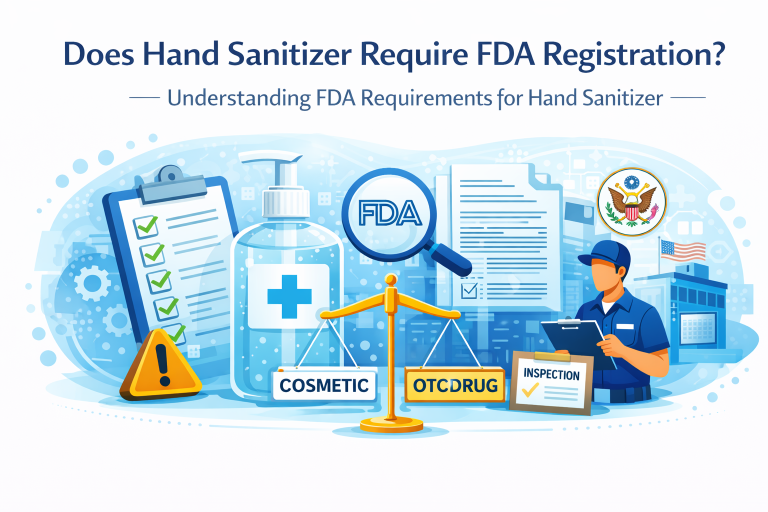
Does Hand Sanitizer Require FDA Registration?
Why hand sanitizer is an OTC drug, which active ingredients are allowed, why the COVID flexibility is gone, and the methanol issue that keeps shipments at the border.
Key Takeaways
- Hand sanitizer is an OTC drug — antimicrobial claims make it a drug, not a cosmetic.
- Only 3 eligible actives — ethanol, isopropyl alcohol, benzalkonium chloride.
- Triclosan & ~28 others aren't eligible — they'd need an NDA.
- The COVID temporary policy is over — use the normal OTC route now.
- Methanol contamination = recalls & Import Alert — test your alcohol.
- Full OTC apparatus — registration, NDC, Drug Facts, cGMP, OMUFA, U.S. Agent.
Why Hand Sanitizer Is an OTC Drug
FDA classifies products by intended use, and a hand sanitizer's whole purpose — "kills 99.9% of germs," "reduces bacteria," "helps prevent illness" — is an antimicrobial (drug) claim. That makes it a topical consumer antiseptic rub, an OTC drug, regardless of how it's packaged or marketed.
Only Three Active Ingredients Are Eligible
FDA's 2019 final rule on consumer antiseptic rubs narrowed the field sharply:
| Active ingredient | Status for OTC hand sanitizer |
|---|---|
| Ethyl alcohol (ethanol) | Eligible — deferred, but marketable (most common) |
| Isopropyl alcohol | Eligible — deferred, but marketable |
| Benzalkonium chloride (BAC) | Eligible — deferred, but marketable |
| Triclosan, benzethonium chloride & ~26 others | Not eligible — would require an NDA/ANDA |
The COVID Temporary Policy Has Ended
During the pandemic, FDA used enforcement discretion to let companies — including distilleries — make hand sanitizer under specific temporary conditions. Those temporary guidances have been withdrawn. If you're making or selling hand sanitizer now, the normal OTC drug requirements apply in full.
The Methanol Problem & Import Scrutiny
Hand sanitizer earned unusually heavy FDA attention after widespread contamination problems — many in imported products:
- Methanol (wood alcohol) — toxic; can cause serious harm absorbed through skin or ingested; triggered numerous recalls and warnings
- Benzene & sub-potent alcohol — additional contamination/effectiveness failures
- Import Alert — hand sanitizers are covered by an FDA Import Alert allowing detention without physical examination for violative firms
- Contaminant testing — testing your alcohol for methanol is part of a defensible cGMP and import file
Requirements & Drug Facts Label
- Drug establishment registration — 21 CFR Part 207 (foreign facilities also need a U.S. Agent)
- NDC drug listing — each product listed in SPL
- Monograph-compliant active — ethanol, isopropyl alcohol, or benzalkonium chloride, at an allowed concentration
- Drug Facts label — active & strength (e.g., "Ethyl alcohol 70% v/v"), purpose (antiseptic), use, warnings, directions
- cGMP + OMUFA + annual renewal — quality manufacturing, the OTC facility fee, and the Oct–Dec renewal
Get Your Hand Sanitizer Compliant
FDA Registration Assistance handles the OTC drug side of hand sanitizer: drug establishment registration, NDC drug listing (SPL), Drug Facts label review, active-ingredient and claims review against the consumer antiseptic rub monograph, U.S. Agent for foreign firms, and import documentation — so your product is compliant before you manufacture, label, list, import, or sell.
Contact us at info@fdaregistrationassistance.com or call +1 (928) 275-8333 for a quote. An independent compliance firm serving 1,000+ companies across 135+ countries, with 15+ years of experience.
Frequently Asked Questions — Hand Sanitizer & FDA
1. Does hand sanitizer require FDA registration?
Yes. Hand sanitizer is regulated as an over-the-counter (OTC) drug — a "topical consumer antiseptic rub" — because it's intended to kill germs and reduce bacteria, which is a drug claim. So the facility that manufactures, packs, or relabels it must complete drug establishment registration, each product must be listed with an NDC, and the product needs a compliant Drug Facts label, cGMP manufacturing, OMUFA fees, and (for foreign facilities) a U.S. Agent. It is not a cosmetic.
2. Is hand sanitizer a drug or a cosmetic?
A drug. Antimicrobial claims — "kills 99.9% of germs," "reduces bacteria," "helps prevent illness" — are drug claims that place hand sanitizer under OTC drug regulations. The only way a hand product avoids drug status is if it's purely cosmetic (for example, it just cleans or scents and makes no antimicrobial claim), which is unusual for something sold as "hand sanitizer."
3. Which active ingredients are allowed in hand sanitizer?
Under FDA's 2019 final rule on consumer antiseptic rubs, only three active ingredients are eligible: ethyl alcohol (ethanol), isopropyl alcohol, and benzalkonium chloride. These three are "deferred" — FDA is still gathering data — but they remain marketable, and ethanol is the most common. Twenty-eight other ingredients, including triclosan and benzethonium chloride, are not eligible for OTC hand sanitizers and would require an approved new drug application (NDA/ANDA) to use.
4. Can I still make hand sanitizer under the COVID-19 temporary policy?
No. During the pandemic, FDA issued temporary guidances (enforcement discretion) that let companies — including distilleries — make hand sanitizer under specific conditions. Those temporary policies have been withdrawn. Any company making or selling hand sanitizer now must follow the normal OTC drug requirements: establishment registration, NDC listing, monograph-compliant actives, Drug Facts labeling, and cGMP. The COVID-era flexibility is gone.
5. What was the methanol problem with hand sanitizer?
FDA found numerous hand sanitizers — many imported — contaminated with methanol (wood alcohol), which is toxic and can cause serious harm if absorbed through skin or ingested, along with products containing benzene or sub-potent alcohol. These led to recalls, consumer warnings, and import action. Hand sanitizers are covered by an FDA Import Alert, so violative products can be detained without physical examination. Testing your alcohol for methanol is part of a defensible compliance and cGMP program.
6. What does hand sanitizer need on its label?
A Drug Facts panel: the active ingredient and its strength (e.g., "Ethyl alcohol 70% v/v"), purpose ("Antiseptic"), a "Use" statement, warnings, directions, and inactive ingredients. The warnings are specific and important — the product is flammable (keep away from heat/flame), for external use only, not to be used in the eyes, must be kept out of reach of children, and must not be swallowed (seek medical help/poison control if ingested). Non-compliant labeling makes it misbranded.
7. Do foreign hand sanitizer manufacturers need a U.S. Agent?
Yes. A foreign hand sanitizer establishment must complete drug establishment registration and designate a U.S. Agent (21 CFR 207.69) — the U.S.-based contact for FDA communications and inspections. Given the import scrutiny on hand sanitizers (including the Import Alert), a responsive U.S. Agent and clean registration/listing are especially valuable for getting shipments through.
8. What is drug listing / NDC for hand sanitizer?
Each hand sanitizer product must be listed with FDA and assigned a National Drug Code (NDC), submitted electronically in Structured Product Labeling (SPL) format. The listing captures the formulation, active ingredient, labeling, and packaging. Registration covers the facility; listing covers each product; both must be accurate and current, and listing errors are a common cause of delays.
9. Does hand sanitizer need to comply with cGMP?
Yes. As an OTC drug, hand sanitizer must be manufactured under current Good Manufacturing Practice (21 CFR Parts 210 and 211). cGMP is what underpins consistent alcohol potency and, critically, testing to rule out methanol and other contaminants. A product not made under cGMP is considered adulterated and can be detained or recalled.
10. Is there an FDA fee for hand sanitizer companies?
Yes — OMUFA, the OTC Monograph User Fee, applies an annual facility fee to OTC monograph drug manufacturers, which includes hand sanitizer. Companies that entered the category during COVID often didn't account for OMUFA; it's a recurring cost of staying in the OTC hand-sanitizer business.
11. How often must the registration be renewed?
Annually, between October 1 and December 31 (21 CFR 207.29) — drug registration is annual, unlike food facility registration, which is biennial. A lapsed registration makes the product misbranded and subject to detention, so keeping the registration and listings current is part of ongoing compliance.
12. Does registering my hand sanitizer mean it's FDA-approved?
No. Registration identifies your facility, listing identifies your product, and monograph compliance means it can be marketed without an NDA — but none of these is FDA "approval." Claiming a hand sanitizer is "FDA-approved" because it's registered or has an NDC is misbranding. It's compliance, not approval.
13. Can imported hand sanitizer be detained?
Yes — and hand sanitizer draws extra scrutiny. FDA can detain imports that appear misbranded, unregistered, unlisted, made with an ineligible active, or contaminated (methanol/benzene) or sub-potent, and hand sanitizers are covered by an Import Alert that allows detention without physical examination for violative firms. A complete registration/listing, compliant label, and contaminant testing are what keep shipments moving.
14. Can I use a scent-only or "natural" hand product to avoid drug rules?
Only if it genuinely makes no antimicrobial claim — and "hand sanitizer" strongly implies one. If the product claims to sanitize, kill germs, or reduce bacteria, it's a drug regardless of being marketed as "natural" or "clean." And an "antimicrobial" hand product using a non-eligible active (not ethanol/isopropanol/benzalkonium chloride) can't rely on the monograph at all and would need an NDA.
15. What are the most common hand sanitizer compliance mistakes?
Treating it as a cosmetic; skipping establishment registration or NDC listing; using an ineligible active ingredient; non-compliant Drug Facts labeling (especially the flammability and "do not ingest" warnings); assuming the withdrawn COVID temporary policy still applies; not testing for methanol; and overlooking OMUFA and the annual renewal. Most are avoidable with the formula and label reviewed up front.
16. How does FDA Registration Assistance help with hand sanitizer?
We handle the OTC drug side: drug establishment registration, NDC drug listing (SPL), Drug Facts label review, active-ingredient and claims review against the consumer antiseptic rub monograph, U.S. Agent for foreign firms, and import documentation — so your hand sanitizer is compliant before you manufacture, label, list, import, or sell. We're an independent compliance firm serving 1,000+ companies across 135+ countries with 15+ years of experience. Contact info@fdaregistrationassistance.com or +1 (928) 275-8333.
