
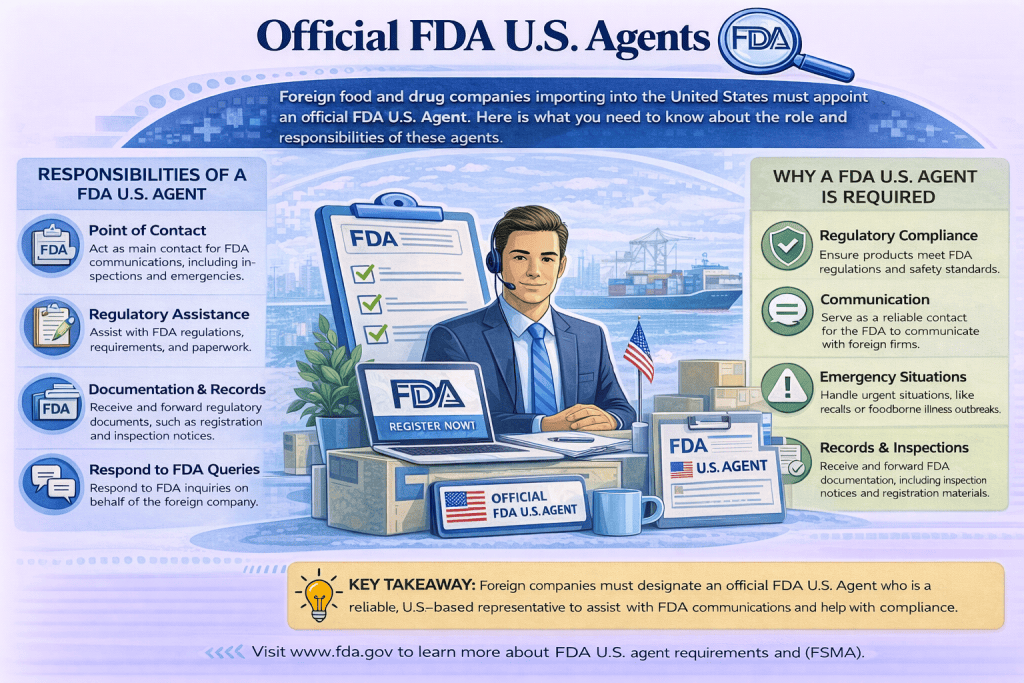
FDA U.S. Agents
A U.S. Agent is the U.S.-based contact every foreign establishment must designate when it registers with FDA, in the food, drug, device and cosmetic programs alike. This hub explains what the agent does and does not do, who qualifies, how the rules and update deadlines differ by program, how to switch without a gap and where to find U.S. Agent service for your product. Prepared by FDA Registration Assistance, with 15+ years of FDA regulatory experience and 1,000+ companies served across 135+ countries.
Registering a foreign facility? Tell us the products, the facility location and the FDA program. We accept the U.S. Agent role, confirm the designation with FDA and can handle the registration alongside it.
Get My FDA U.S. AgentWhat a U.S. Agent Does and Does Not Do
The U.S. Agent Does
- Assist FDA in communications with the foreign establishment
- Respond to FDA questions about products imported or offered for import
- Help FDA schedule inspections of the establishment
- Receive FDA information or documents when FDA cannot reach the establishment; this counts as delivery to the establishment
The U.S. Agent Does Not
- Take legal responsibility for the product
- File premarket submissions such as a device 510(k)
- Handle adverse event reporting on your behalf
- Confer any FDA approval, clearance or certification
Sources: 21 CFR 1.227, 21 CFR 207.69, 21 CFR 807.40 and FDA MoCRA registration guidance. The wording varies slightly by program, but in every program the U.S. Agent is a communication and contact role defined by regulation.
U.S. Agent Rules Differ by FDA Program
The core role is the same everywhere, but each program has its own rule, renewal cycle and update deadline.
| Program | Rule | Renewal | Update After an Agent Change | Our Service |
|---|---|---|---|---|
| Food and dietary supplements | 21 CFR 1.227 | October 1 to December 31 of each even-numbered year | Within 60 calendar days (21 CFR 1.234) | Food U.S. Agent |
| Drugs (OTC and Rx) | 21 CFR 207.69 | Every year, October 1 to December 31 | Update the registration in electronic SPL | Drug U.S. Agent |
| Medical devices | 21 CFR 807.40 | Every year, October 1 to December 31 | Within 10 business days | Device U.S. Agent |
| Cosmetics (MoCRA) | FDA MoCRA registration guidance | Every two years | Within 60 days | Cosmetic U.S. Agent |
Who Needs a U.S. Agent and Who Can Serve
Who Needs One
- Foreign establishments that register with FDA in any program
- One agent per establishment; one agent can serve many firms
- Not domestic firms: FDA can reach a U.S. company directly
Who Can Serve
- An individual or business that resides or keeps a place of business in the U.S.
- Physically present; no mailbox, answering machine or service
- Consents to serve and responds to FDA; devices confirm within 10 business days
- Available during business hours, with backup when needed
Sources: 21 CFR 1.227; 21 CFR 207.69; FDA device U.S. Agent guidance.
U.S. Agent vs. Importer, FSVP Importer and Official Correspondent
| Role | Who It Is | What It Does |
|---|---|---|
| U.S. Agent | U.S.-based contact designated by the foreign establishment | FDA communications, product questions, inspection scheduling, receiving documents |
| Importer of record | The party that brings the shipment into the U.S. | Customs entry and import filings |
| FSVP importer (food) | U.S. owner or consignee at entry, or a designated U.S. agent or representative | Verifies foreign suppliers meet U.S. food safety standards |
| Official correspondent | Contact for registration and listing (drugs and devices) | Keeps registration and listing information accurate; may be the U.S. Agent for devices |
One company can hold more than one role, but each must be covered. See U.S. Agent vs. importer explained and FSVP requirements.
Switching Your U.S. Agent Without a Gap
Guides: transfer your FDA U.S. Agent, replacing your agent, changing a drug registration agent and alternatives to big-name firms.
Common U.S. Agent Mistakes
- Registering without a valid, consenting U.S. Agent, so the registration cannot complete
- A stale or mismatched agent on the registration, so FDA cannot reach you
- An unresponsive agent who misses FDA messages or inspection scheduling
- Assuming one designation covers every program; each establishment and program needs its own
- Using a PO box, virtual office or answering service instead of a physically present agent
- Treating "has a U.S. Agent" as "FDA approved"
More on U.S. Agents and Registration
Which U.S. Agent Do I Need?
Match your product and program to the right agent.
U.S. Agent for FDA Registrations
The U.S. Agent role across all programs, in depth.
Registration + U.S. Agent
Registration and agent handled together.
FDA Registration Agent
The firm that files and renews your registration.
U.S. Agent vs. Consultant
When you need an agent, a consultant or both.
Same-Day U.S. Agent
When a registration or shipment cannot wait.
Get Your FDA U.S. Agent
FDA Registration Assistance acts as the U.S. Agent for foreign establishments across FDA's food, drug, device and cosmetic programs: a physically present U.S. contact that confirms the designation with FDA, forwards FDA communications promptly and helps coordinate inspection scheduling. We can handle your establishment registration and renewals alongside it so everything stays aligned.
- U.S. Agent service for food, drug, device and cosmetic facilities.
- Designation confirmed with FDA and kept current at every renewal.
- Agree the scope, documents and pricing before any paid work begins.
Contact our specialists, email info@fdaregistrationassistance.com, or call +1 (928) 275-8333. Registration pricing · FDA U.S. Agents.
Get My FDA U.S. AgentFDA Registration Assistance is a private consulting firm, not FDA or any government agency. FDA registration is not FDA approval, clearance or certification.
Frequently Asked Questions — FDA U.S. Agents
What is an FDA U.S. Agent?
A U.S. Agent is the person or company in the United States that a foreign establishment designates so FDA has someone in the country to contact about that establishment. The agent assists FDA in communications with the foreign facility, answers questions about its products that are imported or offered for import, helps schedule inspections, and receives information or documents when FDA cannot reach the establishment directly; FDA treats delivery to the agent as delivery to the establishment (21 CFR 207.69, 21 CFR 807.40). It is a required part of FDA registration for foreign establishments across food, drug, device and cosmetic programs.
Who needs a U.S. Agent?
Foreign establishments - companies located outside the United States that manufacture or handle FDA-regulated products for the U.S. market. Whether you make food, drugs, devices, or cosmetics, if your establishment is foreign and must register with FDA, you generally must designate a U.S. Agent as part of that registration. Domestic (U.S.) establishments register but do not need a U.S. Agent, because FDA can reach them directly in the United States.
Does the U.S. Agent requirement differ by FDA program?
The core role is the same, but each program has its own rule: food facility registration (21 CFR 1.227), foreign drug establishments (21 CFR 207.69), foreign device establishments (21 CFR 807.40) and cosmetic facilities under MoCRA. Renewal and update timing differ too: food registrations renew between October 1 and December 31 of each even-numbered year and must be updated within 60 days of a U.S. Agent change (21 CFR 1.234); drug and device registrations renew every year between October 1 and December 31, and device establishments report U.S. Agent changes within 10 business days (21 CFR 807.40); cosmetic facility registrations renew every two years and are updated within 60 days of a change (FDA MoCRA registration guidance). Each program has its own U.S. Agent page linked on this hub.
What does a U.S. Agent do — and not do?
A U.S. Agent facilitates FDA communication for the foreign establishment: assisting communications, responding to FDA questions about the establishment's products, helping schedule inspections, and receiving documents when FDA can't reach the establishment. It does NOT take legal responsibility for the product, file your premarket submissions (like a device 510(k)), or handle adverse-event reporting on your behalf. The role is specifically a communication/contact function, defined by regulation.
Can a company have more than one U.S. Agent?
Each foreign establishment designates one U.S. Agent for a given registration. A single U.S. Agent can serve many establishments, and if you have facilities across different FDA programs, one provider can act as your U.S. Agent for each. But for any single foreign establishment's registration, there is one U.S. Agent on file at a time. Keeping that designation current and consistent with your registration matters, because FDA relies on it to reach you.
What are the requirements to be a U.S. Agent?
The U.S. Agent must reside or maintain a place of business in the United States and be physically present there. A mailbox, answering machine or service, or any place where the person acting as agent is not physically present does not qualify (21 CFR 1.227, 21 CFR 207.69). The agent can be an individual or a business, such as a consultant, law firm, importer or dedicated U.S. Agent service, and it must agree to serve: for devices, FDA asks the named agent to confirm, and an agent who does not respond within 10 business days is not accepted (FDA device U.S. Agent guidance). Responsiveness matters, because FDA communications and inspection scheduling flow through the agent.
Does having a U.S. Agent mean my product is FDA-approved?
No. A U.S. Agent (and registration) is an administrative requirement: it gives FDA a contact and puts you in FDA's system. It does not mean FDA reviewed, cleared or approved your product, and implying that is misleading (for devices, see 21 CFR 807.39). Your product still needs whatever premarket pathway applies to it. A U.S. Agent facilitates communication; it confers no FDA authorization.
Can I change my U.S. Agent?
Yes, and it's common, for example if your current agent is unresponsive or too expensive, or you want your registration and agent handled together. The change is made in the relevant FDA registration system, and the key is to switch without a coverage gap so FDA always has a valid agent on file. Food facilities must update the registration within 60 calendar days of a U.S. Agent change (21 CFR 1.234), and device establishments within 10 business days (21 CFR 807.40). See our pages on transferring your U.S. Agent and alternatives to big-name agent firms for how to switch cleanly.
What happens if my U.S. Agent is unresponsive?
It's a real risk. FDA communications - including questions about your products and inspection scheduling - flow through your U.S. Agent, and if FDA can't reach the establishment directly, giving documents to the agent counts as reaching you. An agent who is unreachable, on vacation without backup, or slow to forward messages can cause missed FDA deadlines, delayed inspections, and compliance problems you learn about too late. Continuous, reliable availability is the whole point.
What happens if my registration lists an outdated U.S. Agent?
A stale or mismatched U.S. Agent on your registration means FDA may be unable to reach you, and import entries can be flagged when registration and agent information are inconsistent. Because the agent is designated as part of registration, the two must stay aligned and current - update any change in the agent's name, address, or contact details promptly in the appropriate FDA system. Keeping registration and agent consistent is a basic but frequently missed compliance step.
Is a U.S. Agent the same as an importer or official correspondent?
Not necessarily. The U.S. Agent is FDA's contact for the foreign establishment. An importer or initial importer is the U.S. entity that first receives an imported product, with its own obligations, and for food the FSVP importer is responsible for verifying foreign suppliers. An official correspondent (in drug and device registration) handles registration and listing communications; a device establishment may designate its U.S. Agent as its official correspondent (21 CFR 807.40). One party can wear more than one hat, but they are distinct roles, so don't assume your importer or correspondent is automatically your registered U.S. Agent. See U.S. Agent vs. importer explained.
Do I need a separate U.S. Agent for each product category?
You need a U.S. Agent for each foreign establishment's registration in each applicable program. A company with products across categories (say a food/supplement, an OTC drug, and a cosmetic) registers in each program and has a U.S. Agent for each - the requirements don't merge into one. One provider can serve as your U.S. Agent across all of them, which keeps things coordinated, but the designations are per establishment/program.
How much does a U.S. Agent cost?
U.S. Agent service is a consulting and representation fee, not an FDA fee. For food facilities, FDA Registration Assistance charges $858 per year for food facility registration with U.S. Agent service and renewal management; FDA charges no fee to register a food facility. Drug, device and cosmetic U.S. Agent service is quoted by program, number of establishments and scope. FDA government fees, such as the annual device establishment registration fee, are separate and paid to FDA regardless of who serves as your agent. See the registration pricing list.
Which U.S. Agent page should I use for my product?
Use the program that matches your product: the food U.S. Agent page for food and dietary supplements, the drug and pharmaceutical U.S. Agent page for drugs, the medical device U.S. Agent page for devices, and the cosmetic U.S. Agent page for MoCRA cosmetics. If you are not sure, start with which U.S. Agent do I need. If you want FDA registration and the U.S. Agent handled together, see the combined registration and U.S. Agent page.
Is a U.S. Agent required to import — or is that the importer?
They're different roles. The U.S. Agent is the foreign establishment's FDA contact (a registration requirement). Importing also involves an importer/initial importer - the U.S. party bringing the product in - who has its own obligations (and, for some programs like food, FSVP responsibilities). A foreign firm typically needs a U.S. Agent to register, and its product needs a proper importer to enter the U.S.; one company can sometimes do both, but confirm each role is covered.
How does FDA Registration Assistance serve as a U.S. Agent?
We act as the U.S. Agent for foreign establishments across FDA's food, drug, device and cosmetic programs: a responsive U.S.-based point of contact that meets the requirements, forwards FDA communications and helps coordinate inspection scheduling. We can handle your establishment registration alongside it so everything stays aligned. We're an independent compliance firm serving 1,000+ companies across 135+ countries with 15+ years of experience. Contact info@fdaregistrationassistance.com or +1 (928) 275-8333, or use the form below.
Does a U.S. company need a U.S. Agent?
No. Domestic establishments register with FDA but do not designate a U.S. Agent, because FDA can reach them directly. The requirement applies to foreign establishments that register with FDA. A U.S. importer, distributor or brand owner may still have its own obligations, such as FSVP for food importers, but naming a U.S. Agent is not one of them.
What happens if a foreign establishment has no valid U.S. Agent?
The registration cannot be completed or kept current without one. For devices, if the named agent denies the designation or does not confirm within 10 business days, the establishment is notified and must name a new agent (FDA device U.S. Agent guidance). Products from a facility without a complete, current registration can be held or refused at the port, so a lapsed or missing agent can stop shipments.
Is a U.S. Agent the same as an FSVP agent or FSVP importer?
No. The U.S. Agent is a registration requirement for the foreign facility. The FSVP importer is the U.S. owner or consignee responsible for verifying that imported food meets U.S. safety standards, and if there is no U.S. owner or consignee at entry, the foreign owner must designate a U.S. agent or representative to act as the FSVP importer. They are separate roles that one provider can sometimes cover. See FSVP requirements.
How quickly can a U.S. Agent be appointed?
Once the agent accepts and your registration details are ready, the designation can usually be made the same day or within a few business days. Timing then depends on the FDA system: device agents confirm FDA's request within 10 business days, and food registrations need a valid facility identifier (DUNS Number) before FDA confirms the registration.
Request U.S. Agent Service
Tell us what your company makes, sells, or distributes, where each product is manufactured or packed, your U.S. importer or buyer arrangement, label readiness, and target shipment date.
Submitting this inquiry does not purchase a service or authorize paid work. Our team can discuss the scope and required materials before you commission assistance. Fields marked with an asterisk are required.