
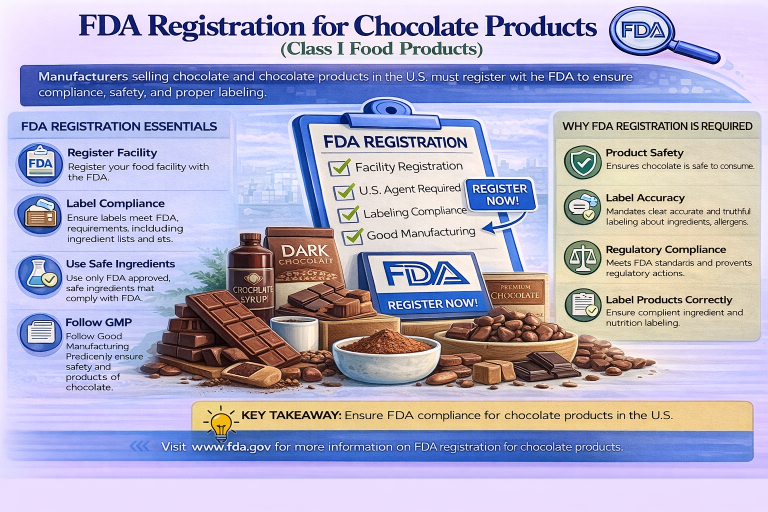
FDA Registration for Chocolate Products
This guide covers every FDA requirement for chocolate importers — including the specific cacao content thresholds for each chocolate type, why "chocolate flavored" is legally required when the standard isn't met, chocolate-specific FSVP hazards including heavy metals and Salmonella, and Dutch-processed cocoa labeling.
FDA Standards of Identity — Cacao Content Requirements for Each Chocolate Type
This is where most imported chocolate violations originate. Under 21 CFR Part 163, each chocolate product name — milk chocolate, semisweet chocolate, white chocolate — requires the product to meet specific compositional thresholds. A product that does not meet the applicable standard cannot be labeled with that name. It must be labeled "chocolate flavored" or use another non-standard name:
| Product Name | CFR Section | Min. Chocolate Liquor | Other Key Requirements |
|---|---|---|---|
| Milk Chocolate | 163.130 | ≥ 10% | ≥ 12% total milk solids; ≥ 3.39% milk fat. Most commonly imported chocolate type. Must meet all three thresholds simultaneously. |
| Sweet Chocolate | 163.153 | ≥ 15% | No minimum milk solids. Higher cacao content than milk chocolate minimum. |
| Semisweet or Bittersweet Chocolate | 163.123 | ≥ 35% | The standard most often described as "dark chocolate." No separate FDA standard for "dark chocolate" — 35% is the closest defined threshold. |
| White Chocolate | 163.124 | 0% (no cacao solids) | ≥ 20% cocoa butter; ≥ 14% total milk solids; ≥ 3.5% milk fat; ≤ 55% nutritive sweetener. Cannot contain non-fat cacao solids. |
| Breakfast Cocoa | 163.112 | N/A — cocoa product | ≥ 22% cocoa fat (cocoa butter). Cocoa powder with higher fat content than regular cocoa. |
| Cocoa (regular) | 163.113 | N/A — cocoa product | 10–22% cocoa fat. If Dutch-processed (alkalized), must be declared as "cocoa processed with alkali" — not simply "cocoa." |
| "Chocolate Flavored" (non-conforming) | 21 U.S.C. § 343 | Does not meet standard | Required label when a product resembles chocolate but does not meet the applicable cacao/milk solids thresholds. Cannot use "chocolate" as the product name. |
A product labeled "milk chocolate" containing only 8% chocolate liquor is misbranded under 21 U.S.C. § 343 and will be refused admission at the U.S. port of entry. FDA Registration Assistance reviews cacao content specifications against 21 CFR Part 163 before any shipment is made.
"Chocolate" vs. "Chocolate Flavored" — The Rule That Gets Shipments Held
This is the most commonly misunderstood chocolate labeling rule for imported products. The distinction is simple but the consequences of getting it wrong are severe:
Products That CAN Use "Chocolate"
Products that meet the applicable 21 CFR Part 163 standard — verified by formulation documentation and analytical testing confirming minimum chocolate liquor, milk solids, and fat content. Examples: "Milk Chocolate Bar," "Semisweet Chocolate Chips," "White Chocolate Coating" (if meeting all thresholds).
Products That Must Use "Chocolate Flavored"
Products that use cocoa powder, cocoa flavoring, or reduced-cacao formulations that do not meet the Part 163 standard. Examples: "Chocolate-Flavored Coating," "Chocolate-Type Candy," "Chocolate-Flavored Wafer." These products cannot use "chocolate" as the product identity even if they taste like chocolate.
Many foreign manufacturers produce products that meet their home country's chocolate definition but fall short of the U.S. minimum chocolate liquor requirements. A European "milk chocolate" with 7% cacao solids meets EU standards but is not "milk chocolate" under U.S. law — it must be relabeled for the U.S. market before import. FDA Registration Assistance checks all imported chocolate products against Part 163 thresholds as part of the label review service.
Allergen Declarations — The #1 Detention Trigger for Chocolate
Chocolate is one of the most allergen-dense categories in the food import space. Multiple major allergens are commonly present in standard chocolate products, and cross-contact allergens in chocolate manufacturing facilities add further complexity. Under FALCPA and the FASTER Act of 2021, all nine major allergens must be declared when present:
Always Present
Milk — present in milk chocolate, many dark chocolates, and most filled chocolates. Must be declared even at trace levels.
Soy — soy lecithin is the most common emulsifier in chocolate. Must be declared.
Frequently Present
Tree nuts — almonds, hazelnuts, cashews in filled or mixed chocolates. Specify the exact nut type.
Peanuts — present in peanut butter chocolates; cross-contact common in facilities processing both.
May Be Present
Wheat — in chocolates containing wafers, cereals, or cookie inclusions.
Sesame — added as FASTER Act allergen in 2023. Sesame paste or sesame-containing inclusions require declaration.
Undeclared allergens are the #1 reason chocolate shipments are detained at U.S. ports and the #1 reason chocolate products are recalled in the United States. All allergen declarations — both ingredient-level and cross-contact — must appear on the label before any shipment is made. FDA Registration Assistance includes allergen declaration review in its chocolate label review service.
FSVP Hazards Specific to Cocoa and Chocolate
U.S. importers of chocolate must maintain an FSVP program under 21 CFR Part 1 Subpart L. The hazard analysis must address chocolate-specific hazards — not just generic food safety concerns:
Heavy Metals — Cadmium & Lead
Cadmium and lead naturally accumulate in cocoa beans. Dark chocolate and cocoa powder — which have higher cocoa content per serving — have higher heavy metal concentrations. FDA monitors heavy metals through its Closer to Zero initiative. California Prop 65 requires warning labels on products sold in California that exceed cadmium or lead thresholds. FSVP programs for dark chocolate and cocoa powder importers should include supplier testing data for heavy metals as a verification activity.
Salmonella in Dry Cocoa and Chocolate
Salmonella is one of the most documented biological hazards in cocoa powder and chocolate, with multiple outbreak investigations linked to contaminated chocolate. Cocoa beans can carry Salmonella from the growing environment and post-harvest drying process. FSVP supplier verification for cocoa and chocolate should include review of the supplier's environmental monitoring program for Salmonella and documentation of pathogen reduction steps (roasting).
Ochratoxin A (OTA)
OTA is a mycotoxin produced by mold during post-harvest cocoa storage when drying conditions are inadequate. OTA is a nephrotoxin and probable carcinogen. FSVP hazard analyses for cocoa importers should identify OTA as a chemical hazard and include supplier verification addressing drying and storage practices, particularly for cocoa from humid growing regions.
Pesticide Residues
Cocoa is a conventionally farmed crop subject to pesticide applications. Pesticide residues in cocoa beans and chocolate are an identified FSVP chemical hazard. FSVP verification activities for pesticide residues may include review of supplier pesticide monitoring data, certificates of analysis, or supplier attestations of Good Agricultural Practices compliance.
Dutch-Processed Cocoa, Dark Chocolate Claims & Service Cost
Dutch-Processed (Alkalized) Cocoa Must Be Declared
Dutch-processed cocoa is treated with an alkalizing agent to reduce acidity and darken the color. Under FDA's ingredient list requirements, alkalized cocoa cannot be declared simply as "cocoa" — it must be labeled as "cocoa (processed with alkali)" or "alkalized cocoa." Using "cocoa" in the ingredient list for Dutch-processed cocoa is an inaccurate ingredient declaration that makes the product misbranded. This is a frequent labeling violation in imported European chocolate products that use Dutch-processed cocoa.
"Dark Chocolate" — No FDA Standard, But Claims Must Be Truthful
"Dark chocolate" is widely used commercially but has no specific FDA standard of identity. FDA's closest defined standard is semisweet/bittersweet chocolate (≥35% chocolate liquor). Products labeled "70% dark chocolate" or "85% dark chocolate" are permitted but the percentage must accurately reflect the actual cacao content. Overstating the cacao percentage on a dark chocolate label is misbranding. FDA Registration Assistance verifies percentage claims against formulation documentation during label review.
Ready to Import Chocolate Products to the United States?
FDA Registration Assistance handles Food Facility Registration, chocolate label review (21 CFR Parts 101 and 163 — standards of identity, allergen declarations, serving size), U.S. Agent designation, FSVP support, Prior Notice guidance, and Biennial Renewal management — for chocolate manufacturers and importers in 135+ countries.
Contact us at info@fdaregistrationassistance.com or call +1 (928) 275-8333. 1,000+ clients. 15+ years of FDA regulatory experience.
Frequently Asked Questions — FDA Registration for Chocolate Products
1. Do chocolate products require FDA registration?
Yes. The manufacturing facility must register with FDA under 21 CFR Part 1 before any chocolate is exported to the United States. Foreign facilities must designate a U.S. Agent. Registration renews every two years. Complete service: $858.
2. What are FDA standards of identity for chocolate products?
Chocolate standards of identity are at 21 CFR Part 163: milk chocolate ≥ 10% chocolate liquor + ≥ 12% milk solids + ≥ 3.39% milk fat; sweet chocolate ≥ 15%; semisweet/bittersweet ≥ 35%; white chocolate ≥ 20% cocoa butter + ≥ 14% milk solids + ≥ 3.5% milk fat. Products not meeting these thresholds cannot use the chocolate name.
3. What is the difference between "chocolate" and "chocolate flavored"?
A product can only be labeled "chocolate" if it meets the applicable 21 CFR Part 163 compositional standard. Products that do not meet the minimum cacao solids, milk solids, and fat thresholds must be labeled "chocolate flavored" — for example, "chocolate-flavored coating" or "chocolate-type candy." This is one of the most common reasons imported chocolate products are misbranded and detained at U.S. ports.
4. What is white chocolate and does it have an FDA standard?
Yes. Under 21 CFR Part 163.124, white chocolate must contain ≥ 20% cocoa butter, ≥ 14% total milk solids, ≥ 3.5% milk fat, and ≤ 55% nutritive sweetener. It cannot contain non-fat cacao solids. Products not meeting these requirements cannot be labeled "white chocolate."
5. What allergens must be declared on chocolate product labels?
Under FALCPA and the FASTER Act, all major allergens present must be declared: milk (in milk chocolate and most filled chocolates); soy (lecithin emulsifier); tree nuts (almonds, hazelnuts, cashews — specify the exact nut); peanuts; wheat (in wafer or cereal inclusions); and sesame. Undeclared allergens are the #1 reason chocolate shipments are detained and the #1 reason chocolate products are recalled in the United States.
6. Does chocolate labeling require specific CFR compliance?
Yes. Labels must comply with 21 CFR Part 101 (general food labeling) and 21 CFR Part 163 (standards of identity). Required elements: correct product identity; net quantity; Nutrition Facts panel with the correct serving size (40g RACC for confectionery); ingredient list in descending order; allergen declarations; and manufacturer/distributor information. All text must be in English.
7. What is Dutch-processed cocoa and how must it be labeled?
Dutch-processed (alkalized) cocoa must be declared as "cocoa (processed with alkali)" or "alkalized cocoa" in the ingredient list — not simply "cocoa." Using "cocoa" in the ingredient list for alkalized cocoa is an inaccurate ingredient declaration and a labeling violation. This is a frequent issue with imported European chocolate products.
8. What FSVP hazards are specific to chocolate and cocoa?
Under 21 CFR Part 1 Subpart L, the FSVP hazard analysis for chocolate must address: cadmium and lead accumulation in cocoa beans (especially in dark chocolate and cocoa powder); ochratoxin A mycotoxin from inadequate post-harvest drying; Salmonella in dry cocoa powder (multiple documented outbreaks); and pesticide residues. Each requires appropriate supplier verification activities.
9. Is there an FDA limit for cadmium or lead in chocolate?
FDA has not established final action levels specifically for cadmium or lead in chocolate under federal law, but monitors heavy metals through its Closer to Zero initiative. California's Proposition 65 requires warning labels on chocolate sold in California if cadmium or lead levels exceed specified thresholds. Multiple brands have received Prop 65 notices regarding heavy metals in dark chocolate. Importers targeting California distribution should test products for heavy metals.
10. Does "dark chocolate" have an FDA standard of identity?
No. "Dark chocolate" has no specific FDA standard. The closest defined standard is semisweet/bittersweet chocolate at ≥ 35% chocolate liquor under 21 CFR Part 163.123. Percentage claims on dark chocolate labels (e.g., "70% cacao") must accurately reflect actual cacao content. Overstating the percentage is misbranding.
11. Does FDA require Prior Notice for chocolate shipments?
Yes. Every chocolate shipment requires FDA Prior Notice under 21 CFR Part 1 Subpart I before arrival at the U.S. port — 8 hours for ocean, 4 hours for most air, 2 hours for road. The manufacturer's active FDA registration number and correct product code must be included.
12. Are there supply chain compliance issues beyond FDA for chocolate importers?
Yes. CBP has issued Withhold Release Orders (WROs) for cocoa from countries linked to child and forced labor in cocoa supply chains. Chocolate importers should conduct supply chain due diligence to confirm their cocoa sourcing does not trigger a WRO. This is separate from FDA compliance but can result in shipment seizure at U.S. ports.
13. What FSVP requirements apply to U.S. importers of chocolate?
U.S. importers must maintain an FSVP program under 21 CFR Part 1 Subpart L for each foreign chocolate supplier. Hazard analysis must address Salmonella, cadmium and lead, ochratoxin A mycotoxin, and pesticide residues — with verification activities appropriate to each hazard.
14. What is the Nutrition Facts serving size for chocolate products?
The RACC for chocolate candy under 21 CFR Part 101.12 is 40 grams. Many imported chocolates use European serving sizes (25g or 100g) that do not match the U.S. requirement. All nutrient declarations must be based on the 40g U.S. serving size. Incorrect serving sizes affect all Nutrition Facts declarations.
15. Does soy lecithin in chocolate require an allergen declaration?
Yes. Soy lecithin is derived from soybeans, a major allergen. Soy must be declared on all chocolate labels even when present only as an emulsifier. The declaration can appear as "soy lecithin (emulsifier)" in the ingredient list or in a "Contains: Soy" statement. There is no minimum threshold below which allergen declaration is not required.
16. Can chocolate products make "sugar-free" or "no sugar added" claims?
"Sugar-free" requires less than 0.5g of sugars per serving under 21 CFR Part 101.60. "No sugar added" requires no sugar or sugar-containing ingredient was added during processing. Both claims require specific compliance conditions. Sugar-free chocolate using sugar alcohols must include a disclosure statement if the product may have a laxative effect.
17. What are the most common reasons chocolate shipments are detained?
Most common: undeclared allergens (milk, soy, peanuts, tree nuts); product labeled "chocolate" not meeting Part 163 cacao thresholds; wrong serving size in Nutrition Facts (not 40g); unregistered manufacturing facility; missing or inaccurate Prior Notice; alkalized cocoa declared as plain "cocoa"; and non-compliant label format.
18. Does "organic" chocolate require USDA certification?
Yes. Organic claims are regulated by USDA under the National Organic Program — not FDA. A chocolate product can only carry the USDA Organic seal if certified by a USDA-accredited certifying agent. FDA and USDA compliance are independent and both required for products making organic claims.
19. What is ochratoxin A and why is it a concern for cocoa importers?
OTA is a mycotoxin produced by mold that can contaminate cocoa beans when post-harvest drying is inadequate or storage is humid. OTA is a nephrotoxin and probable carcinogen. FSVP hazard analyses for cocoa importers should identify OTA as a chemical hazard requiring supplier verification addressing drying and storage practices, particularly for cocoa from humid growing regions.
20. Do chocolate products need FSMA Preventive Controls compliance?
Yes. Chocolate manufacturing facilities must comply with FSMA Preventive Controls for Human Food under 21 CFR Part 117. Key preventive controls for chocolate include allergen controls (critical for multi-variety facilities), environmental monitoring for Salmonella in the processing environment, and process controls for roasting steps that reduce pathogen load.
21. How much does FDA Food Facility Registration cost for a chocolate manufacturer?
FDA charges $0 in government fees. FDA Registration Assistance charges $858 for the complete service — registration, DUNS Number procurement, U.S. Agent designation for foreign facilities, and Biennial Renewal management. See the full cost breakdown.
22. What is chocolate liquor and how does it relate to FDA standards?
Chocolate liquor (cocoa liquor or cacao mass) is the paste produced by grinding roasted cocoa beans, containing both cocoa solids and cocoa butter. It contains no alcohol despite its name. FDA's 21 CFR Part 163 standards specify minimum chocolate liquor content as the primary compositional threshold — 10% for milk chocolate, 15% for sweet chocolate, 35% for semisweet/bittersweet.
23. What is the FDA product code for chocolate products?
Common FDA product codes for chocolate: 09A for chocolate and chocolate confectionery products; 09B for cocoa products. The correct product code must be used in Prior Notice filings and affects FDA's PREDICT risk-scoring for the shipment. FDA Registration Assistance confirms the correct product code before filing Prior Notice.
24. What are the most common FDA compliance mistakes for chocolate importers?
Most common: labeling a product "chocolate" when it does not meet 21 CFR Part 163 thresholds; undeclared allergens; wrong Nutrition Facts serving size (not 40g); Dutch-processed cocoa declared as plain "cocoa"; "organic" claim without USDA NOP certification; facility not registered with FDA; and no FSVP for the foreign chocolate supplier.
25. How do I get started with FDA compliance for my chocolate products?
Contact FDA Registration Assistance at info@fdaregistrationassistance.com or call +1 (928) 275-8333. Provide your chocolate product types, cacao content specifications, current label, and facility location. FDA Registration Assistance will review your label against 21 CFR Parts 101 and 163, confirm standards of identity compliance, complete Food Facility Registration, and advise on FSVP. Complete service: $858.