
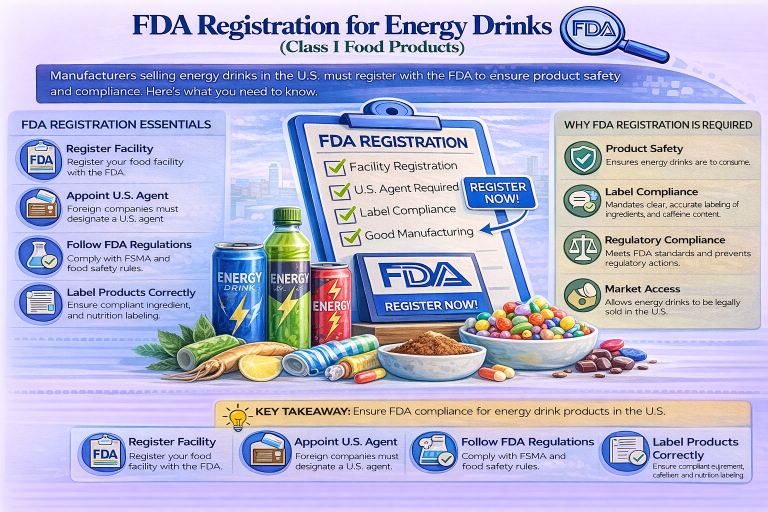
FDA Registration for Energy Drinks
This guide covers the classification decision, the specific caffeine GRAS issue that affects all conventional food energy drinks, ingredient-by-ingredient status for common energy drink components, labeling requirements, claims boundaries, and everything else FDA requires before an energy drink enters U.S. commerce.
Conventional Food vs. Dietary Supplement — How FDA Classifies Your Energy Drink
This is the first question FDA asks about any energy drink — and it determines every downstream compliance obligation. The classification is not a choice you make freely; it is determined by the product's formulation, intended use, and how it is marketed. The live page on this site says classification "depends on formulation and marketing" and stops there. Here is the actual framework:
| Factor | Conventional Food (Beverage) | Dietary Supplement |
|---|---|---|
| Product format | Beverage — consumed as a drink in conventional quantities | Supplement — often small format (shots, sachets); not a conventional meal component |
| Labeling panel | Nutrition Facts panel required under 21 CFR Part 101.9 | Supplement Facts panel required under 21 CFR Part 101.36 |
| Ingredient basis | All ingredients must be GRAS or approved food additives at their use levels | Must contain a dietary ingredient as defined in 21 U.S.C. § 321(ff) — vitamins, minerals, herbs, amino acids, or other dietary substances |
| Caffeine GRAS analysis | Required — FDA's only established caffeine GRAS level is 0.02% in cola beverages (~71mg/12oz). Higher concentrations require separate GRAS support. | Caffeine as a dietary ingredient must be listed in Supplement Facts; no GRAS analysis required for the dietary supplement framework |
| Safety standard | Ingredients must meet food additive / GRAS standards under 21 CFR | Must not present a significant or unreasonable risk of illness or injury |
| Adverse event reporting | Not mandatory (voluntary reporting encouraged) | Mandatory serious adverse event reporting within 15 business days under Section 761 of the FDCA |
| Claims type | Nutrient content claims, health claims (if authorized), structure/function claims about food nutrients | Structure/function claims about dietary ingredients; must include disclaimer: "This statement has not been evaluated by the Food and Drug Administration." |
| FSVP obligation | Full FSVP under 21 CFR Part 1 Subpart L for U.S. importers | Different supplier verification requirements; dietary supplement cGMP under 21 CFR Part 111 |
The Caffeine GRAS Issue — Why This Matters for Every Conventional Food Energy Drink
Caffeine occurs naturally in coffee, tea, and kola nut — and when consumed as part of those foods, no separate GRAS analysis is needed. The GRAS issue arises when caffeine is added to a product at levels above what is naturally present or above the established cola GRAS level. In 2014, FDA issued warning letters to manufacturers of caffeinated chewing gum, questioning the GRAS basis for added caffeine in conventional foods beyond cola beverages. FDA sent a clear signal that it will scrutinize added caffeine in conventional food products at high concentrations.
What this means for energy drink importers classifying their product as a conventional food: the total caffeine — from all sources including guarana, yerba mate, green tea extract, and pure added caffeine — must be supportable as GRAS at the concentration in the finished product. FDA Registration Assistance advises on the GRAS analysis requirement as part of product classification review.
FDA also determined in 2010 that caffeine added to alcoholic beverages is an unsafe food additive, effectively banning pre-mixed caffeinated alcoholic energy drinks. Alcoholic energy drink importers face TTB jurisdiction for the alcohol component and FDA jurisdiction for the food safety of non-alcohol ingredients.
Common Energy Drink Ingredients — FDA Status
Every ingredient in an energy drink classified as a conventional food must be either GRAS for its intended use at its intended concentration, or approved as a food additive. Here is the FDA status of the most common energy drink ingredients:
| Ingredient | Status | Notes for Energy Drink Use |
|---|---|---|
| Caffeine (added, conventional food) | Review Required | GRAS in cola beverages at 0.02% (~71mg/12oz). Higher concentrations in conventional food energy drinks require separate GRAS support. No FDA enforcement action for levels historically used in mainstream energy drinks, but the GRAS basis remains unresolved. |
| Taurine | Generally Accepted | Widely accepted as safe at levels used in energy drinks (typically 1,000mg per serving). No specific FDA action level. Declare in ingredient list for conventional food products. |
| Guarana (Paullinia cupana) | GRAS — Contributes Caffeine | Guarana extract is a natural caffeine source. Its use contributes to total caffeine content. Total caffeine from all sources — including guarana — must be factored into the GRAS analysis for the conventional food classification. Must be declared in the ingredient list by its common name. |
| B Vitamins (B3, B6, B12) | GRAS as Nutrients | B vitamins are GRAS as food nutrients at commonly used energy drink levels. High doses of niacin (B3) above 35mg per serving may cause flushing reactions. Very high niacin levels should be evaluated for safety. Nutrient content claims (e.g., "excellent source of B12") must comply with 21 CFR Part 101.54. |
| L-Carnitine | GRAS / Affirmed | L-carnitine has GRAS affirmation for use in infant formula and is widely used in foods. Acceptable at typical energy drink levels. Must be declared by its common name in the ingredient list. |
| Inositol | GRAS | Inositol (vitamin B8) is GRAS for food use. Commonly used in energy drinks at 50–180mg per serving. No FDA concerns at typical use levels. |
| Ginseng (Panax ginseng) | Case-by-Case | Ginseng as a dietary ingredient in supplements is well-established. As a conventional food ingredient, GRAS status depends on the specific extract and concentration. FDA has not objected to ginseng at low levels commonly used in beverages. At higher concentrations, a GRAS determination should be reviewed. |
| Pure powdered caffeine (bulk) | Prohibited for Consumer Sale | FDA has taken enforcement action against pure powdered caffeine sold directly to consumers in bulk. A single teaspoon (about 3.2g) of pure caffeine powder is equivalent to approximately 28 cups of coffee. Cannot be imported for direct consumer sale. Manufacturing-level ingredient use requires appropriate controls. |
Energy Drink Labeling — Panels, Claims, and the Drug Claim Line
Nutrition Facts vs. Supplement Facts — Which One You Need
Conventional Food Energy Drink
Nutrition Facts panel required — formatted under 21 CFR Part 101.9 in the current 2016 FDA format with updated Daily Reference Values. Serving size based on FDA's RACC for beverages (240mL). Mandatory nutrients must be declared accurately. Caffeine is not a mandatory Nutrition Facts line item but should be disclosed. Cannot use a Supplement Facts panel.
Dietary Supplement Energy Drink
Supplement Facts panel required — formatted under 21 CFR Part 101.36. Dietary ingredients must be declared with their quantities per serving. Caffeine must be declared as a dietary ingredient if present. Must include the mandatory disclaimer: "This statement has not been evaluated by the Food and Drug Administration. This product is not intended to diagnose, treat, cure, or prevent any disease." Cannot use a Nutrition Facts panel.
Permitted Claims vs. Drug Claims
The line between a permitted structure/function claim and a prohibited drug claim is where most energy drink brands get into trouble with FDA. Here are clear examples of each:
✓ Permitted Claims
"Supports energy metabolism" · "B vitamins support normal energy-yielding metabolism" · "Contains 160mg caffeine" · "Natural energy from green tea" · "Helps maintain mental alertness" · "Supports focus and concentration"
These describe general wellness effects or normal body functions. Supplement claims require the FDA disclaimer. Truthfulness and non-misleading presentation required.
✗ Prohibited Drug Claims
"Treats chronic fatigue syndrome" · "Clinically proven to prevent energy crashes" · "Reduces symptoms of ADHD" · "Improves cognitive decline" · "Cures fatigue disorder" · "FDA-approved energy supplement"
These reference specific diseases or conditions. Making drug claims classifies the product as a drug requiring NDA approval before marketing.
Complete FDA Compliance Checklist for Energy Drink Importers
1. Product Classification Review
Determine whether your energy drink is a conventional food or dietary supplement based on formulation, intended use, and marketing. This decision must be made before any other compliance step. FDA Registration Assistance conducts classification reviews for energy drink brands before any filings are made.
2. Food Facility Registration — $858
The manufacturing facility must register with FDA under 21 CFR Part 1 before the first export. Foreign facilities must designate a U.S. Agent. Renewal every two years. FDA charges $0 — the $858 service fee covers registration, DUNS Number, U.S. Agent designation, and Biennial Renewal management.
3. Caffeine GRAS Analysis (Conventional Food)
For energy drinks classified as conventional foods, the total caffeine from all sources must have an established GRAS basis at the concentration in the finished product. FDA Registration Assistance advises on whether the caffeine level in your specific formulation requires additional GRAS support.
4. FDA-Compliant Label Review
Label review confirms: correct panel (Nutrition Facts or Supplement Facts) for the classification; compliant format per 21 CFR Part 101.9 or 101.36; caffeine disclosure; ingredient list; allergen declarations; and claims review to confirm no drug claims are present. FDA Registration Assistance conducts energy drink label reviews.
5. FSVP for U.S. Importers (Conventional Food)
U.S. importers of conventional food energy drinks must maintain an FSVP program for each foreign supplier under 21 CFR Part 1 Subpart L. Hazard analysis for energy drinks should address microbiological, chemical (ingredient purity, especially botanical caffeine sources), and allergen hazards.
6. Prior Notice for Every Shipment
Every energy drink shipment requires FDA Prior Notice before arrival at the U.S. port under 21 CFR Part 1 Subpart I. The manufacturer's active FDA registration number and correct FDA product code must be included. Prior Notice must be filed within the required advance notice window.
Ready to Import Energy Drinks to the United States?
FDA Registration Assistance provides classification review, Food Facility Registration, energy drink label review, U.S. Agent designation, FSVP support, Prior Notice guidance, and Biennial Renewal management — for energy drink brands in 135+ countries.
Contact us at info@fdaregistrationassistance.com or call +1 (928) 275-8333. 1,000+ clients. 15+ years of FDA regulatory experience.
Frequently Asked Questions — FDA Registration for Energy Drinks
1. Do energy drinks require FDA registration?
Yes. The manufacturing facility must register with FDA under 21 CFR Part 1 before any energy drink is exported to the United States. Foreign facilities must designate a U.S. Agent. Registration renews every two years. Complete service: $858.
2. Are energy drinks regulated as food or dietary supplements?
Either — depending on formulation, labeling, and intended use. A product in conventional beverage format marketed with a Nutrition Facts panel is a conventional food. A product labeled with a Supplement Facts panel containing dietary ingredients as defined in 21 U.S.C. § 321(ff) is a dietary supplement. The classification determines labeling format, caffeine GRAS analysis requirements, safety standards, and adverse event reporting obligations.
3. What is the GRAS issue with caffeine in energy drinks?
FDA's only established GRAS level for added caffeine in conventional foods is 0.02% — approximately 71mg per 12oz serving — in cola-type beverages. Most energy drinks contain significantly more. In 2014, FDA issued warning letters questioning the GRAS basis for added caffeine in conventional foods above this level. Energy drink manufacturers classifying their products as conventional foods and using caffeine above cola GRAS concentrations should establish a GRAS basis for their specific formulation.
4. What is the difference between a Nutrition Facts panel and a Supplement Facts panel?
Nutrition Facts panels are required for conventional food energy drinks under 21 CFR Part 101.9. Supplement Facts panels are required for dietary supplement energy drinks under 21 CFR Part 101.36. Using the wrong panel makes the product misbranded. The panels have different mandatory nutrients, different serving size rules, and different ingredient disclosure requirements.
5. What claims can energy drinks make without becoming drugs?
Permitted structure/function claims: "supports energy metabolism," "B vitamins support normal energy-yielding metabolism," "contains 160mg caffeine," "supports focus and concentration." Prohibited drug claims that trigger drug regulation: "treats chronic fatigue syndrome," "clinically proven to prevent energy crashes," "reduces symptoms of ADHD." Supplement claims require the mandatory FDA disclaimer.
6. Does caffeine need to be declared on energy drink labels?
Yes. For dietary supplement energy drinks, caffeine must be declared in the Supplement Facts panel. For conventional food energy drinks, caffeine from all sources — including guarana, yerba mate, green tea extract, and added caffeine — should be disclosed in the ingredient list and ideally in a voluntary caffeine advisory statement. Undeclared or misleading caffeine levels are a significant FDA enforcement risk.
7. Are taurine, guarana, and B vitamins GRAS for use in energy drinks?
Taurine is generally accepted as safe at typical energy drink levels. B vitamins are GRAS as food nutrients — high-dose niacin (B3) above 35mg/serving warrants safety review. Guarana is a natural caffeine source — its caffeine contribution must be factored into the total caffeine GRAS analysis. Each ingredient must be GRAS or approved as a food additive for its intended use in a conventional food energy drink.
8. Is pure powdered caffeine legal to import into the United States?
No — not for direct consumer sale. FDA has taken enforcement action under 21 U.S.C. § 342(a)(1) against bulk pure powdered caffeine sold to consumers, determining it is adulterated due to the extreme danger at consumer-purchasable quantities. A single teaspoon contains approximately 3.2g of caffeine — equivalent to about 28 cups of coffee. Pure caffeine must remain a manufacturing-level ingredient with appropriate controls.
9. Do alcoholic energy drinks fall under FDA or TTB jurisdiction?
Both. TTB regulates alcohol content, labeling, and import requirements. FDA determined in 2010 that caffeine added to alcoholic beverages is an unsafe food additive, effectively banning pre-mixed caffeinated alcoholic beverages. Importers of alcoholic energy drinks must address both TTB compliance for the alcohol content and FDA compliance for the food safety of non-alcohol ingredients.
10. Are dietary supplement energy drinks required to report adverse events?
Yes. Under Section 761 of the FDCA (added by DSHEA), the responsible person must report serious adverse events — death, life-threatening experiences, inpatient hospitalization, disability, or significant disfigurement — to FDA within 15 business days. Annual aggregate reporting is also required. This mandatory reporting obligation applies to dietary supplement energy drinks but not to conventional food energy drinks.
11. What is the Food Facility Registration requirement for energy drink manufacturers?
Any facility manufacturing, processing, packing, or holding energy drinks for U.S. distribution must register under 21 CFR Part 1 — regardless of food or supplement classification. Foreign facilities must designate a U.S. Agent. Registration must be complete before the first shipment and renewed every two years. FDA charges $0 — complete service through FDA Registration Assistance is $858.
12. What labeling violations most commonly get energy drink shipments detained?
Most common: wrong panel format (Supplement Facts on conventional food or vice versa); undeclared or inaccurate caffeine; drug claims on label; missing allergen declarations (milk, soy, tree nuts common in energy drinks); non-compliant Nutrition Facts format; incorrect serving size; and label text not in English.
13. What FSVP requirements apply to U.S. importers of energy drinks?
U.S. importers of conventional food energy drinks must maintain an FSVP program under 21 CFR Part 1 Subpart L. Hazard analysis should address microbiological hazards, chemical hazards (ingredient purity — particularly for botanical caffeine sources and high-concentration ingredients), and allergen hazards. Dietary supplement energy drink importers face different supplier verification requirements under DSHEA and cGMP under 21 CFR Part 111.
14. Do energy drink manufacturers need FSMA Preventive Controls compliance?
Yes, for conventional food energy drink facilities. FSMA Preventive Controls for Human Food under 21 CFR Part 117 requires a written Food Safety Plan including hazard analysis, preventive controls, corrective actions, and recordkeeping. Key preventive controls for energy drinks typically include allergen controls and environmental monitoring in the beverage production facility.
15. How does FDA determine whether an energy drink is a food or dietary supplement?
FDA looks at: (1) Is the product in a conventional beverage format? (2) Does it use a Nutrition Facts or Supplement Facts panel? (3) Does it contain dietary ingredients as defined in 21 U.S.C. § 321(ff)? (4) How is it marketed? Classification is not a free choice — the product's actual formulation and market positioning determine which framework applies.
16. What is the serving size requirement for energy drink Nutrition Facts panels?
The serving size must be based on FDA's Reference Amount Customarily Consumed (RACC) for beverages under 21 CFR Part 101.12 — 240mL (8 fl oz). For common 16oz cans, FDA's 2016 serving size rule determines whether the container is one or two servings based on the amount that can reasonably be consumed at one time. Incorrect serving sizes affect all nutrient declarations in the Nutrition Facts panel.
17. Are energy drink shots (small format) treated differently by FDA?
No special regulatory category exists for small-format energy drink shots. If classified as a dietary supplement, a 2oz shot needs a Supplement Facts panel and must meet all dietary supplement requirements. If classified as a conventional food, the food labeling requirements apply. The small format does not change the food vs. supplement determination or the labeling requirements.
18. Does FDA require Prior Notice for energy drink shipments?
Yes. Every energy drink shipment requires FDA Prior Notice under 21 CFR Part 1 Subpart I before arrival at the U.S. port — 8 hours for ocean, 4 hours for most air, 2 hours for road. The manufacturer's active FDA registration number and correct FDA product code must be included.
19. What happens if an energy drink is classified incorrectly?
Incorrect classification results in the wrong labeling format, which makes the product misbranded under 21 U.S.C. § 343. A misbranded product will be refused at the U.S. port. Reclassification after products are manufactured — reformatting labels, reprinting packaging, re-evaluating ingredient GRAS compliance — is significantly more expensive than getting the classification right before launch.
20. Can an energy drink be both a food and a supplement?
No. The conventional food and dietary supplement classifications are mutually exclusive under FDA's regulatory framework. A product cannot use both a Nutrition Facts and a Supplement Facts panel. Once classified and marketed under one framework, it must be consistently represented as that category across all labeling and marketing materials.
21. What are the most common FDA compliance mistakes for energy drink importers?
Most common: incorrect classification leading to wrong labeling panel; drug claims on labels; manufacturing facility not registered; caffeine in conventional food without GRAS support at the use level; incorrect serving size in Nutrition Facts panel; failure to declare total caffeine from all sources; missing allergen declarations; and no FSVP for the foreign supplier.
22. How much does FDA Food Facility Registration cost for an energy drink manufacturer?
FDA charges $0 in government fees. FDA Registration Assistance charges $858 for the complete service — registration, DUNS Number procurement, U.S. Agent designation for foreign facilities, and Biennial Renewal management. See the full cost breakdown.
23. What caffeine level is safe for a conventional food energy drink?
There is no final FDA-established maximum for conventional food energy drinks beyond cola GRAS levels (0.02%, ~71mg/12oz). FDA has consistently raised GRAS questions about higher caffeine concentrations in conventional foods. Energy drink manufacturers classifying as conventional food with caffeine above the cola GRAS level should work with a regulatory specialist to establish a GRAS basis for their specific formulation and concentration.
24. Do energy drink importers need to worry about state-level regulations?
Yes. Some states have enacted or proposed energy drink regulations including age restrictions, mandatory warning labels, and caffeine content disclosures. California's Proposition 65 may apply to certain energy drink ingredients. State regulations are separate from and in addition to FDA federal requirements and must be reviewed for specific target markets.
25. How do I get started with FDA compliance for my energy drink?
Contact FDA Registration Assistance at info@fdaregistrationassistance.com or call +1 (928) 275-8333. Provide your product formulation, current labeling, market positioning (food or supplement), and facility location. FDA Registration Assistance will classify your product, review your label, complete Food Facility Registration, and advise on FSVP. Complete service: $858.