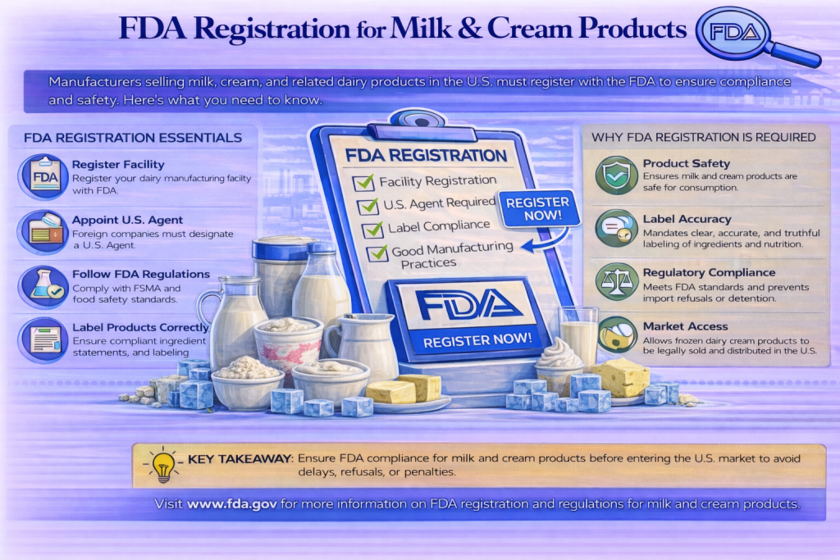
FDA Registration for Milk & Cream Products
This guide explains every FDA requirement for milk and cream product importers and manufacturers — including the exact fat content thresholds for each product name, the pasteurization mandate, dairy-specific FSVP hazards, labeling requirements, and how FDA Registration Assistance handles the full compliance process.
Why Pasteurization Is the First FDA Requirement for Dairy Imports
Pasteurization is not optional for dairy products entering U.S. commerce. 21 CFR Part 1240.61 mandates that milk and milk products offered for import into the United States must have been produced under pasteurization requirements equivalent to U.S. standards. This means:
HTST Pasteurization
High Temperature Short Time (HTST) pasteurization — typically 161°F (72°C) for 15 seconds — is the standard method for fluid milk and cream. Processing parameters must meet or exceed FDA's Grade A Pasteurized Milk Ordinance (PMO) requirements.
UHT / Ultra-Pasteurization
Ultra-High Temperature (UHT) processing — 280°F (138°C) for 2 seconds — is permitted for extended shelf life products. UHT products must be labeled "ultra-pasteurized." Both HTST and UHT satisfy the pasteurization requirement for importation.
Raw Milk — Refused at Port
Unpasteurized (raw) milk and raw cream products cannot legally enter U.S. commerce under any circumstances. This includes products marketed as "raw," "natural," "living," or "artisanal." FDA will refuse the shipment at the port of entry.
FDA Standards of Identity — Fat Content Requirements for Each Product Name
This is where most dairy import violations originate. The FDA standards of identity under 21 CFR Part 131 assign specific product names to milk and cream products based on their actual milkfat content. A product must meet these thresholds to be labeled with that name. A cream product with 30% milkfat cannot be labeled "heavy cream" — it is legally "light whipping cream."
| Product Name | CFR Section | Milkfat Requirement | Other Key Requirements |
|---|---|---|---|
| Whole Milk | 131.110 | ≥ 3.25% | Also ≥ 8.25% milk solids not fat (MSNF). Pasteurized. |
| Reduced Fat Milk | 131.115 | 2% | Must be labeled "reduced fat" or "2% milkfat." Pasteurized. |
| Lowfat Milk | 131.120 | 0.5% – 2% | Labeled "lowfat" or "1% milkfat." Pasteurized. |
| Skim Milk / Nonfat Milk | 131.125 | < 0.5% | Labeled "skim milk" or "nonfat milk." Pasteurized. |
| Heavy Cream / Heavy Whipping Cream | 131.150 | ≥ 36% | Pasteurized. Most commonly mislabeled imported dairy product. |
| Light Whipping Cream | 131.157 | 30% – <36% | Pasteurized. Cannot be labeled "heavy cream." |
| Light Cream | 131.155 | 18% – 30% | Pasteurized. Distinct from "light whipping cream." |
| Half-and-Half | 131.180 | 10.5% – <18% | Mixture of milk and cream. Pasteurized or ultra-pasteurized. |
| Evaporated Milk | 131.130 | ≥ 6.5% | Also ≥ 16.5% milk solids, ≥ 23% total milk solids. Hermetically sealed. |
| Sweetened Condensed Milk | 131.120 | ≥ 8.5% | Also ≥ 28% total milk solids. Added sweetener required. |
A product that does not meet the milkfat threshold for its labeled name is considered misbranded under 21 U.S.C. § 343 and will be refused admission at the U.S. port of entry. FDA Registration Assistance reviews product specifications against 21 CFR Part 131 standards before any shipment is made.
Complete FDA Compliance Checklist for Milk & Cream Importers
1. Food Facility Registration — $858
The dairy manufacturing, processing, or packing facility must register with FDA under 21 CFR Part 1 before the first export to the United States. Foreign facilities must designate a U.S. Agent. Registration renews every two years during the Biennial Renewal window. FDA charges $0 — the $858 service fee covers registration preparation, DUNS Number procurement, U.S. Agent designation, and renewal management.
2. Standards of Identity Compliance
Each product must meet the fat content and composition requirements under 21 CFR Part 131 for the name used on the label. Product specifications — including independent laboratory testing confirming actual milkfat content — should be on file before the first shipment. A product that fails the standard of identity is misbranded and will be refused.
3. FDA-Compliant Labeling
Labels must comply with 21 CFR Part 101: correct product identity under Part 131; net quantity; Nutrition Facts panel in the current FDA format; complete ingredient list with any added vitamins, stabilizers, or other ingredients; milk allergen declaration; and manufacturer/distributor information. All label elements must be in English.
4. FSVP for U.S. Importers
The U.S. importer must maintain an FSVP program for each foreign dairy supplier under 21 CFR Part 1 Subpart L. Dairy FSVP must address biological hazards (Listeria, Salmonella, Campylobacter), chemical hazards (antibiotic residues, aflatoxin M1), and pasteurization as the critical preventive control.
5. Prior Notice for Every Shipment
Every milk or cream shipment requires FDA Prior Notice under 21 CFR Part 1 Subpart I before arrival at the U.S. port. Prior Notice must include the manufacturer's active FDA registration number, the correct dairy product code, and anticipated arrival details — all matching the customs entry exactly.
6. FSMA Preventive Controls
Dairy processing facilities are subject to FSMA Preventive Controls for Human Food under 21 CFR Part 117. Pasteurization is the critical preventive control for biological hazards and must be validated and verified. Temperature control for storage and transport, allergen controls, and sanitation environmental monitoring (for Listeria) are key FSMA requirements for dairy facilities.
FDA vs. USDA Jurisdiction — and Key Dairy Hazards
FDA vs. USDA — Who Regulates What
Dairy importers frequently ask which federal agency they need to deal with. The answer is both — but for different things:
FDA Jurisdiction
FDA regulates: Food Facility Registration; standards of identity and composition for milk and cream products (21 CFR Part 131); pasteurization requirements (21 CFR Part 1240.61); food safety under FSMA; food labeling under 21 CFR Part 101; and import screening and Prior Notice. All FDA requirements described in this guide are enforced by FDA.
USDA Jurisdiction
USDA administers dairy price support programs, tariff rate quotas (TRQs) for certain imported dairy products, and some cheese and butter import standards through its Agricultural Marketing Service and Foreign Agricultural Service. Dairy importers subject to TRQs must obtain USDA import licenses before importing. TRQ compliance and FDA compliance are separate and both required for affected products.
Dairy-Specific FSVP Hazards
The FSVP hazard analysis for dairy products must address hazards that are specific to milk and cream — not just generic food hazards. Key dairy hazards FDA expects to see addressed in FSVP documentation:
Antibiotic / Drug Residues
FDA monitors imported dairy for veterinary drug residues including antibiotics used in dairy cattle production. FDA has established tolerance levels for specific drug residues in milk. FSVP supplier verification for dairy should address the supplier's drug residue testing program — certificates of analysis or review of the supplier's testing records are appropriate verification activities.
Aflatoxin M1
Aflatoxin M1 is a mycotoxin that forms in milk when dairy cattle consume feed contaminated with aflatoxin B1. FDA's action level is 0.5 ppb in milk. This is particularly relevant for dairy imported from regions where aflatoxin B1 contamination in feed is a known issue. FSVP hazard analysis for dairy from high-risk regions should include aflatoxin M1 as a chemical hazard requiring a supplier verification activity.
Listeria monocytogenes
Listeria can survive refrigeration and is a critical concern in dairy processing environments. For pasteurized dairy, post-pasteurization contamination from the processing environment is the primary risk. FSVP supplier verification should include review of the supplier's environmental monitoring program for Listeria, particularly for cream and liquid dairy products with extended refrigerated shelf life.
Temperature Abuse During Transport
Temperature abuse during shipping is a hazard not addressed at the supplier's facility but in the supply chain. FSVP for refrigerated and frozen dairy products should include importer controls for temperature monitoring during transit — temperature recorders or time-temperature indicators accompanying shipments and a protocol for evaluating temperature excursions before accepting delivery.
Complete FDA Compliance for Your Dairy Products — $858
Ready to Import Milk & Cream Products to the United States?
FDA Registration Assistance handles Food Facility Registration, dairy label review against 21 CFR Part 131 standards of identity, U.S. Agent designation, FSVP support, Prior Notice guidance, and Biennial Renewal management — for dairy exporters and importers in 135+ countries.
Contact us at info@fdaregistrationassistance.com or call +1 (928) 275-8333. 1,000+ clients. 15+ years of FDA regulatory experience.
Frequently Asked Questions — FDA Registration for Milk & Cream Products
1. Do milk and cream products require FDA registration?
Yes. The dairy manufacturing or processing facility must register with FDA under 21 CFR Part 1 before any milk or cream product is exported to the United States. Foreign facilities must designate a U.S. Agent. Registration renews every two years. Complete service: $858.
2. Can raw milk be imported into the United States?
No — no exceptions. Under 21 CFR Part 1240.61, all milk and milk products imported into the United States must be pasteurized. Raw (unpasteurized) milk, cream, or milk products will be refused admission at the U.S. port of entry regardless of origin, production method, or labeling.
3. What are FDA standards of identity for milk products?
FDA standards of identity for milk and cream are codified at 21 CFR Part 131. Each product name — whole milk, heavy cream, half-and-half, evaporated milk — requires the product to meet specific milkfat content thresholds. A product that does not meet the threshold for its labeled name is misbranded and will be refused at the U.S. port.
4. What is the fat content requirement for whole milk?
Under 21 CFR Part 131.110, whole milk must contain not less than 3.25% milkfat and not less than 8.25% milk solids not fat. It must be pasteurized. Milk below 3.25% milkfat cannot be labeled "whole milk."
5. What fat content is required for heavy cream?
Under 21 CFR Part 131.150, heavy cream (heavy whipping cream) must contain not less than 36% milkfat. Products with 30%–35% milkfat are light whipping cream (131.157). Products with 18%–30% milkfat are light cream (131.155). Mislabeling cream as "heavy" when it doesn't meet the threshold is the most common dairy standards of identity violation.
6. What is the pasteurization requirement for imported dairy products?
Under 21 CFR Part 1240.61, all imported milk and milk products must be pasteurized — HTST (161°F for 15 seconds) or UHT (280°F for 2 seconds). The Grade A Pasteurized Milk Ordinance (PMO) provides the technical standards Grade A dairy must meet. Documentation of pasteurization process parameters should be maintained for FSVP records and FDA inspection.
7. What labeling is required on imported milk and cream products?
Under 21 CFR Part 101: correct product identity per Part 131; net quantity; Nutrition Facts panel in current FDA format; ingredient list for products with added ingredients; milk allergen declaration (required under FALCPA and the FASTER Act); and manufacturer/distributor name and address. Labels must be in English.
8. Is milk an allergen that must be declared on labels?
Yes. Milk is one of the nine major food allergens required under FALCPA and the FASTER Act of 2021. All milk and cream product labels must include a milk allergen declaration — as a "Contains: Milk" statement or through parenthetical disclosure in the ingredient list. Missing allergen declarations are one of the most common reasons dairy shipments are detained at U.S. ports.
9. What FSVP requirements apply to U.S. importers of milk and cream?
U.S. importers must maintain an FSVP program for each foreign dairy supplier under 21 CFR Part 1 Subpart L. Dairy FSVP hazard analysis must address biological hazards (Listeria, Salmonella, Campylobacter), chemical hazards (antibiotic residues, aflatoxin M1), and pasteurization as the critical preventive control.
10. What biological hazards in milk must FSVP address?
Key biological hazards for dairy FSVP: Listeria monocytogenes (survives refrigeration; post-pasteurization contamination risk); Salmonella spp.; E. coli O157:H7; Campylobacter jejuni; and Staphylococcus aureus. Pasteurization eliminates most biological hazards when properly conducted, but post-pasteurization contamination and temperature abuse during transport remain relevant FSVP concerns.
11. What chemical hazards in dairy products must FSVP address?
Key chemical hazards: antibiotic and drug residues (veterinary drugs — FDA has established tolerances in milk); aflatoxin M1 (FDA action level: 0.5 ppb in milk — formed when cattle consume aflatoxin B1-contaminated feed); melamine (relevant for certain supply chains); and pesticide residues. FSVP verification activities should address the supplier's controls for these hazards.
12. Does FDA require Prior Notice for milk and cream shipments?
Yes. Every dairy shipment requires FDA Prior Notice under 21 CFR Part 1 Subpart I before arrival at the U.S. port — 8 hours for ocean, 4 hours for most air, 2 hours for road. Prior Notice must include the manufacturer's active FDA registration number and the correct FDA product code for the dairy product.
13. What is the Grade A Pasteurized Milk Ordinance (PMO)?
The Grade A PMO is FDA's model ordinance setting technical standards for Grade A dairy products — used cooperatively by FDA and state regulatory agencies for domestic milk safety. Foreign dairy processors whose products are imported as Grade A milk products should ensure their processes and facilities align with PMO requirements for pasteurization, sanitation, and equipment standards.
14. What is the difference between FDA and USDA jurisdiction over dairy?
FDA regulates food safety, standards of identity (21 CFR Part 131), pasteurization (21 CFR Part 1240.61), and food labeling for dairy products. USDA administers dairy tariff rate quotas (TRQs) and some cheese/butter import standards. Importers of dairy products subject to USDA TRQs must obtain USDA import licenses separately from FDA compliance.
15. Are condensed and evaporated milk subject to FDA standards of identity?
Yes. Evaporated milk under 21 CFR Part 131.130 must contain ≥ 6.5% milkfat, ≥ 16.5% milk solids, ≥ 23% total milk solids, and be hermetically sealed. Sweetened condensed milk under 21 CFR Part 131.120 must contain ≥ 8.5% milkfat and ≥ 28% total milk solids. Products not meeting these requirements cannot be labeled under these names.
16. What happens if a milk or cream shipment is refused at a U.S. port?
A refused shipment must be destroyed or exported back to the country of origin at the importer's expense. Common grounds for refusal: unregistered facility; unpasteurized product; product does not meet the labeled standard of identity; missing allergen declaration; non-compliant Nutrition Facts; or Prior Notice not filed. Refused perishable dairy shipments are particularly costly given rapid deterioration.
17. How much does FDA Food Facility Registration cost for a dairy facility?
FDA charges $0 in government fees. FDA Registration Assistance charges $858 for the complete service — registration, DUNS Number procurement, U.S. Agent designation for foreign facilities, and Biennial Renewal management. See the full cost breakdown.
18. Do dairy products need a Nutrition Facts panel?
Yes. Most packaged milk and cream products require a Nutrition Facts panel under 21 CFR Part 101.9 in the current FDA format with updated Daily Reference Values. Serving sizes must follow FDA's Reference Amounts Customarily Consumed (RACC) for dairy products.
19. Can cream be labeled "whipping cream" without meeting the heavy cream standard?
"Heavy whipping cream" requires ≥ 36% milkfat (21 CFR 131.150). "Light whipping cream" requires 30%–<36% milkfat (21 CFR 131.157). Cream below 30% milkfat labeled as any type of "whipping cream" is a standards of identity violation. Incorrect labeling of cream products is consistently one of the most common detained dairy shipment violations.
20. What is the half-and-half standard of identity?
Half-and-half is defined at 21 CFR Part 131.180 as a mixture of milk and cream containing not less than 10.5% milkfat but less than 18% milkfat. It must be pasteurized or ultra-pasteurized. Products with milkfat below 10.5% cannot be labeled as half-and-half.
21. Are dairy products subject to FSMA Preventive Controls?
Yes. Dairy processing facilities must comply with FSMA Preventive Controls for Human Food under 21 CFR Part 117. Pasteurization is the critical preventive control for biological hazards and must be validated. Sanitation environmental monitoring for Listeria, allergen controls, and temperature monitoring are key FSMA requirements for dairy facilities.
22. Does FDA monitor dairy imports for drug residues?
Yes. FDA monitors imported dairy for veterinary drug residues including antibiotics used in dairy cattle production. FDA has established tolerance levels for specific drug residues in milk. FSVP programs for dairy importers should include supplier verification activities addressing drug residue controls — such as review of the supplier's drug residue testing records or certificates of analysis.
23. Can lactose-free milk make that claim on the label?
Yes. Lactose-free milk can carry a "lactose-free" claim if the product has been processed to remove or break down lactose to negligible levels. The product must still meet the applicable standard of identity for the underlying milk type (whole, reduced fat, lowfat, skim) under 21 CFR Part 131 in terms of milkfat and milk solids not fat content.
24. What are the most common FDA compliance failures for imported dairy products?
Most common failures: product does not meet the labeled standard of identity (fat content below the 21 CFR Part 131 threshold); product is unpasteurized; missing or incorrect milk allergen declaration; outdated Nutrition Facts panel format; unregistered manufacturing facility; Prior Notice not filed or filed with incorrect registration number; and no FSVP for the dairy supplier.
25. How do I get started with FDA compliance for milk and cream products?
Contact FDA Registration Assistance at info@fdaregistrationassistance.com or call +1 (928) 275-8333. Provide your product types, fat content specifications, facility location, and processing method. FDA Registration Assistance will confirm standards of identity compliance, review labeling, complete Food Facility Registration, and advise on FSVP. Complete service: $858.