
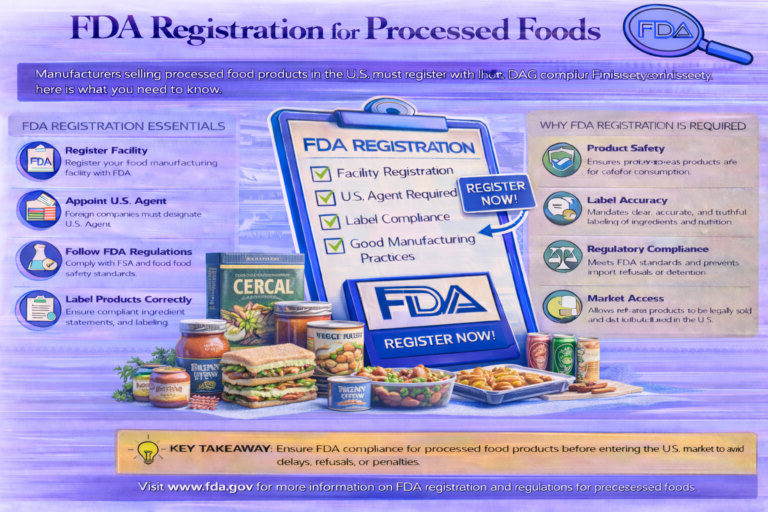
FDA Registration for Processed Foods
Why processing is the facility trigger, how FDA regulates by hazard rather than processing level, and where "ultra-processed" actually stands.
Key Takeaways
- "Processed" is an activity, not a category — changing food from its raw state.
- Processing makes you a facility — it's the farm-vs-facility trigger; you register.
- FDA regulates by hazard, not processing level — "minimally processed" isn't "safer."
- Your process shapes the safety plan — preventive controls sit on the process steps.
- The process points to the regime — thermal → canned, acid → acidified, drying → low-moisture.
- "Ultra-processed" isn't an FDA category yet — a 2025 definition effort is underway.
Processing Is What Makes You a Facility
The clearest thing "processing" does is change your status. A farm that grows and packs raw crops generally isn't a food facility and doesn't register with FDA. The moment you process — cook, bake, mill, cut, cure, can, freeze, ferment, or combine ingredients — you become a food facility that must register and run a preventive-controls food-safety plan.
FDA Regulates by Hazard, Not by "Processing Level"
There's a widespread assumption that a more heavily processed food is more heavily regulated, and that "minimally processed" means safer. From a food-safety standpoint, that's simply not how it works.
So don't judge your obligations by how processed the food seems. Judge them by the hazard analysis of your actual process — which is exactly what the preventive-controls framework asks you to do.
What Your Process Does Decides the Rules
Beyond the preventive-controls baseline, the specific process points to the specific regime:
| What your process does | Regime it triggers |
|---|---|
| Thermal / commercial sterilization (canning) for shelf-stable low-acid | Low-acid canned food → FCE + scheduled process |
| Adds acid to preserve (to pH ≤ 4.6) | Acidified food → FCE + scheduled process |
| Removes moisture (drying) | Low-moisture preventive controls (Salmonella survival) |
| Freezes / refrigerates | Cold chain, Listeria control, date marking |
| Reduced-oxygen / vacuum packaging | C. botulinum barrier controls |
| Cooks as a kill step | Ready-to-eat (Listeria) vs not-ready-to-eat (validated cook) |
Where "Ultra-Processed" Actually Stands
"Ultra-processed" is everywhere in the headlines — but it's important to be precise: there is currently no federal regulatory definition of "ultra-processed food," and no UPF-specific compliance obligations.
- A definition is being developed — in July 2025, FDA and USDA (with HHS) issued a joint Request for Information to build a uniform federal UPF definition, tied to the Make America Healthy Again initiative
- The reference point is NOVA — a research classification (2009) that sorts foods by degree of processing, not nutrition
- It's a "watch," not a "comply" — until a federal definition is finalized, your requirements stay hazard-based; but with policy momentum and some state activity, it's worth tracking
Get Your Processed Foods Compliant
FDA Registration Assistance starts from your process: registration and U.S. Agent, help building the hazard-based preventive-controls plan around your process steps, label review, and any process-specific filings (low-acid, acidified, seafood, juice) — plus FSVP for imports. We also keep you informed on developments like the emerging ultra-processed definition, without over-reacting to something that isn't yet a rule.
Contact us at info@fdaregistrationassistance.com or call +1 (928) 275-8333. Food Facility Registration is available starting at $858. Trusted by companies across 135+ countries, with 15+ years of experience.
Frequently Asked Questions
1. Do processed foods require FDA registration?
Yes — and in fact, the processing is usually what triggers registration. A facility that manufactures or processes food (changes it from its raw state) registers with FDA (foreign facilities also need a U.S. Agent), whereas a farm that only grows raw crops generally does not. So "processed food" isn't a lighter category; the act of processing is precisely what makes you a food facility that must register and run a preventive-controls food-safety plan.
2. What counts as "processing"?
Processing is any activity that changes a food from its raw agricultural state — cooking, baking, milling, cutting, curing, canning, freezing, fermenting, combining ingredients, or formulating a product. The moment you do any of these, you're a food facility rather than a farm. This is the same farm-vs-facility line that runs through produce: growing is farming, but turning that produce into something is processing.
3. Does "more processed" mean "more regulated"?
No — and this is the key misconception. FDA regulates by hazard, not by how "processed" a food is. A lightly processed, refrigerated fresh-cut salad can be far higher-risk (ready-to-eat, Listeria) than a heavily processed, shelf-stable cracker (dry, low-risk). What determines your requirements is what the processing does to the food's hazards — whether it adds a kill step, creates a hazard, or controls one — not a "minimally processed" or "highly processed" label.
4. How does processing shape my food-safety plan?
Preventive controls (21 CFR 117) are built around your process steps. You conduct a hazard analysis and put controls where the process either introduces or must control a hazard — a cook step that must reach a lethal temperature, a cooling step that must be fast enough, an acidification step that must hit a target pH. So the processing isn't just what triggers registration; it's the backbone of the safety plan itself.
5. How does my processing method determine other requirements?
The specific process points to the specific regime. Thermal processing to make a shelf-stable low-acid product is low-acid canned food (FCE + scheduled process). Adding acid to preserve is acidified food. Removing moisture (drying) is low-moisture processing, where Salmonella survival is the concern. Freezing/refrigeration brings cold-chain and Listeria control. Reduced-oxygen packaging brings C. botulinum controls. So "what does your process do?" is the question that routes you to the right rules.
6. Is "ultra-processed food" an FDA category?
Not yet. There is currently no federal regulatory definition of "ultra-processed food." In July 2025, FDA and USDA (with HHS) issued a joint Request for Information to begin developing a uniform federal definition — a move tied to the Make America Healthy Again initiative. The most-referenced definition today is the research-based NOVA system, which classifies foods by degree of processing rather than nutrition. Until a federal definition is finalized, "ultra-processed" carries no direct compliance obligations — your requirements are still hazard-based.
7. Should I be doing anything about the ultra-processed definition now?
It's a development to watch, not to comply with yet. Because there's no federal UPF definition, there are no UPF-specific requirements today. But given the policy momentum (and some states considering their own definitions), it's worth tracking — future rules could affect labeling or reformulation. For now, focus on the compliance that actually applies: registration, hazard-based preventive controls, and correct labeling.
8. What food-safety framework governs processed foods?
For most processed foods, it's FSMA's preventive controls rule (21 CFR 117): register the facility, conduct a hazard analysis, and implement preventive controls with monitoring, corrective actions, and verification. Certain processes layer on specialized rules — low-acid canned foods, acidified foods, seafood HACCP, juice HACCP — on top of that baseline. The preventive-controls plan is the common core.
9. What labeling do processed foods need?
The full consumer label: statement of identity, net quantity, ingredient list, allergen declaration, name/address, and Nutrition Facts. Because processed foods combine and transform ingredients, allergen accuracy and an accurate ingredient list are especially important. We cover the label in depth in our packaged-foods guide — it's the same labeling framework, viewed from the packaging side rather than the processing side.
10. Does importing processed foods require anything extra?
Yes. The foreign facility registers with FDA and keeps a U.S. Agent, and the U.S. importer runs FSVP (Foreign Supplier Verification Program) with prior notice for each shipment. Any process-specific filings (like FCE/scheduled process for canned goods) apply to imported products too, and the label must be fully U.S.-compliant — foreign labels frequently fail on Nutrition Facts format or allergen wording.
11. Does FDA approve processed foods?
No. FDA doesn't pre-approve food products. You register your facility, build the hazard-based food-safety plan around your process, comply with labeling, and (for imports) run FSVP; FDA enforces at the facility and the border. For low-acid and acidified canned foods you do file a scheduled process with FDA, but that's process registration/filing — not approval of the food itself.
12. What's the biggest mistake with processed foods?
Two, really. On safety: assuming a familiar or "simple" process is low-risk without a proper hazard analysis — the hazard depends on what the process does, not on how simple it seems. On registration: a processor treating itself like a farm and skipping registration and preventive controls. Both come from misjudging the processing rather than analyzing it.
13. Can FDA Registration Assistance handle a full processed-food operation?
Yes. We handle registration and U.S. Agent, support the process-based preventive-controls plan, review labels, and route any specialized filings your process requires (canned/low-acid, acidified, seafood, juice). Plus FSVP for imports. It's built as one coordinated solution around your actual processing operation.
14. How does FDA Registration Assistance help with processed foods?
We start from your process: registration and U.S. Agent, help building the hazard-based preventive-controls plan around your process steps, label review, and any process-specific filings (low-acid, acidified, seafood, juice) — plus FSVP for imports. We also keep you informed on developments like the emerging ultra-processed definition without over-reacting to something that isn't yet a rule. Registration is available starting at $858, for companies across 135+ countries. Contact info@fdaregistrationassistance.com or +1 (928) 275-8333.
