
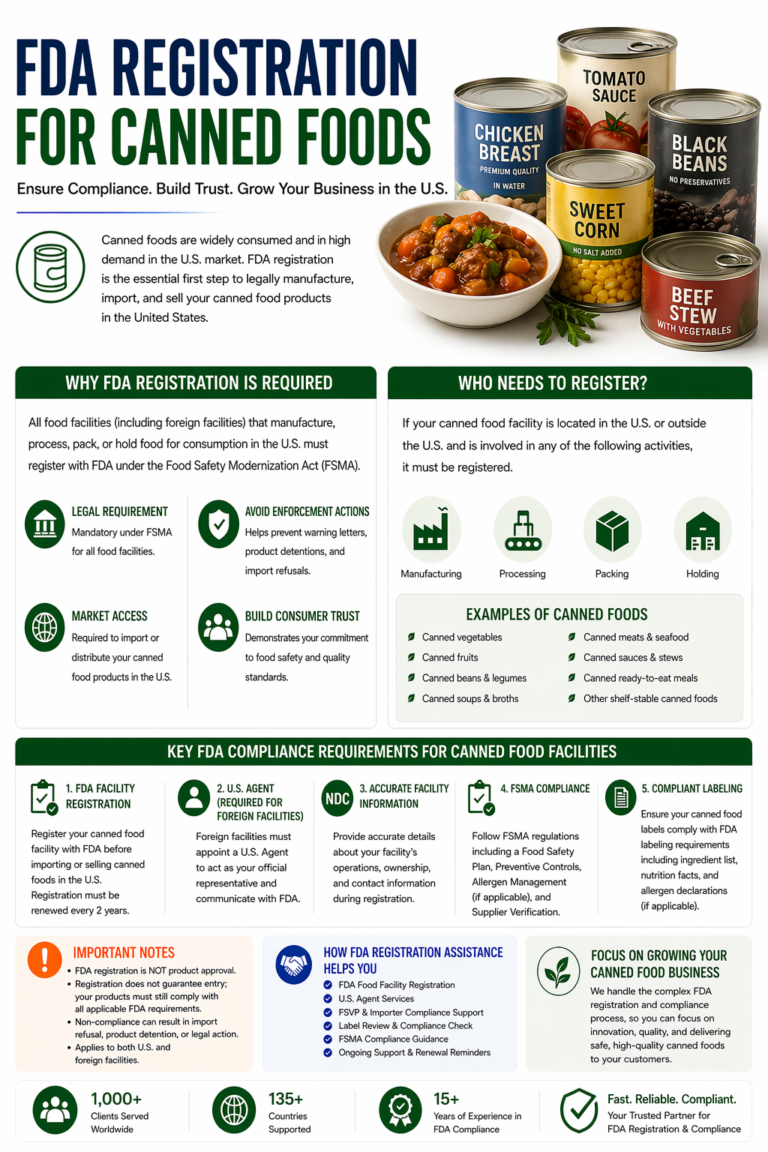
FDA Registration for Canned Foods
The acid classification that decides everything, what triggers FCE + a scheduled process, and the path by product.
Key Takeaways
- Acidity decides, not the can — pH 4.6 is the dividing line.
- Low-acid (pH >4.6) — FCE + a scheduled process (21 CFR 113).
- Acidified (acid added to pH ≤4.6) — FCE + a scheduled process (21 CFR 114).
- Naturally acid (pH ≤4.6 on its own) — generally no FCE/SID.
- The scheduled process is validated by a process authority — not chosen.
- Retort pouches count — a sealed pouch of low-acid food is still LACF.
Canned Foods Split Three Ways by Acidity
Acidity (pH) matters because it determines whether Clostridium botulinum can grow in a sealed, shelf-stable container. The dividing line is pH 4.6: above it, C. botulinum can grow (so the food must be commercially sterilized under a validated process); at or below it, the acid controls the hazard. That single number sorts every canned food:
| Canned food type | What it is | Process filing |
|---|---|---|
| Low-acid canned food (LACF) | pH > 4.6 and water activity > 0.85 — vegetables, meat, fish, soups, coconut water | FCE + scheduled process — 21 CFR 113 |
| Acidified food | Low-acid food + acid added to reach equilibrium pH ≤ 4.6 — pickles, some sauces | FCE + scheduled process — 21 CFR 114 |
| Naturally acid food | pH ≤ 4.6 on its own — most fruits, jams, jellies | Generally none |
Low-Acid & Acidified — What They Require
FCE, Scheduled Process & the Container
- FCE registration — a Food Canning Establishment registration (FDA Form 2541), separate from and in addition to your food facility registration (see what an FCE is)
- Scheduled process (SID) — the validated time/temperature/pH process, filed per product and process (see process filing)
- Process authority — a qualified expert establishes/validates the process; you can't just pick numbers
- Hermetically sealed container — metal cans, glass jars, and retort pouches all count; a sealed pouch of low-acid food is still an LACF
Canned-Food Guides by Product
| Your canned product | Where the rules are |
|---|---|
| Canned tuna & fish | Canned tuna & fish (LACF + seafood HACCP) |
| Coconut water | Coconut water (LACF / aseptic) |
| Pickled / acidified products | Pickled foods (acidified) |
| Jam & jelly | Jam & jelly (usually naturally acid) |
| Retort pouch products | Food pouch packaging |
Get Your Canned Foods U.S.-Ready
FDA Registration Assistance starts by classifying your product's acidity — low-acid, acidified, or naturally acid — which determines the path, then handles facility registration and U.S. Agent, FCE registration and scheduled process (SID) filing with process-authority coordination where required, labeling, and FSVP for imports — and flags when USDA or Seafood HACCP also applies.
Contact us at info@fdaregistrationassistance.com or call +1 (928) 275-8333. Food Facility Registration is available starting at $858. Trusted by companies across 135+ countries, with 15+ years of experience.
Frequently Asked Questions
1. Do all canned foods need FDA registration?
The facility needs registration — any facility that manufactures, processes, packs, or holds canned food for the U.S. market registers with FDA (with a U.S. Agent if foreign). But whether you also need FCE registration and a scheduled process (SID) depends on the acidity of the food, not on the fact that it's canned. Low-acid and acidified canned foods need that process filing; naturally acid canned foods generally don't.
2. Why does the acidity of a canned food matter so much?
Because acidity (pH) determines whether Clostridium botulinum can grow. The dividing line is pH 4.6: above it, C. botulinum can grow in a sealed, shelf-stable container, so the food must be commercially sterilized under a validated process; at or below pH 4.6, the acid itself controls C. botulinum. That single number drives the whole regulatory path for canned foods — which is why the first question is always "what's the pH?"
3. What is a low-acid canned food (LACF)?
A low-acid canned food has a finished pH above 4.6 and a water activity above 0.85, packed in a hermetically sealed container and made shelf-stable — canned vegetables, meats, fish, soups, and coconut water, for example. Because C. botulinum can grow in these conditions, LACF is regulated under 21 CFR Part 113: the facility must register as a Food Canning Establishment (FCE) and file a scheduled process (SID) documenting the validated thermal process. It's the most demanding canned-food path.
4. What is an acidified food?
An acidified food is a low-acid food that has acid (or an acid food) added to bring its finished equilibrium pH down to 4.6 or below — pickles, many sauces and relishes, some vegetables. Because it starts out low-acid, it's regulated under 21 CFR Part 114: the facility registers as an FCE and files a scheduled process (SID), with the pH control validated by a process authority. It's a separate track from LACF but also requires FCE and process filing.
5. What is a naturally acid food, and does it need process filing?
A naturally acid food has a pH of 4.6 or below on its own, without added acid — most fruits, and high-sugar products like jams and jellies. Because the natural acidity already controls C. botulinum, these are neither low-acid canned foods nor acidified foods, and they generally don't require FCE registration or a scheduled process. This is the reassuring part: not everything in a can or jar needs process filing — it depends on the acidity.
6. What is FCE registration?
FCE stands for Food Canning Establishment. A facility that processes low-acid canned foods or acidified foods must register as an FCE (on FDA Form 2541), which is separate from — and in addition to — the standard food facility registration. The FCE identifies the establishment that manufactures these higher-risk shelf-stable products, and it's a prerequisite for filing the scheduled processes for those products.
7. What is a scheduled process (SID)?
A scheduled process is the specific, validated process (time, temperature, pH, and other critical factors) that makes a low-acid or acidified canned food safe. It has to be established by a qualified process authority, and it's filed with FDA per product and process (on the SID forms — for example, the thermal-process form for LACF, the aseptic form for aseptically processed products, and the acidified-foods form). The scheduled process is the heart of canned-food safety.
8. Do I need a process authority?
For low-acid and acidified canned foods, yes. A process authority is a qualified expert who establishes and validates your scheduled process — confirming that your thermal process or acidification actually achieves safety for your specific product, container, and equipment. You can't simply pick numbers; the process has to be scientifically established. This validation is what the SID filing documents.
9. Does the container type matter?
The container has to be hermetically sealed to be a "canned" food in this sense — and that includes metal cans, glass jars, and retort pouches or other flexible/semi-rigid containers. A low-acid food in a sealed retort pouch is just as much a low-acid canned food as one in a metal can, and needs the same FCE and scheduled-process treatment. What matters is that it's a sealed, shelf-stable container plus the acidity of the contents.
10. Are canned meat, poultry, and seafood different?
Canned meat and poultry generally fall under USDA-FSIS rather than FDA. Canned seafood is under FDA but adds Seafood HACCP on top of the LACF requirements — so canned tuna, for example, is a low-acid canned food (FCE + SID) and a seafood-HACCP product at the same time. Identifying whether USDA or seafood HACCP also applies is part of classifying a canned product correctly.
11. Is process filing the same as FDA approval?
No. Filing an FCE and scheduled process puts your establishment and validated process on record with FDA — it isn't an approval of the product. FDA doesn't pre-approve canned foods. The filing is a compliance obligation; the responsibility for a safe, correctly processed product stays with you, and FDA enforces at the facility and (for imports) at the border. A canned food can be filed and still be adulterated if the process isn't actually followed.
12. Do imported canned foods need FSVP?
Yes. The U.S. importer holds FSVP and must verify the foreign supplier meets U.S. standards, with prior notice before each shipment. For low-acid and acidified canned foods, verification centers on the FCE registration and scheduled process — an imported LACF without proper process filing is a leading cause of detention. So for imported canned foods, confirming the supplier's FCE/SID status comes first.
13. What are the most common canned-food compliance mistakes?
Misclassifying the food's acidity (treating an acidified food as naturally acid, or vice versa); missing or incomplete FCE/SID filings for low-acid and acidified products; not using a qualified process authority; assuming a retort pouch escapes the canned-food rules; and, for imports, sourcing an LACF from a supplier without proper process filing. Getting the acid classification right at the start prevents most of these.
14. How does FDA Registration Assistance help with canned foods?
We start by classifying your product's acidity (low-acid, acidified, or naturally acid), which determines the path, then handle facility registration and U.S. Agent, FCE registration and scheduled process (SID) filing with process-authority coordination where required, labeling, and FSVP for imports — and we flag when USDA or Seafood HACCP also applies. Starting at $858 for registration, for companies across 135+ countries. Contact info@fdaregistrationassistance.com or +1 (928) 275-8333.
