
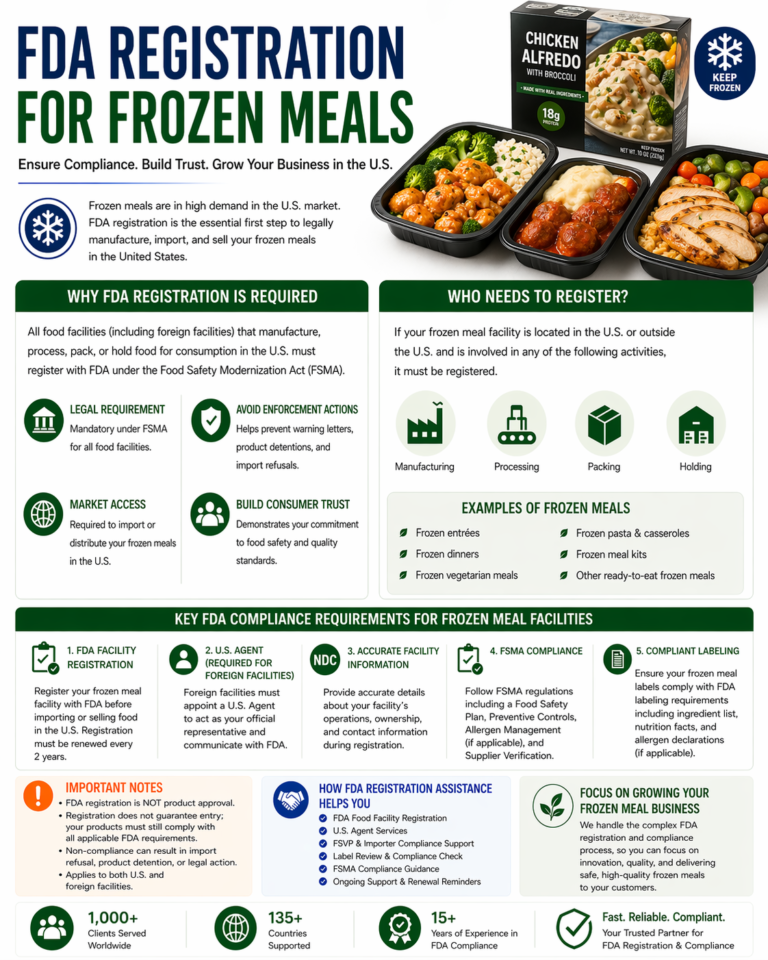
FDA Registration for Frozen Meals
Trusted by 1,000+ companies across 135+ countries, with 15+ years of FDA regulatory experience. Below: the FDA-vs-USDA split, why frozen isn't canned, what compliance actually requires, and how to label a frozen meal.
Is Your Frozen Meal FDA's — or USDA's?
Before anything else, find out which agency you're dealing with. It comes down to how much meat or poultry the meal contains.
| Frozen meal type | Agency |
|---|---|
| More than 3% raw, or 2%+ cooked, meat or poultry | USDA (FSIS) — pre-market label approval & inspection |
| Vegetarian, cheese, or plant-based | FDA |
| Seafood or fish meals | FDA — plus Seafood HACCP (21 CFR Part 123) |
| Small amount of meat (below the thresholds) | FDA |
Get this wrong and you build your whole compliance program on the wrong framework. We confirm jurisdiction first.
Frozen Meals Aren't Canned — No FCE or SID
What Frozen Meal Compliance Requires
Labeling a Frozen Meal
Frozen meals are ingredient-dense and ready-to-eat, so labels carry extra weight. Every FDA frozen meal needs:
Nutrition & Ingredients
A compliant Nutrition Facts panel and a full ingredient list in descending order by weight.
Allergens (All Nine)
Milk, egg, fish, shellfish, tree nuts, peanuts, wheat, soy, and sesame — declared accurately wherever present.
Keep Frozen & Cooking
A “Keep Frozen” storage statement and clear cooking or heating instructions for the consumer.
Identity & Quantity
Accurate product identity, net quantity in U.S. units, and the name and place of business, in English.
Bring Your Frozen Meals to the U.S. the Right Way
Send us your products and ingredients — including any meat, poultry, or seafood — and your facility details. We'll confirm FDA vs. USDA, complete facility registration and U.S. Agent service, build your FSMA food safety plan, review labeling, and support FSVP and Prior Notice. Email info@fdaregistrationassistance.com or call +1 (928) 275-8333.
Frequently Asked Questions — FDA Registration for Frozen Meals
Do frozen meals need FDA registration?
Yes, if they're FDA-regulated. The facility that manufactures, processes, packs, or holds frozen meals for the U.S. must register with the FDA, and foreign facilities need a U.S. Agent. Frozen meals with significant meat or poultry fall under the USDA instead.
Do frozen meals need FCE registration or SID process filing?
No. FCE and SID apply to shelf-stable low-acid and acidified canned foods. Frozen meals are kept frozen, not shelf-stable, so they don't need process filing — a common point of confusion.
Are frozen meals regulated by the FDA or the USDA?
It depends on meat and poultry content. Products with more than 3% raw, or 2% or more cooked, meat or poultry are USDA (FSIS); vegetarian, seafood, cheese, plant-based, or low-meat frozen meals are FDA.
How much does FDA registration for frozen meals cost?
Our service fee is $858, which covers food facility registration and U.S. Agent service. The FDA itself charges $0 to register. A FSMA food safety plan, labeling review, and FSVP support are handled as added scope.
Does the FDA charge a registration fee?
No. The FDA charges $0 for food facility registration. Our fee covers completing and managing the registration and the related compliance correctly so nothing is missed before shipping.
Is a DUNS Number required?
Yes. The DUNS Number is the required Unique Facility Identifier for food facility registration. We help you obtain one if you don't already have it.
Does FDA registration mean my frozen meals are FDA approved?
No. The FDA does not approve foods. Registration is mandatory but separate from any notion of FDA “approval” — a distinction worth keeping clear in your marketing.
Do frozen meals need a food safety plan?
Usually yes. As processed, ready-to-eat foods, frozen meals are typically subject to FSMA Preventive Controls (21 CFR Part 117), which require a written food safety plan with a hazard analysis and preventive controls.
Why is Listeria a concern for frozen meals?
Listeria monocytogenes can survive freezing and grow at refrigeration temperatures if a product is thawed or temperature-abused. For ready-to-eat frozen meals, controlling Listeria is a central part of the food safety plan.
What if my frozen meal contains meat or poultry?
If meat or poultry exceeds the thresholds — more than 3% raw, or 2% or more cooked — the product is USDA-regulated (FSIS), which requires pre-market label approval and continuous inspection, a different system from the FDA's.
What about seafood frozen meals?
Frozen meals built on fish or shellfish fall under the FDA and its Seafood HACCP regulation (21 CFR Part 123), in addition to facility registration. Catfish, however, is regulated by the USDA.
Are plant-based or vegetarian frozen meals FDA-regulated?
Yes. With no meat or poultry, plant-based and vegetarian frozen meals are squarely FDA food products — facility registration, a food safety plan, and compliant labeling all apply.
Do foreign frozen meal makers need a U.S. Agent?
Yes. Every foreign facility that registers with the FDA must designate a U.S. Agent under 21 CFR 1.227 as its U.S. point of contact. We provide this service.
Is FSVP required for imported frozen meals?
Yes. The U.S. importer must run a Foreign Supplier Verification Program to verify the supplier and keep records. We can support FSVP and act as the FSVP Agent.
Is Prior Notice required?
Yes. Every shipment of frozen meals to the U.S. requires FDA Prior Notice before arrival. Errors in Prior Notice can cause refusal at the port of entry.
What labeling do frozen meals need?
A compliant Nutrition Facts panel, ingredient list, the nine major allergens, net quantity, a “Keep Frozen” statement, and cooking instructions — see fixing a food label before import.
Why is allergen labeling especially important for frozen meals?
Frozen meals often combine many ingredients — wheat, milk, egg, soy, fish, shellfish — so several of the nine major allergens are typically present and must be declared accurately. Allergen errors are a leading cause of recalls.
Do meal kits count as frozen meals?
Meal kits are regulated as food products and must meet FDA requirements. If components include significant meat or poultry, USDA rules may apply to those components instead.
How long does FDA registration take?
Facility registration is often completed within a few business days once information and a valid DUNS Number are provided. A food safety plan and label review take additional time depending on your products.
Do I need to register each product?
No. FDA food facility registration is at the facility level, not per product. But each product still needs compliant labeling and must be covered by your food safety plan.
Do frozen meals sold on Amazon need FDA compliance?
Yes. Selling through Amazon or other marketplaces doesn't change FDA requirements; they often request proof of registration and compliant labeling before listing.
How often does registration renew?
Food facility registration renews biennially — every two years, in even-numbered years. We track and manage the renewal so it doesn't lapse.
What are the most common frozen-meal compliance mistakes?
Misjudging FDA vs. USDA jurisdiction, missing or incorrect allergen declarations, no food safety plan, an unreliable U.S. Agent, and FSVP or Prior Notice gaps.
Can one firm handle everything?
Yes. We complete facility registration and U.S. Agent service, build the food safety plan, review labeling, support FSVP, and guide Prior Notice — and we flag where USDA applies instead of the FDA.
How do I get started?
Send us your frozen meal products, ingredients, and facility details. Contact our team and we'll confirm FDA vs. USDA, register the facility, and handle the food safety plan, labeling, and import pieces. Email info@fdaregistrationassistance.com or call +1 (928) 275-8333.
