FDA Food Label Review for Amazon Sellers
What FDA requires, what Amazon adds on top, and where sellers most often get flagged.
Key Takeaways
- Two bars, not one — FDA Part 101 compliance, then Amazon's own review.
- Amazon reviews the images and copy — not just the physical label.
- The Grocery category is gated — you apply for approval in Seller Central.
- "Organic" is USDA, not FDA — and origin marking is a Customs rule.
- Disease-style claims get listings suppressed — on food, they imply a drug.
- Fixing after listing is disruptive — review before you print and list.
What FDA Requires on a Food Label
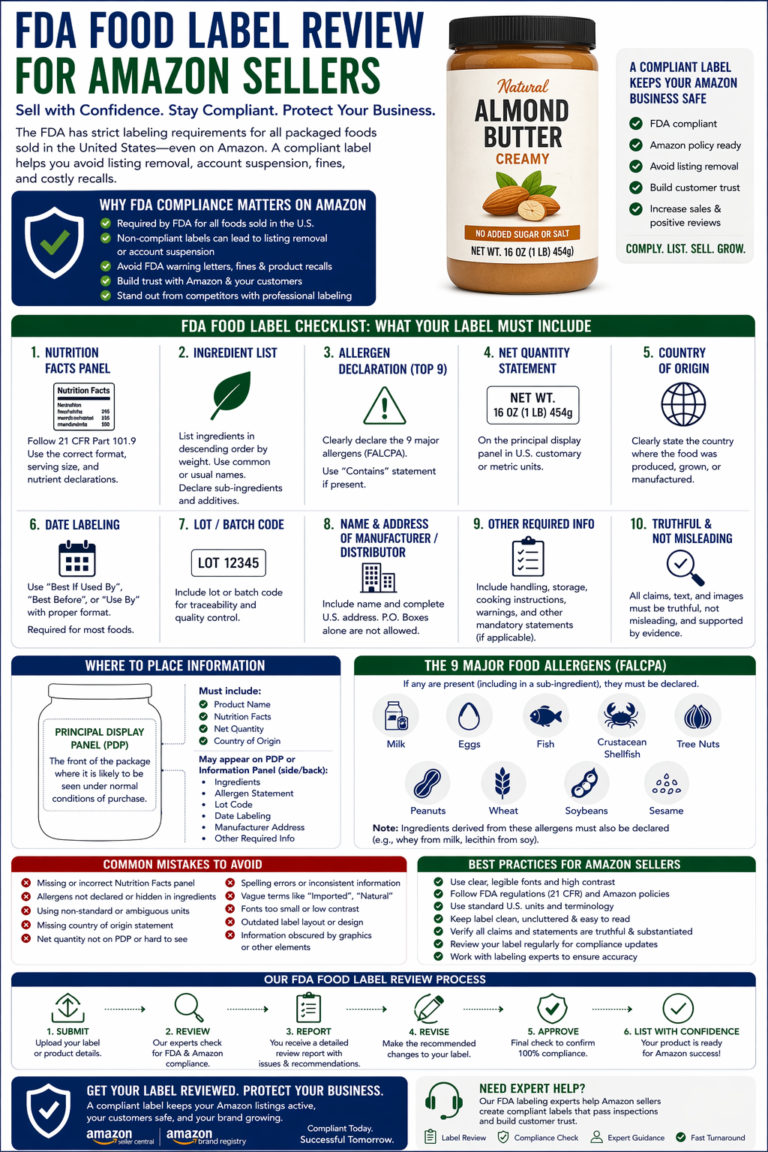
These are the core elements of a compliant U.S. food label under 21 CFR Part 101 — the same rules whether you sell on Amazon, in stores, or direct:
| Element | What it means |
|---|---|
| Statement of identity | The common name of the food, on the principal display panel |
| Nutrition Facts | The 2020-format panel under 101.9, with a serving size based on the FDA reference amount (RACC) |
| Ingredient list | All ingredients in descending order by weight, with sub-ingredients and additives, under 101.4 |
| Allergens | The nine major allergens declared clearly — including sesame, required since January 2023 |
| Net quantity | An accurate net-contents statement in the required format and placement |
| Responsible firm | Name and address of the manufacturer, packer, or distributor |
What Amazon Adds on Top
Amazon isn't a regulator, but it enforces compliance as a condition of listing — and layers its own marketplace rules over the FDA baseline:
| Amazon layer | What to expect |
|---|---|
| Category gating | Grocery & Gourmet Food is a gated category — you apply for approval in Seller Central before listing |
| Expiration dating | Most food units must carry a marked expiration date; Amazon tracks it as an expiration-dated product |
| Image review | Reviewers zoom into your Nutrition Facts and label photos and reject incorrect formatting or serving sizes |
| Claim scanning | Amazon scans titles, bullets, images, and A+ content for unlawful disease or drug-style claims |
| Packaging | Labeled in English, on sealed, tamper-evident packaging; new products only |
Which Agency Owns Which Term
A surprising number of flagged listings come from attributing a claim to the wrong agency. The quick map:
- "Healthy" and "natural" — FDA terms, governed under its food-labeling rules
- "Organic" — a USDA term under the National Organic Program; generally needs organic certification, not FDA sign-off
- Country-of-origin marking — primarily a U.S. Customs (CBP) requirement under the Tariff Act, applied to imported food
- "Gluten-free" — an FDA-defined claim (under 20 ppm) with its own conditions
The Most Common Food Label Issues
Review Before You List
Fixing a label after a product is live is far more disruptive than getting it right first. Once inventory is printed, labeled, and shipped, a correction can mean reprinting packaging, updating product images, relabeling stock, and submitting documentation — while the listing sits inactive or loses visibility.
Note: passing Amazon's review doesn't certify FDA compliance, and FDA doesn't pre-approve labels. Marketplace approval and FDA compliance are two separate bars — you need to clear both, and a review before listing is the cleanest way to do it.
Get Your Food Label Reviewed
FDA Registration Assistance reviews your label against 21 CFR Part 101 — Nutrition Facts, ingredients and sub-ingredients, allergens, net quantity, responsible-firm details, and claims — and flags the formatting and claim issues Amazon's image and listing review tends to catch, so your label is ready before it goes live.
Contact us at info@fdaregistrationassistance.com or call +1 (928) 275-8333. Food Facility Registration is available separately, starting at $858. Trusted by companies across 135+ countries, with 15+ years of experience.
Frequently Asked Questions
1. Do Amazon sellers need FDA-compliant food labels?
Yes. Food sold in the U.S. has to meet FDA labeling requirements under 21 CFR Part 101, and Amazon enforces that as a condition of listing. Amazon isn't a regulator, but it holds sellers accountable — a non-compliant label can be suppressed or removed, and you may be asked for documentation before relisting. Meeting Part 101 is the baseline; passing Amazon's own review is the second layer.
2. What does FDA require on a food label?
Under 21 CFR Part 101: a statement of identity, a Nutrition Facts panel in the current 2020 format with the correct serving size, a full ingredient list in descending order by weight (with sub-ingredients and any additives), allergen declarations for the nine major allergens including sesame, an accurate net quantity statement, and the name and address of the manufacturer, packer, or distributor. Missing or incorrect elements are the usual cause of a flagged listing.
3. What does Amazon check beyond the FDA requirements?
Amazon applies its own marketplace layer on top of FDA rules. The Grocery & Gourmet Food category is gated, so you apply for approval in Seller Central; most food units must carry a marked expiration date; labels must be in English on sealed packaging; and Amazon reviews label images and listing text — titles, bullets, and A+ content — for formatting errors and unlawful claims. A compliant physical label can still be suppressed if the listing images or copy break the rules.
4. Is "organic" an FDA labeling term?
No — "organic" is regulated by the USDA under the National Organic Program, not the FDA, and using it generally requires organic certification. FDA governs terms like "healthy" and "natural." It's a common point of confusion, and getting the wrong agency's rules can lead to a claim that isn't properly substantiated — something both FDA and Amazon can act on.
5. Is country-of-origin marking an FDA requirement?
Country-of-origin marking is primarily a U.S. Customs and Border Protection requirement under the Tariff Act, not an FDA labeling rule — though it does apply to imported food and Amazon expects it. It's worth separating the two: FDA governs the food-label content itself, while Customs governs origin marking. Both matter for an imported product on Amazon.
6. What are the most common food label mistakes on Amazon?
The frequent ones are a Nutrition Facts panel in the old format or with an invented serving size, an incomplete or mis-ordered ingredient list, missing sub-ingredient or allergen disclosures, unlawful disease or drug-style claims, and net-quantity formatting errors. Many stem from reusing a label designed for another country's rules. Amazon's image review catches a lot of these on sight.
7. Can Amazon suppress a listing over the claims, not just the label?
Yes. Amazon scans listing images, titles, bullet points, and A+ content — not only the physical label — and disease or drug-style claims on a food product can get a listing suppressed even if the packaging itself is fine. Claims like treating, curing, or preventing a condition turn a food into an unapproved drug in FDA's eyes, and Amazon acts on them too.
8. Do imported foods sold on Amazon have to meet FDA rules?
Yes. All food sold in the U.S., imported or domestic, must meet FDA labeling requirements — there's no exemption for imported goods. Imported food also involves prior notice before arrival and FSVP obligations held by the U.S. importer, and Customs origin marking. So an imported product carries both the FDA label requirements and the import-side requirements on top.
9. Does a Nutrition Facts panel apply to my product?
Most packaged foods need a Nutrition Facts panel that meets 21 CFR 101.9, in the 2020 format with a serving size based on the FDA reference amount. Some small-business and product exemptions exist, but they're narrow and often don't fit an Amazon seller's situation. Amazon reviewers zoom into the panel image and reject incorrect formatting, so a compliant panel is effectively expected.
10. Is food label review the same as supplement label review?
No — they're different. Food uses a Nutrition Facts panel under Part 101; dietary supplements use a Supplement Facts panel under different rules, plus DSHEA claim requirements and, as of 2026, third-party cGMP verification for supplements sold on Amazon. If you sell supplements rather than food, the requirements and the review are different, and there's a separate guide for that.
11. Can I fix my label after the product is already listed?
You can, but it's disruptive — you may need to update product images, relabel inventory, and submit documentation while the listing sits inactive or loses visibility. Amazon has also scaled back the paid prep and labeling fixes it used to offer for FBA shipments, so a mislabeled unit is increasingly the seller's problem. Reviewing before you list is far smoother than fixing after.
12. Does Amazon approval mean my product is FDA compliant?
No. Amazon marketplace approval doesn't replace FDA requirements, and FDA doesn't pre-approve food or labels. Getting a listing live means it passed Amazon's checks at that moment — it doesn't certify FDA compliance, and FDA can still act on a non-compliant product. The two are separate bars, and you need to clear both.
13. How long does a food label review take?
There's no single fixed number — it depends on the product and how complete your information is. A single simple label is quicker than a line of products with complex formulations and claims. Rather than promise a set turnaround, the practical approach is to start the review before you print packaging or create the listing, so any fixes happen before they cost you.
14. How does FDA Registration Assistance review food labels for Amazon?
We review your label against 21 CFR Part 101 — Nutrition Facts, ingredient list and sub-ingredients, allergens, net quantity, responsible-firm information, and claims — and flag the formatting and claim issues that Amazon's image and listing review tends to catch. You get clear fixes so the label is ready before it goes live. Food Facility Registration is available separately, starting at $858, for companies across 135+ countries. Contact info@fdaregistrationassistance.com or +1 (928) 275-8333.