
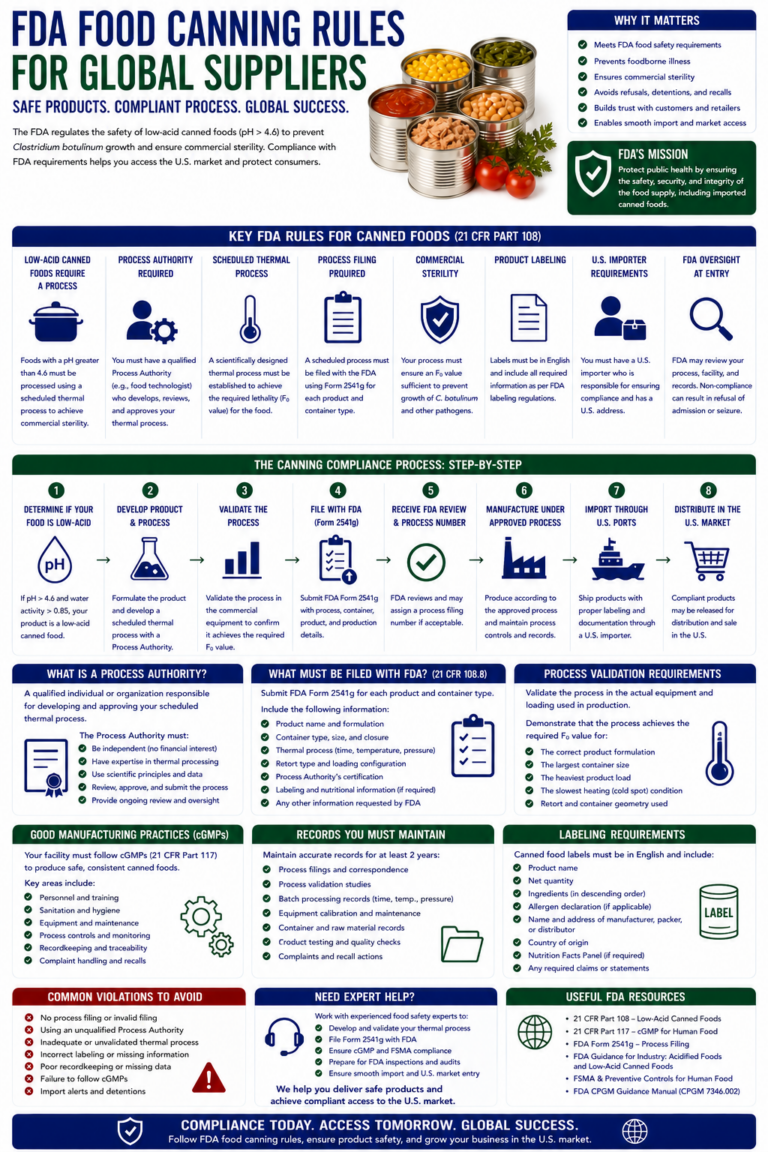
FDA Food Canning Rules for Global Suppliers
This guide explains what FDA actually requires of a canning operation exporting to the U.S. — the scheduled process and critical factors, retort and venting controls, the Process Authority and Better Process Control School, container integrity, deviation handling, recordkeeping, and the registration and filing you need.
The Seven Core Canning Controls for Global Suppliers
What Registration and Filing Cost — And What We Do vs. What You Supply
No Post-Arrival Cure — File Before You Export
A canned-food shipment that arrives without a valid FCE and SID is detained — and the filing cannot be applied retroactively to release it.
FDA’s OASIS system automatically checks each shipment for a valid FCE and SID at entry. A global supplier that waits until a shipment is ready — or until a detention happens — cannot rescue that shipment by filing afterward. Repeated violations land a facility on Import Alert 36-07, triggering Detention Without Physical Examination of every future shipment. The registration and filing must be complete well before your first export.
What Counts as a Canned Food Here
Low-acid canned foods (pH above 4.6, water activity above 0.85, hermetically sealed, thermally processed — 21 CFR Part 113) and acidified foods (acidified to pH 4.6 or below — 21 CFR Part 114). Canned vegetables, meats, seafood, soups, beans, prepared meals; pickled vegetables, certain sauces, relishes. See LACF import requirements →
Any Hermetically Sealed Container
The canning rules apply to metal cans, glass jars, retort pouches, and plastic containers alike. A common global-supplier misconception is that only metal cans require process filing — but a thermally processed low-acid food in a retort pouch or glass jar is fully subject to the FCE and SID requirements.
Why the Scheduled Process Matters So Much
The Process Authority
Establishes the scheduled process for your product. Must have expert knowledge of thermal processing/acidification. You supply this — we do not provide or coordinate the Process Authority. We file using the scheduled process they establish.
Better Process Control School
Your thermal processing, acidification, and closure operations must be supervised by someone who completed an FDA-approved BPCS (21 CFR 113.10). A specific training requirement that’s your responsibility to meet.
FCE + SID Filing
We register your canning establishment (FCE, Form 2541) and file each scheduled process (SID, Form 2541d/2541e) using your Process Authority’s documentation. $1,250 FCE + first SID; $950 each additional.
Get Your Canning Facility Registered and Filed Before You Export
FDA Registration Assistance handles the full FDA registration and filing stack for global canning suppliers: Food Facility Registration ($858, with U.S. Agent and Biennial Renewal), FCE registration and SID process filing ($1,250 FCE + first SID, $950 each additional), using the scheduled process documentation your Process Authority provides. We do the FDA filing work; the Process Authority determination and Better Process Control School training remain yours. Get it done before your first export — there is no post-arrival cure. 1,000+ clients. 135+ countries. 15+ years of FDA regulatory experience.
Contact us at info@fdaregistrationassistance.com or call +1 (928) 275-8333.
Frequently Asked Questions — FDA Food Canning Rules
1. What are the FDA food canning rules for global suppliers?
They apply to low-acid canned foods (21 CFR Part 113) and acidified foods (21 CFR Part 114). A global supplier exporting to the U.S. needs: Food Facility Registration; FCE registration; SID filing per product; a scheduled process from a Process Authority; validated thermal processing with proper equipment; container integrity controls; Better Process Control School-trained supervision; recordkeeping; and a U.S. Agent. Pricing: registration $858; FCE + first SID $1,250; each additional SID $950. FDA charges $0 for registration. DUNS fees separate.
2. What products fall under FDA canning regulations?
Primarily low-acid canned foods (pH above 4.6, water activity above 0.85, hermetically sealed, thermally processed — 21 CFR Part 113): canned vegetables, meats, seafood, soups, beans, prepared meals; and acidified foods (acidified to pH 4.6 or below — 21 CFR Part 114): pickled vegetables, certain sauces, relishes. Applies to any hermetically sealed container — cans, glass jars, retort pouches, plastic. Naturally acidic and low-water-activity foods generally fall outside.
3. What is a scheduled process in food canning?
The specific thermal process selected by a Process Authority for a given product, container, and system to achieve commercial sterility and destroy Clostridium botulinum (21 CFR 113.83). It specifies time, temperature, and critical factors. Every LACF must be processed to its scheduled process, which must be filed as a SID. You cannot choose your own time/temperature — it must be established by a competent Process Authority.
4. What are critical factors in a canning scheduled process?
Conditions that must be controlled to ensure the process delivers the intended lethality: initial product temperature, fill weight and drained weight, headspace, product consistency/viscosity, container size and type, retort come-up time, processing temperature, and processing time. The Process Authority specifies which are critical; the operation must monitor, control, and document them. A deviation in any critical factor can compromise safety.
5. What is a Process Authority and do you provide it?
A person or organization with expert knowledge of thermal processing/acidification who establishes the scheduled process. Required under 21 CFR Part 113. We do NOT provide or coordinate the Process Authority — the documentation must be supplied to us by the client. We handle the FCE registration and SID filing using the scheduled process your Process Authority establishes. Obtaining the determination is your responsibility.
6. What is the Better Process Control School requirement?
Under 21 CFR 113.10, operators and supervisors of thermal processing, acidification, and container closure operations must work under someone who completed an FDA-approved Better Process Control School (BPCS) — a course covering thermal process controls, acidification, and closure evaluation. A specific personnel training requirement. Global suppliers must ensure they have this qualified supervision.
7. What thermal processing equipment requirements apply?
Under 21 CFR 113.40, still, agitating, hydrostatic, and continuous rotary retorts have detailed requirements: an accurate temperature-indicating device (mercury-in-glass thermometer or equivalent), a temperature-recording device, a pressure gauge for pressure systems, proper venting for steam retorts, bleeders, mufflers, and calibration. Equipment must consistently deliver the scheduled process.
8. Why is venting important in steam retort canning?
Venting removes air from a steam retort before the process time begins. Air creates cold spots and prevents the retort from uniformly reaching the scheduled temperature, which can cause under-processing and a failure to achieve commercial sterility — potentially allowing C. botulinum to survive. Under 21 CFR Part 113, steam retorts must follow a validated venting schedule. Improper venting is a recognized cause of process failures.
9. What container closure and seam integrity requirements apply?
Under 21 CFR 113.60, operations must control and examine container closures, since a defective seal allows recontamination after processing. For metal cans: regular double-seam examinations (visual + teardown/measurement) at intervals. For glass and other containers: appropriate closure examinations. Records of all examinations must be kept, and each container must carry an identifying code for traceability. Container integrity is as critical as the thermal process.
10. What happens if there is a process deviation?
Under 21 CFR 113.89, a deviation from the scheduled process means the affected lot must be set aside and evaluated by a Process Authority, fully reprocessed using an adequate process, or destroyed. The deviation, evaluation, and disposition must be documented. Product that experienced a deviation cannot simply be shipped without proper evaluation. Proper deviation handling is core to canning compliance.
11. What records must a canning facility maintain?
Under 21 CFR 113.100: processing records showing each lot was processed to the scheduled process — thermal data (time, temperature, critical factors per run), container closure examinations, venting records, deviation records and dispositions, and calibration records. Retained 3 years (shelf-stable) / 2 years (refrigerated). Available for FDA inspection as evidence the facility follows its filed scheduled process.
12. What registration and filing does a global canning supplier need?
(1) Food Facility Registration ($858) with U.S. Agent; (2) FCE registration on Form FDA 2541; (3) a SID filing on Form 2541d (LACF) or 2541e (acidified) for each product/container/process combination. We provide FCE plus first SID for $1,250 and each additional SID for $950. The Process Authority documentation must be supplied by you. DUNS fees separate. FDA charges $0 for registration.
13. How much does FDA canning compliance cost?
Food Facility Registration $858 (with U.S. Agent and Biennial Renewal); FCE plus first SID $1,250; each additional SID $950. FDA charges $0 for registration. DUNS fees separate. The number of SIDs depends on how many distinct product/container/process combinations you export. The Process Authority documentation is supplied by you; these fees cover the registration and filing work.
14. What is the difference between FCE registration and SID process filing?
FCE registration (Form 2541) registers the canning establishment and produces an FCE number — one per facility. SID filing (Form 2541d/2541e) files the scheduled process for each product/container/process combination — many per facility. FCE says “this is a registered canning establishment”; the SIDs say “here is the validated process for each product.” Both required, both separate from standard Food Facility Registration. FCE + first SID is $1,250; each additional SID $950.
15. Does a global canning supplier also need standard Food Facility Registration?
Yes. Food Facility Registration is required for all food facilities exporting to the U.S., including canning establishments — the baseline identifying the facility to FDA, renewed biennially. On top of it, the FCE registration and SID filing are additional, separate requirements specific to LACF and acidified foods. Registration alone does not allow canned-food export. We provide registration for $858 and FCE + first SID for $1,250.
16. How is canned food regulated differently from other shelf-stable foods?
Low-acid canned foods are subject to the full LACF regulations (21 CFR Part 113) — scheduled process, FCE, SID — because the controlling hazard is C. botulinum in the sealed, low-acid, oxygen-free environment. Other shelf-stable foods that achieve stability through low water activity (dried) or natural acidity (pH 4.6 or below) are not subject to the canning process filing requirements. The distinguishing feature is the validated thermal scheduled process filed with FDA.
17. Why is there no post-arrival cure for canned food process filing?
The FCE and SID must be on record before distribution in the U.S. A shipment that arrives without them cannot be released by filing afterward — OASIS checks at entry. This makes it one of the most time-sensitive requirements for global canning suppliers: it must be in place before the first shipment. A supplier that waits until a shipment is ready, or until a detention, cannot retroactively rescue that shipment.
18. What is Import Alert 36-07 for canned foods?
It covers LACF and acidified foods offered for import without the required FCE and SID, or otherwise violating the rules. A supplier can be placed on it, resulting in Detention Without Physical Examination — every subsequent shipment automatically detained. With no post-arrival cure and Import Alert placement affecting all future shipments, filing correctly before the first export is essential.
19. Do retort pouches and glass jars fall under canning rules?
Yes. The canning rules apply to any hermetically sealed container, not only metal cans. A low-acid food thermally processed in a retort pouch, glass jar, or plastic container is an LACF subject to the scheduled process, FCE registration, and SID filing exactly like a food in a metal can. The container material does not change the requirement.
20. What is commercial sterility in canning?
The condition achieved by thermal processing that renders a canned food free of microorganisms able to grow under normal non-refrigerated storage, and free of viable microorganisms of public health significance such as C. botulinum. It does not mean absolute sterility — it means the relevant microorganisms are reduced to a safe level so the product is shelf-stable and safe. The scheduled process is designed to achieve it.
21. Do foreign canning suppliers need a U.S. Agent?
Yes. Foreign canning suppliers must register and designate a U.S. Agent with a physical U.S. address under 21 CFR Part 1 Subpart H. The U.S. Agent receives FDA communications for the facility. U.S. Agent designation is included in the $858 Food Facility Registration service.
22. What FSVP hazards apply to imported canned foods?
U.S. importers must address in their FSVP (21 CFR Part 1 Subpart L): C. botulinum from inadequate thermal processing (primary); container integrity failures; and inadequate acidification for acidified foods. Verification should confirm the facility has a valid FCE and SID, follows the scheduled process, employs BPCS-trained personnel, maintains records, and performs container integrity examinations.
23. What are the most common canning compliance mistakes for global suppliers?
Assuming Food Facility Registration alone allows canned-food export (FCE and SID also required); waiting until a shipment is ready or detained to file (no post-arrival cure); assuming only metal cans require filing (retort pouches and jars too); not having a Process Authority establish the scheduled process; lacking BPCS-trained supervision; filing one SID and assuming it covers all products; improper venting or closure controls; and inadequate records under 21 CFR Part 113. See also our common mistakes guide.
24. How does FDA Registration Assistance help global canning suppliers?
We handle the complete FDA filing stack: Food Facility Registration ($858, with U.S. Agent and Biennial Renewal); FCE registration plus first SID ($1,250); each additional SID ($950) — using the scheduled process documentation your Process Authority provides. We do not provide the Process Authority determination or BPCS training (your responsibility), but we handle all the FDA registration and filing work. 1,000+ clients. 135+ countries. DUNS fees separate.
25. How do I get started with FDA canning compliance for my facility?
Contact FDA Registration Assistance at info@fdaregistrationassistance.com or call +1 (928) 275-8333. Provide your facility name and address, the canned/acidified products you export and their container types and sizes, whether you have Process Authority documentation, and any existing FDA registration or FCE information. We complete your Food Facility Registration ($858), FCE + first SID ($1,250), and additional SIDs ($950 each). The Process Authority documentation is supplied by you. DUNS fees separate.