
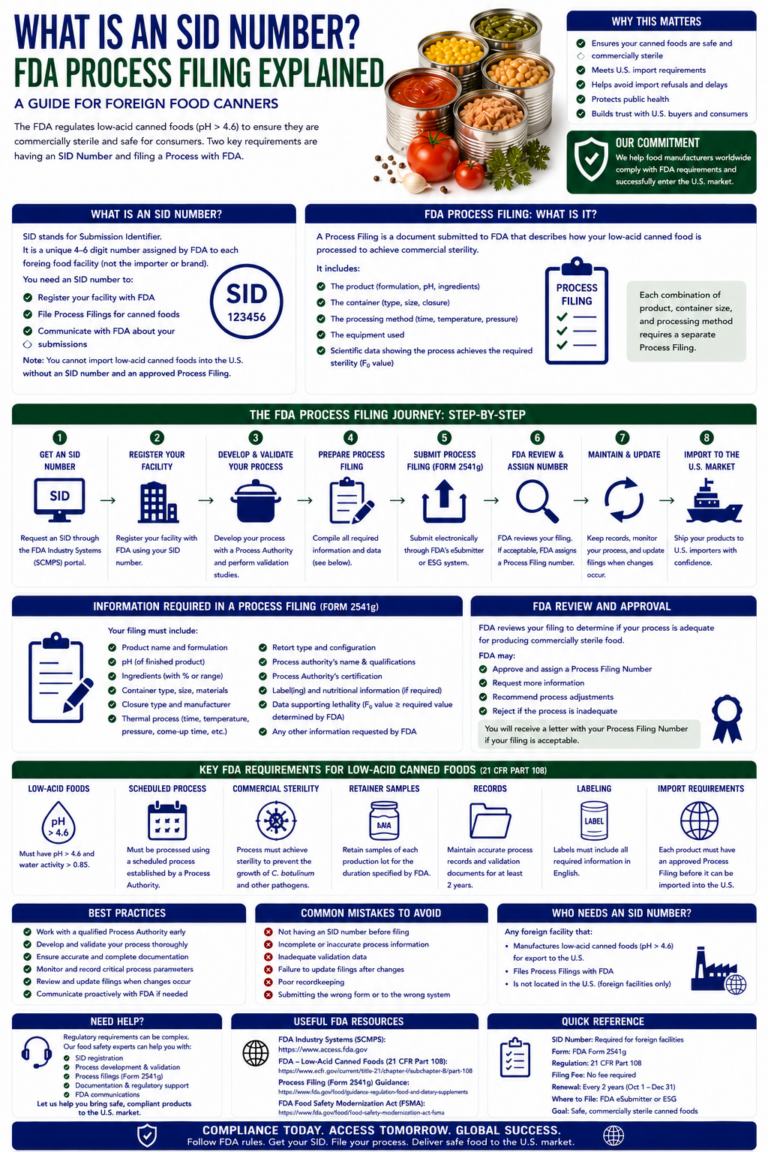
What Is an SID Number? FDA Process Filing Explained
This guide explains the difference between an SID number and a Scheduled Process, the FCE requirement, which products need FCE and SID, the pH 4.6 threshold, what triggers a new SID filing, how import alerts work, and the role of the Process Authority.
FCE Number vs. SID Number — What Each Identifies
The critical sequence: FCE first, then SID. You cannot file a SID without an FCE. You cannot legally ship LACF or acidified food to the United States without both. FDA checks both at import through Prior Notice and the LACF/AF online system.
The pH 4.6 Threshold — Why It Determines Your Filing Obligation
The finished equilibrium pH — not the pH of any single ingredient — determines which category applies. A salsa with tomatoes (naturally low-acid) and added vinegar may achieve a finished equilibrium pH below 4.6 through acidification — making it an acidified food. The same salsa without adequate acid may have an equilibrium pH above 4.6 — making it a LACF requiring retorting. The Process Authority measures and validates the finished equilibrium pH.
When Does a Change Require a New SID Filing?
A new SID filing is required whenever there is a meaningful change to the product or process that could affect food safety. This is where many manufacturers create compliance gaps without realizing it:
Changes That Require a New SID
✗ Change in product formulation that could affect pH or water activity — different vinegar percentage, different acidifying ingredient, changed vegetable-to-liquid ratio
✗ Change in container type — switching from cans to pouches, from glass jars to plastic containers
✗ Change in container size — adding a new size (300g jar alongside 200g jar each needs its own SID)
✗ Change in retort or processing equipment — new retort, different heat transfer characteristics
✗ Change in processing parameters — different retort temperature, different come-up time, different process time
✗ Change in acidification method or acid type — switching from vinegar to citric acid
What Happens If You Ship Without an Updated SID
Shipping LACF or acidified food to the United States with a product or process change not reflected in the filed SID is an automatic violation. At import, FDA may compare the product label, Prior Notice filing, and entry documentation against the FCE and SID records on file. A mismatch — different ingredients, different container size, different formulation — can result in detention without physical examination. The shipment cannot be corrected after it has already arrived — SID corrections must happen before shipment.
Import Alert 36-07 and 36-08 — What Happens Without FCE and SID
How DWPE Works
Once a firm appears on Import Alert 36-07 or 36-08, every subsequent shipment from that facility for those product categories is automatically detained at the port of entry — without FDA needing to physically examine each shipment. The importer must release the shipment through a costly, time-consuming process of providing documentation and potentially product samples for FDA review. DWPE can persist until the firm demonstrates full compliance.
How to Get Off an Import Alert
Removal from Import Alert 36-07 or 36-08 typically requires: submitting complete FCE registration and SID filings for all affected products; providing documentation of the Process Authority review; potentially providing product samples for FDA analysis; and demonstrating that the manufacturing process has been validated and is compliant. The process is significantly more disruptive and expensive than getting compliant before the first shipment.
The CFR Citations Behind FCE and SID Requirements
Need FCE Registration and SID Process Filing?
FDA Registration Assistance coordinates the complete FCE and SID compliance structure for LACF and acidified food processors — FCE registration submission, qualified Process Authority coordination, SID filing, label alignment review, FDA Food Facility Registration, and U.S. Agent designation for foreign processors. 1,000+ clients. 135+ countries. 15+ years of FDA regulatory experience.
Contact us at info@fdaregistrationassistance.com or call +1 (928) 275-8333.
Frequently Asked Questions — SID Number and FDA Process Filing
1. What is an SID number in FDA food regulation?
An SID (Submission Identifier) is the unique number FDA assigns to a specific Scheduled Process filing for a low-acid canned food (LACF) or acidified food. Each SID corresponds to a unique combination of product formulation, container type and size, and processing method. The SID identifies the specific process on file with FDA — not the facility. One FCE can have many SIDs.
2. What does SID stand for?
SID stands for Submission Identifier — the number FDA assigns to a Scheduled Process filing submission. A common confusion: SID is sometimes referred to as “Scheduled Process ID,” but the acronym properly stands for Submission Identifier. The Scheduled Process is the documented processing parameters; the SID is the identifier number assigned to that specific filing.
3. What is a Scheduled Process?
A Scheduled Process is the documented set of processing parameters established by a qualified Process Authority to ensure commercial sterility (for LACF) or a final equilibrium pH at or below 4.6 (for acidified foods). For LACF, it documents the thermal process — retort temperature, come-up time, process time, container type, headspace, and initial temperature. For acidified foods, it documents the acidification method, acid type, and validated pH achievement.
4. What is an FCE number and how does it relate to an SID?
An FCE (Food Canning Establishment) number identifies the manufacturing facility. An SID identifies a specific product-process-container combination at that facility. One FCE per facility; many SIDs per FCE. You cannot file an SID without first having an FCE. Both are required for LACF and acidified food compliance — together under 21 CFR Part 108 and 21 CFR Part 113 or 21 CFR Part 114.
5. Which food products require FCE registration and SID filing?
LACF — thermally processed foods in hermetically sealed containers with equilibrium pH above 4.6 and water activity above 0.85 (canned vegetables, soups, meats, seafood, beans). Acidified foods — low-acid foods with acid or acidifying ingredients added to achieve equilibrium pH at or below 4.6 (pickled vegetables, salsa, hot sauce, relishes). Both domestic processors and foreign facilities exporting to the United States must file.
6. What is the pH 4.6 threshold and why does it matter?
Clostridium botulinum cannot grow and produce toxin below pH 4.6. Foods with finished equilibrium pH above 4.6 (and water activity above 0.85) are LACF and require thermal sterilization under 21 CFR Part 113. Foods acidified to equilibrium pH at or below 4.6 are acidified foods regulated under 21 CFR Part 114 — the acid prevents botulinum growth without thermal sterilization, but acidification must be validated.
7. What is a Process Authority and why is one required?
A Process Authority is a qualified food scientist who evaluates the product formulation and manufacturing process, establishes safe processing parameters, validates that the process achieves commercial sterility or the required pH, and provides documentation for the FDA Scheduled Process filing. FDA does not approve or certify Process Authorities — but process safety responsibility rests with the manufacturer and the Process Authority. FDA Registration Assistance coordinates with qualified Process Authorities on behalf of manufacturers.
8. What triggers a new SID filing?
A new SID is required for: changes in product formulation affecting pH or water activity; changes in container type or size; changes in retort or processing equipment; changes in processing parameters (time, temperature, come-up time); and changes in acidification method or acid type. Shipping with undisclosed changes not reflected in the filed SID is an automatic detention trigger at U.S. ports.
9. What happens at import without valid FCE and SID?
LACF without FCE/SID is subject to automatic detention without physical examination (DWPE) under Import Alert 36-07. Acidified food without FCE/SID is subject to DWPE under Import Alert 36-08. Once on an Import Alert, every shipment from that facility for those product categories is detained automatically until compliance is demonstrated.
10. Does SID filing mean FDA has approved the process?
No. SID filing means FDA has received and recorded the Scheduled Process submission. FDA does not evaluate, validate, or approve the process itself. Technical responsibility for process safety rests entirely with the manufacturer and the Process Authority. FDA verifies that filings exist and are current at import and during inspections.
11. What is commercial sterility for LACF?
Under 21 CFR 113.3, commercial sterility means the condition achieved by heat treatment that renders the food free from microorganisms capable of growing under normal non-refrigerated storage and distribution. Commercial sterility does not mean zero microorganisms — it means all pathogens (including C. botulinum) and all spoilage organisms that could grow at room temperature have been eliminated by the thermal process.
12. What is the regulatory basis for FCE registration and SID filing?
21 CFR Part 108 (emergency permit control — FCE and SID obligation); 21 CFR Part 113 (full LACF regulation including Scheduled Process filing); 21 CFR Part 114 (full acidified food regulation including Scheduled Process filing); 21 CFR 108.25 (LACF registration and process filing requirements); 21 CFR 108.35 (acidified food registration and process filing requirements).
13. Do foreign food manufacturers need FCE registration and SID filing?
Yes. Foreign facilities manufacturing LACF or acidified foods for export to the United States must register as an FCE and file SIDs for each product, just as domestic U.S. facilities must. This is separate from and in addition to FDA Food Facility Registration. Foreign processors without FCE and SID will have products detained under Import Alert 36-07 or 36-08.
14. How does FCE/SID relate to FDA Food Facility Registration?
They are separate and independent requirements. FDA Food Facility Registration (under 21 U.S.C. 350d and 21 CFR Part 1 Subpart H) is required for all food processing facilities. FCE registration and SID filing (under 21 CFR Parts 108, 113, and 114) are additional requirements specific to LACF and acidified food processors. An LACF or acidified food manufacturer needs both.
15. What information is included in a Scheduled Process filing?
Complete product formulation and ingredient proportions; container type, size, and closure method; retort or processing system description; for LACF: retort temperature, minimum initial temperature, process time, come-up time, and headspace; for acidified foods: acidification method, acid type, pH target, and equilibrium pH validation data; and the Process Authority’s credentials and review documentation.
16. How many SIDs does a facility typically need?
One SID per unique combination of product formulation, container type/size, and processing method. A facility making three salsa varieties in three container sizes with one process needs nine SIDs. A large canning facility with dozens of products in multiple can sizes may need hundreds of SIDs. Each new container size or formulation change requires filing an additional SID.
17. Can a product be sold in the U.S. while the SID filing is pending?
No. SID filing must be completed and on file with FDA before the LACF or acidified food product is shipped to the United States. SID filing cannot be submitted after the product has already shipped. FDA checks Prior Notice filings against FCE and SID records at import. A product that ships before its SID is on file is subject to automatic detention.
18. What are the most common SID filing mistakes?
Most common: no FCE before attempting SID filing; wrong product category classification (mislabeling LACF vs. acidified food); container type or size not covered by the filed SID; no new SID after formulation or process changes; using an underqualified Process Authority; and product label ingredients not matching what was filed in the Scheduled Process.
19. What is Import Alert 36-07 and Import Alert 36-08?
Import Alert 36-07: LACF products subject to DWPE for missing or non-compliant FCE or SID filings. Import Alert 36-08: acidified food products subject to DWPE for same. Once listed, every shipment from that facility is automatically detained until the firm demonstrates full compliance through corrected FCE and SID filings and typically product samples for FDA review.
20. Does FDA Registration Assistance prepare the Scheduled Process?
FDA Registration Assistance does not itself prepare the Scheduled Process — that requires a qualified Process Authority with food science expertise. FDA Registration Assistance coordinates Process Authority engagement, handles FCE registration submission, manages SID filing submission to FDA after Process Authority review, and reviews label alignment with the filed process. FDA Registration Assistance manages the complete compliance structure around the Process Authority’s technical work.
21. Does FDA register or approve Process Authorities?
No. FDA does not maintain a registry of approved Process Authorities and does not certify individual Process Authorities. FDA expects the Process Authority to be qualified by education and experience for the specific product type. Various academic institutions with food science programs and private food safety testing laboratories commonly serve as Process Authorities for LACF and acidified food processors.
22. What labeling requirements relate to SID filings?
The product label must be consistent with the Scheduled Process filing — accurately reflecting the product formulation, ingredients, and net weight that correspond to what was filed. A mismatch between the label and the SID filing (different ingredients, different container size) can be identified during import review or FDA inspection and trigger detention. LACF labels must also identify the responsible firm to allow traceability back to FCE and SID records.
23. Are LACF regulations the same for domestic and foreign processors?
Yes. The same FCE registration and Scheduled Process filing requirements under 21 CFR Parts 108 and 113 apply equally to domestic U.S. processors and foreign processors exporting to the United States. Foreign processors file through the same FDA online LACF/AF registration system as domestic processors.
24. How does FDA Registration Assistance help with FCE and SID compliance?
FCE registration submission; coordination with qualified Process Authorities; SID filing submission after Process Authority review; alignment review between the filed SID and the product label; FDA Food Facility Registration for the manufacturing facility; and U.S. Agent designation for foreign processors. 1,000+ clients. 135+ countries. 15+ years of FDA regulatory experience.
25. How do I get started with FCE registration and SID filing?
Contact FDA Registration Assistance at info@fdaregistrationassistance.com or call +1 (928) 275-8333. Provide your facility name and address, the LACF or acidified food products you manufacture or export, container types and sizes, current FDA Food Facility Registration number if applicable, and any existing FCE registration information.