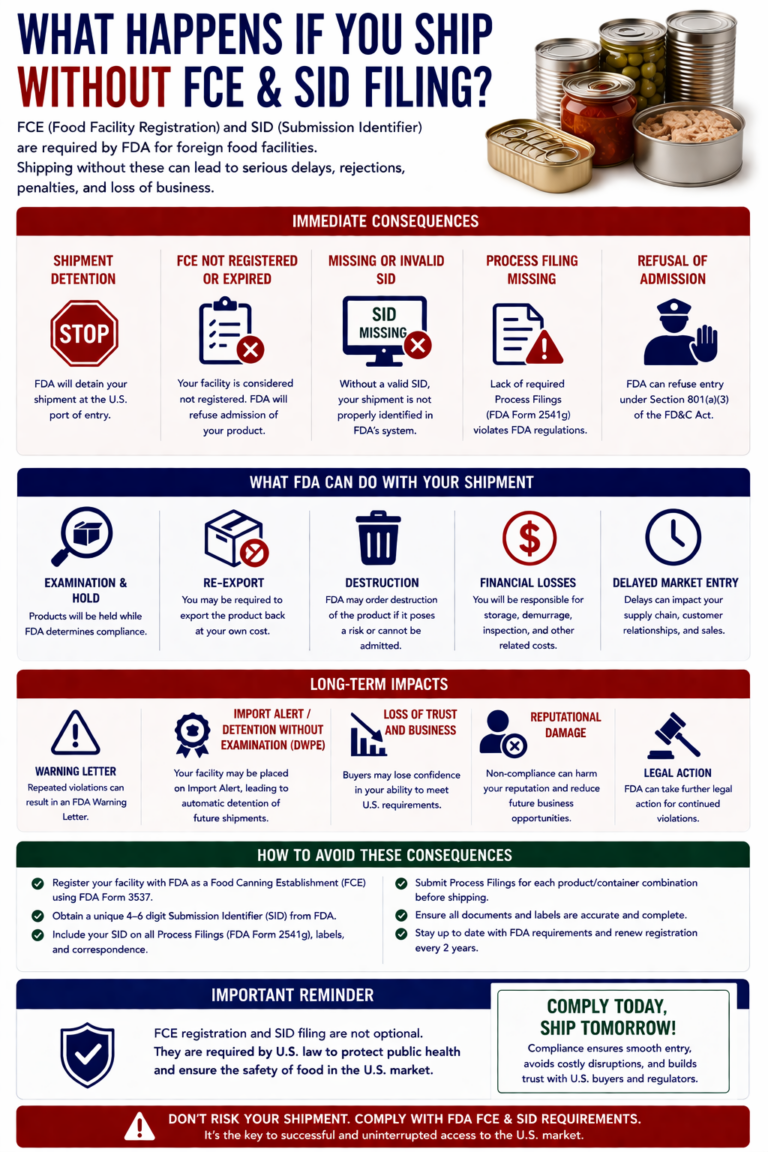
What Happens If You Ship Without FCE & SID Filing?
Trusted by 1,000+ companies across 135+ countries, with 15+ years of FDA regulatory experience. Below: the sequence at the port, what Import Alert 99-37 and DWPE mean, why it can't be fixed retroactively, and how firms get removed.
The Sequence When a Filing Is Missing
FDA verifies process filings as part of its admissibility review. When a LACF or acidified product arrives with no scheduled process on file, this is how it typically unfolds:
Import Alert 99-37 and DWPE
A single refused shipment is painful. Being placed on an import alert is worse, because it stops being about one entry.
It Can't Be Cured After Shipping
The most expensive misconception is that compliance can be handled once the goods are at the port. It can't, for a structural reason: a scheduled process is a validated set of conditions — time, temperature, pH, acidification — that has to be established before production. You cannot validate a process retroactively for cans that were already filled and sealed.
How Firms Get Off an Import Alert
Removal from DWPE isn't automatic and isn't fast. You petition FDA for removal under the Regulatory Procedures Manual (Chapter 9-8), demonstrating that you now meet the requirements. The kind of evidence FDA looks for:
File Before You Ship — or Get Help If You Already Shipped
Send us your product details, formulation, pH, and container sizes. We'll confirm the classification, register the FCE, file the SID with a process authority, and align your label and import filings before anything leaves the factory — or, if a shipment is already held, help assemble the evidence and removal petition FDA expects. Email info@fdaregistrationassistance.com or call +1 (928) 275-8333.
Frequently Asked Questions — Shipping Without FCE & SID
What happens if I ship LACF or acidified food without FCE/SID?
FDA can detain the entry at the port, refuse it admission (forcing re-export or destruction), and place your firm on Import Alert 99-37, which detains your future shipments without physical examination until you prove compliance.
Will my shipment definitely be stopped?
Not always caught on the first try, but the risk is high. FDA's admissibility review checks whether a product is LACF or acidified and whether a scheduled process is on file; if it's required and missing, the entry can be detained and refused.
What is Import Alert 99-37?
It's the FDA import alert for “Detention Without Physical Examination of Low-Acid Canned Foods and Acidified Foods Without Filed Scheduled Processes.” Firms with no process on file can be placed on it, automating detention of their shipments.
What does “detention without physical examination” mean?
DWPE means FDA detains your shipments based on records alone, without inspecting them, because your firm is on an import alert. Every future entry is held automatically until you are removed from the alert.
Can I file FCE and SID after the shipment is already at the port?
Filing now helps future shipments, but it generally can't rescue the lot already produced without a scheduled process — see what's required before shipping canned food.
Why can't it be fixed retroactively?
A scheduled process is a validated set of conditions that must be established before production. You can't validate after the fact for cans already made, so the non-compliant lot stays non-compliant.
When must the scheduled process be filed?
A foreign processor must file its scheduled processes within 60 days of registering as a LACF or acidified-food processor, and before packing any new product (21 CFR 108.25 and 108.35).
Will FDA destroy my product?
Refused goods must be re-exported or destroyed, generally within about 90 days. You bear the cost either way, on top of the storage and demurrage that accrue while the entry is held.
Does this also affect future shipments?
Yes. Once you're on Import Alert 99-37, FDA can detain every future shipment without examining it, turning a one-time error into an ongoing block on your U.S. business.
How do I get off an import alert?
You petition FDA for removal, showing compliance — records that products were made to the filed scheduled process, a process-authority evaluation, heat-penetration data, or third-party certification — under the Regulatory Procedures Manual, Chapter 9-8.
How long does it take to get removed from DWPE?
It varies, but it isn't quick. FDA reviews your evidence of compliance, and you may need a track record of compliant entries. Months is common, during which your shipments stay blocked.
Is the food considered adulterated?
A LACF or acidified food made without the required registration and filed process appears not to be produced in accordance with 21 CFR Parts 108, 113, and 114 — which is the basis for detention and refusal.
What's the difference between a hold and a refusal?
A hold (detention) stops the shipment while FDA reviews it; a refusal is a final denial of admission, after which the goods must leave the country or be destroyed within the allowed time.
Is food facility registration enough on its own?
No. Standard food facility registration does not cover the FCE registration and SID process filing that LACF and acidified foods separately require. Assuming it does is a costly mistake.
What products does this apply to?
Low-acid canned foods such as canned vegetables, tuna, and soups, and acidified foods such as hot sauce, pickles, and salsa, in hermetically sealed shelf-stable containers. Frozen and refrigerated products follow different rules.
Can my importer or broker fix this for me?
They can help with logistics, but they can't create a scheduled process you never filed. The FCE registration and SID filing must be done by or for the processor before shipping the product.
What does a detention cost me?
Port storage and demurrage, customs handling, possible spoilage, re-export or destruction costs, and lost sales — usually far more than completing the filings correctly would have cost upfront.
Could mislabeling cause a hold even with FCE/SID?
Yes. Even with correct filings, a label that doesn't match the filed process can trigger a separate hold — see fixing a food label before import.
Does this apply to domestic processors too?
Yes. Domestic LACF and acidified-food processors must also register an FCE and file scheduled processes; non-compliance can lead to FDA enforcement, warning letters, and recalls, not just import action.
What if FDA requests more process information?
If FDA asks for additional process details and you don't respond adequately, a separate alert (99-36) covers detention for failure to provide process information. Respond promptly and completely.
What about inadequate process control?
Even with a filing, if an inspection finds inadequate process control, Import Alert 99-38 can place you on DWPE. The process must be both filed and properly followed in production.
How do I avoid all of this?
Classify the product, register the FCE, file the SID for each product and container, validate with a process authority, align your label, and confirm FSVP and Prior Notice — all before you ship.
If I already shipped, what should I do now?
Identify the exact problem immediately, begin FCE and SID filings for future production, gather process-authority documentation, and get expert help. Quick action limits damage but won't always release the held lot.
Can you help us recover from a detention or import alert?
We complete FCE and SID filings, coordinate a process authority, assemble the evidence FDA expects, and help prepare a removal petition — see import refusal and detention help.
How do I get started?
Send us your product details, formulation, pH, and container sizes. Contact our team and we'll confirm classification and complete the filings before you ship — or help you respond if a shipment is already held. Email info@fdaregistrationassistance.com or call +1 (928) 275-8333.