FDA Registration for Coffee Products
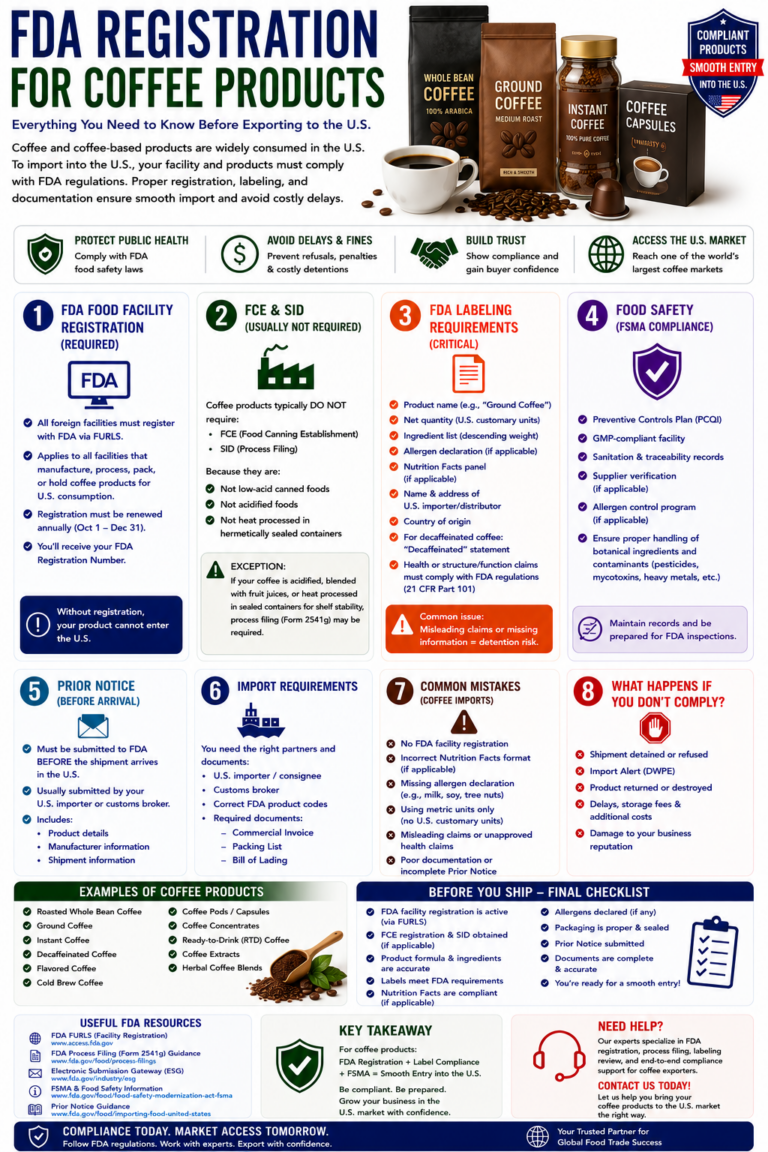
This guide covers the specific FDA requirements for every type of coffee product — from green beans and ground coffee to RTD canned beverages and functional coffee blends — with the regulations, the classification distinctions that matter, and what each type requires before U.S. import or sale.
FDA Requirements by Coffee Product Type
The FDA compliance requirements for coffee vary significantly depending on whether the product is a dry coffee, a shelf-stable RTD beverage, or a functional product with added active ingredients. Getting this classification right before export determines the full compliance path.
| Product Type | Category | Key FDA Requirements | FCE/SID? |
|---|---|---|---|
| Green (unroasted) coffee beans | Dry / Raw | Food Facility Registration, U.S. Agent, Prior Notice, FSVP, labeling | No |
| Roasted whole bean coffee | Dry | Food Facility Registration, U.S. Agent, Prior Notice, FSVP, labeling | No |
| Ground coffee (unflavored) | Dry | Food Facility Registration, U.S. Agent, Prior Notice, FSVP, labeling | No |
| Instant / freeze-dried coffee | Dry | Food Facility Registration, U.S. Agent, Prior Notice, FSVP, Nutrition Facts, labeling | No |
| Flavored ground or whole bean coffee | Dry | Food Facility Registration, U.S. Agent, Prior Notice, FSVP, labeling, ingredient list, allergens if applicable | No |
| Coffee pods / capsules | Dry / Packaged | Food Facility Registration, U.S. Agent, Prior Notice, FSVP, labeling | No |
| RTD coffee — refrigerated / chilled | RTD Beverage | Food Facility Registration, U.S. Agent, Prior Notice, FSVP, Nutrition Facts, full labeling | No (not shelf-stable) |
| RTD coffee — shelf-stable (thermally processed) | RTD Beverage | Food Facility Registration, U.S. Agent, Prior Notice, FSVP, Nutrition Facts, labeling | Yes — FCE + SID required |
| Cold brew concentrate | RTD Beverage | Food Facility Registration, U.S. Agent, Prior Notice, FSVP, Nutrition Facts, labeling, dilution directions | If shelf-stable and thermally processed |
| Functional coffee (protein, adaptogens, CBD, vitamins) | Functional | Food Facility Registration, U.S. Agent, Prior Notice, FSVP, Nutrition Facts, full labeling, claims review, ingredient GRAS status | Depends on format |
When Does RTD Coffee Require FCE/SID Filing?
This is the most common compliance gap for coffee exporters. The live page vaguely said RTD coffee "may require additional evaluation." Here is the actual answer based on 21 CFR Part 113:
A shelf-stable RTD coffee beverage in a hermetically sealed container — cans, glass bottles, aseptic cartons, retort pouches — that has a pH above 4.6 and a water activity above 0.85, and that undergoes thermal processing to achieve commercial sterility, is classified as a Low-Acid Canned Food (LACF). LACF products require:
Food Canning Establishment (FCE) Registration
The processing facility must be registered as a Food Canning Establishment with FDA through the FDA BCFsystems portal. FCE registration is separate from and in addition to standard Food Facility Registration. It identifies the facility as a thermal processor of low-acid canned foods.
Scheduled Process (SID) Filing
Each thermally processed RTD coffee product must have a Scheduled Process filed with FDA. The Scheduled Process describes the thermal treatment parameters — time, temperature, come-up time, container type — validated by a Process Authority to achieve commercial sterility. FDA reviews all SID filings. A product without a valid SID on file cannot legally be shipped to the United States as a shelf-stable LACF product.
What does not require FCE/SID: Refrigerated RTD coffee (not shelf-stable). Acidified RTD coffee with a final equilibrium pH of 4.6 or below (these are acidified foods subject to 21 CFR Part 114, which has its own registration requirements). Cold brew coffee that is not thermally processed and is sold refrigerated.
Most commercially produced canned and bottled RTD coffee — milky coffee drinks, sweetened coffee beverages, canned espresso-based drinks — are shelf-stable, thermally processed, and have a pH above 4.6, making FCE/SID filing mandatory. FDA Registration Assistance handles FCE registration and SID filing for RTD coffee manufacturers.
How to Get Your Coffee Products FDA-Compliant — Step by Step
Classify Your Coffee Product
Determine whether your product is a dry coffee (green beans, roasted, ground, instant, pods) or a ready-to-drink beverage. For RTD, determine whether it is shelf-stable (thermally processed) or refrigerated, and what its pH and water activity are. For functional coffee, identify all added active ingredients and the claims you intend to make. Classification determines your complete compliance path. FDA Registration Assistance performs product classification assessments before any filings are made.
Register the Manufacturing Facility with FDA
Complete FDA Food Facility Registration under 21 CFR Part 1 before the first export. Obtain a DUNS Number if the facility does not have one. Foreign facilities must designate a U.S. Agent. Most registrations are completed within 24–48 hours. Registration must be renewed every two years during the Biennial Renewal window — October 1 through December 31 of every even-numbered year.
FCE Registration + SID Filing (Shelf-Stable RTD Coffee Only)
If your RTD coffee is shelf-stable and thermally processed with a pH above 4.6 and water activity above 0.85, complete Food Canning Establishment (FCE) registration and file a Scheduled Process (SID) with FDA under 21 CFR Part 113. The SID must be prepared based on a thermal process validated by a qualified Process Authority. This step must be completed before the first shipment of shelf-stable RTD coffee enters the United States.
Review and Finalize FDA-Compliant Labels
Review all label elements against 21 CFR Part 101: statement of identity; net quantity in U.S. and metric units; ingredient list; Nutrition Facts panel (required for RTD, flavored, and functional coffee); allergen declarations for flavored products; and manufacturer/distributor information. For functional coffee, all added ingredient claims must be reviewed for compliance with FDA nutrient content claim and structure/function claim rules before printing.
U.S. Importer Establishes FSVP Compliance
The U.S. importer must develop an FSVP program for your coffee facility under 21 CFR Part 1 Subpart L. For coffee, relevant hazards in the FSVP hazard analysis include biological hazards (pathogens in green beans), chemical hazards (pesticide residues, mycotoxins such as ochratoxin A in coffee), and physical hazards (stones or metal fragments from coffee harvesting). FSVP must be in place before the first import.
File Prior Notice Before Each Shipment
File FDA Prior Notice through PNSI or the CBP ACE portal before each coffee shipment arrives at the U.S. port of entry. Include the manufacturer's active FDA registration number, correct FDA product code for coffee, and expected arrival details. All information must match the CBP customs entry exactly. Missing or inaccurate Prior Notice results in shipment refusal.
Coffee-Specific FDA Compliance Considerations
Functional Coffee — When Does it Become a Drug?
Functional coffee is one of the fastest-growing segments of the coffee market — products combining coffee with adaptogens, nootropics, protein, collagen, vitamins, CBD, mushrooms, or other active ingredients. Most functional coffee is regulated as a food product under FDA's food safety and labeling framework, provided claims do not cross into drug claim territory.
Claims about general wellness, energy, and alertness are generally permissible as structure/function claims if truthful and not misleading. But claims suggesting the product treats, cures, mitigates, or prevents a disease — "reduces anxiety disorder," "treats adrenal fatigue," "prevents cognitive decline" — are drug claims that require Drug Establishment Registration. Added ingredients must also be GRAS or approved as food additives. CBD in food products remains subject to FDA scrutiny and has not been broadly authorized as a food ingredient at the federal level.
Caffeine — Natural vs. Added
Caffeine naturally present in coffee requires no separate regulatory approval — it is inherent to the product. However, caffeine added to coffee products above naturally occurring levels is regulated as a food additive and must have GRAS status for its intended use and concentration. FDA has issued multiple warning letters to companies marketing pure caffeine products. Energy-enhanced coffee formulations with significantly elevated caffeine should have their added caffeine concentration reviewed against applicable GRAS determinations before launch.
Decaffeinated Coffee — Solvent Residues
If your decaffeinated coffee uses methylene chloride (dichloromethane) as a decaffeination solvent, residual methylene chloride levels must comply with 21 CFR Part 173.255, which permits residual methylene chloride in decaffeinated coffee up to 10 ppm. Manufacturers using methylene chloride decaffeination should have analytical testing confirming residual levels within the tolerance. CO₂ and water decaffeination processes do not raise this concern.
Acrylamide in Coffee
Acrylamide forms naturally during coffee roasting through the Maillard reaction and is present in virtually all roasted coffee. FDA has studied dietary acrylamide exposure but has not set a specific regulatory limit for acrylamide in coffee under federal law. California's Proposition 65 previously required acrylamide warnings on coffee sold in California, but in 2019 a California court ruled that coffee businesses are not required to include Prop 65 acrylamide warnings because coffee provides net health benefits. Coffee sold in the United States is not required to carry acrylamide warnings under federal FDA regulations.
Health Claims on Coffee
No FDA-authorized health claim currently exists for coffee. Qualified health claims require FDA review and authorization. Structure/function claims about general wellness (e.g., "provides antioxidants") are permitted if truthful and not misleading. Disease claims ("reduces risk of Type 2 diabetes," "prevents Parkinson's disease") are not permitted and would be unlawful drug claims.
Organic Claims — USDA, Not FDA
Organic claims on coffee are regulated by USDA under the National Organic Program — not by FDA. A coffee product can carry the USDA Organic seal only if certified by a USDA-accredited certifying agent. FDA has jurisdiction over all other label elements. Organic certification and FDA compliance are independent requirements that must both be addressed.
FDA Consulting for Coffee-Exporting Countries
Coffee is a major agricultural export from dozens of countries. FDA Registration Assistance provides FDA consulting services for coffee exporters across all major coffee-producing regions. Visit the relevant service area page for country-specific FDA compliance guidance:
Ready to Export Your Coffee Products to the United States?
FDA Registration Assistance handles Food Facility Registration, FCE/SID filing for shelf-stable RTD coffee, U.S. Agent services, FSVP compliance, label review, Prior Notice guidance, and functional coffee claims review — for coffee exporters in 135+ countries.
Contact us at info@fdaregistrationassistance.com or call +1 (928) 275-8333. Food Facility Registration: $858 complete service. 1,000+ clients. 15+ years of experience.
Frequently Asked Questions — FDA Registration for Coffee Products
1. Does coffee require FDA registration?
Yes. Any facility that manufactures, processes, packs, or holds coffee products for importation into or sale in the United States must complete FDA Food Facility Registration under 21 CFR Part 1. Foreign facilities must also designate a U.S. Agent. Registration must be renewed every two years during the Biennial Renewal window — October 1 through December 31 of every even-numbered year.
2. What types of coffee products are regulated by FDA?
All coffee products: green (unroasted) beans; roasted whole bean and ground coffee; instant and freeze-dried coffee; ready-to-drink (RTD) coffee beverages; cold brew and nitro cold brew; flavored coffee; functional coffee with added ingredients; and coffee pods and capsules. All are regulated as food products under the Federal Food, Drug, and Cosmetic Act.
3. Do RTD coffee products require FCE/SID filing?
Yes, for shelf-stable products. Shelf-stable RTD coffee in hermetically sealed containers with pH above 4.6 and water activity above 0.85 that undergoes thermal processing is a Low-Acid Canned Food (LACF) under 21 CFR Part 113 and requires Food Canning Establishment (FCE) registration and Scheduled Process (SID) filing. Refrigerated, non-shelf-stable RTD coffee does not require FCE/SID.
4. Does plain unflavored coffee require a Nutrition Facts panel?
Plain unflavored coffee with no reportable nutrients may qualify for an exemption under 21 CFR Part 101.9 since all required nutrients are present in insignificant (zero-declarable) amounts. In practice, most packaged coffee carries a Nutrition Facts panel. Flavored, sweetened, or blended coffee products containing reportable nutrients must carry a compliant Nutrition Facts panel in the current 2016-updated format. RTD coffee beverages always require a Nutrition Facts panel.
5. Is functional coffee regulated as a drug?
Functional coffee with added vitamins, adaptogens, protein, or collagen is a food product if claims relate to general wellness. Claims that suggest the product treats, cures, or prevents a disease are drug claims triggering Drug Establishment Registration requirements. Claims language on functional coffee must be reviewed before launch. CBD in food products has not been broadly authorized as a food ingredient at the federal level and carries additional regulatory risk.
6. Are there FDA rules on caffeine in coffee products?
Caffeine naturally present in coffee requires no separate regulatory approval. Caffeine added above naturally occurring levels is a food additive requiring GRAS status. FDA has issued warning letters for highly concentrated caffeine products. Added caffeine in RTD or functional coffee products should be reviewed for GRAS status and appropriate labeling before launch.
7. What labeling is required on packaged coffee products?
Under 21 CFR Part 101: statement of identity on the Principal Display Panel; net quantity in U.S. and metric units; ingredient list (required for blended, flavored, or multi-ingredient products); Nutrition Facts panel (required for most products); allergen declarations if applicable; and manufacturer/distributor name and address. Labels must be in English.
8. Does green (unroasted) coffee require FDA Food Facility Registration?
Yes. Facilities that process or hold green coffee beans for U.S. export must register with FDA. Farms that only grow and harvest coffee cherries without processing may qualify for the farm exemption, but facilities that mill, sort, dry, or otherwise process green beans must register.
9. What is the statement of identity for coffee products?
The statement of identity must prominently and accurately describe the product: "Roasted Ground Coffee," "Instant Coffee," "Decaffeinated Ground Coffee," "Cold Brew Coffee Concentrate," "Ready-to-Drink Coffee Beverage." Origin claims (e.g., "Colombian Coffee," "Ethiopian Yirgacheffe") must be accurate and not misleading.
10. Do coffee products require Prior Notice before import?
Yes. Every coffee shipment requires FDA Prior Notice under 21 CFR Part 1 Subpart I before arrival at the U.S. port. Prior Notice must include the manufacturer's active FDA registration number, correct FDA product code, shipper and importer information, and anticipated arrival details. Missing or inaccurate Prior Notice results in shipment refusal.
11. What FSVP obligations does a U.S. coffee importer have?
U.S. importers must maintain an FSVP program under 21 CFR Part 1 Subpart L for each foreign coffee supplier. Relevant hazards include biological (pathogens), chemical (pesticide residues, ochratoxin A mycotoxin), and physical (stones, metal fragments). FSVP must be in place before the first import.
12. Can coffee products make "no sugar added" or "unsweetened" claims?
"No sugar added" is a nutrient content claim regulated under 21 CFR Part 101.60 with specific requirements. "Unsweetened" indicates no sweeteners were added. Both claims must comply with FDA nutrient content claim regulations and must be truthful and not misleading on the specific product.
13. Does decaffeinated coffee have additional FDA requirements?
Decaffeinated coffee using methylene chloride as a solvent must comply with residual solvent limits under 21 CFR Part 173.255 — residual methylene chloride may not exceed 10 ppm in the finished product. CO₂ and water decaffeination processes do not have this concern.
14. What are the allergen requirements for flavored coffee?
Flavored coffee containing any of the nine major allergens (milk, eggs, fish, shellfish, tree nuts, peanuts, wheat, soybeans, sesame) must include allergen declarations under FALCPA and the FASTER Act. Common issues include hazelnut or almond flavorings (tree nuts), cream or milk-derived flavorings (milk), and protein-enriched products with soy or dairy.
15. Is organic coffee subject to FDA or USDA regulation?
Organic claims are regulated by USDA under the National Organic Program — not FDA. USDA Organic certification requires a USDA-accredited certifying agent. FDA has jurisdiction over all other label elements. Organic certification and FDA labeling compliance are independent and both must be addressed.
16. What are the FDA compliance considerations for cold brew coffee?
Refrigerated cold brew RTD is not subject to LACF/FCE requirements but requires Food Facility Registration, food labeling compliance, and FSVP for the importer. Shelf-stable cold brew in hermetically sealed containers may require FCE/SID if pH is above 4.6, water activity above 0.85, and thermal processing was applied.
17. Does adding protein, collagen, or adaptogens to coffee change FDA requirements?
Added ingredients must be GRAS or approved as food additives. They must appear in the ingredient list. Claims enabled by added ingredients must comply with FDA nutrient content claim rules. Claims suggesting added ingredients treat a disease or condition may trigger drug or dietary supplement reclassification.
18. What FDA product code applies to coffee?
Common product codes include 04B (coffee — dried, roasted, ground, instant) and 14L (RTD coffee beverages). The correct product code must be used in Prior Notice filings. FDA Registration Assistance confirms the correct product code before filing Prior Notice for each coffee shipment.
19. Is there an FDA concern about acrylamide in coffee?
Acrylamide forms naturally during coffee roasting. FDA has studied dietary acrylamide but has not set a federal regulatory limit for coffee. California's Prop 65 acrylamide warning requirement for coffee was struck down by a California court in 2019. No federal acrylamide warning is required on coffee under FDA regulations.
20. Can coffee products carry health claims?
No FDA-authorized health claim currently exists for coffee. Structure/function claims about general wellness are permitted if truthful and not misleading. Disease claims ("reduces risk of Parkinson's disease," "prevents Type 2 diabetes") are drug claims not permitted without FDA authorization.
21. What happens if a coffee shipment is detained at the U.S. port?
A coffee shipment may be detained if the facility is unregistered, Prior Notice was missing or inaccurate, the facility is on FDA Import Alert, or the product is found to be misbranded or adulterated. Detained shipments incur storage fees and cannot be released until the compliance issue is resolved or the shipment is exported back.
22. Do coffee pods and capsules require FDA registration?
Yes. Coffee pods and capsules are packaged food products requiring FDA Food Facility Registration, food labeling compliance (statement of identity, net quantity, ingredient list, Nutrition Facts if applicable, allergens for flavored varieties), and Prior Notice for each imported shipment.
23. Does FDA Registration Assistance handle FCE/SID filing for RTD coffee?
Yes. FDA Registration Assistance handles Food Canning Establishment (FCE) registration and Scheduled Process (SID) filing for RTD coffee manufacturers whose products qualify as LACF under 21 CFR Part 113, in addition to Food Facility Registration, U.S. Agent designation, and label review.
24. What are the most common FDA compliance mistakes for coffee exporters?
Most common: exporting without FDA Food Facility Registration; missing or inaccurate Prior Notice; failing to file FCE/SID for shelf-stable RTD coffee; drug or disease claims on functional coffee; non-compliant Nutrition Facts panel; missing allergen declarations on flavored products; incorrect net quantity format; and missing Biennial Renewal.
25. How do I get started with FDA compliance for my coffee products?
Contact FDA Registration Assistance at info@fdaregistrationassistance.com or call +1 (928) 275-8333. Provide your coffee product types, facility location, and U.S. market plans. We will classify your products, identify all applicable FDA requirements, and handle every compliance step.