Is Your Supplement Label Non-Compliant?
A 60-second self-check for the warning signs — followed by what each red flag actually means.
Key Takeaways
- Looks right ≠ compliant — most violations are invisible to the untrained eye.
- Uncertainty is a red flag — if you can't confirm an element, treat it as a likely issue.
- Claims & Supplement Facts formatting are the most common hidden problems.
- Copied or international labels import someone else's rules — or violations.
- FDA doesn't pre-approve — problems surface at import or on the market, at the worst time.
- A self-check is triage — a professional review is the only real clearance.
Red-Flag Self-Check
Check every statement that applies to your label — including anything you're not sure about. Uncertainty counts, because a label is only compliant if each element actually meets the rules.
Start checking to see your risk
This self-check is a quick triage — not a substitute for a professional review, which is the only way to confirm the subtle issues.
Get My Label ReviewedThis self-check runs entirely in your browser — nothing is recorded or sent.
The Red Flags, Explained
Each warning sign maps to a real, common way supplement labels fail. Here's why they matter:
Claims that drift into disease
The #1 cause of enforcement. A disease claim turns a supplement into an unapproved drug. The line is subtle — "supports joint health" is fine; "relieves arthritis" is not.
Supplement Facts formatting
The 101.36 panel has strict heading, serving, and typography rules. Using "Nutrition Facts" or food-style formatting is a frequent, invisible violation.
Missing disclaimer or elements
A structure/function claim without the DSHEA disclaimer, or a missing U.S. responsible party, makes the product misbranded — easy to overlook, easy to catch.
Ingredient legality
A new dietary ingredient needs a 75-day notification 190.6; some ingredients are unlawful outright. A perfect label on an illegal ingredient still fails.
Copied or international labels
Copying a competitor copies their violations; an international template follows the wrong country's rules. Both are common roots of hidden non-compliance.
No final compliance check
Design and marketing optimize for looks and sales, not regulation. Without a final regulatory review, issues sail straight through to print.
If You Flagged Anything, Here's Your Next Step
A self-check tells you whether to worry; a professional review tells you exactly what's wrong and how to fix it. Depending on your situation:
Get the full picture
Our FDA label review guide lays out every required element, and our expert review confirms the subtle issues a self-check can't.
Match your channel
Importing? See review before customs. Selling on Amazon? See Amazon compliance. New to the framework? The dietary supplements guide.
From Suspicion to Certainty
Run the red-flag self-check
Count the warning signs that apply to your label.
Focus on the three high-risk areas
Claims, Supplement Facts, and ingredient legality cause most violations.
Note what you're unsure about
Uncertainty is itself a red flag — don't assume it's fine.
Get a professional review
The only way to confirm the subtle issues and how to fix them.
Fix before you print or ship
Correct every issue while the label is still a file.
Re-check when things change
Reformulations, new claims, and new channels reintroduce risk.
Find the Hidden Issues Before They Cost You
FDA Registration Assistance runs a full label review to catch what a self-check can't confirm — claims, the Supplement Facts panel, required elements, allergens, and ingredient legality — and delivers documented, actionable corrections. We also handle registration, U.S. Agent, prior notice, and supplier verification.
Contact us at info@fdaregistrationassistance.com or call +1 (928) 275-8333. Food Facility Registration is available starting at $858. Trusted by companies across 135+ countries, with 15+ years of experience.
Frequently Asked Questions
1. How can my label be non-compliant without me knowing?
Because most compliance issues are technical, not visual. Formatting rules for the Supplement Facts panel, the exact wording of a claim, ingredient order and legality — these are invisible to the untrained eye. A label can look completely professional and still be misbranded, which is why brands are often surprised when a shipment is held or a listing is pulled.
2. What are the biggest red flags on a supplement label?
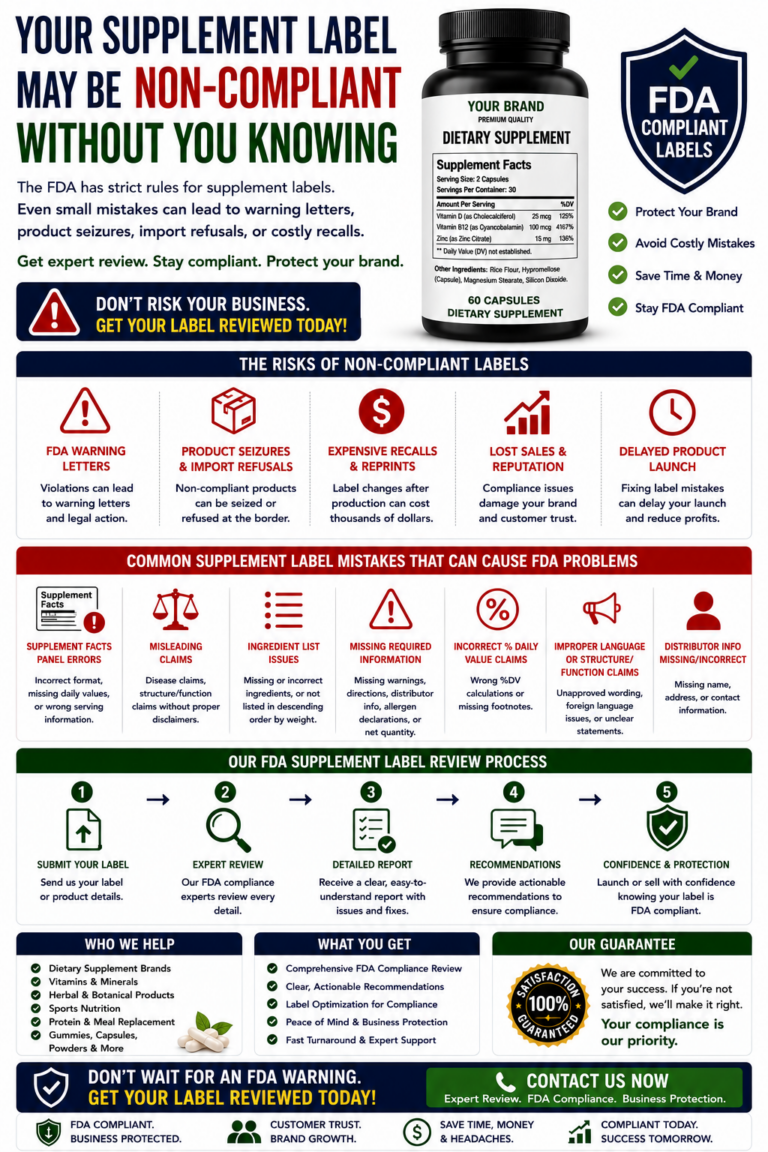
A panel headed "Nutrition Facts" instead of "Supplement Facts"; a claim that names or implies a disease; a structure/function claim without the DSHEA disclaimer; no U.S. responsible party; a label copied from a competitor or an international template; and any ingredient that may be a new dietary ingredient or a prohibited one. If any apply, the label likely needs a review.
3. Is uncertainty itself a warning sign?
Yes. If you can't confirm that an element is compliant — the panel format, a claim, the ingredient order — that uncertainty is a red flag in its own right. Compliance isn't the default; a label is only compliant if each element actually meets the rules, so "I think it's fine" usually means it hasn't been verified.
4. Does FDA check my label before I sell?
No. FDA doesn't pre-approve supplement labels. It reviews products at import and after they're on the market — which is exactly when hidden problems surface, at the worst possible time. That's why catching issues yourself, before launch, is so valuable.
5. What's the most common hidden issue?
Two: incorrect Supplement Facts formatting and subtle claim violations. The panel has strict rules for heading, serving size, and typography that are easy to get slightly wrong, and a claim can drift into disease territory without the writer realizing it. Both are common and both can make a product misbranded.
6. Are small formatting errors really a problem?
Yes. FDA's Supplement Facts formatting rules (21 CFR 101.36) are specific requirements, not guidelines — heading size, boxing, type size, serving information. A panel that merely looks right can still be non-compliant, and formatting is one of the most frequently cited issues.
7. Can a claim make my label non-compliant?
Very easily — claims are the single most common cause of enforcement. Structure/function claims are allowed with the DSHEA disclaimer, but a claim that says or implies the product treats, cures, or prevents a disease turns it into an unapproved drug. "Supports joint health" is fine; "relieves arthritis" is not.
8. Why do so many labels become non-compliant?
Usually one of five reasons: the label was designed without regulatory review; an international template was used instead of U.S. rules; claims were written for marketing rather than compliance; a competitor's label was copied (along with its violations); or no final compliance check was done before printing. All are extremely common.
9. Can I use a label designed for another country?
No. Labels built for other markets follow those markets' rules — different panel format, claim rules, and required elements. An international label almost always needs to be rebuilt to U.S. FDA standards before you can sell here, and using one as-is is a common source of hidden non-compliance.
10. Do I need a U.S. address on my label?
Yes. A U.S. responsible party — the name and address of the manufacturer, packer, or distributor, with a U.S. contact for adverse-event reports — must appear on the label. A missing or non-U.S. responsible party is a frequent, easily overlooked red flag.
11. Can Amazon remove my product for label issues?
Yes. Amazon enforces its own compliance standard and can suppress or remove listings for the same issues that concern FDA — non-compliant claims, mismatched panels, missing documentation — often faster than FDA acts. A hidden label problem can therefore cost you sales immediately.
12. How reliable is a self-check?
A self-check is great for catching obvious red flags and deciding whether you need help, but it can't replace a professional review. The subtle issues — claim context, substantiation, ingredient legality, panel typography — need a trained regulatory eye. Think of the self-check as triage, not a clearance.
13. How long does a full review take?
Typically about 2–3 business days once we have the label and product details. The goal is to fit before your print, import, or launch deadline, so hidden issues are corrected while they're still cheap to fix.
14. How does FDA Registration Assistance help?
We run a full FDA label review to find and correct the hidden issues a self-check can't confirm — claims, the Supplement Facts panel, required elements, allergens, and ingredient legality — and deliver documented, actionable corrections. We also handle registration, U.S. Agent, prior notice, and supplier verification. Starting at $858 for registration, for companies across 135+ countries. Contact info@fdaregistrationassistance.com or +1 (928) 275-8333.