FDA Label Review for Supplements
Everything a compliant supplement label must contain — and how to get yours reviewed before you print, import, or list.
Key Takeaways
- FDA doesn't pre-approve labels — the review is your only compliance gate before market.
- Every required element counts — a missing one makes the whole product misbranded.
- Three areas cause most violations: claims, the Supplement Facts panel, and ingredient legality.
- Supplement Facts ≠ Nutrition Facts — supplements use the 101.36 panel.
- Disease claims turn a supplement into a drug — the most common serious error.
- Match the review to your channel — import, expert review, or Amazon.
Anatomy of a Compliant Supplement Label
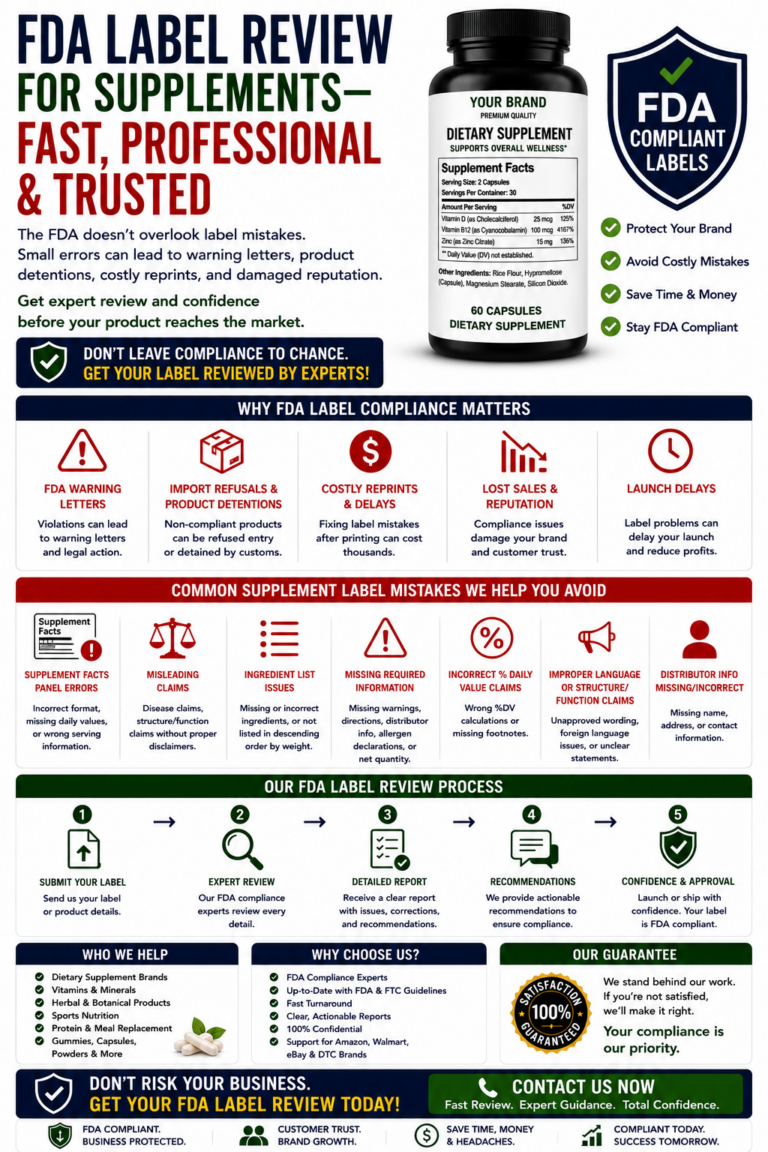
A supplement label is organized across two areas: the principal display panel (what the shopper sees first) and the information panel (typically to its right). Here's every required element, what FDA expects, and the error we see most often:
Principal Display Panel| Element | What FDA requires | Common error |
|---|---|---|
| Statement of identity | The product name and the words "dietary supplement" (or "___ supplement") | Omitting the "dietary supplement" descriptor |
| Net quantity of contents | Amount in the container (count, weight, or volume) | Wrong placement or missing units |
| Element | What FDA requires | Common error |
|---|---|---|
| Supplement Facts | Panel headed "Supplement Facts" per 101.36 — serving size, servings per container, dietary ingredients, %DV where set | Using "Nutrition Facts" or food-style formatting |
| Other ingredients | Non-dietary ingredients listed in descending order of predominance | Missing excipients or wrong order |
| Responsible party | Name and address of manufacturer, packer, or distributor — with a U.S. contact for adverse-event reports | No U.S. responsible party listed |
| Allergen declaration | Major food allergens declared clearly | Undeclared or hidden allergens |
| Directions & warnings | Directions for use, plus any required warning statements | Missing warnings where applicable |
The Three High-Risk Areas
Most enforcement traces back to just three areas. A thorough review weights them heavily:
1. Claims
Structure/function claims are allowed with substantiation, a 30-day FDA notification, and the DSHEA disclaimer. Disease claims (treat, cure, prevent) turn the supplement into an unapproved drug — the most common serious violation.
2. Supplement Facts
The 101.36 panel has strict rules for heading, serving size, ingredients, and %DV. Food-style "Nutrition Facts" formatting is a frequent, avoidable error.
3. Ingredient legality
A new dietary ingredient (post-Oct 15, 1994) generally needs a 75-day notification 190.6; some ingredients (ephedra, DMAA, androstenedione) are unlawful outright. A perfect label on an illegal ingredient still fails.
Which Label Review Do You Need?
The FDA foundation above is the same for everyone — but the context changes what matters most. Pick the path that fits:
Review Before Customs
Catch label problems before a shipment reaches the border — where a misbranded label means detention, refusal, or re-export.
Import timing →Expert Label Review
Why trained regulatory eyes catch what designers, competitor copies, templates, and AI checkers miss — with documented corrections.
Expert review →Amazon Compliance
Amazon's 2026 rules add cGMP verification and claim-to-label alignment on top of FDA — and enforce with instant listing suppression.
Amazon layer →The Review Process
Send the label & details
Artwork plus ingredients, claims, and intended market and channel.
Check every required element
Principal display panel and information panel, element by element.
Review claims & ingredient legality
Claims classification, DSHEA disclaimer, NDI and prohibited-ingredient checks.
Get documented corrections
Each issue, why it matters, and the specific fix — prioritized by risk.
Match the review to your channel
Add import, expert-review, or Amazon context before you commit to print.
Finalize & keep it current
Lock the compliant label; re-review when formula or claims change.
Get Your Supplement Label Reviewed
FDA Registration Assistance runs a complete label review — required elements, Supplement Facts panel, claims, allergens, and ingredient legality — delivers documented, actionable corrections, and points you to the right path for import, expert review, or Amazon. We also handle registration, U.S. Agent, prior notice, and supplier verification.
Contact us at info@fdaregistrationassistance.com or call +1 (928) 275-8333. Food Facility Registration is available starting at $858. Trusted by companies across 135+ countries, with 15+ years of experience.
Frequently Asked Questions
1. What is an FDA label review for supplements?
A complete evaluation of a dietary supplement label against FDA requirements — the Supplement Facts panel, required elements, claims, allergens, and ingredient legality — to confirm the product isn't misbranded before it's printed, imported, or listed. Because FDA doesn't pre-approve labels, this review is effectively the only compliance gate before market.
2. Why does the label matter so much if FDA doesn't approve it?
Precisely because FDA doesn't pre-approve it. There's no agency check before your product reaches the market, so the label is where compliance is judged — and enforcement happens afterward, when fixes are expensive. A misbranded label can trigger detention, refusal, warning letters, or marketplace removal.
3. What are the required elements on a supplement label?
On the principal display panel: a statement of identity including "dietary supplement," and the net quantity of contents. On the information panel: the Supplement Facts panel (21 CFR 101.36), an "Other ingredients" list in descending order, an allergen declaration, and the manufacturer/packer/distributor name and address with a U.S. responsible party for adverse-event reports. Directions and warnings are added where applicable.
4. What's the difference between Supplement Facts and Nutrition Facts?
Dietary supplements use a "Supplement Facts" panel under 21 CFR 101.36, not the "Nutrition Facts" panel used on conventional foods. Using the wrong heading or food-style formatting is a common, avoidable violation. The panel has specific rules for serving size, servings per container, dietary ingredients, and % Daily Value where established.
5. Which claims are allowed on a supplement?
Structure/function claims (how an ingredient supports normal body function) are allowed with substantiation, a notification to FDA within 30 days of first marketing, and the DSHEA disclaimer. Disease claims — stating or implying the product diagnoses, treats, cures, or prevents a disease — are not allowed and turn the product into an unapproved drug. This is the most common source of violations.
6. What is the DSHEA disclaimer?
When a label makes a structure/function claim, it must carry: "This statement has not been evaluated by the Food and Drug Administration. This product is not intended to diagnose, treat, cure, or prevent any disease." Under 21 CFR 101.93 it must be boxed, boldface, at least 1/16 inch, and linked to each claim.
7. What is ingredient legality, and why is it reviewed?
Not every ingredient is a lawful dietary ingredient. One not marketed in a U.S. supplement before October 15, 1994 is a "new dietary ingredient" (NDI) generally requiring a premarket safety notification to FDA at least 75 days before marketing (21 CFR 190.6); without it, the product is adulterated. Some — ephedrine alkaloids, androstenedione, DMAA — are unlawful outright.
8. What are the highest-risk areas on a supplement label?
Three stand out: claims (crossing from structure/function into disease territory), the Supplement Facts panel (formatting and content errors), and ingredient legality (NDIs and prohibited ingredients). Most enforcement traces back to one of these three.
9. Do I need a different review for importing versus selling on Amazon?
The core FDA review is the same, but the context differs. Importers need the label right before it reaches customs to avoid detention; Amazon sellers face an additional marketplace layer with its own cGMP and claim rules. We have dedicated guides for each — reviewing before customs, an expert review, and Amazon compliance — all built on the same FDA foundation.
10. How long does a review take?
Typically about 2–3 business days once we have the label and product details, depending on the number of products and complexity of the claims. The goal is to fit before your print, import, or launch deadline.
11. Can my designer or an international template handle this?
Rarely. Designers optimize for appearance, and international templates are built for other markets' rules — not U.S. Supplement Facts and claim requirements. A polished label can still be misbranded. Compliance is a separate discipline from design.
12. What do I receive from the review?
A documented review: each issue identified, an explanation of why it's a compliance problem, and a specific, prioritized correction you can apply directly — not a vague pass/fail. If you'd like, we can also handle the corrections and the surrounding registration and import steps.
13. Does a label review replace registration and FSVP?
No — it's one piece of compliance. Your facility still needs FDA registration and a U.S. Agent, imports need prior notice, and importers need supplier verification. A clean label removes one major failure point; we can handle the rest.
14. How does FDA Registration Assistance help?
We run a complete FDA supplement label review — required elements, Supplement Facts panel, claims, allergens, and ingredient legality — deliver documented, actionable corrections, then point you to the right specialized path for import, expert review, or Amazon. We also handle registration, U.S. Agent, prior notice, and supplier verification. Starting at $858 for registration, for companies across 135+ countries. Contact info@fdaregistrationassistance.com or +1 (928) 275-8333.