FDA Registration for Food Packaging Facilities
Which kind of "packaging facility" you are — and the food-contact-substance clearance a material maker actually needs.
Key Takeaways
- Two situations, two requirements — packing food vs making packaging material.
- Pack food → register — you're a food facility.
- Make the material → clearance, not registration — it's a food contact substance.
- Only migrating substances need authorization — the material has to become part of food.
- The FCN is the main pathway — effective 120 days after FDA receipt unless FDA objects.
- Don't buy a registration you don't need — material makers need FCS compliance.
Which Kind of "Packaging Facility" Are You?
Everything follows from one question — do you handle food, or do you make the material?
You pack food
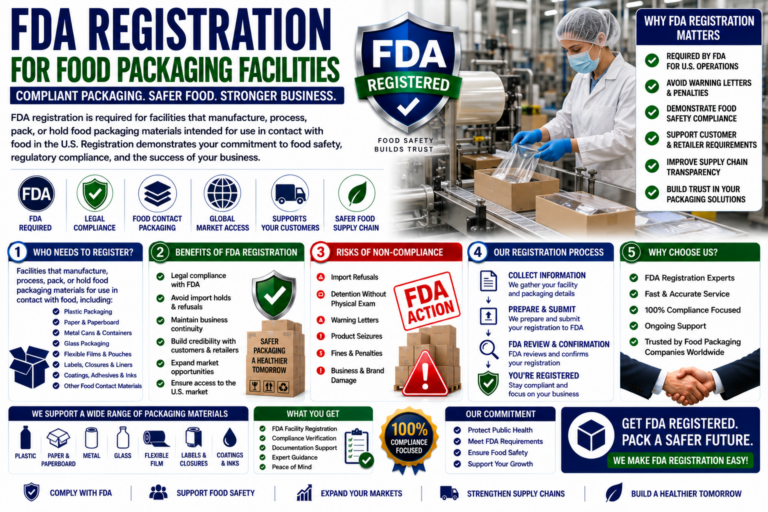
A contract packer, co-packer, or any operation that places food into its packaging is manufacturing, processing, packing, or holding food.
You make the material
A maker of packaging materials — plastics, paperboard, cans, films, coatings, adhesives, inks — isn't handling food, so it isn't a food facility.
What a Food Contact Substance Is
Under the FD&C Act, a food contact substance (FCS) is any substance intended for use as a component of materials used in manufacturing, packing, packaging, transporting, or holding food — where the use isn't meant to have a technical effect in the food. Packaging films, container polymers, coatings, adhesives, and inks are all FCSs.
How a Material Gets FDA Clearance
There isn't one route — there are several, and the right one depends on the substance and its use:
| Pathway | What it is |
|---|---|
| Indirect food additive regulation | Already-authorized uses listed in 21 CFR 174–179; if your material and use fit and you meet the conditions, you may be covered |
| GRAS / prior sanction | Generally recognized as safe for the food-contact use, or sanctioned before 1958 |
| Threshold of Regulation (TOR) | Exemption under 21 CFR 170.39 for substances migrating at negligible levels (and not carcinogens) |
| Food Contact Notification (FCN) | The primary route for a new substance under §409(h); effective 120 days after FDA receipt unless FDA objects |
| Food Additive Petition (FAP) | Used for higher dietary concentrations, under 21 CFR 171.1 |
Buying Packaging? Get the Documentation
If you're a food company or importer using packaging rather than making it, the compliance question lands on you — you're responsible for using compliant packaging for your product. Your evidence comes from your supplier:
- Ask for a food-contact compliance statement or letter of guarantee — not a vague "FDA compliant" claim
- It should cite the basis — the applicable FCN, regulation, GRAS conclusion, or TOR exemption
- It must match your actual use — food type, temperature, and contact conditions
- Imported packaging counts too — a material legal abroad isn't automatically cleared in the U.S.
Sort Out Your Food Packaging Compliance
FDA Registration Assistance starts by identifying which situation you're in — packing food (food facility registration) or making packaging material (food-contact-substance compliance) — so you pursue the right requirement, not one you don't need. For materials, we help determine the pathway — existing regulation, GRAS, TOR, or an FCN — and the documentation your customers need; for packers, we handle registration, U.S. Agent, and FSVP.
Contact us at info@fdaregistrationassistance.com or call +1 (928) 275-8333. Food Facility Registration is available starting at $858. Trusted by companies across 135+ countries, with 15+ years of experience.
Frequently Asked Questions
1. Do food packaging companies need FDA registration?
It depends on what you actually do. If you pack or package food — put food into containers — you're a food facility and must register with FDA. But if you only make the packaging material itself (film, containers, cans, cartons, coatings), you're generally NOT a food facility, so food facility registration doesn't apply. Instead, your material has to be an FDA-cleared food contact substance. These are two very different situations that both get called "food packaging."
2. I manufacture packaging materials, not food — do I register?
Generally no — a company that only makes packaging materials isn't manufacturing, processing, packing, or holding food, so it isn't a "food facility" and food facility registration doesn't apply. What does apply is that the material must be a cleared food contact substance for its intended use. Be cautious of anyone selling you a food facility registration you may not need; the real requirement for a material maker is food-contact-substance compliance.
3. What is a "food contact substance"?
Under the FD&C Act, a food contact substance (FCS) is any substance intended for use as a component of materials used in manufacturing, packing, packaging, transporting, or holding food, where the use isn't intended to have any technical effect in the food. Packaging films, container polymers, coatings, adhesives, and inks are all FCSs. The key regulatory question is whether the substance migrates into food.
4. Does every packaging material need FDA authorization?
Only those that are food additives — meaning they migrate, or may be expected to migrate, into food. If a substance stays put and doesn't become a component of food, it may not require authorization. But if it migrates at more than a negligible level, its use must be authorized through one of the food-contact pathways. Most real-world packaging involves some migration, so authorization usually matters.
5. How does a packaging material get FDA clearance?
There are several pathways: the material may already be covered by an indirect food additive regulation (21 CFR Parts 174–179); it may be GRAS or prior-sanctioned for the food-contact use; it may qualify for a Threshold of Regulation exemption (21 CFR 170.39) if it migrates at negligible levels; or a Food Contact Notification (FCN) can be submitted for a new substance. A Food Additive Petition is used for higher dietary concentrations. The right pathway depends on the substance and its use.
6. What is a Food Contact Notification (FCN)?
The FCN is the primary way FDA authorizes new food contact substances. The manufacturer or supplier submits a notification with the chemical identity, intended use, and safety data demonstrating the substance is safe for that use. The FCN becomes effective 120 days after FDA receives it, unless FDA objects. An FCN is proprietary — it's specific to the notifier and the substance and use described.
7. What is the Threshold of Regulation exemption?
Under 21 CFR 170.39, a substance used in a food-contact article that migrates into food at negligible levels can be exempted from regulation as a food additive — if it isn't a carcinogen and meets the threshold criteria. It's a lower-burden pathway for very low-migration substances. Whether it fits depends on the migration level and the substance's toxicological profile, so it's confirmed case by case.
8. What are the indirect food additive regulations?
They're the pre-existing FDA authorizations for food-contact materials, in 21 CFR Parts 174 through 179 — covering general provisions, adhesives and coatings, paper and paperboard, polymers, production aids, and irradiation. If your material and its use are already described in one of these regulations, and you meet the conditions, you may be covered without a new submission. Confirming the fit is the key step.
9. What's the safety standard for food contact substances?
The same standard as other food additives: a "reasonable certainty of no harm" under the intended conditions of use. That means competent scientists are reasonably certain the substance isn't harmful as used — not proof beyond any possible doubt. Whichever pathway applies, the underlying question is whether the substance is safe for the way it will actually contact food.
10. If I buy packaging, how do I know it's compliant?
Ask your supplier for documentation — a food-contact compliance statement or letter of guarantee identifying the applicable FCN, regulation, GRAS basis, or TOR exemption for your intended use (for example, the food type and temperature). As the food company or importer, you're responsible for using compliant packaging, so supplier documentation that matches your actual use is your evidence. Generic "FDA compliant" claims without specifics aren't enough.
11. Does imported food packaging have to be cleared?
Yes. Imported packaging and food-contact materials must meet the same U.S. food-contact requirements as domestic ones — a material legal in another market isn't automatically cleared here. If you import packaging, or import food already in its packaging, the packaging still has to be a compliant food contact substance for its use. Confirming clearance is part of import due diligence.
12. Does registration or an FCN mean FDA "approved" my packaging?
No. FDA doesn't "approve" companies, and even an effective FCN isn't an approval of your business — it's an authorization for a specific substance and use. FDA doesn't pre-approve packaging the way it approves drugs. The responsibility to use a properly cleared material for the actual food, temperature, and conditions stays with you.
13. What if I both make packaging and pack food?
Then both apply. The food-packing side makes you a food facility that must register (with cGMP and, if importing, FSVP), and the packaging material still has to be a cleared food contact substance. Companies that do both need to cover both tracks — it's not either/or. Mapping which activities you perform is the way to see the full set of requirements.
14. How does FDA Registration Assistance help with food packaging?
We start by identifying which situation you're in — packing food (food facility registration) or making packaging material (food-contact-substance compliance) — so you pursue the right requirement, not one you don't need. For materials, we help determine the pathway (existing regulation, GRAS, TOR, or FCN) and the documentation your customers need; for packers, we handle registration, U.S. Agent, and FSVP. Starting at $858 for registration, for companies across 135+ countries. Contact info@fdaregistrationassistance.com or +1 (928) 275-8333.