U.S. Food Import Regulations: An FDA Compliance Guide
The pillars mapped, who's responsible for each, what happens at the border, and where to go deeper.
Key Takeaways
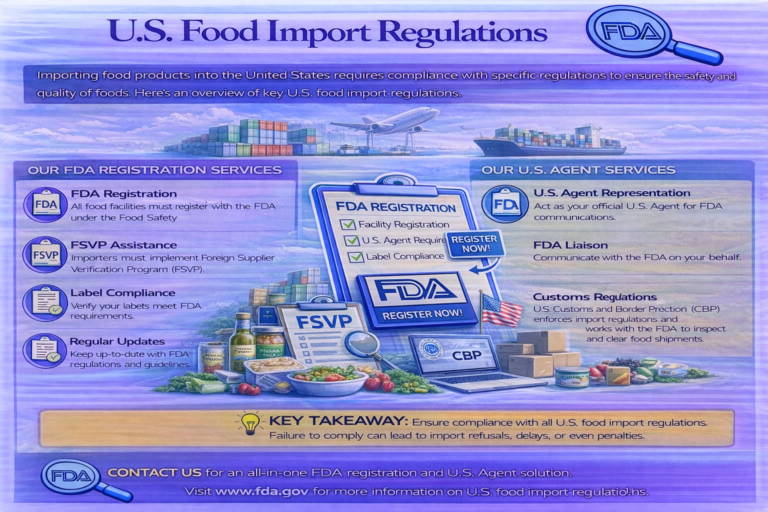
- Five core pillars — registration + U.S. Agent, FSVP, prior notice, labeling, product-specific rules.
- The importer holds FSVP — and is legally responsible; you can't rely on your supplier.
- Imports meet the same rules as domestic food — there's no lighter standard.
- Meat & poultry are USDA, not FDA — a different agency entirely.
- CBP admits; FDA can detain or refuse — repeat problems lead to DWPE.
- Compliance is the gate, not approval — FDA doesn't pre-approve food.
The Pillars of U.S. Food Import Regulation
Most import compliance comes down to these pillars. Here's what each requires, who's responsible, and where to go deeper:
| Pillar | Who's responsible | Deep guide |
|---|---|---|
| Facility Registration + U.S. Agent Part 1(H) | Foreign facility | Registration · U.S. Agent |
| FSVP Part 1(L) | U.S. importer | FSVP guidance |
| Prior Notice | Broker / importer | Import basics |
| Labeling Part 101 | Manufacturer / importer | Labeling for import |
| Product-specific rules | Manufacturer | Canned · Juice · Seafood |
The Roles in an Import
| Party | Responsible for |
|---|---|
| Foreign manufacturer | Facility registration, U.S. Agent, and any product-specific filings (e.g. FCE/SID, HACCP) |
| U.S. importer | FSVP — and legal responsibility for the food meeting U.S. requirements at entry |
| Customs broker | Prior notice and the CBP entry filing before arrival |
| CBP | Manages admission of the goods into the U.S. |
| FDA | Oversees safety, labeling, registration; can examine, detain, or refuse |
| USDA / NOAA | USDA/FSIS for meat, poultry, egg products; NOAA for certain seafood |
What Happens When Goods Arrive
Entry & prior notice
The broker files the CBP entry and FDA prior notice before arrival.
FDA review
FDA screens the shipment and may examine or sample it.
Detention
If noncompliant, FDA issues a Notice of FDA Action; you hold it under bond.
Resolve or refuse
Prove compliance or recondition — or the goods are refused and exported/destroyed.
Why Food Shipments Get Detained
- Missing or incorrect facility registration — including an expired biennial renewal
- No FSVP documentation when FDA asks for it during review
- Labeling that doesn't meet Part 101 — missing Nutrition Facts, undeclared allergens
- Missing or late prior notice — filed outside FDA's required window
- Missing product-specific controls — no process filing for LACF/acidified, or no HACCP where required
Guides for Each Part of Import Compliance
Registration for importers
Facility registration and the basics.
Get registered →FSVP guidance
The importer's verification program.
FSVP →Labeling for import
Meeting Part 101 for U.S. entry.
Labeling →International food compliance
The wider picture for foreign sellers.
Compliance →Canned & shelf-stable
FCE/SID and process filing.
Canned foods →Import alerts & DWPE
If a product gets flagged.
Import alerts →Import Food Into the U.S. Compliantly
FDA Registration Assistance handles the compliance chain end to end: Food Facility Registration and U.S. Agent, FSVP setup and maintenance, label review against Part 101, and product-specific filings — so your shipments meet U.S. requirements before they leave the supplier.
Contact us at info@fdaregistrationassistance.com or call +1 (928) 275-8333. Food Facility Registration is available starting at $858. Trusted by companies across 135+ countries, with 15+ years of experience.
Frequently Asked Questions
1. What are the main U.S. food import regulations?
The core pillars are: the foreign facility must have Food Facility Registration and a U.S. Agent; the U.S. importer must run a Foreign Supplier Verification Program (FSVP); prior notice must be filed before each shipment; the product's label must meet FDA labeling rules (21 CFR Part 101); and product-specific rules may apply, such as process filing for low-acid canned and acidified foods, or juice and seafood HACCP. CBP handles entry, and FDA can examine, detain, or refuse noncompliant shipments.
2. Who is responsible for compliance — the supplier or the importer?
The U.S. importer is legally responsible for ensuring imported food meets U.S. requirements, primarily through FSVP — you can't simply rely on your supplier. That said, the foreign manufacturer has its own obligations: facility registration, a U.S. Agent, and any product-specific filings. Responsibility is shared across the chain, but the importer carries the FSVP obligation at entry.
3. Does my foreign facility need FDA registration and a U.S. Agent?
Yes. A foreign facility that manufactures, processes, packs, or holds food for the U.S. must register with FDA and designate a U.S. Agent as FDA's U.S.-based point of contact. Registration is renewed biennially, and the U.S. Agent has to be kept current. Both are foundational to importing.
4. What is FSVP and who has to do it?
The Foreign Supplier Verification Program (21 CFR Part 1, Subpart L) requires the U.S. importer — the owner or consignee at entry — to verify that each foreign supplier produces food meeting U.S. safety standards. It involves hazard analysis, supplier evaluation, and verification activities. Some products, like seafood and juice under HACCP, follow their own verification paths.
5. What is prior notice?
Prior notice is an FDA submission identifying an incoming food shipment — the product, shipper, and importer — that must be filed before the goods arrive, within FDA's required windows. It's usually filed by the customs broker or importer through the customs system. Missing or late prior notice can lead to refusal at the port.
6. What labeling rules apply to imported food?
Imported food must meet the same FDA labeling requirements as domestic food, under 21 CFR Part 101 — a statement of identity, Nutrition Facts panel, full ingredient list, allergen declarations, and accurate net quantity. There's no lighter standard for imports; a label built for another market often needs to be revised to meet U.S. rules.
7. Do some foods have extra requirements?
Yes. Low-acid canned and acidified foods require FCE registration and a scheduled process (SID); juice and seafood follow HACCP rules with their own importer verification; and certain products carry additional controls. Meat, poultry, and processed egg products generally fall under USDA rather than FDA, so they follow a different agency's rules entirely.
8. Which agencies are involved besides FDA?
U.S. Customs and Border Protection (CBP) manages the entry process itself. FDA oversees most food safety, labeling, and registration. USDA's FSIS regulates meat, poultry, and processed egg products instead of FDA, and NOAA can be involved with certain seafood. Which agencies apply depends on your product.
9. What happens if my shipment doesn't comply?
FDA can detain the shipment by issuing a Notice of FDA Action; you keep possession under bond but can't distribute it. You may get a chance to bring it into compliance or recondition it; if not, it can be refused and must be exported or destroyed. Repeated problems can lead to an import alert and detention without physical examination (DWPE) on future shipments.
10. Why are food shipments most often detained?
The common causes are missing or incorrect facility registration, lack of FSVP documentation when FDA asks for it, labeling that doesn't meet Part 101, missing or late prior notice, and — for regulated products — missing process filings or HACCP controls. Most are avoidable by getting compliance in order before the goods ship.
11. Does FDA "approve" my food before import?
No. FDA doesn't pre-approve foods or labels. Registration and the various filings are compliance steps that make a product eligible to enter — they don't certify or approve it. Compliance is the gate to the U.S. market; the product still has to actually meet all applicable requirements at entry.
12. How long does FDA registration take?
There's no single fixed number — the registration submission itself is relatively quick once your facility information and DUNS are ready. What can take longer is assembling everything correctly and, for regulated products, the process-authority or HACCP work behind product-specific filings. Starting early avoids a rushed problem before shipping.
13. Is registration a one-time thing?
No. Food Facility Registration must be renewed biennially — every even-numbered year, between October 1 and December 31 — and kept accurate whenever facility details change. FSVP is an ongoing program, not a one-off. Import compliance is something you maintain, not complete once.
14. How does FDA Registration Assistance help food importers?
We handle the compliance chain end to end: Food Facility Registration and U.S. Agent, FSVP setup and maintenance, label review against Part 101, and product-specific filings such as process filing or HACCP support — so your shipments meet U.S. requirements before they leave the supplier. Starting at $858 for registration, for companies across 135+ countries. Contact info@fdaregistrationassistance.com or +1 (928) 275-8333.