
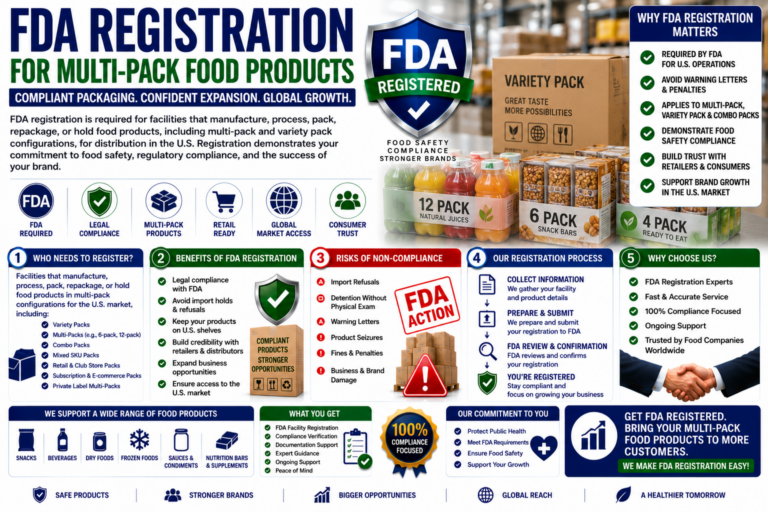
FDA Registration for Multi-Pack Food Products
Same food or different, inner units sold separately or not — and the label rules each combination triggers.
Key Takeaways
- Two questions decide the label — same/different food, and sold separately or not.
- Identical-food multiunit ≠ variety pack — different rules apply.
- Inner units can skip their own label — if not sold separately and the outer is labeled.
- Sold separately? Each needs a full label — no shortcut.
- Variety packs use aggregate Nutrition Facts — each food in its own column.
- Net quantity shows count + each + total — e.g., "6-16 oz bottles (96 fl oz)".
The Two Questions That Decide Everything
Before designing a multi-pack label, answer these — the combination determines the rules:
| Your multi-pack | How it's labeled |
|---|---|
| Same food, units not sold separately (a 6-pack of the identical item) | Outer package fully labeled; inner units exempt from their own name, ingredients & nutrition |
| Same food, units sold separately (each can be sold on its own) | Each inner unit carries a full, compliant label |
| Different foods (variety / assortment) (mixed flavors or products) | Outer label uses an aggregate-display Nutrition Facts; each food identified |
Identical-Food Multiunit Packs
A multiunit retail package is two or more individually packaged units of the identical food, in the same quantity, sold together but capable of individual sale — a twelve-pack of the same chip bag, a six-pack of the same drink.
- Inner units not sold separately — if the outer package is fully labeled and the units are securely enclosed, the inner units are exempt from carrying their own name/address, ingredient list, and nutrition information
- Inner units sold separately — each must carry a full, compliant label of its own (vending or "sold separately" formats)
- Visible, already-labeled inner units — an open or transparent pack where each unit's label is fully compliant and readable can satisfy the requirement
Variety Packs of Different Foods
When a package holds two or more different foods meant to be eaten individually — a variety pack of cereals, a mixed snack box — the outer label may use an aggregate display Nutrition Facts (21 CFR 101.9(d)(13)):
- Each food is identified — named right beside the "Nutrition Facts" heading
- Separate columns per food — each food's nutrient amounts and percent Daily Values shown in its own column
- One outer label, several products — the aggregate display accurately represents each different food at once
- Ingredients for every food — the ingredient lists for all the different foods must appear
Net Quantity & Assembling Others' Products
Bring Your Multi-Pack to Market
FDA Registration Assistance handles facility registration and U.S. Agent, and reviews your multi-pack labeling against the right framework — identical-food multiunit versus variety-pack aggregate display, inner-unit labeling, net-quantity format, and full allergen coverage across every food in the pack — plus FSVP for imports.
Contact us at info@fdaregistrationassistance.com or call +1 (928) 275-8333. Food Facility Registration is available starting at $858. Trusted by companies across 135+ countries, with 15+ years of experience.
Frequently Asked Questions
1. Do multi-pack food products need FDA registration?
Yes — the facility that manufactures, processes, packs, or holds the product registers with FDA, and foreign facilities need a U.S. Agent. That includes a company that assembles multi-packs or variety packs, since packing and holding food are registrable activities. But for multi-packs, the questions that actually take work are about labeling, not registration — specifically how to label a package that holds more than one unit.
2. How is a multi-pack labeled?
It depends on two things: whether the units are the same food or different foods, and whether the inner units are meant to be sold individually. An identical-food multiunit pack (say, a six-pack of the same item) and a variety pack of different foods follow different rules, and whether each inner unit needs its own full label depends on whether it can be sold separately. Getting those two questions right drives the whole label.
3. Do the inner units each need a full label?
Not always. Under FDA's rules, the inner units of a multiunit retail package are exempt from bearing their own name/address, ingredient list, and nutrition information when the outer package is fully labeled and the inner units are securely enclosed and not intended to be sold separately. If, however, the inner units are meant to be sold individually, each one has to carry a full, compliant label of its own.
4. What is a "multiunit retail package"?
It's a package containing two or more individually packaged units of the identical food, in the same quantity, intended to be sold together but capable of being sold individually in full compliance. A twelve-pack of identical chip bags or a six-pack of the same beverage are typical examples. The key traits are "identical food" and "individually packaged units" — which is different from a variety pack of different foods.
5. How are variety packs of different foods labeled?
Packages containing two or more separately packaged different foods meant to be eaten individually — like a variety pack of cereals or snacks — may use an "aggregate display" Nutrition Facts on the outer label. In an aggregate display, each food is identified next to the "Nutrition Facts" heading, and the amount and percent Daily Value for each nutrient are shown in separate columns under each food's name. It's one of FDA's recognized label formats.
6. What is an aggregate Nutrition Facts display?
It's a Nutrition Facts format for variety and multi-item packs where the units have different nutrition values. Instead of one set of numbers, the panel lists each food and shows that food's nutrient amounts and percent Daily Values in its own column. It lets a single outer label accurately represent several different products at once, which is why variety packs rely on it.
7. How is net quantity shown on a multi-pack?
On the outside of the package, the net-quantity statement has to show the number of individual units, the quantity of each unit, and the total quantity in parentheses. FDA's own example is a format like "6-16 oz bottles - (96 fl oz)" or "3-16 oz cans - (net wt. 48 oz)." So it's not just a single total — the count and per-unit size have to be there too.
8. How are allergens handled in a multi-pack?
Every allergen present in any food in the pack has to be declared. If the inner units carry their own labels, each declares its allergens; if only the outer package is labeled, that outer label has to cover the allergens of all the foods inside. For a variety pack of different foods, that means capturing allergens across every component — a common gap when products with different allergen profiles are combined.
9. What if I combine other companies' products into a multi-pack?
Assembling a multi-pack or gift pack from other manufacturers' products is still packing/holding food, so your facility registers, and you become responsible for the outer package labeling — identity, net quantity, and (depending on the setup) nutrition and allergens for the combined pack. You'll also want documentation of each component's compliance from its maker, since your pack's label has to reflect what's actually inside.
10. Does a multi-pack need its own Nutrition Facts if the inner units have them?
For an identical-food multiunit pack where the inner units are fully labeled and visible, the outer package may not need to repeat the Nutrition Facts. But if the inner units aren't individually labeled, or aren't visible, the outer package has to carry the required information. For variety packs of different foods, the outer label typically carries the aggregate display. The setup determines what the outer package must show.
11. Do imported multi-packs follow the same rules?
Yes. Imported multi-packs and variety packs must meet the same FDA labeling rules as domestic ones, and the importer holds FSVP for imported foods. A variety pack assembled abroad still needs a compliant outer label — correct format, net quantity, and full allergen coverage for every food inside — so it's worth reviewing before import rather than at the port.
12. Does registration mean FDA approved my multi-pack?
No. FDA doesn't pre-approve food or facilities — registration just puts the facility on record. It doesn't certify your labeling or your pack's compliance; those remain your responsibility. Your multi-pack still has to meet all the applicable labeling, nutrition, allergen, and net-quantity requirements, whichever format applies.
13. What are the common labeling mistakes for multi-packs?
Treating a variety pack of different foods like a single-product pack (missing the aggregate display); leaving inner units unlabeled when they're actually sold separately; net-quantity statements that omit the count or per-unit size; and allergen declarations that miss a component's allergens. Most trace back to not first answering whether the units are the same or different and whether they're sold separately.
14. How does FDA Registration Assistance help with multi-pack products?
We handle facility registration and U.S. Agent, and we review your multi-pack labeling against the right framework — identical-food multiunit versus variety-pack aggregate display, inner-unit labeling, net-quantity format, and full allergen coverage across every food in the pack — plus FSVP for imports. Starting at $858 for registration, for companies across 135+ countries. Contact info@fdaregistrationassistance.com or +1 (928) 275-8333.