How to Make Your Food Label U.S. FDA Compliant
The mandatory elements, where each goes, and the claim checks — step by step.
Key Takeaways
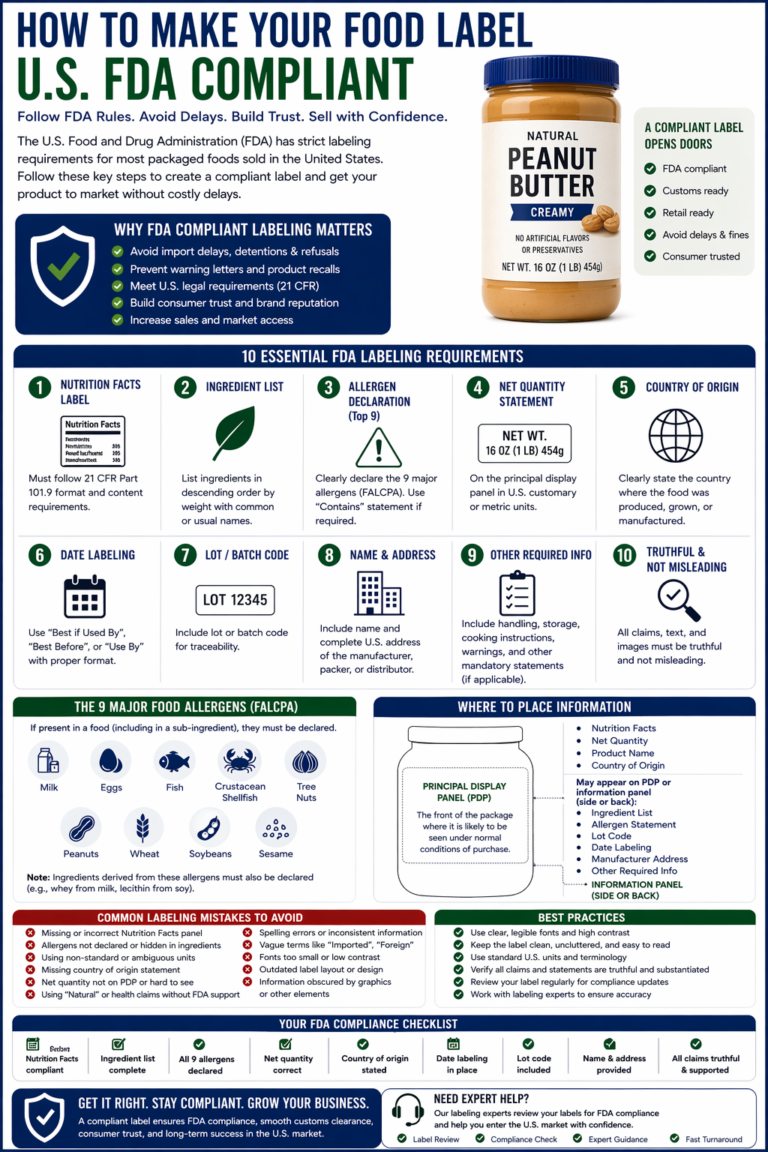
- Six mandatory elements — identity, net quantity, Nutrition Facts, ingredients, allergens, responsible firm.
- Two panels — PDP for identity + net quantity; information panel for the rest.
- Nutrition Facts in the 2020 format — with an FDA reference-amount serving size.
- All nine allergens — including sesame, in-list or in a "Contains" statement.
- "Organic" is USDA; origin marking is Customs — not FDA.
- FDA doesn't pre-approve labels — review before you print.
Build a Compliant Label, Element by Element
Add the statement of identity
Put the common or usual name of the food on the PDP, in bold type, so it's immediately clear what the product is.
Add the net quantity of contents
State the net quantity in the bottom 30% of the PDP, in both U.S. customary and metric units, with the correct type size.
Build the Nutrition Facts panel
Use the current 2020 format, with a serving size based on the FDA reference amount (RACC), calories, the required nutrients, and vitamin D, calcium, iron, and potassium.
Write the ingredient list
List every ingredient in descending order by weight, using FDA-recognized common names, and declare sub-ingredients of any compound ingredient.
Declare allergens
Declare the nine major allergens — including sesame — clearly, in the ingredient list or a separate "Contains" statement, and catch allergens hidden in compound ingredients.
Add the responsible firm
Include the name and address of the manufacturer, packer, or distributor.
Check every claim
Verify each claim — nutrient content, health, or structure/function — meets FDA's definition and is substantiated. Remember "organic" is USDA (needs certification), and origin marking is Customs, not FDA.
Where Each Element Goes
Half of "formatting" errors are really placement errors. Elements live on one of two panels:
| Principal Display Panel (PDP) | Information Panel |
|---|---|
| Statement of identity | Nutrition Facts panel |
| Net quantity of contents | Ingredient list |
| Allergen declaration | |
| Manufacturer / packer / distributor |
Match Each Claim to the Right Agency
Claims are where labels adapted from other markets most often go wrong. Keep the agencies straight:
- "Healthy" and "natural" — FDA terms, with their own conditions and substantiation
- "Organic" — a USDA term (National Organic Program); generally needs certification
- Country-of-origin marking — a U.S. Customs (CBP) requirement for imported products, not an FDA label rule
- "Gluten-free" — an FDA-defined claim (under 20 ppm) with specific conditions
Review Before You Print
The single most valuable step is reviewing the finished label before production. Once packaging is printed and inventory is made, a correction means reprinting, relabeling, and — for imported goods — potentially a shipment detained at the port while you fix it.
Because no one at FDA signs off on your label in advance, the review is yours to do. Getting each element and claim right before printing is how compliant brands avoid the expensive version of this problem.
Make Your Label Compliant Before You Print
FDA Registration Assistance reviews your label against 21 CFR Part 101 — each element, its formatting, and its placement — and checks your claims against FDA's definitions, giving you clear corrections before you print rather than surprises at the port.
Contact us at info@fdaregistrationassistance.com or call +1 (928) 275-8333. Food Facility Registration is available separately, starting at $858. Trusted by companies across 135+ countries, with 15+ years of experience.
Frequently Asked Questions
1. How do I make my food label FDA compliant?
Include every mandatory element under 21 CFR Part 101 and place each on the correct panel: the statement of identity and net quantity on the principal display panel, and the Nutrition Facts, ingredient list, allergen declaration, and responsible-firm name and address on the information panel. Then check every claim against FDA rules. Each element has specific formatting and placement requirements, so reviewing the label before printing catches issues early.
2. What are the mandatory elements of a food label?
A statement of identity, a net quantity statement, a Nutrition Facts panel, an ingredient list, allergen declarations, and the name and address of the manufacturer, packer, or distributor. Missing even one is often enough to make a label noncompliant. Country-of-origin marking also applies to imported products, but that's a Customs requirement rather than an FDA label element.
3. Where does each element go on the label?
The principal display panel (PDP) — the part customers see first — carries the statement of identity and the net quantity statement. The information panel, usually to the right of the PDP, carries the Nutrition Facts, ingredient list, allergen declaration, and responsible-firm information. Placing elements on the wrong panel is a common formatting error.
4. How should the Nutrition Facts panel be formatted?
In the current 2020 format, with a serving size based on the FDA reference amount (RACC), calories displayed prominently, the required nutrients, and vitamin D, calcium, iron, and potassium. Specific font sizes, spacing, and layout rules apply. Formatting errors in the Nutrition Facts panel are one of the most common issues found in reviews.
5. How detailed does my ingredient list need to be?
It has to include every ingredient in descending order by weight, using FDA-recognized common or usual names, and declare the sub-ingredients of any compound ingredient. Labels adapted from other markets often fail here because of different naming conventions. Missing or mis-ordered ingredients are a frequent reason a label needs correction.
6. How should allergens be declared?
The nine major allergens — milk, egg, fish, crustacean shellfish, tree nuts, peanuts, wheat, soybeans, and sesame — must be declared clearly, either within the ingredient list or in a separate "Contains" statement using common names. Allergens hidden in compound ingredients must be identified too. This is one of the most strictly enforced areas of labeling.
7. Is "organic" an FDA labeling claim?
No. "Organic" is regulated by the USDA under the National Organic Program and generally requires certification — it's not an FDA claim. FDA governs terms like "healthy" and "natural." Using "organic" without meeting USDA's standard is a common compliance risk, especially on labels adapted from other markets.
8. Is country-of-origin marking an FDA requirement?
Country-of-origin marking is primarily a U.S. Customs and Border Protection requirement under the Tariff Act, not an FDA labeling rule — though it applies to imported products. It's worth separating the two: FDA governs the label content itself, while Customs governs origin marking. Both apply to an imported food, but they come from different agencies.
9. Do imported food labels meet the same requirements?
Yes. Imported food must meet the exact same FDA labeling standards as domestic food — there are no reduced standards for imports. Your label has to comply fully for Nutrition Facts, ingredients, allergens, and net quantity, plus carry Customs country-of-origin marking. Many companies underestimate this and run into problems at the port.
10. Does my product need a Nutrition Facts panel?
Most packaged foods do. There are limited exemptions — such as certain very small businesses — but they're narrow and often don't apply, and many retailers expect a compliant panel regardless. It's safest to assume a Nutrition Facts panel is required unless you've confirmed a specific exemption applies to your product.
11. What happens if my label isn't compliant?
For imported products, the shipment can be detained while it's reviewed, and you may have to relabel before release — adding delay and cost. In more serious cases, the goods can be refused and must be exported or destroyed. Because a noncompliant label can't be fixed once goods are at the port, getting it right before printing is what avoids the problem.
12. Does FDA approve my label before I use it?
No. FDA doesn't pre-approve or certify food labels. The responsibility to make the label compliant sits with you, the manufacturer or importer — FDA simply enforces the requirements, and can act on a noncompliant label. That's why a careful review before printing matters: no one signs off on it in advance.
13. How long does it take to get a label compliant?
There's no single fixed number — it depends on how far the current label is from compliant and how complex the product is. A simple label with minor fixes is quick; a line with complex formulations and claims takes longer. The practical approach is to review before you print packaging, so any corrections happen before they're costly.
14. How does FDA Registration Assistance help make labels compliant?
We review your label against 21 CFR Part 101 — each element, its formatting, and its placement — and check your claims against FDA's definitions, giving you clear corrections before you print. That way the label is right before production rather than discovered at the port. Food Facility Registration is available separately, starting at $858, for companies across 135+ countries. Contact info@fdaregistrationassistance.com or +1 (928) 275-8333.